
Quantum computers are not yet very practical as they require special conditions, such as large cooling installations and isolation from the surrounding environment, to function correctly. However, about 60 years ago, the mainframe computer wasn't practical either. It used to occupy an entire room—if not a building—was very costly to operate, and performed fewer calculations per second than a smartwatch does today. Skeptics at the time claimed that a computer had no place in a household and that regular people would have no use for it. It took a few decades and the minds of a few visionaries to miniaturize it sufficiently so it could fit onto a desk. Eventually, it became so accessible that almost anyone owns or has access to one, and most of us even carry one around all the time in our pockets. Today, digital computers are everywhere. We might see a similar trajectory for quantum computing.
Classical computers work by using millions of transistors as logic gates. These gates either allow electrical current to flow or block it. When the current flows, it represents a 1; when it doesn’t, it represents a 0. These states are called bits, the fundamental building blocks of classical computers. Since there are only two possible states, 1 and 0, this system is referred to as binary. By opening and closing transistors in specific patterns, the CPU performs operations like addition and subtraction. Groups of transistors can also be combined to implement logic, such as "if-then" statements in programming.
To understand how quantum computing works, you need to understand three key concepts: superposition, entanglement, and interference.
In classical computing a bit can be either a 0 or a 1. This is not the case in quantum computing.
The building blocks of quantum computing are called quantum bits or qubits. A qubit is like a coin that has two sides, head (0) or tails (1) but also a mix of the two sides as if it were spinning in the air. This is called the superposition state.
In the superposition state, a qubit doesn’t just represent 0 or 1; it can represent both simultaneously, weighted by probabilities. This basically means that the cat in the box is both alive and dead at the same time.
This unique property allows quantum computers to process an immense amount of information compared to classical computers, as they can explore multiple solutions at once.
In a classical computer, bits are independent of one another. Qubits, however, can become entangled. In a system of entangled qubits, the state of one qubit directly affects the states of all other qubits in the system. This relationship holds regardless of how many qubits are added to the system and enables highly coordinated and efficient computations.
A qubit is often visualized as a sphere with an arrow pointing up, down, or somewhere in between to represent the states of 1, 0, or superposition. Mathematically, however, a qubit is described as a wavefunction. When multiple qubits are entangled, their individual wavefunctions combine to form a single, overall wavefunction.
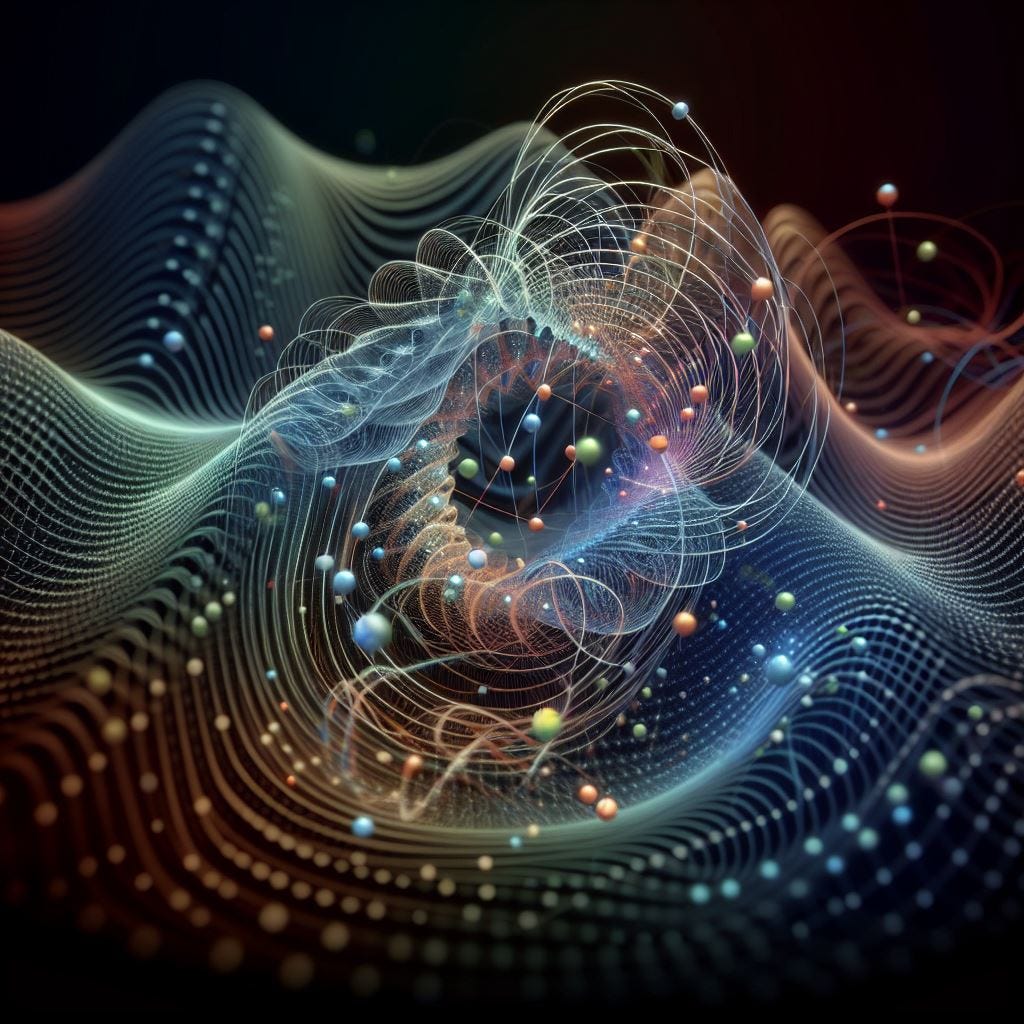
To understand this, imagine waves on the surface of a lake. When two waves meet, one of two things can happen: they can merge to form a larger wave, or they can collide and cancel each other out. In quantum computing, this phenomenon is known as interference. Interference can be constructive, where wavefunctions amplify each other, or destructive, where they cancel each other out.
When solving problems with a quantum computer, constructive interference is used to amplify the probability of correct answers, while destructive interference is used to reduce the likelihood of incorrect ones.
By carefully manipulating the probabilities during computation, quantum algorithms can achieve results that would take classical computers an impractical amount of time to compute.
We are accustomed to evaluating computers in a linear progression, as described by Moore's Law. According to this principle, computing power roughly doubles every couple of years. This made it natural to expect that each new generation of computers would be more powerful than those from two or four years ago. This steady improvement translated into increased productivity, enhanced online experiences, or smoother gaming.
We might be tempted to apply the same rationale to quantum computers as we do to classical ones, but this is not necessarily an accurate representation. A more appropriate perspective is to see quantum computing as a qualitative leap rather than a quantitative one. While quantum computers may offer better performance in certain fields, this advantage does not stem from sheer computing power but from the fundamentally different way they solve problems.
There are problems believed to be solvable only with quantum computers or where quantum systems provide a tremendous advantage over classical ones. These problems are so complex that tackling them with digital computers would be highly impractical, if not impossible. Quantum computers excel in such cases by exploiting the unique properties of quantum mechanics: superposition, entanglement, and interference.
There are algorithms that are uniquely suited to either classical or quantum computers due to the fundamental differences in how these systems work. A classical computer can be simulated on a quantum computer and vice versa, however, each type of algorithm performs best on its native platform. Running algorithms designed for classical computing on a quantum computer does not improve efficiency because it doesn't benefit from quantum properties like superposition or entanglement. In fact, running classical algorithms on a quantum system often requires additional resources, making the process less efficient. Similarly, simulating a quantum computer on a classical system introduces resource overhead, which makes the process unfeasible.
The true advantage of quantum computers lies in their ability to tackle a completely different set of problems that are infeasible for digital computers. These problems are addressed using quantum algorithms, with one of the most famous examples being factorization.
Multiplying two large numbers to get the result is a fairly simple and you can easily get the result even from a pocket calculator. That is because there is an efficient algorithm that does that. However, starting with the result and working backward to find the two original numbers—called factors—is much harder because no efficient classical algorithm exists for this process. This challenge is known as factorization.
In fact this is so hard to solve that it's used every second to encrypt internet traffic, secure messaging like Signal and WhatsApp, email security, cryptocurrencies, blockchain and many more. If you know the factors, this information is easy to decrypt, but if you don’t, you have to work them out and this would take so long that makes it unfeasible. For example, a 2048-bit RSA key, which is commonly used today, would take hundreds to thousands of years to factorize using Frontier, the world's most powerful supercomputer. A 3072-bit RSA key would require even more time, rendering it unbreakable for classical computers.
But quantum computers with sufficient qubits and stability could theoretically break this using Shor's algorithm, which can efficiently factorize numbers and solve discrete logarithms. Shor's algorithm makes use of quantum specific properties, making it exponentially more efficient at solving factorization problems compared to the best classical algorithm, the General Number Field Sieve (GNFS).
But there's a catch. Current quantum computers, like those from IBM or Google, have fewer than 1,000 qubits and lack the error correction needed for large scale calculations. It is estimated that breaking a 2048-RSA key would require a quantum computer with approximately one million error-corrected qubits which is likely still decades away.
Even though we're far from placing a quantum computer in a robot's head, there are specific problems that quantum computing solves much better and faster than classical computers. These solutions will lead to significant advancements in data science and, subsequently, artificial intelligence (AI). AI relies heavily on the use of large language models, which are becoming bigger and more complex each day. Training these models requires vast amounts of energy and resources, which is increasingly becoming an issue as investors grow more reluctant, given the lack of a clear product to sell at this point. Another challenge is sifting through ever-growing quantities of data, a task that digital computers perform in a linear fashion.
For these reasons and more, quantum computing may provide a qualitative leap. By changing the paradigm, there may be no need to continuously increase resources; instead, these challenges can be tackled in a completely different way.
Let's see how the three principles of quantum computing can have potential applications in the world of AI:
Generative AI
Generative AI involves creating new content, such as images, text, or data. A widely used method is through the use of Generative Adversarial Networks (GANs). A GAN is a deep learning architecture where two neural networks are trained to compete against each other in order to generate more authentic new content from an existing data set, like images or music. How it works is that one network generates new data from an input of existing data by adding random variations to it and then sends it to the other network. The second network, called a discriminator, looks at the generated content and tries to predict whether or not it belongs to the original dataset. The generator continues to improve on the result until the discriminator can no longer tell new data from the original dataset. This method is widely used in image generation models available today.
Quantum Generative Adversarial Networks (QGANs) are the quantum counterpart of classical GANs. QGANs leverage quantum computing's ability to process complex information and explore high-dimensional spaces more efficiently than classical methods. QGANs can be deployed to create high-quality synthetic images, audio signals, or other types of data with finer nuances captured due to the quantum advantage in handling complex patterns.
Data Clustering and Pattern Recognition
Data clustering and pattern recognition are essential tasks in AI, where the goal is to group similar data points together or identify patterns within large datasets. Quantum computing can enhance these tasks by using superposition to evaluate multiple clusters or patterns simultaneously, significantly speeding up the process. The mathematics behind this is very complex but simply put, there are multiple calculations which a QC can do simultaneously rather than iteratively like a classical computer would do.
Entanglement allows quantum algorithms to capture complex relationships between data points, improving the identification of subtle or non-linear patterns that might be difficult for classical models to detect.
Quantum interference can be used in this case to amplify correct patterns or groupings, while suppressing less relevant or incorrect ones, leading to more efficient and accurate clustering and pattern recognition in complex datasets.
Quantum Neural Networks
Quantum Neural Networks (QNNs) are a type of computational model that combines neural network architectures with the principles of quantum computing. Unlike classical neural networks, which process information using classical bits, QNNs operate on qubits.
In a QNN, quantum gates and circuits are used to perform operations on qubits, allowing the network to process and analyze data in fundamentally new ways. The potential advantages of QNNs include the ability to evaluate multiple pathways concurrently, leading to potentially faster and more efficient training processes, and the ability to encode and manipulate complex correlations between data points with greater fidelity than classical neural networks.
Reinforcement Learning
Reinforcement learning (RL) is a process where an agent takes action in an environment, which is evaluated by an interpreter and rewarded based on certain rules. For example a human can be the interpreter while training an AI agent in order to get certain results. If the expected results are obtained, the agent is being rewarded. Quantum computing can enhance RL by leveraging superposition to explore multiple actions simultaneously, allowing the agent to explore more possibilities in less time. Entanglement can capture complex dependencies between states and actions, making it easier to model environments with interrelated dynamics. Additionally, interference can amplify the probabilities of optimal strategies while suppressing sub-optimal ones, helping the agent focus on the best actions more efficiently.
Natural Language Processing
Natural Language Processing (NLP) involves understanding and generating human language, a task that often requires analyzing complex relationships between words and their contexts. Quantum computing can enhance NLP by leveraging entanglement to capture and represent these relationships more naturally and efficiently. For instance, entanglement can model the interconnected meanings of words within a sentence, improving context comprehension in tasks like translation or sentiment analysis.
Superposition allows quantum computers to compare a query against an entire dataset of possible matches simultaneously, significantly speeding up semantic search and similarity tasks. These quantum properties could lead to faster, more accurate language models that better understand nuances, such as sarcasm or ambiguous phrases, which are challenging for classical approaches.
Handling Large Datasets
Handling large datasets is a significant challenge in AI because traditional methods often struggle with the scale and complexity of the data. Using superposition, all data points can be represented simultaneously, drastically reducing computation time. For example, instead of evaluating millions of data points one by one, a quantum computer can explore the entire dataset in parallel. This capability is especially useful for tasks like feature selection, where the goal is to identify the most relevant attributes from a dataset.
Interference can be useful to emphasize important features and suppress irrelevant ones, improving the efficiency of model building.
Additionally, quantum computers excel at matrix operations, which are central to many AI models, enabling faster training and analysis for applications like deep learning and large-scale data mining.
Bayesian Networks
A Bayesian network is a graphical model used to represent and reason about uncertain situations using probability. They are used to model complex systems where some information is uncertain or missing, calculate probability, make predictions or infer causes from observed effects using Bayes' theorem.
Bayesian networks are used in probabilistic reasoning for AI, and quantum mechanics aligns naturally with their probabilistic nature. For example, quantum superposition and interference can speed up the inference process, which is computationally expensive on classical computers.
Quantum computing opens many doors but is unlikely to be the next big leap in personal computing. We won’t be seeing quantum computers in households anytime soon. For the foreseeable future, quantum computing will likely exist in a hybrid model alongside classical computing, primarily used in scientific research, financial applications, and data science.
Even though it's not practical today, we may soon see advancements in technology that will reduce its footprint enough for large-scale consumer adoption. Even today, there are 2-3 qubits portable quantum computers available for learning and research purposes. However, it is more likely that quantum computing will initially be used as a service, similar to how mainframes were utilized in the past, only now consumption can be accelerated by the use of the internet.
A cloud-based quantum computing service would offer timeshares to run workloads on a quantum computer, or subscriptions to platform services running on quantum computers. This approach would make the immense computational power of quantum computing accessible to businesses and researchers without the need for them to invest in specialized hardware and infrastructure. By leveraging the cloud, companies could solve complex optimization problems, enhance cryptographic security, and process vast amounts of data more efficiently.
However, with fast wireless communication available worldwide through technologies like Wi-Fi and 5G, it’s possible to have classical systems with digital processors permanently connected to quantum capabilities. Processing doesn’t necessarily need to take place at the edge, especially given the hardware requirements of quantum computing. A digital computer could function as a terminal, requesting quantum calculations via a high-speed connection to a quantum mainframe located thousands of miles away. This setup could enable advanced robots for example to benefit from quantum computing power while avoiding the technical challenge of fitting them with quantum processors. Labs in remote locations or even space could benefit from quantum processing capabilities without the laborious and expensive task of acquiring, installing and maintaining a full quantum computer.
As with many other technologies, the inventors of these innovations are not necessarily the ones that see their future applications. While we can speculate about how AI and Quantum will integrate and what synergies will emerge, both fields are still in their infancy, and there are many challenges to overcome in their implementation. But we can surely say that the 21st century will be the century of Quantum AI.
Comments
Nothing yet. Say the first thing.
Sign in to join the conversation.