
It was a hot day that day, hazy and humid. The town’s name was Toronto where high-rise buildings frame the background with their geometric shapes like a child leaving their building blocks behind. And somewhere north of downtown, suburbs, strip malls and Tim Horton’s multiplying by the minute, a girl in a hat returned to the heights of her game. The girl’s name was Iga Swiatek and the fans screamed her name.
Thanks for reading Finite Jest! Subscribe for free to receive new posts and support my work.
It shouldn’t come as a surprise that somebody with Iga’s pedigree, a 6-time major champion, wins a big title and yet everything leading up to it suggested otherwise. Swiatek hadn’t reached a final in 2026, she had dropped out of the TOP 5 for the first time in years and maybe more worryingly for her fans, she seemed the most brittle when it mattered most. This was the girl (really, she was only a girl then) that “accidentally” became number one in the world when Ash Barty retired unexpectedly and the way she reacted to it was by winning the Sunshine Double in Indian Wells and Miami.
There have been plenty of more experienced players in our sports’ history who have crumbled in lesser situations. But Iga seemed to posses a mental fortitude unlike any other. On court, she looked nervous at times, stressed and anxious, but despite it all she’d always find a way to play her best tennis when she needed to. In many ways, her strength derived from a very similar source her idol Rafael Nadal tapped into time and time again. It was something fear-adjacent but once touched by them transformed instantly into great power.
A few years later, two other current champions of the WTA tour started growing into their bodies and abilities, into their confidence and talent and their names were Aryna Sabalenka and Elena Rybakina. Blessed with a different kind of strength, with physiques that were tall and strong and serves that were ferocious and precise, Iga’s domineering years were not exactly over but new obstacles had arisen in her path. It’s very normal for tennis players to orient themselves towards qualities that seem indispensable to succeed. And ever the student, ever the avid reader of books, Iga looked at the game and she looked at Aryna and Elena and she decided that she needed flatter groundstrokes and a better serve.
A long process of trial and error began. Coaching changes, service motion changes, forehand changes. Everything always served the purpose of one thing and one thing only: become a better tennis player, a better champion, win more titles and hopefully one day, return to the top of the world (again).
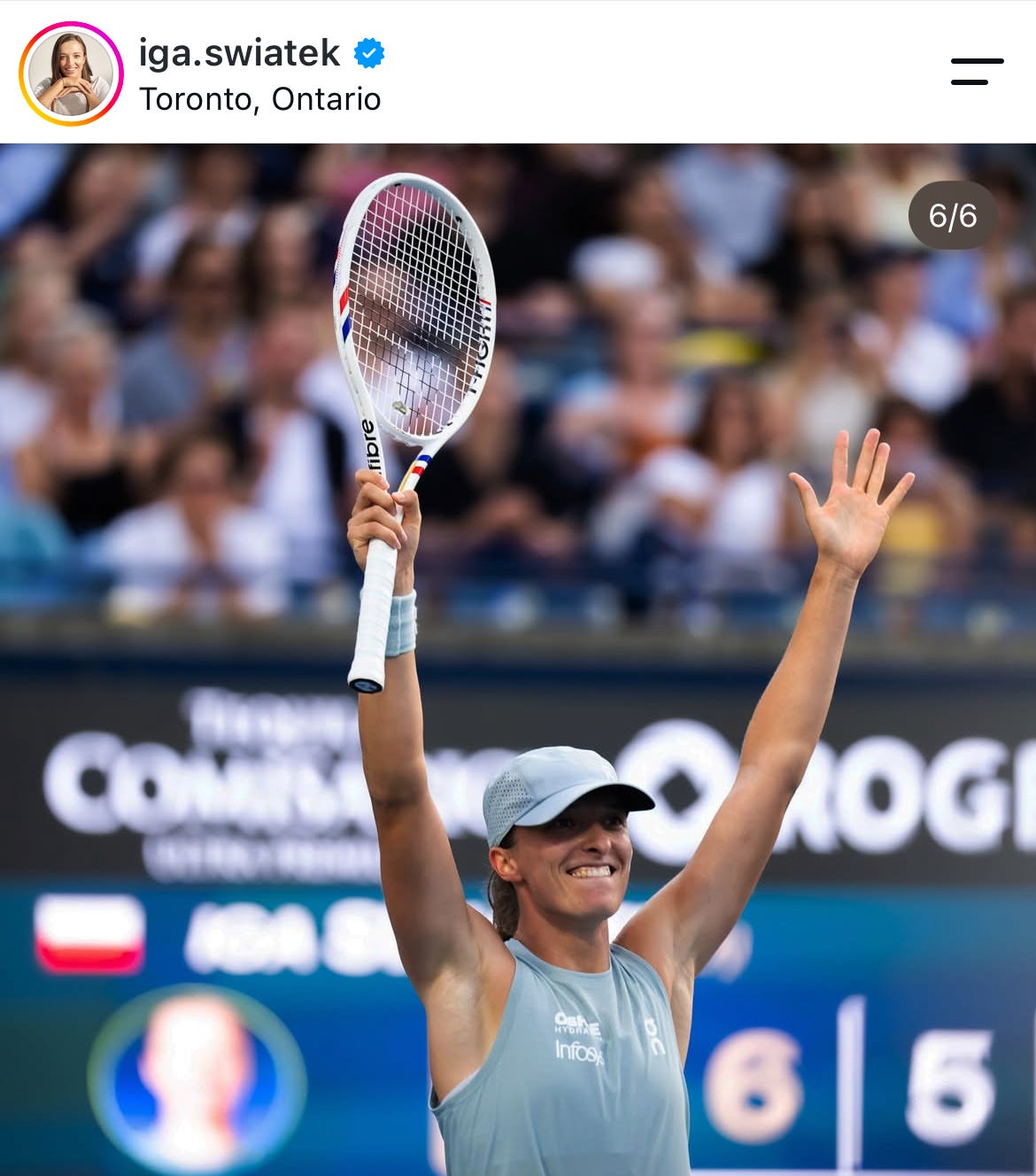
In Toronto, everything came together. If I had to compare Iga’s last two years to literature (don’t tempt me), I would say they were a book that feels disjointed in the beginning, parts of it don’t make sense in relation to one another but when you get to the end, you realise you were always in good hands with its writer. They may have dangled you above the abyss a few too many times but it’s all worth it when you feel the firm ground of steady earth beneath your feet again.
Before the tournament, I asked Hawkeye for a bunch of numbers on Iga’s tennis because I wanted to make sense of why she hadn’t been able to reach a final this year. There were numbers about groundstroke speed, height above the net, serve numbers, return numbers. Interestingly, they were not much different to some of Iga’s numbers during her best years. Some were down by a very small margin of points, but others were up so they should’ve balanced each other out. When I came across breakpoints saved and breakpoints converted, though, is where I saw the biggest discrepancy. That’s where she had fallen of. To me, this meant one thing: the barrier in front of Swiatek was not her tennis, it was her belief. Not necessarily the belief in herself as a champion - after all, she had shown many times that she was one in the truest meaning of the word - but the belief in which style of tennis was the right one during what time of the match. Having evolved as a tennis player suddenly meant she had options. Too many options? Maybe for a little while.
The semifinal match against Elina Svitolina encapsulated all of Iga’s last two years in a nutshell. She started conservatively with a lot of spin on her forehand, high first serve percentage and big margins. As long as Elina was still looking for her groove, that was plenty and more. In the second set, however, Elina found her best tennis. She was hitting winners left and right, going down-the-line swiftly and effectively. Iga remained in the conservative kind of lane for the second set and until she went down a break in the third. This is where she realised, okay, friends, Elina is not going to let up, I need to do more. And she did. Many more net approaches and higher groundstroke speeds later, she had won the match and was into her first final of the season. A mere 24 hours later, she was the queen of Toronto.
It was a hot day that day, hazy and humid, and a girl in a hat returned to the heights of her game.
Playing tennis at the highest of levels is never a straight line. Everyone around you is changing and transforming, evolving and shape-shifting, adding and learning. The best you can do is try to keep up and hope that during a few weeks of the year you will out-evolve the others.
What tennis players always need and never have is time. I think Shakespeare had tennis players in mind when he wrote in Richard II:
“I wasted time, and now doth time waste me.”
But when you waste time correctly, time doth waste you correctly back. Good luck with that!
Things that make me happy
On the subject of time. I have just recently had my first iced coconut coffee ever. It’s a coffee specialty from Vietnam that tastes like the best milkshake you ever had. A sweet but not too sweet blended mixture of coconut milk or cream, condensed milk and coffee. I know, I know, to all of you Southeast Asian experts, this means nothing and I’m simply a philistine and yes, I did strongly feel what it means to waste time. But I’m glad my life is richer now. If anybody could volunteer to tell me why iced coconut coffee is very healthy? That would be greatly appreciated, thank you.

Things that make me unhappy
Every time I have to handle luggage, hoist and carry my numerous bags from and to airports, I find a plethora of chipped nails at the other end of it. Is that a female phenomenon or does it also happen to men? I refuse to get help for carrying my luggage because I strongly believe that by lifting my own too heavy bags I will learn one day to not over-pack. That day hasn’t come. YET.
I was so glad to read how many of you were interested in a book list. Right now, I’m working through our in-house long list for the book prize we will give out in November and I have roughly ten more books to read until September 17 when we, the jury, meet for the first time to make a long list into a short list. In the aftermath of it all, I will put together a list of my favourite books of the year. Strong frontrunner right now: Ben Lerner’s Transcription.
May you have all the iced coconut coffee in the world!
Yours truly, Andrea
Thanks for reading Finite Jest! Subscribe for free to receive new posts and support my work.
Comments
Nothing yet. Say the first thing.
Sign in to join the conversation.