
Hello fellow highwaymen and women and welcome back to Finite Jest. It’s been a week since clay court season started and my adductors are still sore in spirit commiserating with my former colleagues, the tennis players. I traveled forward in time and back to Europe, fought off jet lag and ghosts and washed my hair twice in one session which made it very shiny. That’s all it took, a day and a half, a trip across one of the oceans, for the tennis world to be in a frenzy over a double bagel that was eaten by clay court’s contender number one Daniil Medvedev. I was shocked, too, until I remembered that another rare double bagel in men’s tennis was dished out last year and that also happened in Monte Carlo. The French Riviera has double bagel energy.
While I could talk about double bagels for hours, I won’t. This week, I want to focus on one player and one player only: Jessica Pegula. One of the most frequently asked questions I get is about Pegula’s tennis. Similar to somebody like Angelique Kerber or Gilles Simon and in the very beginning even Novak Djokovic, their strengths as tennis players are difficult to discern from a screen alone. Only when you play them, can you truly, deeply feel their geniuses. That’s why I decided to break down Jessica Pegula’s game and what makes her a true champion of the sport (in more ways than one).
The Game
I played Jess twice when I was still a tennis player myself which was in the 1800s and clearly, longevity is one of Jess’ strengths. I beat her when she was a mere teenager in Washington, and lost to her towards the end of my career when she was already the top player we came to know so well. It was clear to me from the beginning, even in that first match in Washington, that an immense talent played on the other side on the net. I’m not going to pretend like I knew what lay in her future but my coach, too, saw something special in Jess. She was fairly unknown at that point and needed a wildcard to enter the main draw. My coach went out to scout her in practices and when he returned, he said: “Andrea, she’s much better than her ranking indicates, do NOT underestimate her”.
I won in two tight sets and particularly in the second set I needed luck, tailwind and more than good will to get over the finish line in two. The interesting thing about Jess in that moment of time is (probably something that will surprise a lot of people) that she was a hard hitter. Somebody who refused to play proper defence, went down-the-line often when you put her under pressure and generally flirted with percentage tennis but never really gave it a chance to date her until much later. What was evident, though, was the fact that she had an astonishing hand-eye-coordination which helped her protect the line and take balls early, and that she anticipated patterns and directions better than most which helped her get to balls she technically shouldn’t have been able get to in terms of movement (at that time).
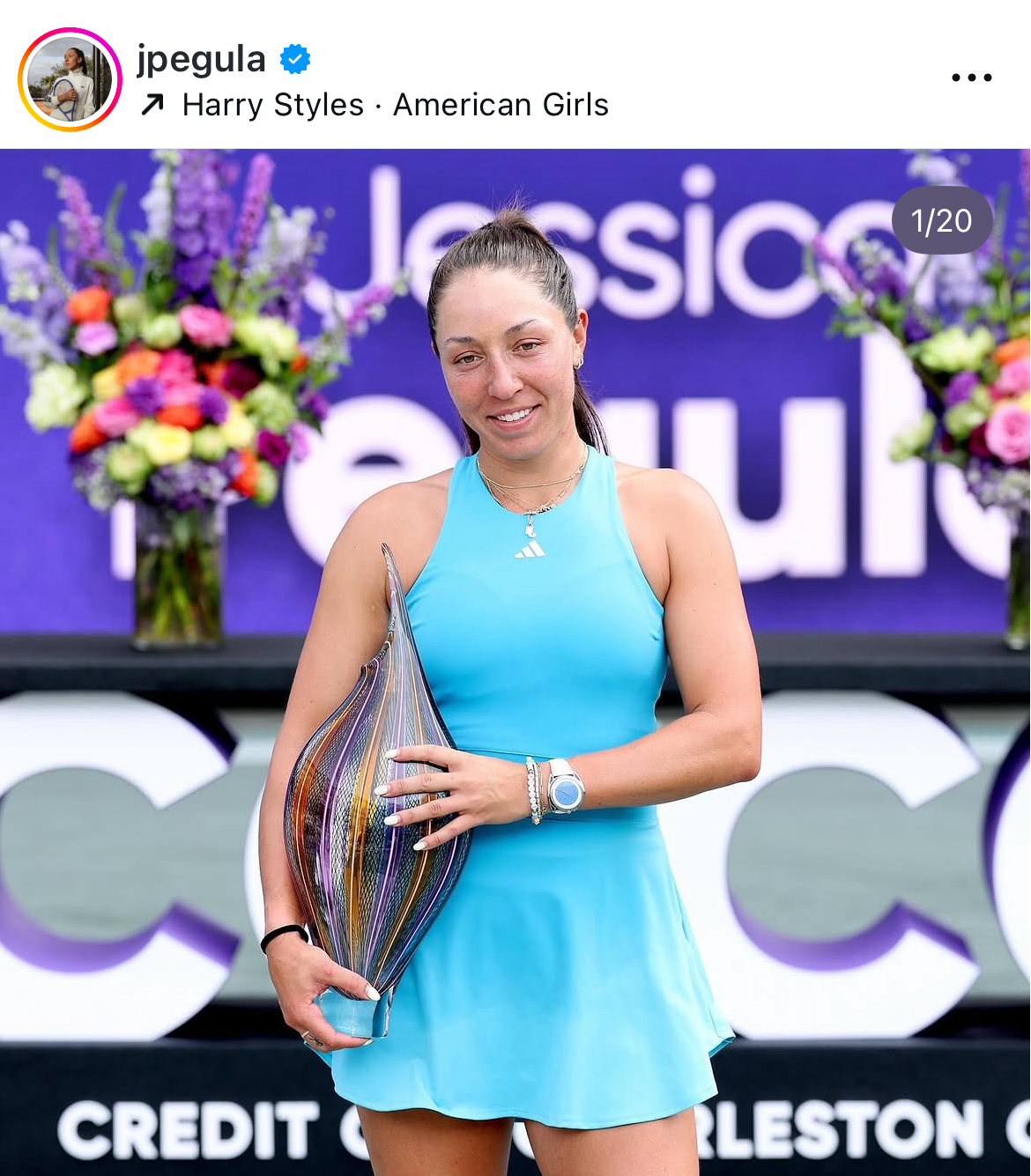
I laugh when people talk about Pegula as if she was a counterpuncher who cannot accelerate off the ground on her own. The pure mileage per hour Jess achieves on groundstrokes might not be as intimidating as somebody else’s like Elena Rybakina for example but her timing and clean ball-striking gives the opponent as little time, sometimes less, than some of the bigger hitting women will give you. That’s one of the reasons why you must never look at stats or numbers and expect to understand the many intricacies of a game as complex as tennis. Jessica Pegula’s eye and her inherent and immediate comprehension of the most efficient patterns on court could never be captured by something so mundane as stats.
One aspect of her game that is underestimated and that reminds me of Angie Kerber in a way is the shape and energy her ball takes after it bounces on the opponent’s side of the net. Usually and obviously, the surface breaks the ball down, in different ways depending on the surface. There are certain players that may not be able to completely circumvent it (not a single tennis player in this world is above the laws of physics) but they are strangely able to slow the breakdown down. In the case of Aryna Sabalenka or Elena Rybakina, it’s the heaviness of their shots that makes your own answer so hard to control. Despite the bounce off the ground their balls continue to rotate more vigorously than others, and they continue to do so in your strings when you make contact. To not drop your own groundstroke short in response, you need to have your full bodyweight behind their ball which makes you work harder, expand more energy and get tired earlier. Now, don’t get me wrong: it’s always recommended to have your bodyweight behind the ball. But it’s not always necessary. Against these players, however, it is.
Jessica Pegula’s groundstrokes behave differently than those mentioned above. They may not hurt you with their heaviness, but they do drive through the court and stay extremely flat. While Aryna and Elena seem to overrule the law of object hitting the ground with their power, Jess’ method is sneakier. Her ball merely grazes the ground, slides through like it was hitting ice not clay or concrete and therefore – the mode may differ but the result is the same – makes you get your entire bodyweight behind the shot if you want to keep a semblance of depth intact. And again, it you have to work harder, expand more energy and you get tired earlier.

Jess also casually changes directions as if it wasn’t one of the hardest things to do in tennis and does so with nearly the same positioning of her body which makes it incredibly difficult to read. That skill is rooted in her hand-eye-coordination, or more accurately in what her brain does with once it has registered a tennis ball – it knows the location of ball and hand and their distance toward each other without having to stare at them at all times which gives Jess the opportunity to also check out where her opponent is on the other side. It’s pretty spectacular, actually, so maybe that’s why it makes me mad when people don’t appreciate it. Her weapons may be better hidden and not as overt as some others, but they are there, and you just have to put a little effort into finding them. Basically, Jess has talent, but many people have talent and don’t have the same career Pegula has had and that notion brings me to…
The Personality
Jessica Pegula is emotionally stable, extremely (pain-)resilient, probably a little stubborn and above all: curios. People call her a late bloomer because her breakthrough into the Top 10 came when she was 28 years old. Not everyone knows, however, that Jess’ early career was haunted by injuries and surgeries. She kept coming back and kept trying to make it and kept wanting it (this is the good kind of stubbornness I just speculatively attributed to her). I don’t think it’s a secret that her family is wealthy. I don’t think it’s a secret that Jess is very intelligent. She could’ve and would’ve found a way to be successful with or without tennis. But she chose this sport – our sport.
She seems not to get too high when she wins and not too low when she loses and that is a huge asset and the perfect disposition for a sustainable career in tennis which can sometimes feel a little bipolar in its extremes when you’re an emotional person. She stays, mostly, stable. She doesn’t lose her mind when she loses early or when she wins big titles. Her temperature remains the same.
She also has curiosity not only for the game but for the whole sport of tennis. She understands the business side of it, she works on the board to optimise schedules for players and with her podcast The Player’s Box, she dabbles in media, too. It gives her a holistic 3D view of tennis.
We have the idea that a single-minded focus in sport is required to make it, but we forget to praise players who can take themselves out of the storm and look at it from the outside. Doing multiple things will give you multiple perspectives. Making decisions off the court, trains making decisions on the court. And when you see Jessica Pegula process information during a match, adjust and adapt to make it work, ignore tiredness and pain to win, try and discard strategies on the go, you get an idea, a glimpse maybe, of how her brain works.
And her brain and her talent truly work in mysterious ways. I would dare to say: in magical ways. I have tried to capture the magic here with the unsatisfactory tools of the word, but may it lift the curtain just a little bit.
Things that make me happy:
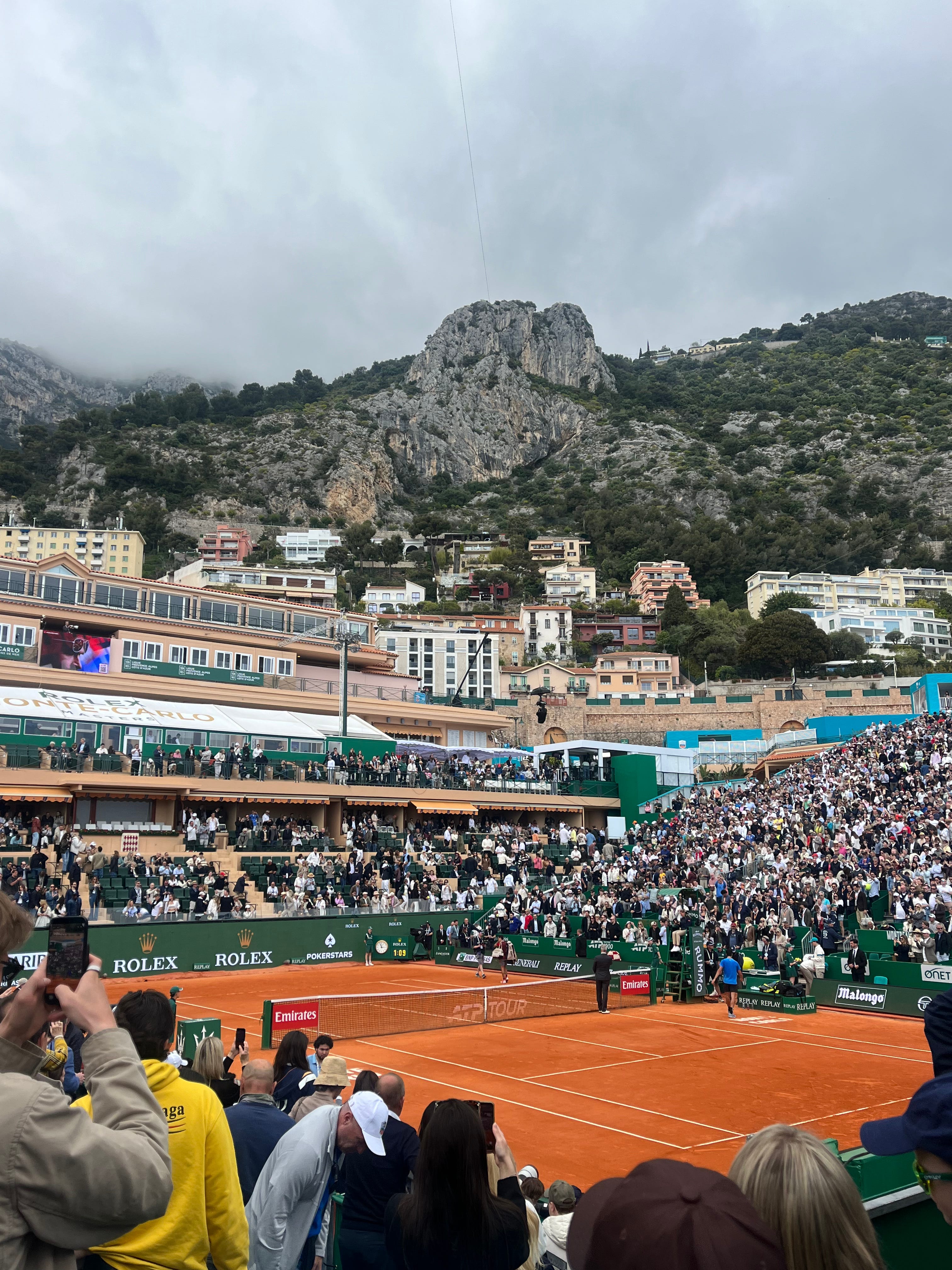
I was in Monte Carlo for a day and in no other role BUT AS AN AUDIENCE MEMBER. It was a truly charming experience. I heckled players and groaned when they hit double faults, gave standing ovations where it was warranted and all in all, tremendously enjoyed being completely partial and an embarrassing, silly, little fan girl.
Things that make me unhappy:
Last week, I got a few emails along the lines of:
“Less coffee, more tennis!”
“I enjoyed it more when you talked about tennis, unsubscribe”
“Who cares?”
Here is the thing: This is a free newsletter that you pay zero monies for. Which means - this doesn’t take a math genius - I make zero monies from it. So, whether I have one subscriber or ten or one million does not make a difference for me. I spend 3-5 hours each week composing this silly, little thing in a language that is not mine because I have fun doing it and because I enjoy the community of fellow tennis lovers. I don’t mind questions or people giving me inspiration at all. Quite the contrary, it’s incredibly hard to come up with a new topic once a week. I have taken many suggestions of yours and have made them into newsletters before. What I don’t like and don’t appreciate is the entitlement to something you don’t pay for. To be honest, I wouldn’t even like entitlement to something you DO pay for, but I like it even less when you don’t. Consequently, if I want to write a 10,000-word think piece on a mushroom that only grows in German forests, I will do so, and you will unsubscribe IN SILENCE. Thank you and goodbye.
See you all next week!
Yours truly, Andrea
No posts
Comments
Nothing yet. Say the first thing.
Sign in to join the conversation.