
Text within this block will maintain its original spacing when published
It's almost May
and yesterday
I caught a firefly in my hand.
First firefly I
seen in a
long, long time.
Make a wish,
Miss Edna said.
Make a good one.
~from "Firefly" by Jaqueline Woodson
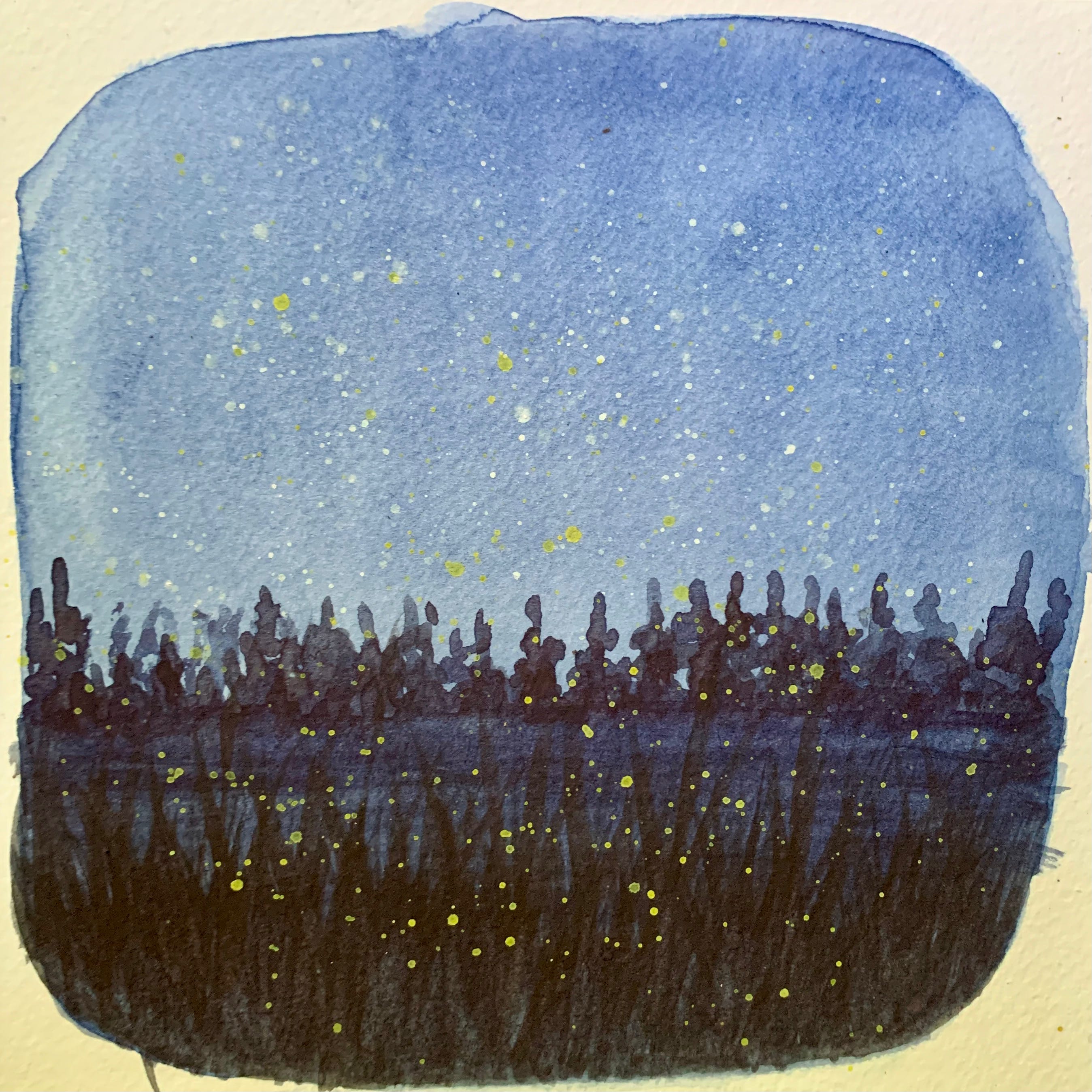
June arrives with a sparkle and flash, when the first firefly of the season (the first one that I see, anyway) alights on the window screen behind the TV on the third day of the month. I’m nearly ready for bed when I see this greenish, spectral glow, but I don’t want to miss the annual light show—free admission and right outside my door—as I have done far too many years, so I go outside and stand on the front step for a few minutes, watching the flare and spark of a half-dozen tiny white lights roving over the small lawn between our house and the woods. The next night I go out onto the deck, which overlooks a larger expanse of gardens and an unmown meadow, and watch twenty or thirty lights flicker at different frequencies and at different levels, from just above the tips of the tall grass to the top of the tallest apple tree. The following night, I walk the length of the driveway, where dozens of fireflies glimmer over our neighbors’ field and our roadside meadow.
The next night, I coax my family to walk the driveway with me, and my sons run through the field, chasing fireflies, catching them, letting them go. I feel a squeeze in my chest as I watch my children—now nearly grown men—scamper among the blinking lights. We didn’t do this nearly enough when they were young. Fireflies, like Fourth of July fireworks, would be easier to appreciate in December, when darkness falls by four in the afternoon. But in summer, with the dark not arriving until nearly nine p.m., I always weighed an expedition out amongst the magical sparkle against a decent bedtime. With school in session through the peak of firefly season and baseball games filling our June evenings, I often chose sleep. Now I’m certain I made the wrong choice.
I didn’t have the chance to run among fireflies when I was a kid. Though not unheard of in Colorado, they are uncommon, and they didn’t frequent my suburban neighborhood. I had read the usual stories about children catching lightning bugs in mason jars, but I’d mentally categorized the illuminated insects alongside fairies, unicorns, and other creatures of myth. Witnessing the glitter and glow of fireflies for the first time was as astonishing as a dragon flying across my path. It happened during the summer after I graduated college, when I was working in Bar Harbor and living in Otter Creek. I’d set out late for my five-mile bicycle ride home, opting to go the long way, through a quiet corner of Acadia National Park, to avoid the rush of traffic along Route 3 in the growing darkness. The road was lonely and nearly pitch-black as it wound its way through dense forest. After a time, the trees gave way to the wide-open expanse of Great Meadow. To my right, across the wetland, I saw a tiny white spark, and then one to my left, and then another, and another, until I was surrounded by blinking, flickering, gleaming lights, as if the Milky Way had dropped out of the sky and swirled around me. I stopped my bike in the the middle of the road and stood transfixed amid the galaxy of fallen stars. It was like nothing I’d ever seen before—no Christmas display or laser show could come close to imitation. I lost all sense of time standing there, mesmerized by the magical sparkle of thousands, perhaps millions, of luminescent insects glittering all around me.
Fireflies are beetles in the family Lampyridae. Worldwide, there are around 2,000 species, roughly 180 in North America, and just over a dozen in Maine. The male firefly meanders over wetlands and meadows, emitting a series of flashes or pulses particular to his species. The female, sitting on the ground or on low vegetation, watches for a light pattern that not only indicates a male of the correct species but also one in possession of a certain je ne sais quoi that tells her he’s the one for her. When she detects Mr. Right (or perhaps Mr. Light?), she flashes a return signal, he descends, they mate, and she lays eggs, which hatch within a few weeks.
Fireflies spend their larval stage below ground or ensconced in moist leaf litter or rotting logs, where they feast on worms, slugs, and snails for a year or two. The larvae are bioluminescent (i.e., glow worms), and in some species the eggs and pupae are as well. It is thought that this light serves as a warning to predators about toxic chemicals contained inside the grub, and that at some point the lights evolved to play their current come-hither role in the adults. But not all fireflies blink and flash at night. I’ll sometimes see one of these capsule-sized day-flyers piloting through the air a few feet above the ground. It looks like a fat-trunked capital T, with its stiff forewings, or elytra, held horizontal, its abdomen pointing toward the ground, and its gossamer hindwings whirring too fast to see. A pair of long, thick antennae like two false eyelashes spring out at 45-degree angles from the center of T’s cross-bar, where the head and its shield-like covering, or pronotum, come to a point.
Nocturnal, bioluminescent fireflies also have this awkward, bottom-heavy posture as they pilot over yard, meadow, and field, sending out their Morse code messages of love. But in the darkness, that clumsy-looking, nondescript body is transformed into white, bluish, greenish, or yellowish light, depending on the species. The light comes from an organ called the photophore, generally located in the tip of the firefly’s abdomen, and is produced through a chemical reaction involving ATP, oxygen, and two chemicals known as luciferin and luciferase. (I enjoy imagining the biochemist—surely a mad scientist type—who discovered these chemicals and named them after the devil.)
It is, technically, possible to identify species of firefly by counting flashes. But watching fireflies is a bit like watching fish jump in a lake; you often don’t know one is there until it’s already gone under, leaving behind a splash, and when it reemerges, it appears somewhere else altogether. It’s also hard for me to focus on a single blinking light when a half-dozen others are vying for my attention. I want to see them all, to be lifted and carried away by this living glitter. The best way to appreciate fireflies, I’ve found, is to not try to see them at all, but rather soften my focus and let them dance in my peripheral vision, to become ambient sparkle, like those flickering, living stars I witnessed all those years ago in Great Meadow.
I want to revisit that first firefly encounter, to not just spend a few minutes watching them from the deck or along the driveway but be immersed in and transported by them. It is all too easy to let the small, daily—and nightly—miracles of nature pass unheralded, to experience the ephemeral as a flash of light at the edge of vision, a blink and then it’s gone. But it is these flashes of beauty, of wonder, that give shape to our seasons and years, that infuse our days with meaning. So I set up a tent in the yard to put myself in the fireflies’ midst for a whole night. With a nearly full moon and cloudy skies, the night is not as dark as it was, either a few nights or thirty years ago, and our yard is not nearly as extensive as Great Meadow. Nevertheless, I settle in and gaze out through the insect netting to witness the nightly show. I drift off to sleep with green frogs and gray tree frogs calling from the nearby pond, a barred owl hooting from the edge of the woods, and a dozen fireflies glinting and gleaming, flickering and sparkling all around my tent.
When the latest book by Austin Kleon, Don’t Call it Art, arrived in the mail early in June, I remembered I hadn’t finished his previous book, Keep Going. Although Keep Going was published around a decade ago, I bought my copy last year, thinking it would help when world events made it hard to write or do anything that was not actively burning all the fascism down. But I hadn’t finished reading it. And when I picked it up to read it before starting the new one, I realized why.
The first piece of advice in the first section is: Establish a Daily Routine. And I had I stopped there, with the intention of doing so before moving on to the rest of the book, but, well, I didn’t do it. I couldn’t do it. I’ve been trying since I became a full-time writer to set myself a schedule and stick to it, to no avail. I’ve tried time-tracking and made myself detailed agendas multiple times. And still, each day ends up being its own free-for-all, which makes me very susceptible to requests to spend my time elsewhere.
As hard as it is to fight my natural (dis)inclination, I’m continuing to strive to establish a daily routine. The first piece that I’ve put into place is to get up and go for a walk first thing in the morning. I was able to naturally transition the near-daily bird walks I took from late March through early June into a little more vigorous exercise. By necessity, I immediately follow the walk with showering, getting dressed, and eating breakfast. No more putting off walking until I run out of time. No more puttering around in my pajamas until noon.
I still have to work on which parts of my day are for writing, which are for administration, which are for other kinds of creativity, and which are for fulfilling other obligations. But having a firm foundation—a surprisingly morning-person-type foundation—for all those other things makes them seem a lot more doable.
Are you a natural routine maker and follower? Or do you struggle to structure your time? What strategies work for you to get all the work done?
I’ve got a bunch of workshops coming up this summer and fall:
Summer Nature Journaling: Sears Island, July 14, 2026, 9:30 a.m. to noon.
Praisesongs and Litanies: A Nature Journaling and Poetry Workshop (with Samaa Abdurraqib), Saturday, July 18, 2026. 10 a.m. - 1 p.m. Wolfe’s Neck Center, Freeport.
Pay Attention. Be Astonished. Tell About It: A Nature Writing Workshop
Orono Public Library, Saturday, July 25, 2026, 1-4 p.m., Orono, Maine.
Falmouth Public Library, Saturday, August 29, 2026, 2-4 p.m., Falmouth, Maine
Turner Public Library, Saturday, September 19, 2026, 1-4 p.m., Turner, Maine
Bethel Public Library, Saturday, October 10, 2026, 2-4 p.m., Bethel, Maine
On Friday, July 10, I’ll be reading form my essay “Our River” at the Spire 10th Anniversary Launch Party at the Foster Center for Innovation, University of Maine, Orono, 5-8 p.m.
Check out my two articles, one on the big trees of Maine and the other on invasive plants, in the latest Green & Healthy Maine Summer magazine. Find a copy at your local coffee shop, natural foods store, or tourist information site.
For a truncated list of books I read in May (the computer ate my homework), see my May Reads post.
Now that hiking season is in full swing, why not pick up a copy of my book, Uphill Both Ways: Hiking toward Happiness on the Colorado Trail?

No posts
Comments
Nothing yet. Say the first thing.
Sign in to join the conversation.