
Text within this block will maintain its original spacing when published
Everything is beautiful and I am so sad.
This is how the heart makes a duet of
wonder and grief.
~from "Adrift" by Mark Nepo
Spring in Maine unfolds in increments, like a paper fan being opened one pleat at a time. Each opening feels like the moment that defines the season until the next one unfolds and then the next and the next.
This week’s unfolding is frog song. I began listening for frogs back in March, after the next-to-last snowstorm, imagining I heard wood frogs muttering from every snowmelt puddle.
But it wasn’t until April first that I truly heard the first frog of the season. The call of the wood frog is described in field guides as a “duck-like chuckle,” which is a fairly good description of the frog’s chur-chur-chur; chur-chur-chur. But this spring, I’ve taken to thinking of the sound as the mutterings of a group of disgruntled old men: grump-grump-grump.
Three days after those first mutterings, we got the final winter storm of the year, a foot of wet, heavy snow. This shushed the frogs for a few days, until rain and a couple of warm afternoons melted most of the snow and recharged the frogs. By April ninth, they were fully chorusing, a steady rumble of chuckles and mutters flowing from areas of shallow, fish-free water. At night I cracked the bedroom window, even though the temperature outside was in the low 40s, in order to fall asleep to the sound of frogs chuckling from the small duck pond my son dug below our house a few years ago.
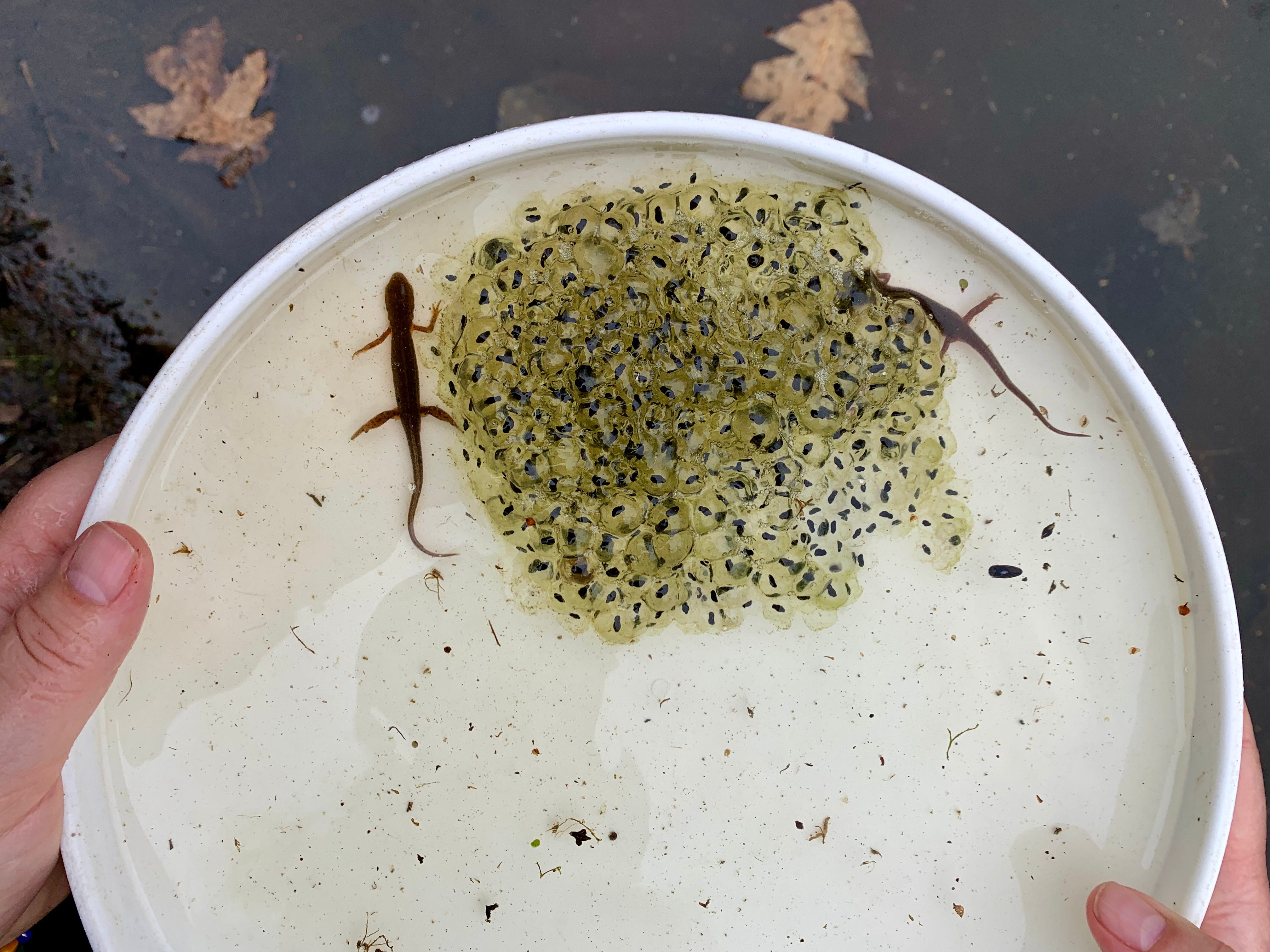
Frogs sing most lustily at night, but a few individuals can be heard calling during the day, and I tried sneaking up on a handful of wood frogs muttering in the little pond, but they sensed me coming, and all I saw was the ripples on the surface where they sank below the turbid water. Closer inspection revealed double-fist-sized masses of frogs’ eggs clinging to dead grasses in the water, each mass made up of hundreds of clear, gelatinous blobs dotted with the black squiggle of a developing frog.
A week after their first full chorus, the wood frogs have mostly ceded the stage to spring peepers. Throughout the ten days or so leading up to their chorus debut, I heard stray peepers squeaking and chirping at odd times, and I wondered if these were the same individuals who peep on warm days in September and October, rebels who refuse to confine their performances to either early spring or evening hours. Now I hear them singing from a variety of wet areas around our property, but the main din of their song emanates from a swamp that lies halfway between our house and the road. This wetland is maybe an acre in size, an impenetrable thicket of 10-foot-tall willow and alder shrubs growing out of dark, shallow water. It’s the best place on our land to see warblers in late spring and to gather winterberries in autumn. And it’s the place the frogs love most of all.
Peepers and wood frogs are elusive little creatures. Bullfrogs and green frogs laze in the gravel pit pond in July and August. Pickerel frogs leap off the river banks and the wobbly logs we use to cross a swampy area in the woods when they sense us coming. Leopard frogs hop around our yard. Gray tree frogs climb onto our deck and shelter in the house plants that spend the summer outside. American toads visit our gardens. But I might catch only a glimpse of either a peeper or a wood frog from year to year. Wood frogs, as their name implies, spend most of their time, when not breeding, in the woods, where their coppery color blends with the leafy forest floor. Peepers are so tiny, hardly bigger than my thumbnail, that I only see them by chance—when I’m picking raspberries or looking at a flower, I’ll catch sight a tiny frog crouched in silence on a leaf, its sticky toe pads holding it in place, the X-shaped marking on its back leaving no doubt as to its identity.
While I only rarely see a wood frog or a peeper, their music forms a continuous soundtrack in these weeks of early spring. When I walk to the mailbox in the evening, down the driveway and past the swamp, the peepers are wound up to nearly full gear, their song a steady rain of peep-peep-peep; peep-peep-peep. A few individual voices stand out, harmonizing with trills: brrree and peep-brrreep-breep. Still a few wood frogs mutter among them, providing counterpoint, but they can’t compete with the peepers’ steady wall of sound. The song of the peeper, one of the tiniest vertebrates on our patch of earth (the northern redback salamander is longer but weighs less), is one of the loudest natural sounds we hear, when hundreds, perhaps thousands, of individuals raise their little peeper voices in concert.
When I step outside after dinner, near dark, the sound is even louder than in the afternoon, the air filled with not only peepers and wood frogs, but also woodcocks peenting from a clearing in the woods, wild turkeys gobbling in a nearby field, a barred owl hooting from deep in the forest, a pair of Canada geese flying up the river valley. It’s a ruckus, a raucous celebration of the change of season, after a winter of silence, shut up in a well-insulated house, the night’s quiet broken only by an unruly car engine on the road or the occasional yappings and howlings of a pack of coyotes hunting in the darkness.
For the peepers and wood frogs, their songs mean something along the lines of How you doin’? or What’s a nice frog like you doing in a swamp like this? They are a storm of pickup lines, a thunder of Let’s get it on! To me, however, the chorus of song is a shout of exuberance and abundance, an announcement heralded from the ramparts: Spring is here! Spring is here! Spring is here! Even when the temperatures dip again, as they invariably will, this being Maine, and the frogs go quiet for a night or two, the seal has been broken, the accordion-fanned paper unfolded this one crucial pleat. It’s official: Spring is here!
“Joyful Noise” was first published in the December 2024 issue of Spelt Magazine.
Things are dark these days. Some of this darkness we all hold collectively, some is more personal. We each have our own share. I’m thinking not about darkness today, however, but rather about delight. In The Book of Delights, Ross Gay writes about joy and sorrow being not so much opposites but close kin. This feels important now.
I’m re-reading ’s The Book of (More) Delights, after having recently re-re-(perhaps re-) read The Book of Delights. Both books are collections of short essays about the things Gay finds delightful on a given day: a flower growing in a sidewalk crack, a fruit-bearing tree, an offhand remark, a basketball game, a realization, a weird dream, a person, an animal, a memory a bug, a cup of coffee. Gay also, which is something I want to better understand and appreciate.
The last time I re-(re-?)read TBOD, I decided to try to notice and note the delights I encountered each day. I found that I’m not good at either noticing or writing about the things that delight me. I’ll sit down with my journal in the morning and, thinking over the previous day, write, Delights: Birds? Sunshine? A smoothie bowl?
Both being delighted and expressing that delight are a practice, meaning they take practice, and so here I want to share what I’m finding delightful in Gay’s writing today: his long, labyrinthine sentences. I just read an essay that spanned a page and a half, all one sentence, about notebooks, and I delighted in every hill and valley, hairpin curve and scenic bypass that those sentence took me on.
I had to good fortune of having seen Gay speak last year in Norway, Maine, of all places. During the Q&A, I wanted to ask, “How do you get away with writing such long sentences?” Meaning, how do you sneak them past the editors? But I was afraid this would sound both prosaic and envious.
Although, yes, I have a tendency toward writing long-ish sentences, and though editors have sliced and diced those sentences into Hemingway-esque snippets, I am not jealous of Gay’s apparent free rein to engage in discursiveness. I’m more curious about how he got this style past publishers, who are an inherently conservative (lower case c) lot, who despite their claims of seeking new, strange, and experimental work really just want to keep publishing whatever worked in the past.
Now, in the midst reading both books in close succession, I see at least part of my answer. In The Book of Delights, Gay occasionally slips a long and winding sentence into an essay that is otherwise made up of standard-length sentences. In The Book of (More) Delights, he engages in a lot more long sentence writing. The essays in the book that came out between these two, Inciting Joy, the sentences are delightful thickets of digressions and parenthetical statements and paragraphs-long footnotes.
My guess is that he may have been asked to keep his sentences shorter in his first book, while his style also evolved as he played with the syntax and stretched his sentences out longer and longer. Meanwhile, as his sentences lengthened, he was training his readers to keep up with his mental loop-de-loops and training his editors and publishers to trust him. He earned that trust.
My creative advice: keep stretching, keep pushing boundaries, keep evolving and growing, and keep writing long sentences. And keep practicing paying attention to and taking note of your delights, and the ways they often snuggle right up against your sorrows.
I’m thrilled that my essay “Our River” appears in the 2026 issue of Spire: The Maine Journal of Conservation and Sustainability.
Check out what I read last month in my March Reads post.
With beach season right around the corner, it’s a good time to pick up a copy of Echoes in the Fog: Literary Reflections on the Liminal Spaces of Maine’s Coast, and read my essay “The Saltwater Cure.”
If you’re starting to daydream about summer hikes, pick up a copy of my book, Uphill Both Ways: Hiking toward Happiness on the Colorado Trail.

For more writing, plus workshops and editing services, visit www.AndreaLani.com.
No posts
Comments
Nothing yet. Say the first thing.
Sign in to join the conversation.