
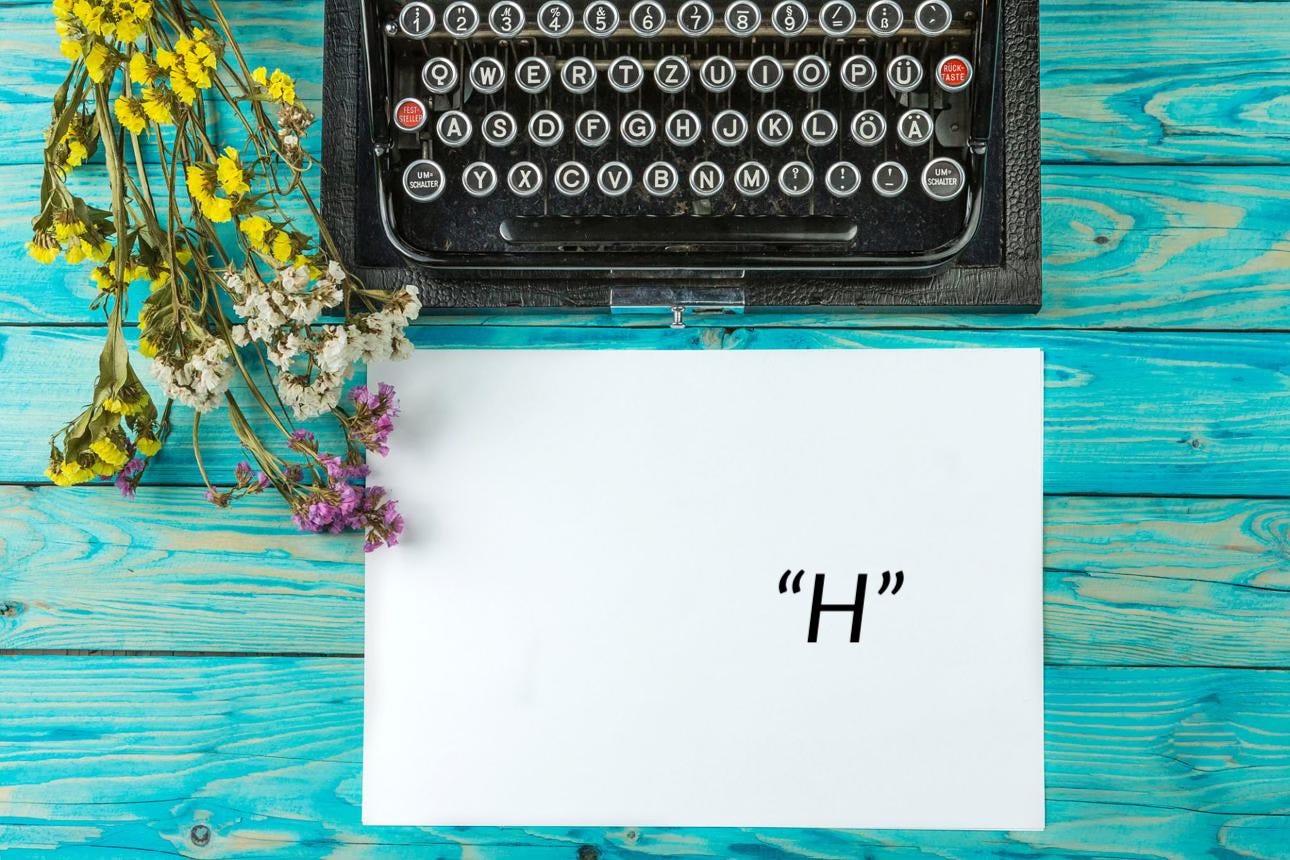
I recently bought a new blue-tooth keyboard. For months, the “h” key on my old keyboard didn’t work unless you tapped the key with extra vigor, which I lacked, so my emails and docs were riddled with missing-h-typos: I tink so, tank you, tat’s he ting—you get wat I mean. One friend told me that she found my missing-h-typos endearing, which I thought was a generous take given that I’m an editor. So I was intrigued to recently read Brenda Miller’s flash essay entitled “Typos” in Short Reads to see what she has to say about what she calls “happy mistakes.”
Welcome to Everything Essay! where we read an essay together and study the craft at work. Go ahead and read Brenda Miller’s essay, “Typos” now—it’s about 700 words and will take about 3 minutes to read.
“Typos” is a four-part, segmented flash essay. Each segment starts with a brief quoted phrase that has a typo, including: an incorrect letter, where wine becomes wind; a missing letter, where thought becomes though and hope becomes hop; and two letters transposed where dog becomes god. Miller explores these transformed words and the new meaning of the phrases as she weaves in her own stories too. Let’s look at the craft at work in each segment.
“Maybe we’ll go wind tasting”
Miller looks at wind through the lens of wine: Winds assume the flavor of the land in which they originate—a terroir—and vary by how long they’ve aged. Written in the second person point of view, the reader is encouraged to sample wind in the way one tastes wine—to cup, smell, and then sip their wind through the nose, on the lips and along the tongue. Like wine, wind has varietals: the breeze, the whisper, the gale, the chinook, Santa Ana, sirocco and mistral. Like wine, wind carries hints of flowers, fruit and spices. Miller cleverly plays with language here. And as the segment closes, she turns to a personal narrative, walking alone in a village in France at sunrise, in heartbreaking silence—a moment that eludes a tasteful description.
“She looks deep in though”
In this segment, Miller writes in the third-person about the miscarriages, the boyfriend, and the drunk man. These are all connected to true events from Miller’s past, which I know because I’ve been reading Miller’s personal essays for years and she has written about these relationships before.
She repeats the phrase Perhaps she three times in row, which catches the reader’s attention, adds emphasis, and provides a nice rhythm and flow to the prose. This writing technique is referred to as the rule of threes. Lately that technique has been getting a bad rap, because AI writing tools tend to overuse patterns like it.
But it’s AI’s overuse that’s the problem. Any writing technique becomes cliche and cumbersome when used too often, which doesn’t make it bad technique but poor application. For example, I arrange the plants in my garden in threes, because I like the way it looks. And, I still group words, phrases and sentences in threes when that structure fits and elevates the writing, because it sounds right.
We learn about the narrator’s experience in theater and are given a hint at the close that maybe she was hiding behind the characters she played. What do you think about the last sentence? She became characters thought up by someone else, embodiments of another’s imagination. Note how this is the one time the word thought is used in the segment. See how this paragraph and the one before, albeit both are short, each has a beginning, middle and end—its own narrative arc.
“This fills me with hop”
Miller is back to using the second-person you, and this time she speaks directly to us, the readers, reminding us of how our bodies—and her body—felt when we were children. Almost aloft. But by the close of this short paragraph, gravity has settled in and we/she are grounded. What do you think Miller is talking about here? She opens with the line, You know the feeling. What is she asking you to explore? How is hope part of this segment?
“Do you want to go to the god park?
Oh yes. The first two words of the paragraph answer the question—and I’ve already got a smile on my face. This is my favorite segment of the essay because it’s so funny! Inserting the word god for dog on a visit to the park is an inherently humorous set up, and Miller uses several effective writing techniques to up the funny quotient.
Situation: placing gods in a dog park is unexpected—it’s ironic.
Specificity: Miller uses very specific dog park examples to “show” the humor—the shy god on its first visit to the park; separate areas for small and big gods; the show off god; the god owner who doesn’t clean up after her god. The specificity of the situation amplifies the joke.
Dialogue: Miller talks to the god with the same tone and language she’d use with a dog: Go on boy, play!; good god; Who’s a good god?—more irony.
Voice: Miller uses word play (e.g., the gods run free) and an elevated level of understatement in this segment, which adds exponentially to the funny factor.
Writing funny isn’t easy. Starting with an ironic situation helps multitudes. But from there word play, voice and specificity are key elements to funny writing.
I walked into this essay wanting to discover something more about typos, and what I found is Brenda Miller’s exploration of language and four distinct ways it can be used to tell a personal story.
For months I’ve been writing without an “h.”
Now my challenge is to figure out how to turn my typos into appy mistakes :-)
We’ve talked about Short Reads, a great online outlet that publishes a quality, flash nonfiction essay each Wednesday. Have it delivered to your inbox—all great reads. Sometimes Short Reads will publish an essay that appeared elsewhere first. Brenda Miller’s essay first appeared in Brevity #54, another brilliant outlet for flash cnf.
Brenda Miller has a new book just launching, Love you, Bye: A Daughter’s Journey in Essays and Poems. I haven’t read the book yet, but it’s on order, and I can’t wait to talk about it here.
Thanks for reading Everything Essay! with Andrea A. Firth! This post is public and always FREE, so feel free to share it. Thx!
Comments
Nothing yet. Say the first thing.
Sign in to join the conversation.