
This week, something exciting (and complicated, and imperfect, but ultimately big) happened: A judge granted final approval to the $1.5 billion settlement for Bartz v. Anthropic. Two years after we first sued the AI giant on behalf of those whose books they stole to train their chatbot, the court okayed the first major win for creatives against an AI company as well as the largest copyright recovery in history.
My grandma had an obvious question: As a class representative, “you’ll get lots of money, right?”
Plenty of people are wondering (and, in the case of social media, saying [RIP my mentions]) the same thing: Are you getting rich off this? And over the last year, several folks have also reached out to me because they’re considering signing on as a lead plaintiff in another class-action suit against an AI company. They want to know what it entails and if it’s worth it.
Well, as you know, I am all about transparency here on Get It Write. So I thought I’d break down exactly how much I’m getting (it’s public information, after all) and what the process looked like for me. Let’s go!
Table of contents:
In August 2023, more than nine years after I started working on my debut, The Lost Night, I typed my name into the searchable database The Atlantic had created to identify the hundreds of thousands of books in one of the troves of pirated books used to train generative AI algorithms. The Lost Night popped up.
I was alone in my studio apartment, and I felt robbed, betrayed, and profoundly violated. AI companies saw the pirated ebook, the thing I couldn’t have written without a lifetime of reading and writing and revising and laboring, and downloaded it on the spot. Fed it into an algorithm along with a bajillion others, gulp. I was horrified…and fired up.
The next month, I read an article about a class-action lawsuit against OpenAI on behalf of authors. I sent a note to the law firm involved, just in case I could be helpful to the class. Nothing came of it. I watched the lawsuit unfold from the sidelines.
Then, in August 2024, the legal firm got back in touch about a similar lawsuit they were considering filing against Anthropic. I had long talks with a partner there about the pluses and minuses, then more discussion with my agent and girlfriend. There would be a lot of downsides: an invasive discovery phase, depositions and hearings, tons of time, an uphill battle.
But I’d been harmed and I wanted to take a stand. Not just for me, but for others in the book industry who’d been harmed as well. So I said yes.
I invested many, many, many hours into this lawsuit. I answered extensive discovery requests, handing over thousands of pages of documents and digging through a decade’s worth of contracts and communications to provide accurate information.
I traveled from New York to San Francisco to attend major court hearings as well as the deposition—a scheduled eight-hour interview with Anthropic’s lawyers (preceded by days of prep with my own counsel). Though my lawyer could (and did) object to questions throughout the conversation, I couldn’t discuss with them on the side. Once I was sworn in, I was on my own.
I reviewed and approved major court filings, including the settlement agreement. I did my best to be an informed and engaged class rep, peppering my attorneys with questions about the case, reading up on copyright law, sharing important information about my claims and the class’s potential point of view on relevant details, and more.
For about a six-week period in Fall 2025—from the time the settlement was proposed until the time the court granted it preliminary approval—I put my other obligations aside and worked on the case full-time. I said no to paying projects and pushed back deadlines on contracted work. I took important calls anytime, anywhere—once, memorably, on a whale-watching boat ride in Brooklyn, and another time at a music festival in the Hudson Valley. “Always-on” doesn’t quite cover it.
In particular, I dedicated substantial time to the proposed plan of distribution. Since signing the term sheet on August 25, 2025, I was heavily involved in the creation and refinement of the materials. I made comments and suggestions on the notice packet, claim form, and other materials, identifying potential pitfalls and suggesting language for clarity and inclusion.
(And here I should note that while I keep using I in an effort to not speak for others, I was one of three named plaintiffs alongside nonfiction authors Charles Graeber (whose books include The Good Nurse) and Kirk Wallace Johnson (who wrote, among other titles, The Feather Thief). They invested exactly as much time and effort as I did. I have the alphabet to thank for my name being on the lawsuit.)
And then the settlement got preliminary approval. But the work was far from over! From that point on, we worked to get the word out to potential class members and the general public about the terms of this deal—and why we supported it. I talked to different media outlets weekly, if not daily. To prepare for these conversations, I reread hearing transcripts, honed my talking points, and sought clarification from counsel on any potential misinterpretation or lingering questions. I published op-eds and Substack posts. I yapped and yapped and yapped. (Frankly, I’m a little tired of yapping.)
Ahead of the Works List’s public release, we provided feedback and helped craft explainers and FAQs for both the settlement website and the Authors’ Guild’s info center. As writer friends reached out with questions about the process of filing a claim, we provided feedback to make the claims administration site more informative and user-friendly. And we fielded near-constant questions from the publishing community—as Kirk put it, “I don’t think 72 hours have passed without an author writing to me for help or guidance.”
We had regular check-in calls with our counsel to stay up-to-date on the claims process, opt-outs and objections, a motion and then hearing to address ClaimsHero’s misleading solicitations, changes to claims deadlines, and continued orders from Judge Alsup (and then Judge Martínez-Olguín). Finally, we regularly brought to our counsels’ attention relevant news articles about AI and ads from misleading law firms. And now that we got final approval…we’re back in the spotlight again. I had an interview yesterday, two this morning, a possible fourth tomorrow.
I wouldn’t even know how to begin to calculate the time investment, but it was certainly thousands of hours. And while I didn’t notice dark vans from Big Tech idling on my block (someone actually asked me this!), I’ve dealt with an at-times overwhelming tide of vitriol from strangers on the internet personally contacting me to share their issues with our lawsuit and this settlement: Why we’re wrong, why it’s not enough, why we shouldn’t have settled, why it’s absurd to call IP piracy “theft,” and so on (comments, for the record, that I hear and largely understand).
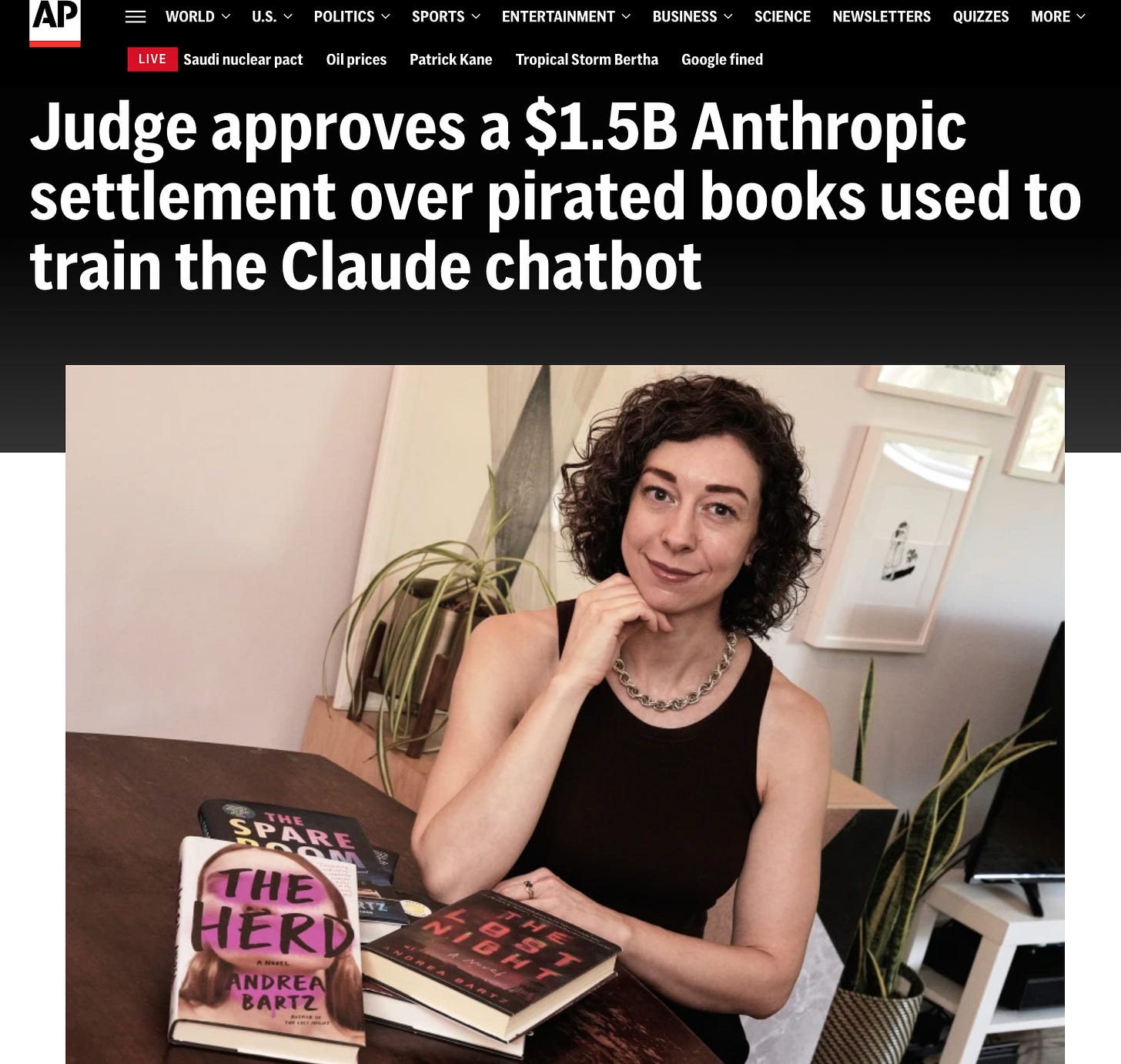
It’s one thing to be a woman on the internet. Try being a woman on the internet whose face is next to a headline about a $1.5 billion “win”.
As a class member, I’m entitled to the same ~$3,100 per book that everyone else is. I have two (2) books in the Works List, The Lost Night and The Herd1, so I’ll receive about ~$6,200 altogether. (The split between authors and publishers varies person-to-person and book-to-book based on contract language, rights reversions, etc.)
Additionally, lead plaintiffs often receive a “service award” to recognize their efforts on behalf of the class. Our lawyers requested a $50,000 award for each of us. This week, in the final ruling, the judge granted us each $15,000, calling the $50,000 request “unreasonable.”
So, all in, before taxes, paid out in a few installments, I’ll receive about $21,200. I didn’t get involved for the money, of course, and I’m very glad that authors who had dozens of books in the class (sometimes 100+!) will see substantial payouts for the work that was stolen from them. As a reminder, this isn’t a license to use our work going forward, and the settlement terms include the destruction of our pirated ebooks as well as reassurances that they were never—and will never be—used to create commercial models of Anthropic’s chatbot, Claude2.
Nope! Not as far as I can tell. I haven’t seen sales spikes around any media announcements or major moments (though of course, I’ve gotten unique opportunities to mention my titles). I also haven’t booked paid speaking gigs or anything similar from my work on the case, and I haven’t been paid for any media appearances or podcast recordings. But hey, feel free to browse my backlist, and check out Kirk’s and Charlie’s excellent books too!
Absolutely.
There are so many more crucial battles to be fought, but my God, we have to start somewhere.
The class-action suit brought to light something we’d long suspected but that hadn’t been publicly confirmed: Anthropic chose to download our IP from known troves of pirated ebooks—illegal and infamous sites that courts and law enforcement have repeatedly shut down. Litigation and discovery revealed just how brazen Anthropic’s wide-scale theft was in the company’s unchecked pursuit of “winning” the AI race and creating their immensely profitable commercial product.
With this settlement, the book publishing industry sends a message to the almost unfathomably wealthy and powerful AI industry: Our intellectual property isn’t yours for the taking, and you are not above the law.
The settlement also represents an important step forward not just for authors but also for creators of all types—artists, journalists, screenwriters, filmmakers, musicians, and more—whose work AI companies steal and devalue. The half-million books on the Works List comprise hundreds of millions of hours of labor, not to mention unquantifiable talent, dedication, and vulnerability.
For the first time, a big AI company is facing consequences for its move-fast-break-things actions that violated the law. Accountability, welcome to the party! This settlement can’t undo the violation and theft, but as a critical affirmation that piracy is a crime, it’s an important step towards making things right.
Yes, additional books of mine are hanging out in pirate libraries today! But when Anthropic downloaded this set in 2021, those were the only two books of mine present.
Please, please don’t come after me for this. I too have a brain and of course find it infuriating that the judge said it was fine for Anthropic to stop using pirated books and start scanning books they’d purchased instead. Our books effectively exist in the models, and we were forced (sans consent and compensation) to have our work used to threaten our livelihood. That’s unjust.
Libraries can’t buy an old paperback, scan it, and start lending it out as an ebook; they have to pay for a license to add an ebook to their collection. It’s absurd that different, more lenient rules apply to tech companies worth hundreds of billions of dollars who are using those scans to make a commercial product.
Future courts must sort this out. But that fair-use ruling was amputated from this lawsuit, and the settlement is only about their IP theft in downloading pirated ebooks.
Comments
Nothing yet. Say the first thing.
Sign in to join the conversation.