
Hello, friends! A couple quick announcements before today’s freaking fantastic bookseller Q&A:
I’ll be signing books and yapping with book lovers at meet-and-greets at Minneapolis’s Once Upon a Crime and the Poughkeepsie area’s Sloop Brewing with Olivia Worley (Man of My Dreams), in part to celebrate the paperback publication of The Last Ferry Out, a queer puzzle-box mystery on a tropical island populated by enigmatic expats and tight-lipped locals. (Psst—for a limited time, the ebook is on sale for $1.99!)
On Wednesday, 7/15 at noon ET, I’ll be chatting with Elizabeth of Open Book Club about why book clubs are having a moment and, more importantly, how to find the perfect one—or start one yourself. It’ll stream here!
Welcome back to Ask a Bookseller, a monthly column in which folks from amazing indie bookstores across the nation answer authors’ burning questions. Y’know, stuff that’s obvious to booksellers but shrouded in mystery to us writers, a la…
How do you gauge if an in-store event was a “success”?
How can authors let bookstores know about their upcoming release?
Can stores return autographed copies to the publisher?
Be sure to give the bookshops helping us out lots of love (and traffic), and comment to share the questions you’d like answered. (And if you run an indie bookstore and would like to be featured, hit me up!)
Today’s bookseller is Substack’s favorite bookmonger: Fisher of Carmichael’s, an independent shop in Louisville. I loved her detailed breakdown (with screenshots!) of how she decides what to stock, her nuanced take on how authors can get their bookstore pitch right (and so very wrong), and loads more. Enjoy!
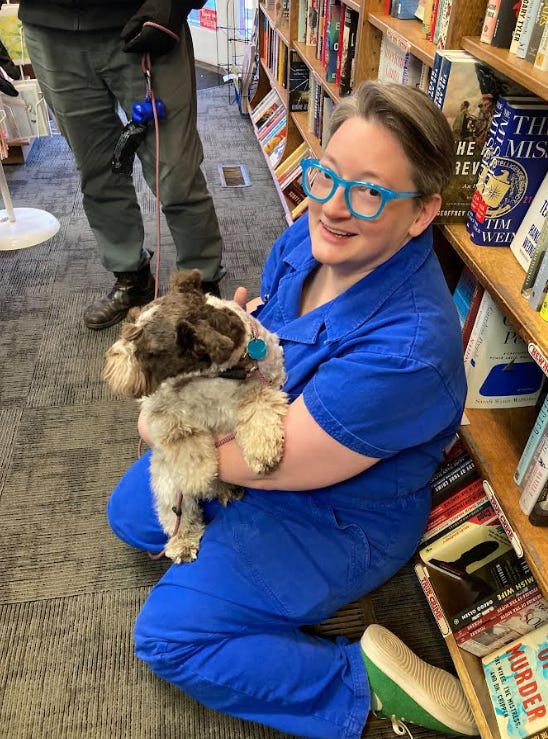
Carmichael’s is Louisville’s oldest independent bookstore. Michael Boggs and Carol Besse opened the store in 1978, then in 2016, they sold it to their daughter Miranda Blankenship and niece Kelly Estep. We now have three locations–one of which is a children’s bookstore that feels really magical. The other two locations are both general interest bookstores. They each have their own personalities that match the neighborhoods they are in. I buy the adult books across all genres for those general interest stores, and I work in both stores as a regular bookseller one day a week.
This isn’t something I knew about until I actually worked in the bookstore. The short answer is yes, we can return unsold books for the full amount we paid–but there are some hidden costs there. The first is that we have to pay for shipping to send those books back, so we return them at a bit of a loss. We usually buy books in such a quantity that the publisher foots the bill for shipping to us. But when we return, that cost falls to us.
The second hidden cost is that those books have been occupying their space on the shelves rent-free, if you want to think about it in real estate terms. Every inch of space that isn’t working for us is a potential lost sale. It sounds cutthroat, but margins at independent booksellers are incredibly thin, so penny-pinching really matters.
In an ideal world, we would never have to return books at all! Both we and publishers would maximize our profits if we didn’t need to return books. But at a certain point, we need to make those inches of space work for us. So we pull books that aren’t selling for returns. This is more of an art than a science, but most books get between 8-12 months to sell before we start considering them for returns. We try to shoot for a return percentage of less than 20%. If our return percentage is too high, then I am missing the mark as a buyer by not selecting the books our customers want to buy.
It is definitely the former! I run a sales report every week for the books that sold at all three of our stores, including any online sales. Then I submit that report to the bestseller list organizations we report to. It’s definitely real sales data!1
I think reporting for author’s royalty statements works very differently–I’m not the expert there, because that’s not something that gets reported at the bookstore level. From what I understand, the publisher compiles that data and it includes returns from bookstores, which is why a royalty statement can sometimes look like you sold negative numbers (something I imagine is very disheartening for an author to see).
The easiest and first decision factor for me is whether we have sold that author before. I’ll pick you as an example! We’ve sold your books, so we keep buying your books to sell in the store. Sometimes, an author that sells very well in other places has never sold in our store at all, even when we’ve stocked them. So we don’t keep bringing them in. For whatever reason, that author just might not hit with our customers.
For a debut author where no sales track exists, I look at what the publisher is doing with it (are they pushing it hard, are they talking it up, have I seen it on most anticipated lists, etc.), whether or not the concept appeals to me or our store’s general personality, whether or not I think it’s important to stock based on topic (this is helpful in nonfiction especially), and if I’m still not decided, then other factors, like author’s fame/following, blurbs, etc.
This might be hard for authors to hear, but we skip more than we stock. I’m only bringing in 25-45 percent of any given catalog depending on the strength of the publisher and their list. A lot of what I skip is based on my knowledge of the store and what a given section does or doesn’t need.
I’ll pick an example that might not hurt your author readers as much: Cookbooks. How many Italian cookbooks can I reasonably fit on the shelves at the cookbook section? We want more than one but less than twenty. So I try to select the ones that I know will sell, have the broadest appeal or fit the store personality the best. I want to have room on the shelves for other international cookbooks, and of course, plenty of Southern cookbooks. So sometimes I skip a perfectly nice looking Italian cookbook because I’ve already bought six other Italian cookbooks this season and the next one I see just doesn’t quite make the cut.
I do this for every section. I’m not sure if people know just how many books get published that look and sound nearly identical to one another, even in fiction categories. I have to balance out the sections to make sure I am hitting all the possible areas of interest for our customers, and that means picking out the best, most saleable, or most interesting in each genre and sub-genre. If I’ve bought quite a few of one kind of book already, I am less likely to pull the trigger on the next one. That’s the (probably horrifying) calculus that authors can’t possibly plan for: when the book is sold to me. If a publisher is selling me their list for the fall and they are my first catalog for that season, I am probably an easier sell than later in the season.
I try to balance out this timing bias by looking at sales data and numbers for each individual publisher from season to season, so I’m not buying, say, half of Random House’s list and only a quarter of Macmillan’s list. I keep a spreadsheet, which helps keep me from buying more units than the store can reasonably hold, or fewer units than we need to keep the shelves stocked.
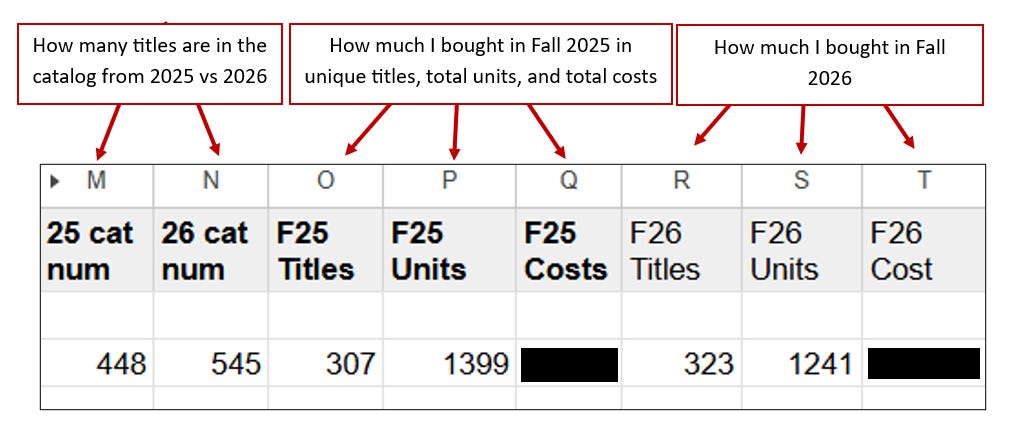
I removed the publisher info from this example, but you can see that the publisher has almost 100 more titles in their fall 2026 catalog than they did last year. You can also see that I bought more overall individual titles (323 compared to last year’s 307), but fewer individual units (1241 this year vs 1399 last year). This is specifically because I overbought last fall and the booksellers had a hard time fitting the books on the shelves.
You can also see my ratio is high for buying with this publisher. I’m bringing in over half of their titles. That’s partially because Fall lists are usually quite strong, but also because of how some publishers organize their sales and imprints into different catalogs.
I really do try to take into account all of the potential biases I am aware of, but at the end of the day, buying can be an idiosyncratic process, made even more so by the fact that each independent bookstore is unique and their buyers are unique. The sales reps do an excellent job and really can influence me one way or the other depending on the strength of our relationship. There are some books I absolutely don’t believe in and a sales rep will tell me I’m wrong, so I buy it. Then that book flies off the shelf. They miss once in a while like everyone else does, but a good sales rep knows how to steer their buyers to the books that will sell in their stores.
I cannot stress this enough, please do not call us. Email and snail mail are both great! They allow booksellers to answer at a time that is convenient for them rather than the author, and also, you are much more likely to get the right bookseller when you email.
I feel like there’s this old-fashioned advice about knocking on doors and making real time connections…and I get it. It’s much harder to say no to someone standing right in front of you or waiting for your answer on the phone. But when you call us to sell us something (which is what you are doing if you are telling us about your upcoming release), you are taking the bookseller away from their job so that you can do your job. The bookseller is at work, and suddenly you’ve turned them into the customer, and that switch can be confusing.
Also, you are completely at the mercy of the person who answers the phone, and that person might have just been trained yesterday. They might not know what to do with you, and they might give you bad information. You would be shocked at the things I’ve heard new booksellers say to people out of simple ignorance or misunderstanding. (Like a new bookseller one time telling someone a book was out of print because it was out of stock at Ingram...which is just. No. No. No. I intervened quickly, but what if I hadn’t been there!?)
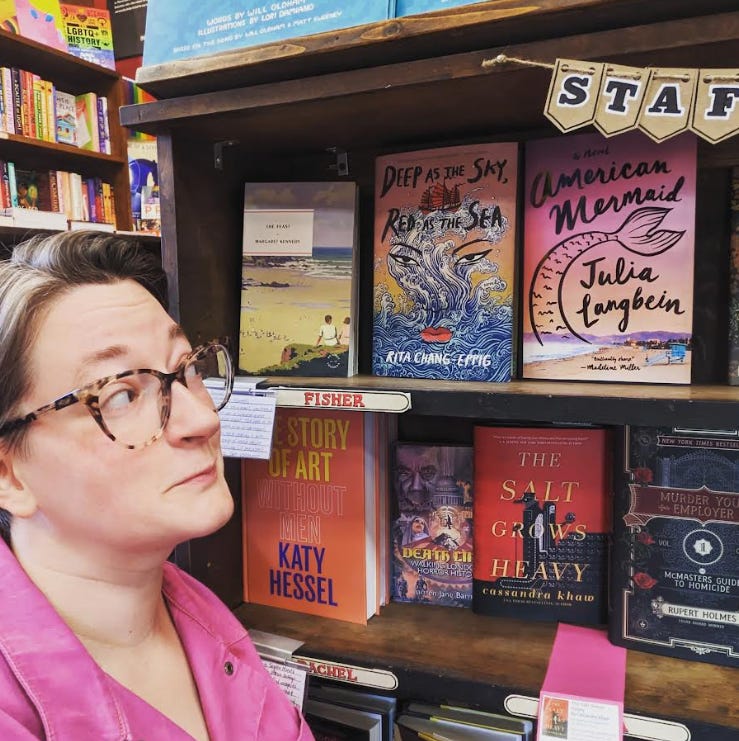
If you are worried about a store being inundated with emails and you really want to stand out, there’s nothing wrong with going to introduce yourself in person, BUT please be aware of how busy the store is in a given moment, and pick your time wisely. Go on a weekday morning during the school year (not a holiday weekend, not December!) and introduce yourself then.
You can ask to talk to a buyer or manager, but at stores with a larger staff, the booksellers tend to screen for us, sometimes because we just aren’t there and other times because we are busy. It’s never personal if you can’t get to a decision maker right away! Feel free to leave a card or a note.
I want to add in a caveat: If you are traditionally published, then strictly speaking, you don’t need to let a bookstore know about your upcoming release. If every author with a book coming out emailed us or called us, we wouldn’t be able to do our jobs. Your publisher is already selling us your book, you should trust them!
That being said, if you have a specific relationship to the store, then reaching out is more effective. If you are a regular customer, if you live or have family in the area, or you met a bookseller at a conference (or even online) and want to keep that connection alive, those are all good reasons to reach out about your book. Handwritten cards are nice–I genuinely do feel more obligated to someone who sends me a personalized and handwritten card.
Oh gosh, I think I would be a terrible publisher. But if I wanted to get into the publishing game, I would have a very small, focused, highly curated list. I would follow the model of Hagfish or the dorothy project. Maybe 2-4 books a year total, with a clear design story and a sense of cohesion: I would want my books to make sense in relation to each other. People would say: That’s SUCH a Fisher book. But lovely people already do this work and they do it well, so I doubt I will ever jump into publishing.
But if I were to talk to the publishing industry as a whole, especially the biggest players, my suggestion would be to scale back. You want to get in on a new trend? Maybe only do 60 percent as much as you think you should, and stop acquiring those trendy books about a year before you think you should.
The industry is massive and publishing a single book takes such a long time that trend-chasing seems to be an obviously bad business model. And yet...those trendy books keep coming out for 2-3 years after the trend has fallen out of favor. Focus your lists and your employees might stop burning out. You might spend less and make more. You might be able to better support the authors you do sign.
But I readily admit that the publishing industry is large and complex with many moving parts, and I don’t know how any individual could reasonably execute those suggestions. It’s more of a wish than any kind of actionable advice.
There’s this scene in the show New Girl when Schmidt is buying Jess lunch and he says “you can have whatever you want on the menu. They got pizza, gelato, Tikka Masala. A raw bar. This place is doing too much. They can’t be doing all this right.” (I could not find a clip of it which is sad, because his delivery is hilarious.) Anyway, that’s how I feel about most big publishers these days: they are doing too much. They can’t be doing all this right.
I think your readers probably already know this, but independent bookstores are not a monolith. Each indie bookstore and their employees are unique and they don’t always have the same policies and procedures. My best advice for authors is to just do a bit of research–read the store’s About page on their website. Check to see if they have an FAQ or consignment (for indie authors) section on the website. Read it!
And be aware that a less experienced, pushy author may have muddied the waters before you with bad behavior. We have had authors we’ve never seen before claim to be store regulars; we’ve had authors saying they want us to stock their books, then hiding a secret stash of fliers in the store with a QR code that leads straight to Amazon. One time an author reverse-engineered my email, even though no one had given it to them, and emailed me to say that my coworker had promised them I would read their manuscript in process AND PROVIDE THEM WITH FEEDBACK. It should go without saying that my coworker did no such thing.
But on the bright side, these bad examples help highlight how nice it is when an author comes into the store friendly and prepared. They stand out in comparison to the rough and weird interactions.
Thank you so much, Fisher! Friends, be sure to give Carmichael’s some love, and let me know in the comments what else you’d like to learn from booksellers. And don’t forget to sign up for Fisher’s fantastic Substack, Fisher the Bookseller!
This all sounded rather obvious once Fisher explained it, but every author knows that book sales are weirdly slippery—we see different numbers in Bookscan, in our author sales portals, and on royalty reports. Also, it breaks my brain that bookstore returns wipe out actual POS sales to count against our earnings. Like, if I sell 10 books, and bookstores order and return 3 (which never otherwise showed up on my royalty reports!), I’ve now “sold” 7. I know it’s because publishers take a hit from returns and share that burden with authors, but I don’t like it.
Comments
Nothing yet. Say the first thing.
Sign in to join the conversation.