
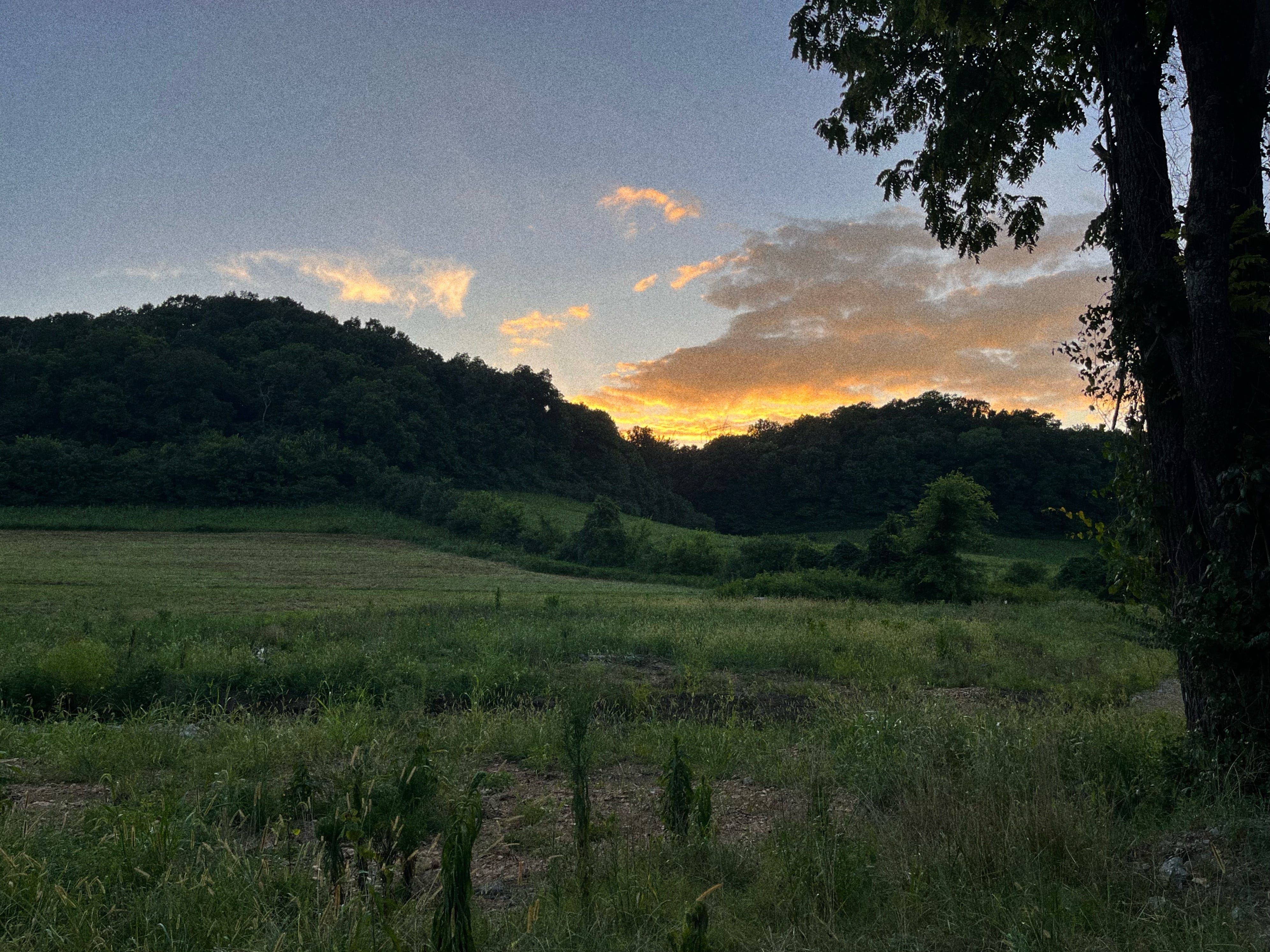
“We want certainty, we want solid ground under our feet. We want to be sure of our place in the world, and yet we rarely, if ever, have that certainty.” —Patti Callahan Henri
It’s late July in Tennessee and the sun is roasting. These days are meant to be spent in swimming pools, creeks, and rivers, so that’s what we do. My best friends of 20 years and I spend the morning floating and chatting, sinking our heads underwater every now and then to cool off—and to evoke the childlike sensation of being fully immersed in the water and the moment. It’s a special river access point, one we only know of because our families have been around here for so long.
I drive the familiar route home: back roads lined with four-rail fencing, black cows in the fields and tightly rolled golden hay bales. I pull up to a stop sign, and ahead of me I see three old farmers with weathered faces and worn overalls sitting next to a Sun Drop vending machine on the porch of the old lumber mill. It’s such a charming scene, and yet I am pummeled by sadness. I capture a mental image, hoping to preserve this vignette in my memory like a time capsule of history and heritage—a postcard that will live on beyond their years. I spend the rest of my drive reflecting on the love and grit that’s been sewn into this land—the generations of families, traditions, culture, simplicity, and connection to the soil, and I find myself wishing I could stop time.
Growing Up
I was born in Tennessee 32 years ago and raised in a classic Southern neighborhood down the road from Alan Jackson. Home was a simple ranch in Franklin with an open backyard and the perfect climbing tree out front. At Halloween my dad would do hayrides around the neighborhood and we would spend our summers at the pool playing Green River or Marco Polo then ride home wearing wet swimsuits in the trunk of our green Eddie Bauer explorer.
In high school, I spent half of my time on my mom and stepdad’s horse farm, and the other half of my time on the thousand acre crop farm that my dad manages. I went to school for Graphic Design at the University of Tennessee, then moved to Oregon for five years where I met my husband. Our plan was always to move back to Tennessee, and in January 2022 we bought a century-old farmhouse here.
Coming Back
When we came back in ‘22, Franklin wasn’t the place I had left. It had exploded in popularity—some parts were almost unrecognizable. My ordinary childhood home was now worth ten times what my parents originally paid for it. Needless to say, we chose to expand our radius and live further out. Further from family, further from my old stomping grounds and childhood memories, and even still, our new small town isn’t so small anymore. It feels like it’s becoming more of a found gem than a hidden one.
As a Tennessee native, I have such mixed feelings about the way things are changing. The majority of my friends and acquaintances now are recent transplants (mostly from out West), and I’m so happy they’re in my life. I understand why they want to be in a place like this. I appreciate the good food, good coffee, good company and all the other good things that have been brought to our area. And at the same time, I lament for the place I grew up. It’s disorienting to be considered a unicorn simply for being a native in my own hometown. The culture is changing, longtime locals are struggling to keep up, and quintessential Tennessee pastures are being subdivided and developed left and right.
We’ve experienced the raw beauty of rolling farmland all these years, and it’s heavy to witness the contrasting image of what’s to come in the years ahead. The farm my dad manages, where Kyle and I got married six years ago, is now covered in hundreds of homes crammed in so tightly you could almost reach out one window and touch the next house. The neighborhood is paving over what was once open green pasture with deer roaming about, looking for leftover corn kernels or juicy apples to eat from the trees. Every time I drive up the road now, I’m mystified by how much has changed so fast.
Our Home and Future
When we bought our farmhouse three years ago, it was surrounded by endless crop fields. It was a selling point for us. We dreamed of buying those fields, and eventually that opportunity came. We made an offer, but the seller switched gears and decided to pull it off the market and divide it into smaller lots. A month later we made an offer on another 60 acre farm, and the same thing happened again. They revoked the listing and made plans to chop it into eight lots. Our journey to find land has been emotional, not only because of the way it affects our personal plans, but because I’m a preservationist at heart. It’s hard to sit in a front row seat watching land and legacy traded in for quick profit and commercialization. We grapple with it regularly, wondering if it’s time to move on somewhere with a little less demand and competition.
Only God knows what our future will hold and at the end of the day, I realize that a place can never truly be mine to hold. I’m learning to live with open hands and less dependence on the land beneath my feet, because being rooted isn’t about a physical location. It’s about being at home in my own soul and spirit. Secure in the life I’ve built and in the person I’m becoming. I’ve come to a poignant realization that the two things in life I want most—land and children—cannot be taken by force. They’re not a guarantee, not something I can grasp for or conjure up out of thin air, no matter how deep my desire. They can only be waited for, hoped for, and prayed for, so that’s what we do.
××
Andi
Footnote: If you follow along on IG, you may be confused about our “new land” that I’ve posted about. We bought the 5 acres next to us, which has an open field and a creek. It’s one of the parcels that was subdivided down from the bigger lot surrounding us. We bought it so that no one could build right next to us, and while it’s been so fun, it’s not a long-term solution for our vision of living on a larger, more tucked-away piece of land.
No posts
Comments
Nothing yet. Say the first thing.
Sign in to join the conversation.