
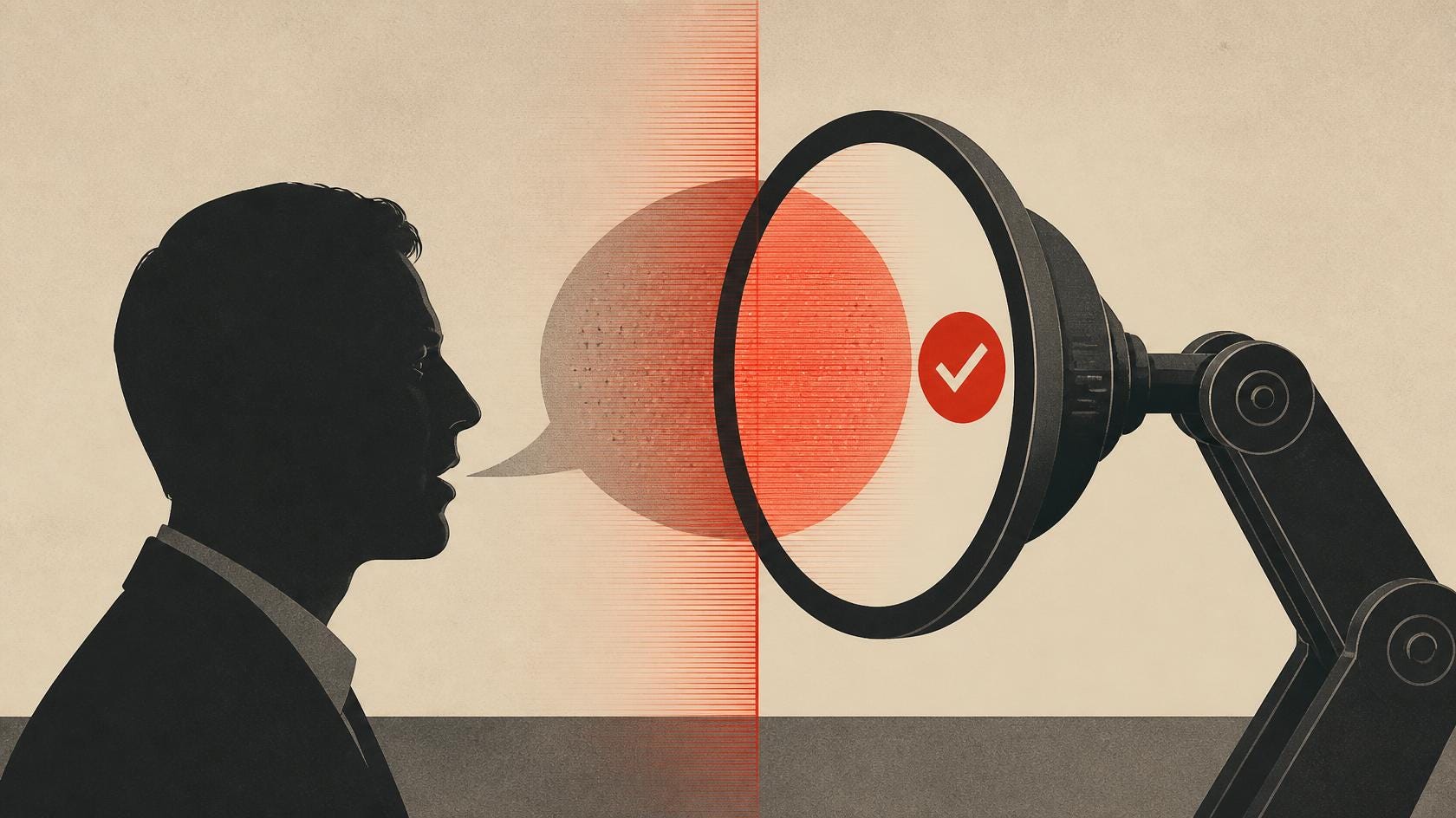
AI will not save a weak company narrative.
It will expose it.
For years, many technology companies have treated communication as a production problem. More content. More posts. More visibility. More activity.
AI makes all of this easier.
But, it also raises the standard.
When investors, journalists, partners and customers use AI tools to understand a company, they are not only reading the company’s website. They are reading all the public evidence surrounding it.
The press coverage.
The founder voice.
The technical explanations.
The investor language.
The consistency between claims, proof points and market behaviour.
In that sense, AI is turning communication into a credibility audit.
And many companies are not ready for this.
The old communications model was built around attention.
Can we get seen?
Can we get coverage?
Can we drive traffic?
Can we stay visible in the market?
Those questions still matter. But they are no longer enough.
The new question is harder:
Can the company be understood, verified and trusted when someone starts looking closely?
That someone may be an investor. A journalist. A potential partner. A board member. A regulator. Or an AI system summarising the market before any human conversation has even started.
This changes the role of communication.
It is no longer only about what a company says about itself. It is about the evidence ecosystem that surrounds the company.
A vague positioning statement will not carry much weight if every other company in the category sounds the same.
A bold claim will not survive if there is no proof behind it.
A technical breakthrough will not matter commercially if nobody outside the lab understands why it changes anything.
And a company that changes language every quarter will struggle to look serious in a world where both people and machines compare signals over time.
This is especially important for AI and deep technology companies.
Many of them face the same problem from opposite directions.
Some sound too generic. Everything is “AI-powered,” “transformative,” “next-generation” and “game-changing.”
Others sound too technical. The science may be strong, but the outside world cannot easily understand the relevance, the market, the timing or the strategic consequence.
Both are communication failures. One hides substance behind hype. The other hides substance behind complexity.
Neither is ideal when trust becomes the main bottleneck.
In the AI era, communication needs to become more disciplined. Not louder. More disciplined.
That means:
Clearer category definition.
Sharper founder and executive narratives.
Stronger proof points.
Better technical translation.
It also means
consistent language across websites, decks, media material and investor conversations.
And source material that can be understood not only by humans, but also by the systems increasingly used to analyse, summarise and compare companies.
This is where communication moves closer to strategy.
It is not about decorating the company story after the real work is done. It is about making the company legible.
To markets.
To investors.
To journalists.
To partners.
To AI systems.
And, often, also to the company itself.
Because a strong narrative does not invent credibility. It organises it. It connects what the company is building, why it matters, what evidence supports it, who should care and why now.
That is very different from marketing language.
It is the architecture of trust.
The companies that understand this early will have an advantage. Not because they produce more content. But because they become easier to understand, easier to verify and easier to believe.
In the AI era, the strongest companies will not necessarily be the loudest.
They will be the clearest.
And clarity, backed by evidence, is becoming one of the most valuable assets a technology company can build.
No posts
Comments
Nothing yet. Say the first thing.
Sign in to join the conversation.