
The AI debate today is something of a clash of personalities. On one side, Dario Amodei of Anthropic has been saying that current architectures, scaled and refined, will replace most software engineering work within a year and reach Nobel-level scientific contribution within two. Demis Hassabis has said something similar in softer language. Sam Altman has been saying it for longer. On the other side, Yann LeCun, after his departure from Meta following twelve years as Chief AI Scientist, and now fresh off his billion-euro seed round for his new company AMI Labs, argues that the entire premise is, in his preferred phrasing, a dead end. Not a hard road. A dead end.
Both positions cannot be correct. But what makes the debate interesting is what it passes over in silence. Because beneath the disagreement about trajectory sits an older, unresolved question: whether what these systems do is, in any meaningful sense, contact with the world.
The systems we call artificial intelligence today, however capable, operate on abstractions. Tokens, vectors, probabilities. They find patterns in data that human beings have produced — text, images, video, audio, all tokenized, compressed, represented. What the model processes is always already a description. It acts upon our account of the world, never upon the world itself.
This distinction is easy to miss as long as we stay inside benchmarks. The benchmark is a proxy: bounded, clean, static, repeatable. What we refer to as reality is none of these things. It is a continuous stream of noise and instability, a dense fabric of uncertainty, physical constraint, and social context. There is no held-out test set. There is no training cutoff.
The philosophical name for what these systems lack is grounding, the bridge between symbol and thing, and it is not a new observation. Stevan Harnad formalized it in 1990. Rodney Brooks has argued for some form of it since the late 1980s. What has changed is not the question but the stakes. The debate has long left the academic classroom and moved into capital allocation.
LeCun has a way of making the point concrete. We have systems, he observes, that pass the bar exam, compute integrals, and generate code. We do not have a robot with the common sense of a cat. A cat navigates a continuously changing environment in real time, predicts the consequences of its own actions, plans around obstacles it has never seen, and updates its model of the world with every step. It does all of this on roughly twelve watts. A state-of-the-art language model, dropped into a kitchen, could explain the physics of a falling glass but could not be trusted to pick one up. Whether this gap closes by scaling, or whether it requires a different kind of system altogether, is what Amodei and LeCun actually disagree about.
The current wave of humanoids is, in this sense, less a product category than an experiment. AGIBOT has shipped its ten thousandth robot. 1X is preparing consumer deliveries of NEO. Figure, Optimus, Apollo, and Boston Dynamics’ electric Atlas are all moving from demo into deployment. Each of them embeds the assumption that intelligence is developed first, and then placed into a body second.
This assumption is doing more work than people acknowledge. Existence in the world is not a sequence of defined tasks. It is occupation of an open system, where perception is continuous, where every action reshapes the conditions of the next, and where nothing resets between episodes. A humanoid that breaks continuity, that forgets, that pauses to think, that requires the problem to be re-posed, is not yet an autonomous agent. It is a demo of one. This is not a scaling problem. It is a continuity problem.
Today’s models learn in versions. They are trained, deployed, updated in cycles, frozen in between. Human cognition does not work this way. The brain learns in the act itself, integrating experience without losing what came before, maintaining coherence across decades, adjusting its model of the world moment by moment.
A genuinely intelligent system operating in physical reality would not be one that excels at isolated tasks. Reality does not present isolated tasks. It would be one that adapts continuously, without discrete training phases, without catastrophic forgetting, without the clean boundaries between inference and learning that current architectures depend on.
Once you accept this framing, the bottleneck moves. It is no longer primarily about parameter count or training compute. It is about something much harder: perceiving, storing, reasoning, and acting simultaneously, in real time, within the energy, thermal, and mechanical envelope that a body can actually carry. Cloud computation introduces latency. Onboard computation hits energy limits. Distributed architectures run into bandwidth ceilings. A fully autonomous humanoid running on current silicon would, in effect, need to drag a data center, a power plant, and a cooling system behind it. The image is absurd. It is also approximately correct.
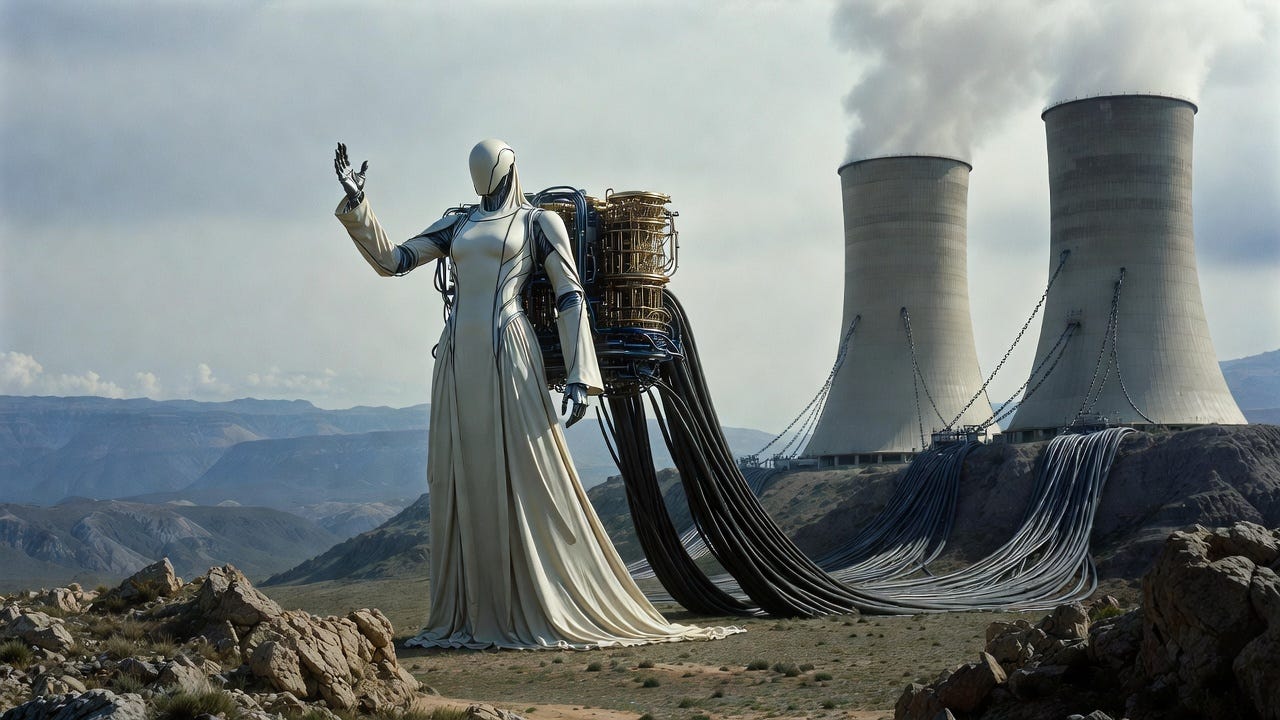
For most of the field, the answer is specialized silicon, inference accelerators, neuromorphic chips, more efficient attention variants. These matter. But there is a parallel track that is worth taking more seriously than it usually is, because the standard objection against it no longer holds in one specific case: room-temperature quantum computation.
Until now, the objection has been that quantum systems need cryogenic cooling, vacuum chambers, and vibration isolation, precisely the opposite of what a mobile body can offer. This is true of most qubit modalities. It is not true of all of them. Nitrogen-vacancy centers in diamond behave differently. Here, the qubits sit inside the carbon lattice, manipulated optically and electrically, insulated by the material itself. Companies such as SaxonQ in Leipzig, co-founded and led by Prof. Marius Grundmann, an experimental physicist with three decades of work in semiconductor and quantum systems and an H-index of 97, are beginning to explore this path. They have built a mobile NV-center quantum computer on this principle. It runs off a standard wall outlet. A four-qubit system has been in operation at the Fraunhofer Institute for Machine Tools and Forming Technology in Dresden since mid-2025, and live real-time image classification has been demonstrated publicly. (Disclosure: tomorrowmensch is an investor in SaxonQ.) It is early. It is small. But it is real.
Why does this matter for embodied intelligence? Because early theoretical and empirical work suggests that certain classes of data, high-dimensional, dynamic, uncertain, can be processed with exponentially less memory on quantum substrates than on classical ones. These are precisely the classes of data that dominate physical reality. If that scaling holds in practice, the implication is not that quantum computers replace GPUs. It is that the architecture of a truly autonomous body may require a computational substrate we have not yet integrated into the conversation about AI at all.
This is the part of the argument that is most easily dismissed, and it is therefore where the question becomes most interesting. Hassabis and Amodei may be right that current architectures carry further than their critics think. LeCun may be right that they don’t. But both framings keep the debate inside software. The harder possibility is that the limit is not in the model, it is in the physical substrate we have chosen to run our models on.
There is a question hiding inside the scaling debate that neither side tends to name. Amodei and LeCun disagree about method, but both treat intelligence as something to be constructed, external, synthesized, placed into a body or a data center, in either case manufactured. The only argument left is about which substrate reaches the finish line first.
I want to return to an older question, running parallel to the one currently absorbing the capital of the moment. Not how to build a mind, but how to evolve the ones that already exist. There is a third path, rarely discussed. What Florian Neukart and I call Artificial Human Intelligence (AHI) is not another variant of AGI. It is not a more physically grounded version of the same construction project. It proposes something categorically different: the gradual transformation of the human being through technology itself, so that biological components may progressively be complemented or replaced by synthetic ones and cognitive and physical capacities extend beyond their evolved limits, while the individual’s consciousness is never interrupted in the process. An AHI does not begin as code or as a chassis. It begins as a person, and stays one, even as the substrate beneath that person changes.
This is the Ship of Theseus rendered as biography. The brain is not constructed; it is refined, neuron by neuron, through neural prosthetics, biocompatible synthetic tissue, and, potentially, the cellular-scale intervention that new classes of computing substrate, NV-center quantum platforms among them, start to make conceivable. Identity survives. Memory survives. Subjective experience survives. What is added is range.
The distinction matters because it reframes the entire problem. AGI, however it is scaled, is an attempt to create consciousness from scratch, a problem no one has solved, and which may not be solvable in the terms currently being used. AHI begins with consciousness already present and asks a different question: how do we keep being ourselves while becoming something more? This is the singularity paradox, the attempt to build entities identical to the Mensch, while the concept of the Mensch itself remains philosophically unsolved.
The paradox is not rhetorical. It carries real risk. The gravest is the loss of the very thing the process was meant to preserve: a body and brain fully enhanced, fully capable, but hollowed out at the level of subjective experience. A Mensch replaced, step by step, by its functional imitation. Whether that outcome is avoidable depends on questions about consciousness we cannot yet answer, whether subjective experience is substrate-independent, whether it depends on physical (possibly quantum) processes in biological tissue, whether continuity of identity requires continuity of material. These are not questions AGI has to confront, because AGI has no baseline to preserve. They are the questions that define AHI.
The underlying wager is this: the scaling debate assumes that intelligence will eventually catch up with reality by becoming large enough, or by being given the right substrate. The AHI wager is that the only intelligence whose contact with reality is not in question is the one already living inside it, and that the faster, safer path is to extend that intelligence, carefully, rather than attempt to reconstruct it from the outside. The question of what it means to be a Mensch, a human, is no longer merely philosophical. It is now practical.
Next in this series: an updated essay on The Final Narcissistic Injury, followed by The Continuity Problem, the structural limits of current AI architectures, and why they cannot, on their own terms, reach what they are reaching for.
If you are building at the intersection of life, infrastructure, intelligence, and energy, and are willing to sit with the paradoxes this opens, I would like to understand what you are building, and what you believe this becomes.. Leave your comments below.
No posts
Comments
Nothing yet. Say the first thing.
Sign in to join the conversation.