
Ancient Healing Ways - nature based healing rites
“Holy spirit, giving life to all life, moving all creatures, root of all things, washing them clean, wiping out their mistakes, healing their wounds, you are our true life, luminous, wonderful, awakening the heart from its ancient sleep” – Hildegard of Bingen
Special Way of Council - at Hawkwood college, Stroud https://www.hawkwoodcollege.co.uk/our-programmes/programme/27002-the-way-of-council
When I first started to offer the Way of Council, I wanted to do it in a small, intimate way. I thought I’d do it in my home, invite a few chosen friends who had shown an interest in Council before and were eager to find out more. I was innocently green and yet passionate about this Form. I also embodied that sense of the unknown, although I had been raised to think I was stupid, a ‘retard’. It turned out that this kind of naivety was a gift of innocence that gave me an openness.
I chose the room upstairs. I wanted to make sure the space really beautiful and inviting. I did this by taking a walk in the local nature reserve, gathering branches of oak, hazel, and wild rose. It was Autumn, so the colours were extra rich yellows, oranges and soft browns. I picked chestnut tree leaves from the ground, and all the while I was in this walk, my thoughts and heart turned towards the offering of this Council. Like a living, waking dream, I think I was initiating a nature prayer in the preparations. Back in my room I arranged the branches in the four corners, I laid a Moroccan rug on the floor. In the centre I made an altar with a simple plain grey piece of circular slate. I placed the chestnut leaves around the edge of the grey slate, which complemented the oranges, reds and blues of the rug. I added a candle and nothing more. I wanted it to be a blank canvas so people could bring what they needed. I didn't want to lay any trips or preconceived ideas down.
I invited my five women friends, Louise, Marie, Sue, Mel and Robin. We arranged a date and I sent them guidelines of how we were going to be sitting together in a circle. I included the fact that the Way of Council is a slightly different Form and way of being from other speaking and listening circles.
It was a Saturday afternoon in late November. I had created a neutral space and the room looked absolutely beautiful. The wall with a window had a strong yellow bright sun shining through. The window frame was painted bright lime green, the walls were bright yellow, so as the sun came in that window to rest on and embrace these colours, it made the room radiate and shine. The green and orange branches in the corners lit up. The whole space felt alive and welcoming.
My friends arrived. I greeted them with a cup of tea, and we had some small talk before we moved upstairs to enter the Council space. My heart was beating.
As said before, Council as a way of communicating is different and not the same as having a conversation or everyday chit-chat. What makes that difference is the fact that it's a ceremony. We create a ritual, a Form that steps into a different time frame, a meditative perspective and setting in which things start to slow down.
Everyone sat in a circle on the floor, some of my friends brought cushions to sit on and I had provided a few chairs as well. Before we lit the candle and opened the gateway into our Council, I shared a little of the history: how the Way of Council came to life, as part of that opening is to honour those who have gone before. I shared the story of the Ojai Foundation and the original roots of Council evolving out of the natural world, and the ways indigenous peoples shared and listened in this way. Then, I shared those guidelines: -
Listen from the heart
Speak from the heart
Speak spontaneously
Share the essence – stay lean in speech
Speak what serves myself, the community, and the planet
Keep confidentiality
Then I offered them a little more information about the Form. ‘We have a centre, and we sit in a circle. It's not linear: we have a Talking Piece that invites a space for attention and intention and to take a moment to slow down, take a breath, and see what truly lives inside my heart, my body. Our hearts tell us what needs to be shared and fits into and serves the prompt or intention of our round of Council.’
After that I lit the candle and we all made a dedication, an intention of goodwill to someone or something in our lives. Then I invited someone to share a poem or a song, or something that struck them or felt appropriate to bring to this circle as a way of opening. Mel said, ‘I have a poem that feels good to share right now”.
‘Do not try to save the whole world
or do anything grandiose
instead create a clearing in the forest of your life
and wait there patiently
until the song that is your life falls into your own cupped hands
and you recognise it and greet it.
only then will you know how to give yourself to this world
so worthy of rescue -’ By Martha Postlethwaite
It seemed a perfect opening for us and set the ‘field’.
We started in a light, gentle, easy way. ‘Tell a story about your journey here’ was to be our first prompt for a round of Council. By inviting people to share a ‘story’, we aimed to sidestep the impulse to explain or justify or philosophise. When we share a story, rather than a linear recital of facts about a journey, it opens up many more facets of the experience. It brings up feelings, opening other doorways, evoking a sense of place, other times, other parts of our life, revealing forgotten secrets and evoking memories and images. Everything involved in telling a story paints a picture, giving more sense of wholeness. In the old ways, storytelling was a way of educating, of recalling and honouring past culture and remembering that we are not alone. Stories create myth, and in the old ways, stories connected us to the Earth, each other, our ancestors and to nature.
Every one of us told a simple story about their journey to my house. At times some of the women forgot that it was a story and gave a linear timeline. It's hard for us with our modern education and culture to think in this circular way, and yet the practice of Council gives us the opportunity to widen and expand ourselves. We moved on with several other simple prompts; and then what became apparent was that a field, an atmosphere was growing, a kind of energy in the room of struggle, of tough financial circumstances; and there was a kind of depressive energy that was underneath. As I was leading this Council, it felt appropriate to witness this to our group. We decided together what the next prompt or intention would be that fitted well with the depressive, slightly dark mood that was lurking and brewing beneath the surface.
‘Tell a story about a time in your life where you experienced a hard time, a challenging time and yet something good came out of it,’ I proposed; and we all agreed. Now this atmosphere in the room was very present, and we women were centred, even if uncomfortable with what was rising from deep within. Time was starting to stand still. It was as if the Council was taking on its own voice: Council was unfolding with our stories, emerging out of the truth of our hearts. Mel went first. She reached over to the centre of the circle and picked up the Talking Piece and with a long face she shared a time in her childhood when she was scared. She remembered how much her mother drank alcohol and how her mother would become out of control and do crazy things: one day she took the children for a ride in the car when she was raving drunk. The car was all over the road and eventually it crashed. Nobody was seriously hurt, and the outcome of that story was that she went to live with her aunt and, although none of it was perfect, she felt much safer in her very young life from then on. Then Robin shared a story about the time when she left her husband. He was quite abusive, but in a subtle way - always putting her down so that she felt pretty worthless and was unable to leave for a long time. Eventually she plucked up the courage: “It was the best thing I could have done,” she said. Her life changed.
Each woman shared an equally powerful story of disempowerment and pain from all different parts of their lives.
Spirit of Council says – ‘when listening to others in the circle – by allowing the mental commentary to stay out of the circle and just listen you open, you receive. Empathy and compassion arise, behind a thinking conceptual mind.’
When I listened to the stories it brought back many memories of my own stories from my life. I had to let go of what ideas I might want to share and listen deeply inside to what story needed to arise. So, when the Talking Piece was handed to me, I was silent for several minutes; then I remembered.
My mind flashed back to my return to London from Beirut, how life was a rollercoaster of wild storms. How I was struck by a sense of excitement – to be back on home turf! Along with this, a pang of dread darted through my heart. What comes next?
Life was a blank canvas again. We had nowhere to live and little money to live on. There was no pushchair laden with disposable nappies this time, as Hannah and I left Heathrow Airport. I had my backpack and several bags (filled with prints of Kahlil Gibran paintings and beautiful objects from the Middle East). We got the train into London and then out to Harlow, Essex and I listened to the British voices around me, thinking how strange they sounded, how dull and grey Britain looked. There was no sun and no bright sky.
A few of the old friends from my time here with Robert still lived in those Kasbah flats. Hannah and I showed up at Ian and Sue’s.
‘Sue and I split up,’ announced Ian, as soon as he opened the door to us. ‘She met someone else.’
‘Wow! I thought you two were set for life!’
‘We always had big differences,’ explained Ian. ‘Sue was straighter than me. But you’re really welcome to stay. There’s a spare room, and you and Hannah can take as much time as you need to settle back. You’ll need time to see what you’re going to do next. And I’d enjoy having you both around.’
‘Thank you so much, Ian,’ I said sincerely. ‘You’re a real friend. But, I’m sorry to say, I didn’t bring any Red Lebanese dope back with me - too afraid to get caught at Customs!’
After a few days on British soil, it was clear to me that I did not want to live in Harlow, Essex. Nor did I want to send Hannah to school in Harlow. I met up with my old friend Lynnette Jones, the one who had gone off with Robert. She had come back but he had stayed out in India. Apparently, he had worked out a way of smuggling dope back into Britain, returning here at periodic intervals and making a successful business out of it.
I wanted to find somewhere to make a home for Hannah. I wanted to make a new start for myself and to think about finding a school for her. I got a map of Britain and threw a pin at it to see where it landed. I decided that wherever it fell, I would go there and make a life for us. It landed in North Wales, in the heart of Snowdonia National Park. I had never been there, but the decision was made. Within a few days of making plans to find a place to rent, we set out again: Hannah and backpack, hitchhiking to North Wales. We made our way along the M6, hit the A5, then cut our way across the most astounding landscapes of mountains and valleys; and finally, ended up in a village not far from the sea called Llanfrothen. I had found a caravan to rent on the edge of a farm in this little village. I signed on the dole to get enough money to pay the rent and buy food. Lynette joined us after a few weeks.
The caravan was a ‘winter let’ because the rent was much lower at that time than during the summer months. It was easy to find somewhere to live in the winter, but in summer it was not so easy. The scenery was beautiful, magical, with mountains looming against the backdrop of the ocean. The wild oak trees, shaped and twisted by wind and weather, were like no trees I had seen before, ancient branches contorted like withered witches’ hands. The lichen, which grew on the bark of each oak and adorned the large granite outcrops, created fairy landscapes: sage green, grey and bright green, tiny jewel-like mosses and plants. That random pin I had thrown back in Essex had certainly landed us in a beautiful place. North Wales in particular has a strong Welsh culture. Welsh is spoken as a first language, connecting the land to its ancient roots, alive with Story and potent with Myth. I realised I was living in the right place. I loved this sense of connectedness, interlacing everything with everything else, even though I wasn’t Welsh nor yet a Welsh speaker.
Spirit of Council says – ‘there is an awake and alert state of consciousness/stillness from which words and actions arrive when the Council form has dropped into the deepest part of your being.’
One day, I was out walking beside one of the full, rushing streams that bounded down from the mountains. The clear water swirled round the massive granite boulders, spraying the tiny, perfect terrain of the green lichen and making its colours even more vibrant. The crusted oak trees overshadowed the stream with their witchy hands. Suddenly, I looked up and saw, walking towards me, a tall man with long, thick, dark brown hair, which fell half way down his back. A guitar was thrown over his shoulder. He looked like a warrior from a tale of King Arthur. My stomach flipped: something within me was touched by the sight.
‘Hello,’ he said.
I felt shy. ‘Do you live here?’ I asked meekly.
‘No, but I come here as often as I can. I have friends who own Gelli, the cottage at the end of the track alongside this stream.’
As the weeks went by, I got to know this man. Josh was his name. He and his friend Tim invited Lynnette, myself and Hannah to their cottage for a meal. I definitely found Josh attractive, but I wasn’t sure if he felt the same for me. I loved the image of this wild, long-haired man from the hills. We became friends.
Life in the Llanfrothen caravan was basic and simple. It was well-worn and not the cleanest, with an odour of ghastly air freshener struggling ineffectually to conceal the smell of damp. I soon found a traditional Welsh longhouse to rent for the rest of the winter. It was in a village called Talsarnau, the other side of the estuary. Hannah went to the local school and began to learn Welsh. It became her first language: she sang Welsh songs around the house and recited Welsh poems in her imaginary play world. This life rekindled my love of art and making things. I started to make children’s clothes, such as unusual patchwork dungarees, and sold them from a market stall in Pwllheli.
Josh was living in London and working at Kew Gardens, where he was training to become a gardener. He came to North Wales for weekends and holidays, staying in Gelli, his friends’cottage. We met up almost every time he was visiting. He always invited Hannah and me for a meal and, if Lynnette Jones was able to look after Hannah, we would go for long walks in the mountains together, discovering sacred sites.
'I love to study mythology, especially British and Celtic,' he said on one of our walks.
'Me too!’ I exclaimed. ‘I have a deep passion for stone circles and burial mounds.'
As we got to know each other better, we found out we shared a lot. We both had a love and connection to ancient trackways and ley lines. Josh taught me what he knew about these things. As he spoke, he would remind me of my own love for William Blake and his mystical understanding of the land. I remembered how I had adored the tales of King Arthur and how I used to lose myself in their enchantments.
'I think we have an understanding, Pip,’ he said one day. ‘We share something very special. Why don’t you come and visit me in London?’ He paused for a moment, then added, ‘I miss you when I leave here.'
I was happy to hear this. It was becoming clear we both liked each other very much. Periodically, when Hannah and I hitchhiked to London, we did visit him.
'I know this great shop near Leicester Square tube,’ I declared on one of our visits. ‘Let’s go there. It’s called Watkins Books and I think it’s probably one of the first bookshops in London ever to sell mystical and spiritual books. I just know you’d be really interested in it, Piers. It was founded by a man called John Watkins in 1893 and they say he started it up at the suggestion of Madame Blavatsky herself. It even played a part in the establishment of the Theosophical Society.'
We were both interested in the Theosophical Society. Before we ever met each other, we had independently bought books by Madame Blavatsky and studied her teachings on esoteric wisdom.
On another occasion, Josh said, 'I love The Old Straight Track by Alfred Watkins and The View Over Atlantis by John Michell.'
'Me too,’ I responded, secretly amazed that we already shared so much.
We devoured books like these, sitting quietly together of an evening, hungry for their knowledge of the ancient land and the mysteries of life. We had a sense of peace together. Hannah relaxed in his company too and loved him for his gentle manner and sense of humour. He would always invent a game to play together or sing a song to her, softly strumming his guitar.
Sometime later, he moved to North Wales full time. We rented a cottage together and after a while we got married in Blaenau Ffestiniog registry office. We wanted just a few close friends with us to celebrate.
One day, Josh declared suddenly, ‘Let’s plan a journey. Let’s do a trip, a pilgrimage through Wales, following these ancient trackways and the ley systems. We’re always talking about them and we love them so much, so it’s time we did something about it!’
‘Oh, that’s a great idea! Why not?’ I immediately began planning the trip in my head. After a long silence of being busy with my own thoughts, I added, ‘We could follow what Alfred Watkins discovered in The Old Straight Track.’
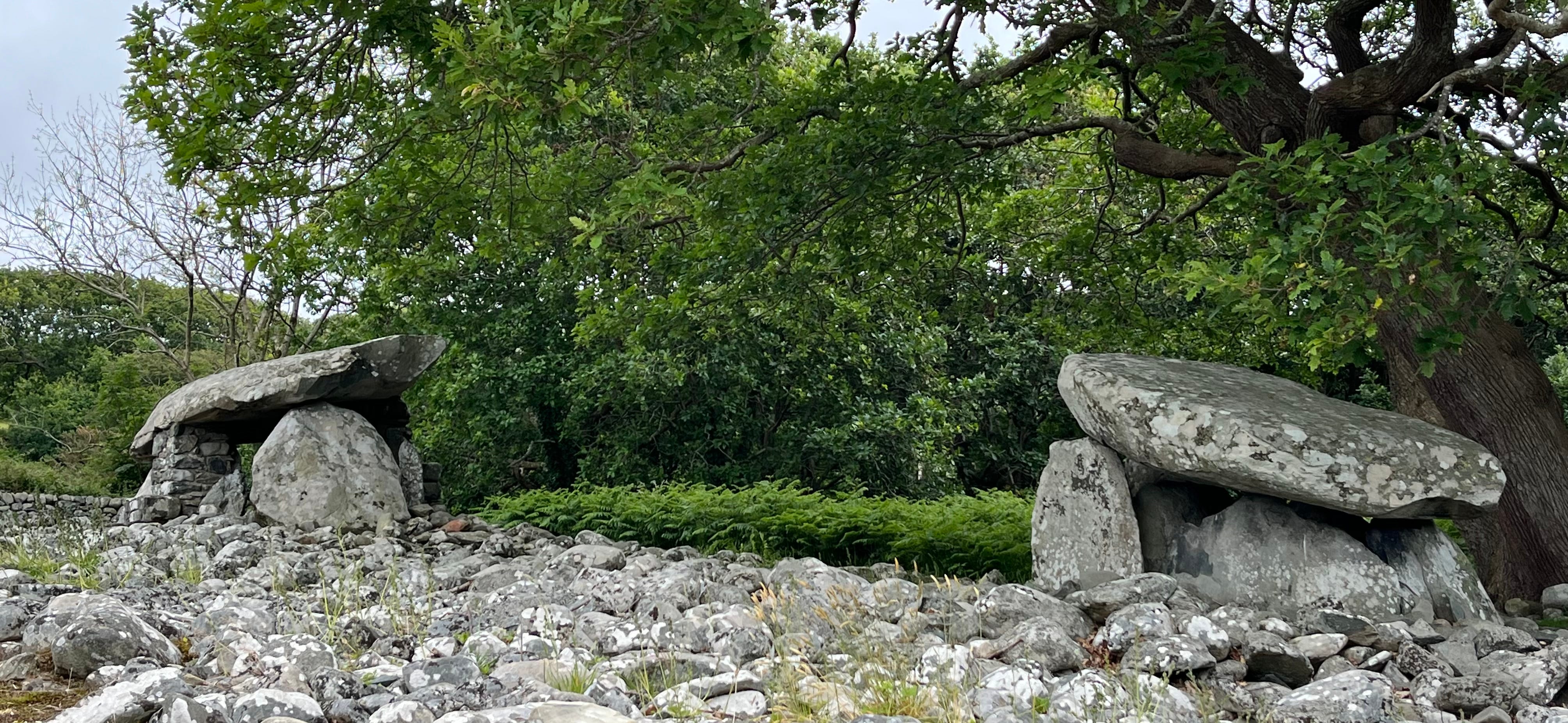
Dawn was a glow of orange. We set off on Josh’s motorbike, equipped with a sidecar for Hannah, our camping gear, our sacred books and a set of Ordnance Survey maps of Wales. Heading north to Ynys Môn (Anglesey), where the Druids of Britain long ago made their last stand against the Roman invaders, it seemed the right place to honour the beginning of our small family pilgrimage. The road was completely empty as we whizzed through the mountains like a surging stream. Through Beddgelert we rode, passing Mount Snowdon’s majestic peaks rising out of the morning mist. The chill stung my hands and face with cold, but the air smelt fresh and pure as I breathed through the scarf covering my face. We crossed the Menai Straits, turning left for our first stop: a Neolithic burial chamber called Bryn Celli Ddu (which means ‘The Mound in the Dark Grove’).
A green mound rose before us out of the greenest grass pastures. I saw it had two openings: a front entrance, which looked like a birthing canal to me, leading into an underground chamber; and a back entrance, like a slit in the mound. Outside stood a large standing stone, engraved with the remnants of ‘Celtic’-style rock art. It smelt musty inside this mound, protruding out of the earth. Sitting inside felt like being in the womb of Mother Earth herself, while at the back the slit looked to me like a vagina, a gateway out of the earth.
We travelled further up the coast to Barclodiad y Gawres (‘Apronful of the Giantess’), a burial mound by the sea. It had a chamber deep underground, with a larger space inside, big enough for me to walk around freely, like a dark square room. The heavy dark-grey stone was carved all over with images and figures, dripping with brown, earth-stained water in the subterranean dampness.
We spent a week travelling through Wales in rain, sun and even hail. Camping, living wild, cooking over open fires and sometimes very cold, we discovered and walked the ancient ley lines, going from one sacred site to another. We arrived in the Wye Valley in Monmouthshire to visit the ruins of Tintern Abbey and its nearby standing stones and holy well. At the conclusion of our journey, we travelled home along Offa’s Dyke, an ancient border between England and Wales.
Josh’s family came from Monmouthshire. I was astonished to find that his father had been a good friend of Alfred Watkins, who was not only the author of our favourite book but also the son of John Watkins, the founder of our favourite bookshop. John Watkins had carried on his father’s work. This was yet another synchronicity, which I felt sure revealed a deeper level of meaning and connectedness in our relationship.
Sometime later we left Wales. Josh got a gardening job in Yorkshire with a tied cottage for us to dwell in. Our plan was to live here for a while and eventually for Piers to go to Askham Bryan Horticultural College to study for a degree in Horticulture. Not long after our arrival in Yorkshire, during the very hot summer of 1976, I found out I was pregnant.
Special Way of Council - at Hawkwood college, Stroud - https://www.hawkwoodcollege.co.uk/our-programmes/programme/27002-the-way-of-council
No posts
Comments
Nothing yet. Say the first thing.
Sign in to join the conversation.