
Years before considering emigration, I’ve learned that an emigrant blogger preferred a therapist who spoke her second language. I was curious about the reasons.
Since then, I’ve encountered this belief multiple times. It was rationalized differently, but the reason usually sat between the wording and the emotional distance.
Some people complained that their first language doesn’t have clear, clean-cut terms for discussing psychology and feelings. Some words are borrowed from English, so why not switch to the original?
Fun fact: there’s no established term for “personal space” in Russian.
I can’t say “I need personal space today” — I’d have to build a long, descriptive sentence about my needs instead. The literal translation word by word, lichnoye prostranstvo, sounds more like “having a private room.”
One explanation is that collectivist cultures, unlike individualist ones, don’t care for privacy in the same way. Closeness is a sign of connection, not a burden.
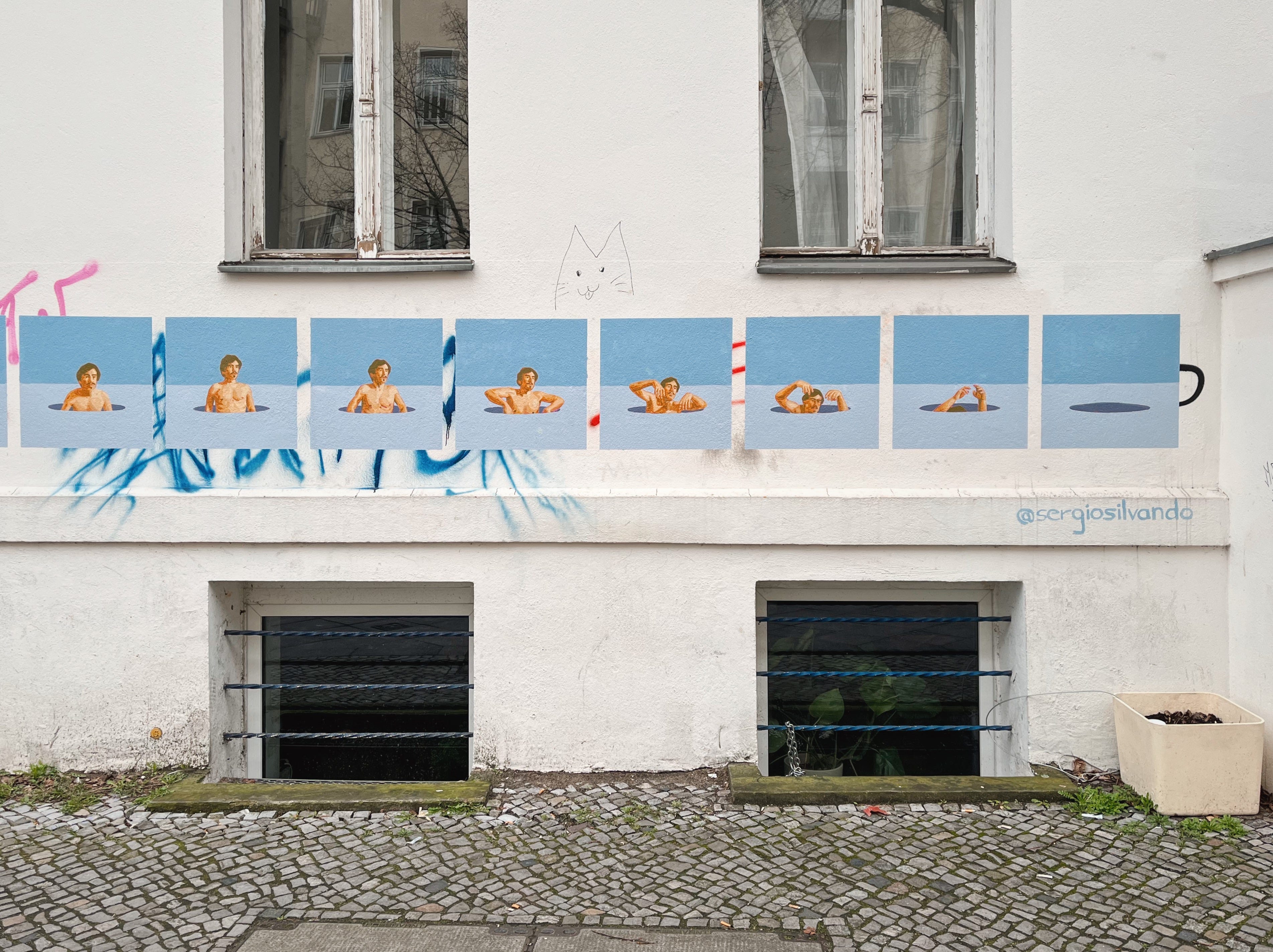
Some people stated that in the second language, they’re able to emotionally distance themselves from what they want to discuss. To be a laboratory assistant in a white coat with a tablet, watching rats go through the maze, finding words for what is happening below. In their first language, they find themselves in the maze, unable to discuss on a meta level.
This is why trauma therapy hits differently in different languages. How you’ve heard it exactly will always be harder to bear, and you can work around it by adjusting the distance.
Some people also claimed developing a new personality for each language environment.
It depends on features of language and culture: for example, I feel more extroverted in (Castellano) Spanish, because it requires you to gesticulate and move your face way more than when you speak Russian.
It also stems from the level of formality you’re well-versed in: by using German for work in a serious company, you’ll pick up different antics than while dealing with teenagers. We become what we do.
To a certain extent, this creation of the new personality is controlled. You might want to dim certain aspects of your primary-language character to adjust to another culture or develop new facets. It is, in a way, starting from scratch, painting on the canvas of the self as an adult, adding and subtracting.
It can be freeing to put energy into creating a self you’re proud of. And then, the mask sticks. This will be you in another language, the only side of you some people will get to know.
At my yoga group (see the story of me finding it), another participant congratulated me on using confident, though clunky, German. (We all know that the way through clunkiness is to do it boldly and regularly; that’s the spirit.)
I wouldn’t be able to relax my body while using my second language, English, — she said. She’d studied English for decades and was still overwhelmed using it.
Did she think that German was my second language? — I thought.
Looking for jobs at the beginning of 2022, I prioritized countries that used a language I knew (English), a language I loved and could recover from a passive state (Spanish), or a language I could improve by building on the basics from school (French).
It didn’t work out, so at 37, having received a job contract for Berlin, I started studying German. After three years and having finished the C1 textbook, I consider my German good enough to navigate life in Berlin, where I use 3 languages every day: English, German, and Russian. My poor brain.
Am I able to relax my body in German? Well, fuck yeah. I needed to learn to do that. I didn’t have the luxury of not.
It is a privilege not to need to be fluent in another language.
It is a privilege not to switch between several languages all the time.
I lost both by emigrating, and I think I gained something more precious: access to the cultures, people, and my own personality in different languages.
A friend invited me to dinner, together with other people, one of whom was another Russian emigrant. We discussed cultures and languages over food, as we always do.
I shared that my English personality is very polite. I learned quickly and painfully, having started working at an international company, that small talk needs to be smooth and energetic, and deep talk belongs elsewhere. I cannot show I am tired and sad because of the world events, because this brings people down. No one is interested in deep, dark topics (ever tried bringing up colonialism at business lunch? Watch me.)
Now I don’t share my full opinions with people who aren’t close friends. I smile, discuss the weather, throw an accidental decolonial remark, and otherwise mostly save my energy. I think it’s a shame and a lost chance to connect deeply, but it’s not a ball they would catch if I’d throw it. I’ve learned my lesson.

In addition to the tone change, I disclosed to that friend-of-a-friend that I am way more ironic (and even sarcastic) in Russian.
In my mother tongue, I can joke in a really mean way. I do my best not to, because it’s not how I want to be. But it’s how I’ve grown up, so when I’m relaxed, I can dive into dark humor, the type that makes people catch their breath. It’s easier to refrain in another language.
(and if you know me only in English, try multiplying whatever dark humor you’d gotten from me so far by a lot to imagine me go in my mother tongue)
A lot of irony in Russian hides between the lines — I will, anyway, never master any other language to that extent of native linguistic freedom. It is also a high-context culture, so I rely on shared context to convey that irony. For someone from a low-context culture, it would go over their head.
In Berlin and online, I use English to interact with people from different cultures and backgrounds. Many of my jokes do not land well in another culture. I learned to restrain for efficiency, too. So I am more bland in English as a result.
My friend’s other Russian immigrant friend squinted at me, fell silent, and nodded. “I can see that,” she said affirmatively, even though we spoke English all the time, politely and light-heartedly. She could see a part of me that others probably won’t.
And I felt seen. She knew the distance between our personas in our languages. What is required of us in a foreign language to be seen as safe, as clever, to convey closeness, and to signal values in different cultures and rooms. It’s hard to put into words, especially with all the intersectionality of different factors, but if you know, you know.
This ability to read cultural codes and distinguish between personalities across different languages is a side of cultural (mis)understanding that I am highly interested in.
Each side of me isn’t a full me. I contain multitudes, and this also applies to cultural and linguistic codes. Getting to know me in one language will always be limited knowledge.

Many fresh Russian emigrants in Berlin who arrived, as I did, in 2022, struggle with German.
They have plenty of other priorities, from work to children to documents and family chores. Most, including me, work in English. Many, including me, work in English for the first time in their life. We need to do a really good, solid, senior job in a second language to secure our lives abroad. Getting fluent in a third language after work conflicts with the animal instinct to rest, to be ready for another stressful day in a second language, and to prioritize needs over nice-to-haves.
Having a German-speaking partner would have helped, but many people are single or arrived with a partner who speaks the same mother tongue. Many, not including me, live in Berlin with a family they speak Russian with. It helped that I arrived alone. My brain was able to jump between English and German, putting Russian in the first years to the back burner.
My friends who emigrated in 2022 to non-Berlin Germany paid a different price, losing fluency in English. Their German is now way better than mine. You can’t have everything. Our brain keeps only what’s needed right now and gets rid of everything else. It’s practical in the short term, but it doesn't always leave us with the best results after four years.
At a doctor’s appointment, in the first year or two in Berlin, I had to speak English. Most doctors didn’t know Russian, and I couldn’t understand German. We had only one common language.
Bit by bit, as I’ve geared up, I was slowly but surely switching to German. First, at the receptions. Then, at the laboratory, when they draw blood and whatnot. And lastly, at the doctor’s office.
It was delicate: what if I don’t fully understand what my doctor said about my health? What if I misinterpret something? Using the language I am better at feels safer.
On a website that checks your age in another language, I found myself last year with the vocabulary of a ten-year-old in German. Would you trust a ten-year-old with your complicated medical history? My logic was solid.
However, there is a catch. By choosing English, I’m trying to control my side: which available language is the better medium for producing and receiving?
There is another side: the doctor. Even if they are comfortable using their second language at work... I end up meeting their second-language personality. But it is good enough if the doctor speaks English fluently, right?

Over time, I noticed that even if my German lags, choosing the doctor’s mother tongue is actually way more efficient and safer.
Just as I polish my English personality for efficiency, the German-speaking doctor creates a sterile personality in English.
(And we don’t even go into racism or moralistic pressure to learn the local language that impacts the lives of immigrants everywhere. I’m speaking now only of the difference between perceived personalities in different languages.)
By choosing German at the doctor's appointment, I get access to additional content:
non-verbal information: tone, gestures, hesitation, eyebrow movements;
more precise terms of the moral judgment: in German culture (as well as in Russian), there are many formulaic ways to say something politely, meaning something else (It’s tough to translate all the veiled meanings, and when in a hurry, like when they translate, people aim for shortcuts. Accessing the original is like reading a book in its original language.);
small words that add nuance to the meaning (German is full of modifiers: eben, bloß, halt);
less formal discussion in general, more warmth, small jokes here and there, because everyone is more relaxed in their first language;
them not worrying if I understand them or not, being more confident;
directness when it’s needed: less polite, straight to the point (‘culturally German’ in comparison with British English they were taught at school);
no English idioms that I don’t know what to make of — English that I studied is a lot more different from English that people studied elsewhere.
Even back in my home country, I was always anxious before a doctor’s visit.
I wrote down my questions, I double-checked, and asked again. It was never easy: doctors are something else.
But in Berlin, the way to efficiency for me was actually to build access to the more relaxed side of the specialist, so the discussion is less walled off and less stiff.

An excerpt from “Alfabet/Alphabet” by Sadiqa de Meijer:
Years later, I tell my friend Sebastian, “People who speak a language they learned after early childhood live in chronic abstraction.”
He says it makes no difference; he feels the same in English or Polish. But one day, when I’m over, his father calls. I hear Sebastian’s end of the conversation: younger, faster, and livelier than he sounds in English. It gives me the unsettling sense that I’m friends with a stoic disguise, or more precisely, my disguise is friends with his.
“The second language is an exoskeleton. I often don’t feel much in it. Polish is my tender skin,” writes Jowita Bydlowska, another linguistic exile.
You can argue, but I heard you, Sebastian. I heard the mazurka of your Polish voice.
*
In a sense, my poems take the form of spectral piano scores. Dutch is the left hand, the bass clef, but I’m the only one who hears it clearly. English is the melodic right hand, the one that others hear. When my left and right hands are in tune, I am speaking from something deep and elemental, from my grounding, from generations long before me. When the right hand departs and does its own thing, dissonant or incongruous, then I am impro-vising. I allow myself to drown the left hand out.
Then the phrases get conceptual, or playful, or the-atrical; on some lucky days, the feeling is that great, unanchored freedom of leaving the ground.
When I write a Dutch poem, that is also my left hand writing, but in a different sense; I feel scrawling and uncoordinated. What has happened would have been unimaginable to me at twelve years old; my Dutch is no longer sure of itself. I write in searching, disoriented trajectories, not in control of the medium. The resulting poems appear primal and strange to me, but the truth is that I don’t possess an astute, contemporary idea of how they read.
Handwritten and shadowy, taped to my wall, they speak to me as possible omens of English work.
At work, once I’d passed B2 or something, once I’d watched too many TikToks, some Germans stopped switching to English with me. They kept at what was familiar and easy.
Stumbling upon me in the office kitchen between the meetings didn’t require them to switch to their second language anymore, and I could see them being more relaxed.
The atmosphere, the environment around is crucial for me. I want to access the less controlled, less formal, warmer side of people. It’s not about my assimilation, it’s about emotional safety. And when the input comes dubbed in English, the meaning is a little lost.
The only thing is, foreigners would never know how funny I can be in Russian.
And perhaps it’s for the best.
Thank you for reading 🫶🏻
I am happy to hear your thoughts — in a comment or email.
No posts
Comments
Nothing yet. Say the first thing.
Sign in to join the conversation.