
The paradox of my emigration is that although I was issued a privileged ‘blue card’ visa (available to people in fancy industries like tech, with higher income expectations), it felt like running away.
In 2022, many people I knew became emigrants. Some left as soon as they could without caring so much which way to flee; others took time to prepare. My friends landed everywhere. I haven’t seen most of them since, but we keep our connections online.
Around a million1 Russian passport holders have emigrated for economic and political reasons since 2022. As happened 100 years ago, many landed in Berlin again. Including me.
Because of sanctions and structural changes in international relations, many to-dos became much harder for people who emigrated in 2022 than before. For example, Visa and Mastercard disconnected Russia from their infrastructure, so my Russian bank cards were downgraded from payment methods to pieces of plastic.
It was understandable (a political statement), but I had a job offer. I needed to find a place in Berlin, book it before I arrived, and pay for it. I didn’t have anyone who would host me, provide Anmeldung2, or help me open a bank account. I had to find ways myself (and find help if needed).
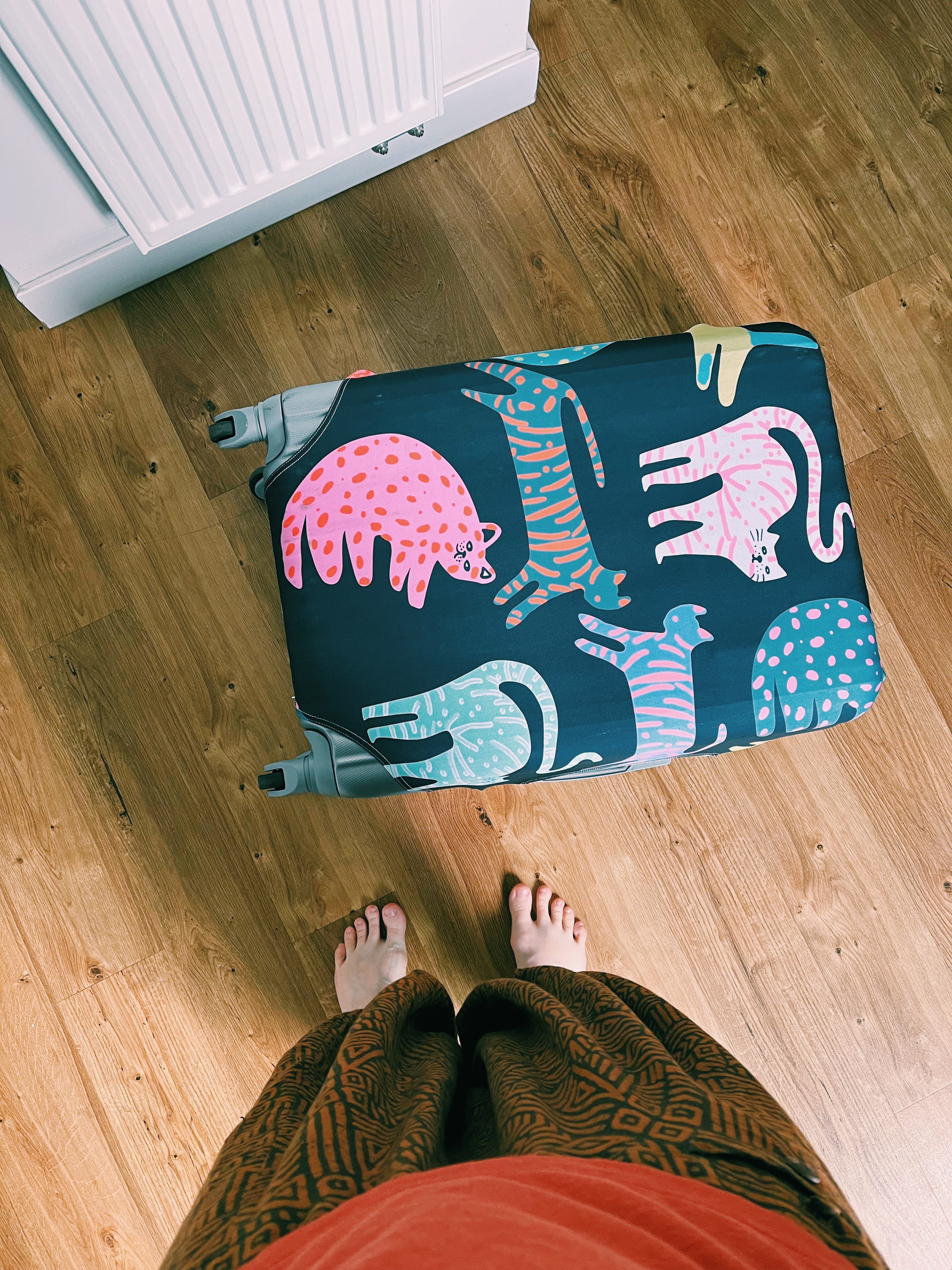
So my bank cards were useless, my Russian PayPal account was suspended, and the apartment hotel I found was cashless. I asked if I was allowed to arrive like a Russian gangster from the 90s movie with bags full of cash, but they weren’t interested.
If you grew up in Russia in the 90s, you know that when times are hard and the system is not playing along, the solution is to work your connections. One person paid for my flight using their Italian card, another footed the hotel bill from their German card. I also had variants B and C prepared.
Connections and reputation become the main currency when the system isn’t reliable. I don’t really like to work my connections, but sometimes you don’t have other options. Giving up, as anyone who grew up in Russia in the 90s knows, is not an option.
On the other side of the border, Russia limited how much cash you could leave with (to support the economy). Banks were told to cut ATM withdrawals of foreign-currency deposits, too (to prevent the banking system from crashing). There were huge queues at ATMs that quickly ran out of paper money. Even if I were allowed to check in with cash bags, they would be pretty empty.
My hope was to start earning in euros soon and ‘somehow figure it out.’ I think we could say it worked. Or, I worked it.
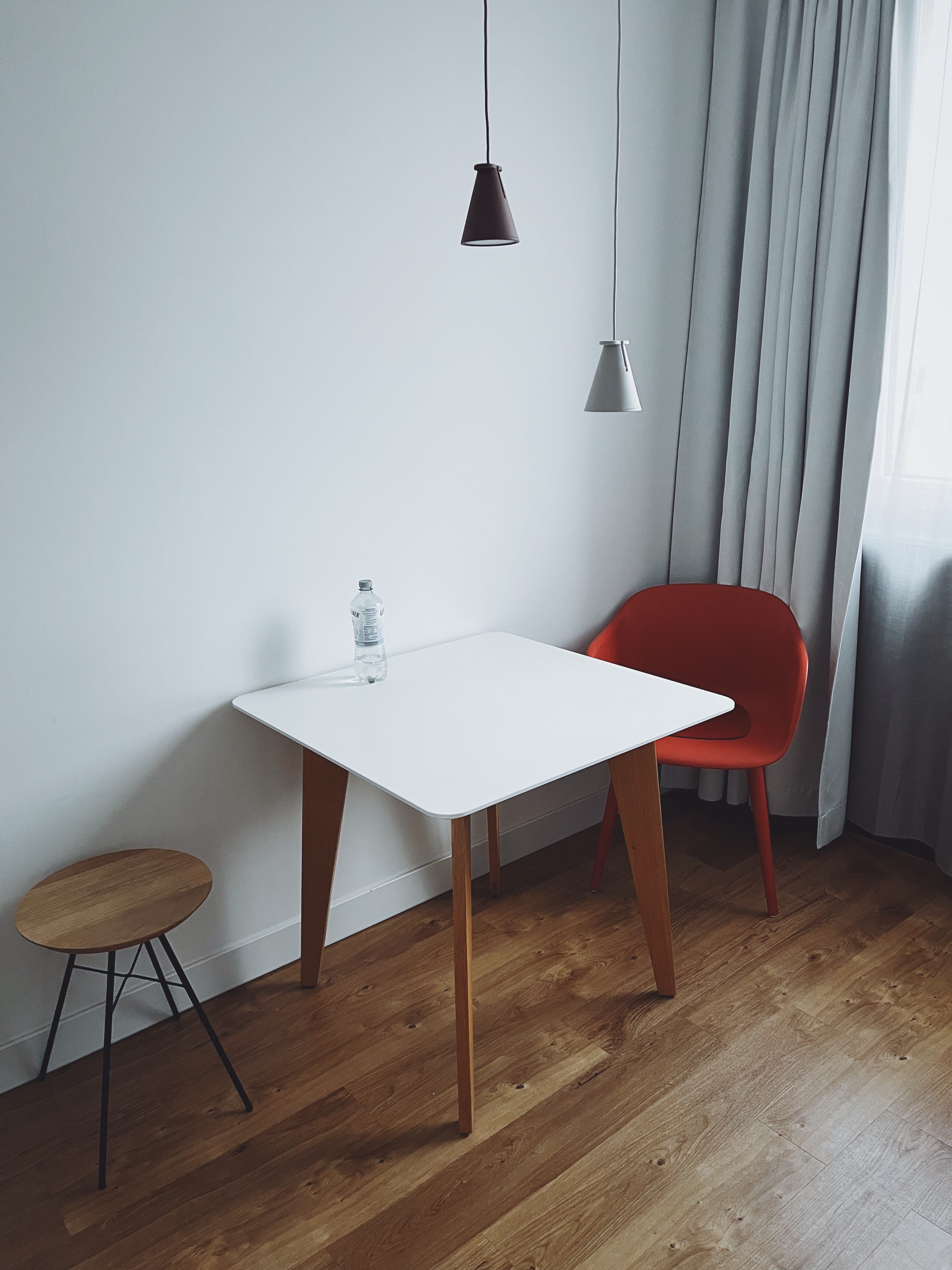
I stayed in the apartment hotel until the end of August. I wished to live there even longer, but I needed to leave: September is conference season, so they were overbooked. I eventually found something, again with the help of connections, but before that, I watched the grass fade to hay under the bright sun outside my window. I listened to the church bells in the morning. And to the S-Bahn announcements. Zurückbleiben, bitte!
It was +30 outside. If I had kept my only window open, I couldn’t sleep because the city was loud. If I had closed it, I would have been sweating so much that I couldn’t sleep.
There was a swimming pool in the building opposite. The water quietly splashed there. Splash, splash in the dark, bluish hall behind the word Eingang3. I ached to go there. In the summer, this Hallenbad4 was closed for technical work; I later learned it was to be expected. Then, I felt it as a personal attack. I could see it splashing, but I couldn’t get in.
They opened it again the next day after I left the hotel.
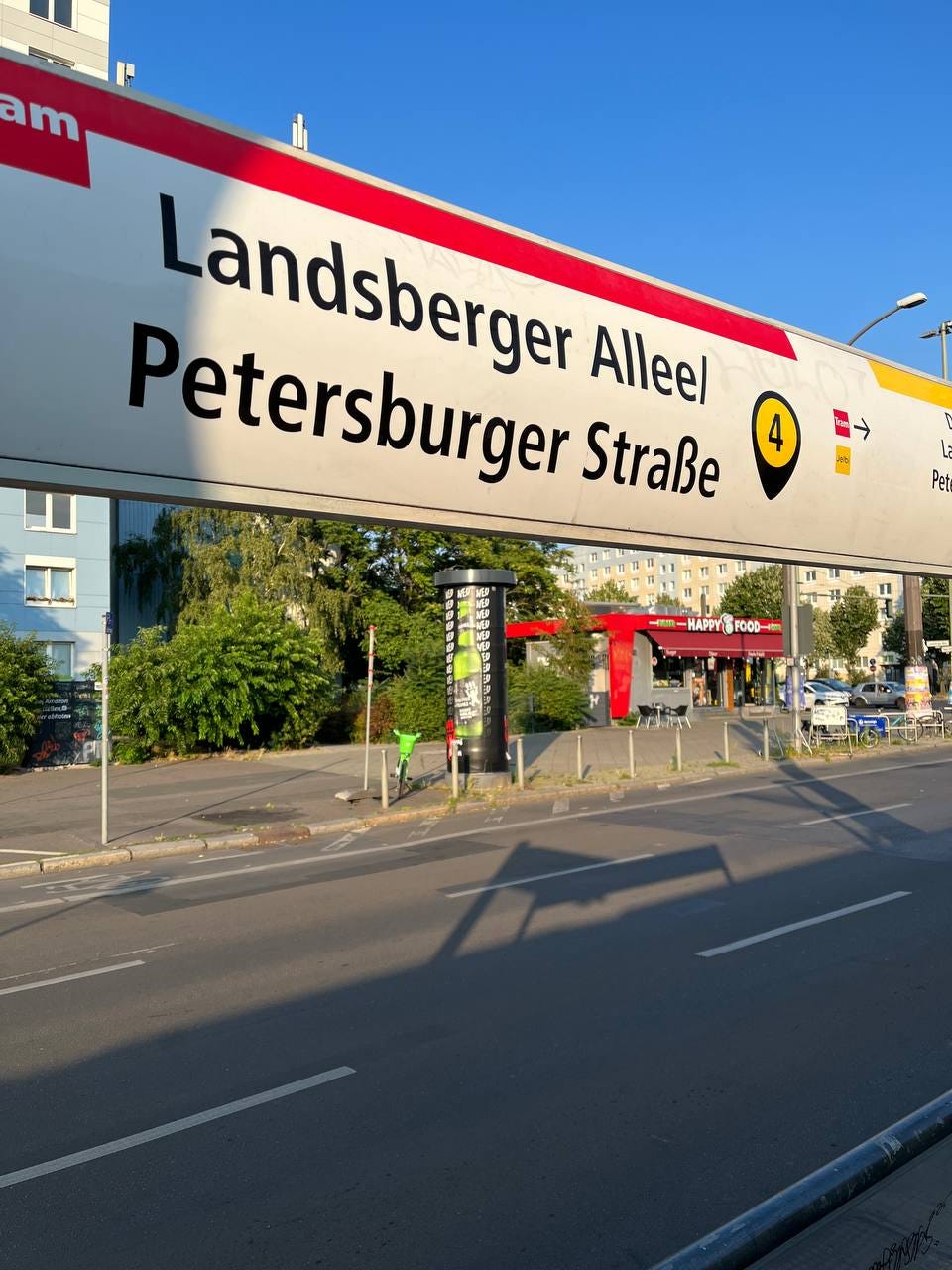
On the way to work in the first weeks, before I discovered better routes, I was regularly on the tram that crossed the street named after the city I left behind5. It felt like a reminder, a warm embrace. There used to be a railway connection between my previous city and my current city, and the name of the street is what’s left, and I was passing it.
It was tough to leave the city I’d loved the most in my life, but I had a good reason. What was there for me in Berlin, however, remained to be determined. Berlin was sitting in front of me like a bear, tilting his large head curiously, trying to figure me out. I was doing the same.
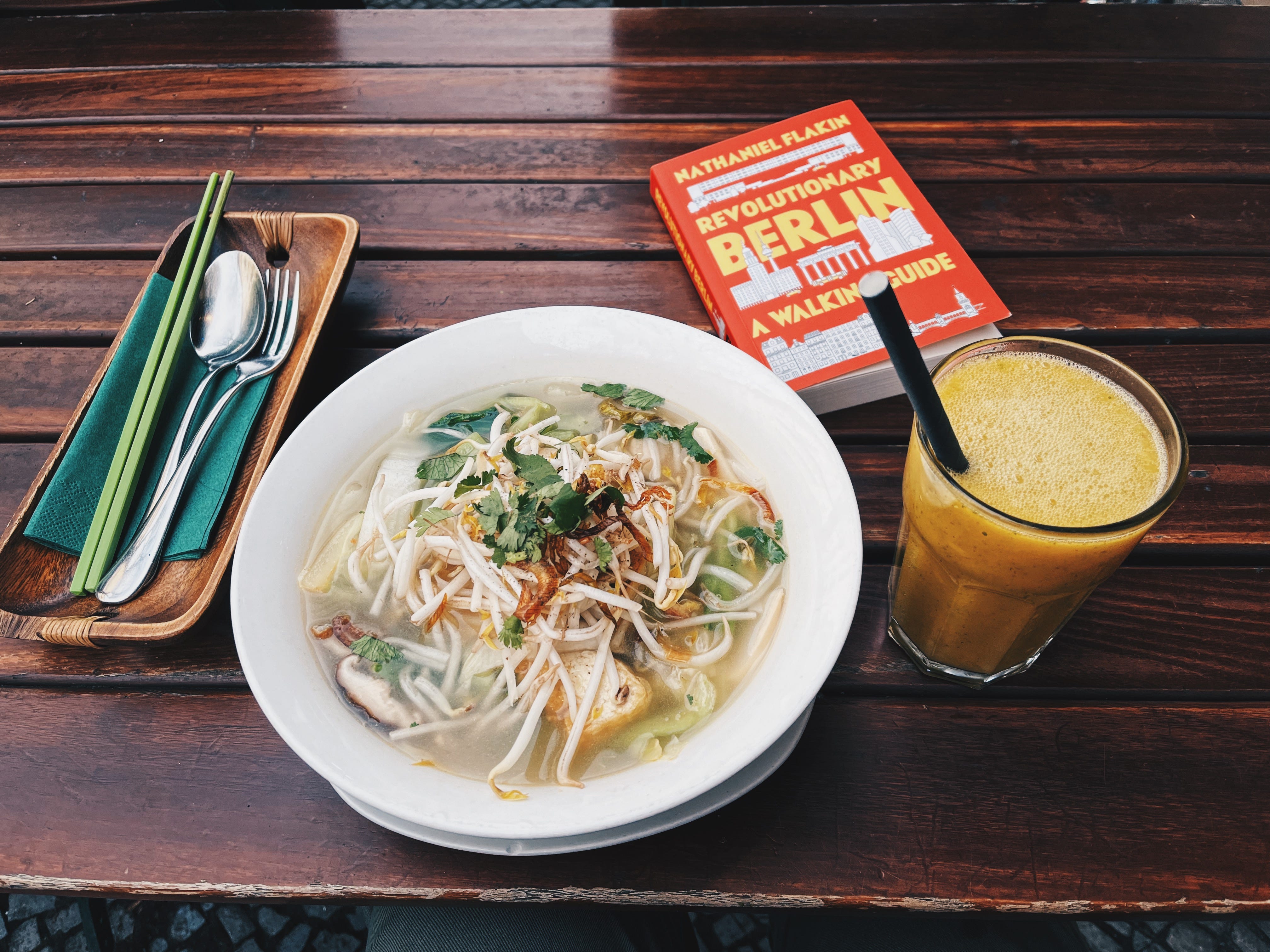
Exhausted after work, having to speak with people from thirty countries in a day, having to be professional in a language I’d never used for eight hours straight before, I always craved hearty food. Crunchy, fatty, and salty. I was always hungry, and snacks wouldn’t cut it. I needed at least a soup: piping hot, no matter if it was +30 outside.
What mattered was that food was filling and embracing me from the inside. I had no one to embrace me from the outside.
It wasn’t just hunger for food. It was the general overwhelm. It was loneliness. It was several foreign languages to decipher. It was giving my cats away before the move, being on my own now. It was the tiredness of painfully waiting for months, then frantically working instead of resting. It was the feeling of being lost in a new place. It was the expectations I had of myself. It was the urgency to figure everything out. It was the fear of doing something wrong and losing this opportunity.
I needed something to shift my nervous system from sympathetic (fight-or-flight) to parasympathetic (rest-and-digest).
Food was the easiest answer.
It felt like I could eat the entire bear that was Berlin, so big my hunger was inside of me. But after a good soup, I felt better and walked home to drop dead into my hotel bed.
On one of my first Sundays, I felt adventurous.
I finished work early and wanted to have something special to celebrate it. I managed to emigrate, and now I was bearing the fruits of my efforts. Or I should have been bearing them, if I had some time to rest first.
I found a sushi bar with a good rating on the map and walked there. It was on a wide square. The square itself and the surrounding district looked abandoned. I’d never seen Moscow or St. Petersburg getting so chill and peopleless, as some parts of Berlin appear to look on Sundays. Maybe only on the morning of January 1st, when everyone is still asleep after a big New Year celebration or is trying to finish yesterday's salads. Or maybe it looked like Minsk in Belarus: wide squares and few people enjoying them.
I looked at the sushi bar, asking myself if it was even open. It didn’t look lively at all. Between lunch and dinner, around 4pm, no one was sitting there. But I walked in bravely and looked at the menu.
As I was finishing, an older couple arrived and sat at another table. I wasn’t the only visitor anymore. I did feel detached, though. I was obviously swimming against the current. Everyone else was doing something else, somewhere else, and with someone. But the food worked. I felt full and hugged from the inside.
I paid with my new bank card, using my new salary in euros, and walked back to my hotel room.
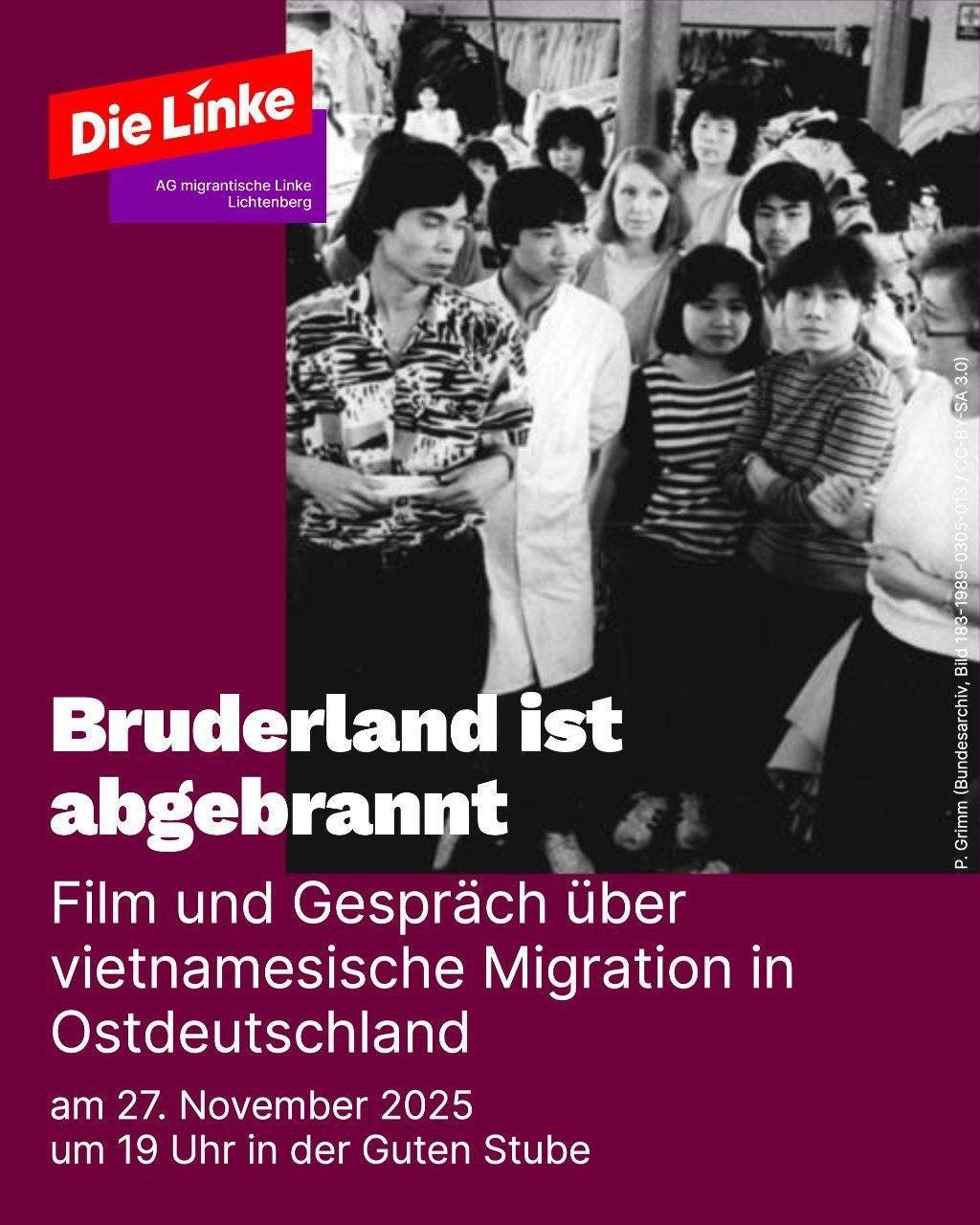
Three and a half years later, end of 2025, I learned about an interesting event. It was shared in the union activist chat that I was in.
Die Linke in Lichtenberg planned to show the movie ‘Bruderland ist abgebrannt’ (1992), which I’d already watched on YouTube. But the event was not just to watch a half-hour documentary, but to do so in the presence of the creator, Angelika Nguyen, and with a discussion in German afterward. I thought I could manage it at my level of German; at least I should try.
I already lived in Schöneberg by that time. I took the U-Bahn and then a tram. Walked next to the small pond called Fennpfuhl on my Google map. Didn’t recognize it.
But entering the wide square, I suddenly remembered.
The sushi bar was just next door to the event location I was looking for now. When I was walking the square in 2022, I didn’t even notice this political and communal center next door. I had tunnel vision, which saved me energy by letting me ignore everything I could afford to ignore. How the times changed. How I changed!
I took a moment to savor the comparison.
Then, in July 2022, I knew nothing about the local communities, activism, or history of migrants. I knew zero German, and my English was shaky. To feel better, I had to pay to be safe and regulated: a hotel room, a sushi bar. I didn’t know where to go; I had to research first. I didn’t have favorite spots. I wasn’t a part of the local chats or communities. I knew nothing about political parties.
Three and a half years later, I didn’t pay to be allowed to participate. I was already at the B1-B2 level of German and could understand most of the movie and conversations, even if I didn’t trust myself to join them. I understood who was organizing the event, I understood the importance of this part of history, I knew the story of Vertragsarbeiter6. I was happy to add Angelika’s memories to the mix.
I arrived alone again. I didn’t chat with anyone. But I wasn’t, and I didn’t feel lonely at all.
After the movie, I learned that the local Die Linke in Lichtenberg has the most international audience in Berlin. The volunteers started to translate all the materials and were still planning to cover a couple of additional languages. The goal was to translate everything at least into the 18 most popular languages in the area.
On the way home, I felt that this big, multinational, diverse, rich-in-history bear that is Berlin had become my home. There are so many people with their stories who moved here for one reason or another. They are all part of the city.
I became a part of that bear named Berlin, too. We stared into each other's eyes for so long that we became part of one another.
Thank you for reading 🫶🏻
I am happy to hear your thoughts — in a comment or email.
Really tough to count! Every official way to count would be incomplete. One person I know left for Turkey and then returned (if we count people who left for Turkey, she is not there anymore). One person I know left for Egypt and now is living in Armenia (if we count people who live in Egypt, she left as well). Many left for the neighboring countries without a visa or even a foreign passport. Some left to a neighboring country only to return soon to apply for a visa in a faraway country, and then left again — they would be counted twice. I estimate a million, based on what I know.
Registration of place of residence — usually done once you get an apartment, but I was able to already secure it at the apartment hotel. I needed it right away to get a SIM card, open a bank account, register a tax number, use insurance, and do everything else. Serious things in Germany arrive in your mailbox, sometimes without an announcement (a bank card, for example), and the address they use is your Anmeldung, because this proves it will be you who gets the thing in the end.
Indoor swimming pool (literally hall-pool). They are closed for the summer, roughly from May to September, and open-air Sommerbäder (literally sun-pool) are open.
Petersburger Straße received its current name on April 23, 1874.
The name was chosen in honor of the Russian capital at the time, as a continuous rail connection between Berlin and Saint Petersburg had been established a few years earlier with the Prussian Eastern Railway.
On July 31, 1947, the street was renamed Bersarinstraße. It was named after Nikolai Bersarin, the first Soviet city commander of Berlin, who had died in a motorcycle accident about two years earlier. At the same time, the former Baltenplatz was given its current name, Bersarinplatz.
The street was renamed back to its original name on December 1, 1991. Unlike the street, however, Bersarinplatz retained its name.
You might know about the practice of Gastarbeiter (guest workers) in West Germany.
By inviting workers from other countries in the 1950s-1970s (contracts with: Italy in 1955, Spain in 1960, Greece in 1960, Turkey in 1961, Morocco in 1963, South Korea in 1963, Portugal in 1964, Tunisia in 1965, and Yugoslavia in 1968), West Germany was able to achieve the ‘economic miracle’.
East Germany, at the same time, invited Vertragsarbeiter (contract workers) from ‘Brother countries’: the Eastern Bloc, Hungary, Poland, Algeria, Cuba, Mozambique, Vietnam, Angola, and China.
They weren’t paid much; a lot went to their country or was lost (people still protest in Mozambique weekly about their lost money; see Madgermanes). They were promised professional education and good jobs; they were put into menial jobs with close to no support or language courses, and weren’t allowed to ‘mix with locals’.
When the Berlin Wall fell, Vertragsarbeiter lost their status. Many went home (they were offered money to leave); some stayed. From what I learned, hard-working Vietnamese migrants who wanted to stay and had little knowledge of German (and no work permits) ended up opening businesses like restaurants and flower shops, working around the barriers in creative and hard-working ways.
No posts
Comments
Nothing yet. Say the first thing.
Sign in to join the conversation.