
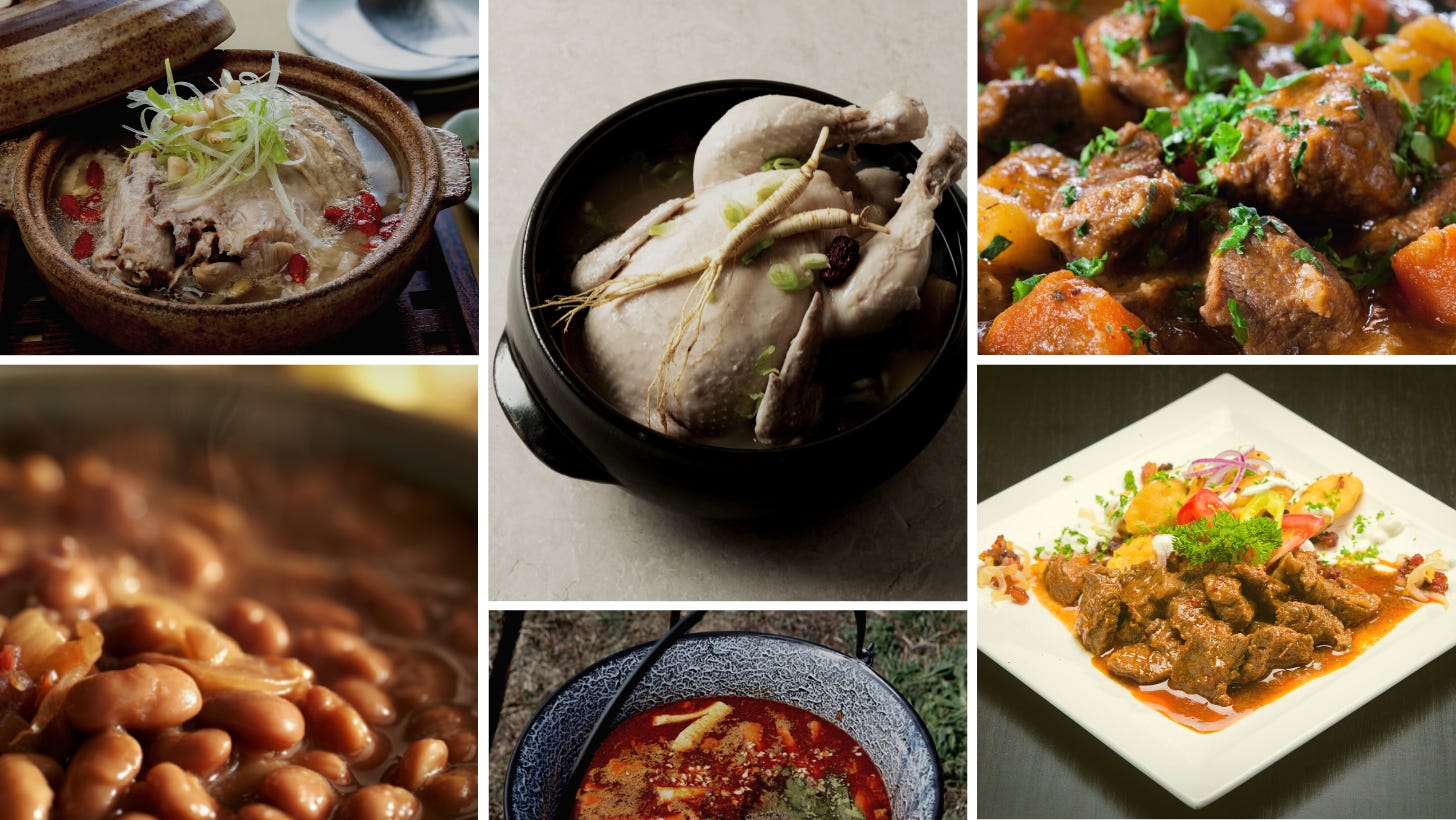
In a Korean home, dinner begins with broth. A pot of samgyetang, whole chicken stuffed with rice, ginseng, and jujubes, simmers low and slow until the meat falls from the bone and the broth turns milky and rich. In southern China, a clay pot of double-steamed soup has been going for hours, a technique rooted in Taoist philosophy dating to the sixth century BC, built on the belief that slow, moist heat preserves the vital essence of food. In West Africa, a pot of groundnut stew bubbles over low flame, its proteins and vegetables softening together in a shared liquid. In India, a pressure cooker hisses out dal. In Mexico, a pot of pozole, hominy and pork in rich, slow-cooked broth, feeds a family from a single vessel.
Now picture a typical American dinner: a chicken breast seared in a hot skillet. A steak charred on the grill. Roasted vegetables caramelized at 425°F until their edges blacken. A burger pressed against cast iron until the Maillard reaction delivers that signature crust.
These are not just different meals. They are fundamentally different relationships with heat. And, as an expanding body of scientific research now suggests, they produce fundamentally different effects inside the human body.
This is the premise of The Water Kitchen, a series about what I’m calling water cooking: the practice of using water or liquid as the primary medium for preparing food. Boiling, steaming, stewing, braising, poaching, simmering, blanching, pressure cooking. These methods share a common principle. Water caps cooking temperatures at or near 212°F, maintains high moisture throughout the process, and keeps food in constant contact with liquid rather than exposing it to the dry, intense heat of an open flame or a 400-degree oven.
Water cooking is not a trend. It is not a hack. It is the way most of humanity has prepared food for thousands of years, and the way most of the world still does. The real question is not “what is water cooking?” It’s “why did the West stop doing it?”
Here’s something that rarely makes it into dietary guidelines: how you cook your food may matter as much as what you cook.
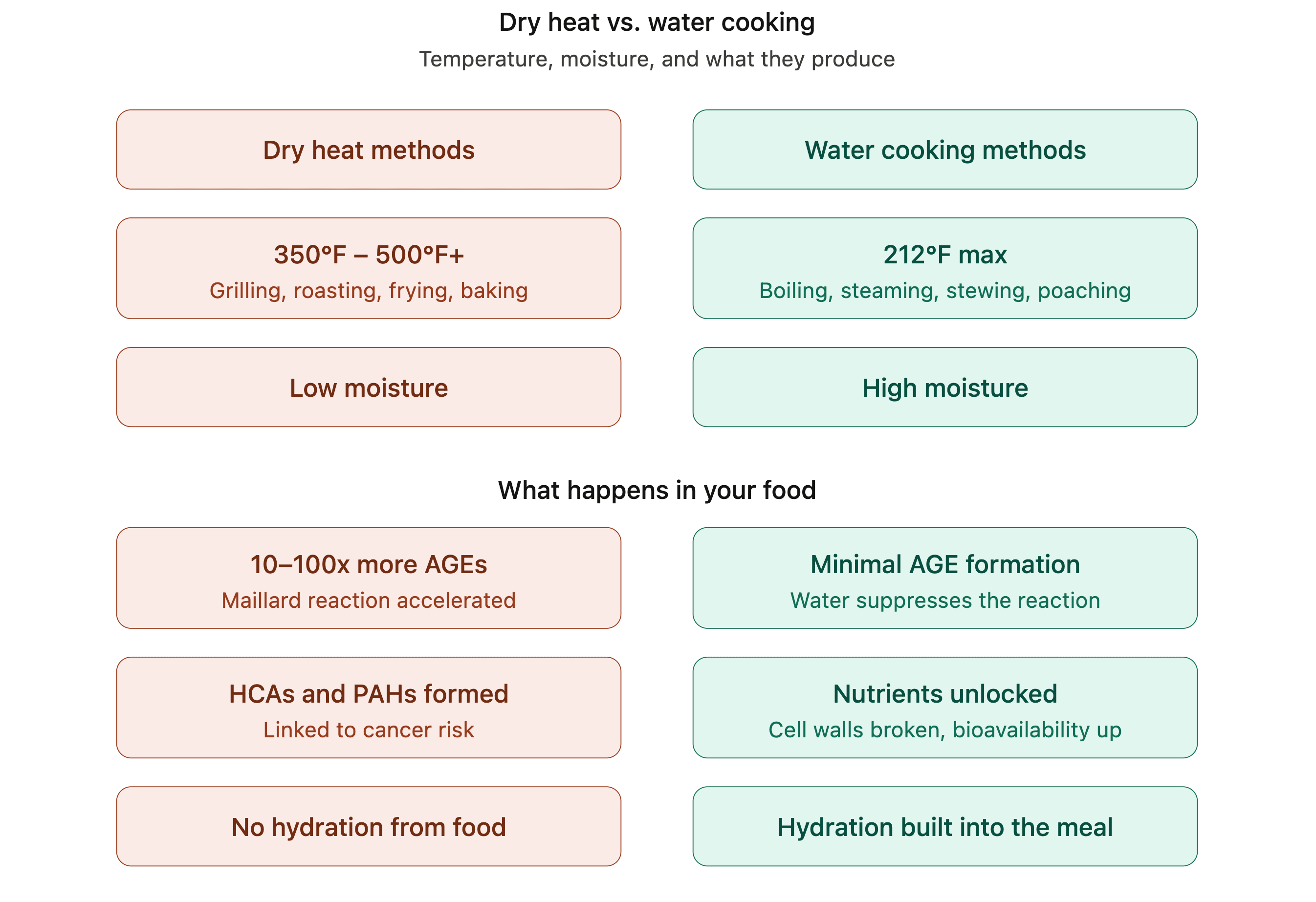
When food is exposed to high temperatures and low moisture, the conditions created by grilling, roasting, frying, broiling, and baking, a chemical reaction occurs between sugars and proteins called the Maillard reaction. This is the reaction responsible for the browned crust on a steak, the char on grilled vegetables, the golden surface of a roasted chicken. It is, by nearly universal agreement, delicious.
It also produces compounds called advanced glycation end products, or AGEs.
AGEs are not a fringe concern. They are the subject of a large and growing body of peer-reviewed research linking them to inflammation, oxidative stress, insulin resistance, cardiovascular disease, diabetes, kidney disease, and accelerated aging. They form naturally inside the body as part of normal metabolism, but when consumed in excess through diet, they overwhelm the body’s ability to clear them, and accumulate in tissues, stiffening blood vessels, degrading collagen, and triggering chronic inflammatory pathways.
The critical finding for our purposes: cooking method is one of the most powerful determinants of how many AGEs end up in your food, and therefore in your body.
A 2025 randomized crossover trial published in Cell Reports Medicine tested this directly. Researchers fed healthy subjects identical ingredients (the same meats, the same vegetables) prepared using two different approaches: low-AGE methods (boiling and steaming) versus high-AGE methods (grilling and baking). The results were striking. Participants eating boiled and steamed food showed measurably lower levels of AGEs in their blood, improved cholesterol profiles, and even modest weight loss, all from changing nothing about their ingredients, only their cooking method.
A comprehensive database published in the Journal of the American Dietetic Association, which catalogued the AGE content of over 500 common foods, found that dry-heat cooking methods generated ten to one hundred times more AGEs than the same food in its uncooked state. Broiled beef contained roughly three times the AGEs of beef boiled for twice as long. Roasted chicken breast showed about six times the AGE content of poached or steamed chicken.
The mechanism is straightforward: water limits temperature. Boiling and steaming top out around 212°F. Grilling operates at 450°F and above. Frying can exceed 350°F. Higher temperatures with lower moisture accelerate the Maillard reaction and, with it, AGE formation. The presence of water physically suppresses the chemical pathways that produce these compounds.
There is also an emerging acid angle. Marinating food in acidic liquids like lemon juice, vinegar, and tomato before cooking has been shown to reduce AGE formation by as much as fifty percent, suggesting that the wet, acidic environment common to so many traditional stew and braise cultures serves a protective function that goes beyond flavor.
Water does not just limit harmful compounds. It actively makes food more nutritious.
When heat and moisture work together on plant cells, they break down rigid cell walls that the human digestive system struggles to penetrate on its own. This is why cooked carrots deliver dramatically more beta-carotene than raw ones. The carotenoids are trapped inside crystalline structures within the cell wall, and without heat and water to soften and open those structures, much of the nutritional content passes through the body unabsorbed. Studies on carrots have found that boiling produced three to four times higher concentrations of bioavailable beta-carotene compared to raw. Steaming showed similar gains.
The same principle applies across a wide range of foods. Cooking spinach in liquid reduces its oxalate content, compounds that block calcium and iron absorption, making those minerals significantly more available to the body. Legumes, one of the most nutrient-dense food categories on Earth, are essentially inedible raw. They contain lectins and other anti-nutrients that must be neutralized through soaking and boiling before the body can safely access their protein, fiber, and minerals. This is not a limitation of legumes. It is a feature of water cooking: the method that makes them safe, digestible, and nutritionally complete.
Heat also denatures proteins, unfolding their tightly wound chains so that digestive enzymes can break them down more efficiently. This is true of all cooking methods, but water-based cooking does it at lower, gentler temperatures, without the added cost of producing AGEs and other harmful byproducts in the process.
There is a reason that bone broth, simmered for hours, extracts collagen which cooks down into gelatin and calcium from bones that would otherwise be nutritionally inaccessible. There is a reason that slow-cooked stews concentrate flavor and nutrition into a single bowl. Water is not a passive medium. It is an active participant in making food more nourishing.
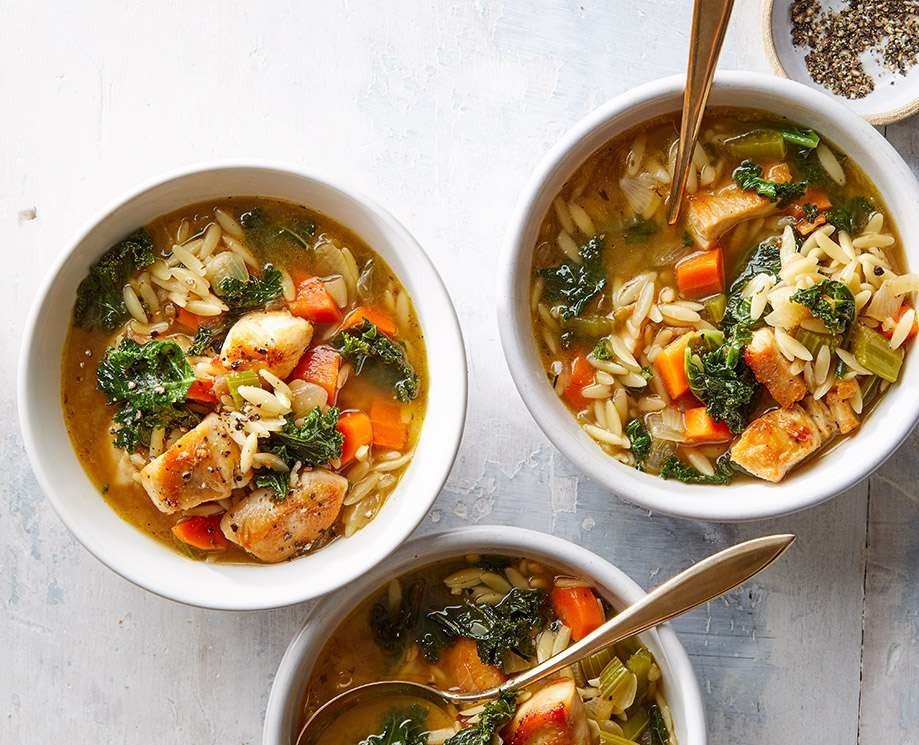
And here is the part that ties it all together: in water cooking traditions around the world, you consume the liquid. The soup is the point. The stew is the meal. The broth is not discarded. It is the vehicle that delivers both flavor and nutrition. A Vietnamese phở, a Japanese miso soup, a West African pepper soup, a Korean jjigae, in every case, the cooking liquid is eaten. Whatever the water pulls from the food goes directly into the bowl and directly into the body. Water does the extracting. Water does the delivering of bioavailable nutrients.
There is another benefit of water cooking that is so obvious it tends to be overlooked: hydration. When you eat food that has been cooked in water, you are consuming water. Soups, stews, broths, and steamed dishes deliver meaningful amounts of fluid with every meal, often without the eater thinking about it at all.
This matters more than most people realize. Chronic low-grade dehydration is remarkably common, and it affects digestion, circulation, joint health, cognitive function, and skin integrity. Drinking water throughout the day helps, but the body absorbs water more effectively when it arrives alongside food, electrolytes, and minerals. A bowl of soup or stew is not just a meal. It is a hydration delivery system, one that cultures around the world have relied on instinctively for thousands of years.
Consider the structure of a traditional Korean, Japanese, or Chinese meal: a broth-based soup is present at virtually every sitting. In West Africa, stews with liquid bases accompany every plate of starch. In Latin America, caldos and sopas are daily staples. These cultures did not design their meals around hydration science. But the result is the same: people who eat water-cooked food stay hydrated through their food in a way that people eating grilled chicken breasts and roasted vegetables simply do not.
The Western approach to hydration treats water as something separate from food, something you remember to drink between meals. Water cooking traditions treat hydration as built into the meal itself. It is a fundamentally different, and arguably more effective, approach to one of the body’s most basic needs.
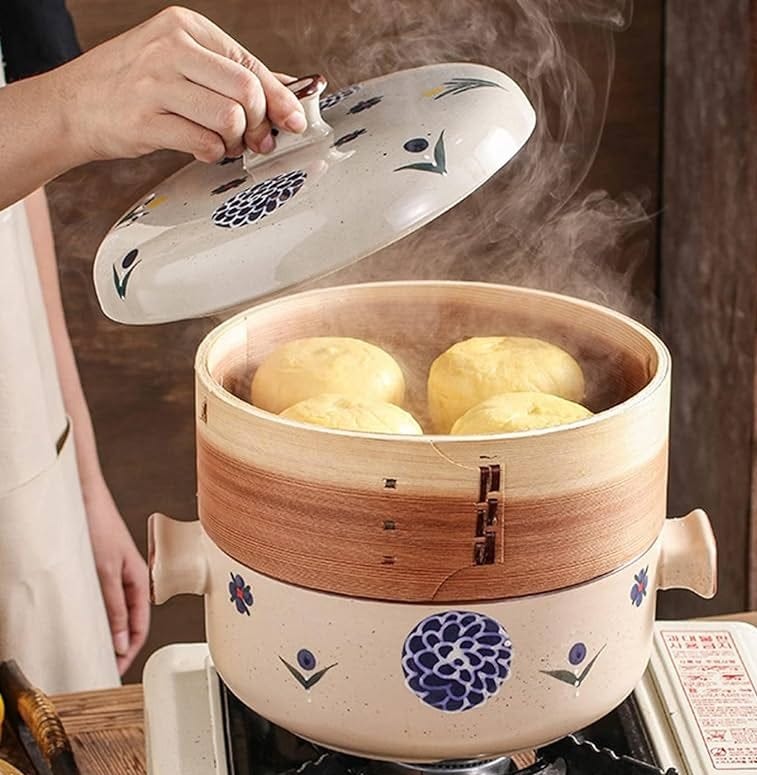
The framing matters here. Water cooking is not an alternative method. It is the original method, or at the very least, one that developed almost everywhere humans settled and learned to make vessels that could hold liquid over heat.
The invention of pottery, which emerged in China roughly 20,000 years ago, was a cooking revolution precisely because it allowed humans to boil and stew for the first time. Before pots, cooking meant roasting over open flame, a limited technique that couldn’t extract nutrients from tough grains and legumes or create the slow-cooked, nutrient-dense broths that would become dietary staples across civilizations. Pots made water cooking possible, and water cooking made new foods, and new nutritional possibilities, available to humanity.
From that point forward, water-based cooking became central to daily life across Asia, Africa, South Asia, Southeast Asia, the Middle East, Latin America, and much of Europe.
East Asia built entire culinary philosophies around liquid. Chinese cuisine is structured around soup. A broth is served with virtually every home-cooked meal. The Cantonese tradition of slow-simmered medicinal soups, double-steamed in ceramic jars, treats food preparation as a form of healthcare. Japanese cuisine centers on dashi, a water-extracted stock of kelp and dried fish, as the foundation of nearly everything. Korean cuisine may be the most soup-forward food culture on Earth: jjigae (stews), guk (soups), tang (broths) are not side dishes but the structural center of the meal, eaten over rice at every sitting.
South and Southeast Asia rely heavily on curries, dals, and coconut-milk-based stews, all liquid-medium cooking. Indian pressure cooking is essentially a high-efficiency water cooking technique. Indonesian cuisine features an enormous diversity of soup bases built from coconut milk, tamarind, and spice-infused broths.
Africa has deep traditions of stewing and boiling. West African cuisines are built around slow-simmered stews like groundnut soup, egusi, and palm oil-based preparations, cooked in clay pots over low heat. East African cooking centers on stewed meats and boiled starches. The practice of boiling meat with minimal seasoning and consuming it with the cooking broth is common across the continent.
Latin America features sopas, caldos, pozoles, and sancochos, all liquid-based preparations that have fed communities for centuries. And then there is the foundation of daily eating across the region: rice and beans. Both are water-cooked. Beans are simmered for hours in seasoned water or broth until tender. Rice is boiled or steamed. Together they form a complete protein, and together they represent one of the most widespread examples of water cooking as the backbone of a population’s diet.
Even Europe, before its modern culinary identity crystallized, was a stew-and-pottage culture for most of its history. The medieval European peasant diet revolved around slow-cooked pots of grain, legumes, and whatever meat was available, simmered in water over hearth fires.

So when did things shift?
The American relationship with fire-based cooking is a relatively recent phenomenon, and a culturally specific one. Barbecue has roots in Caribbean and Indigenous American smoke-cooking traditions, but the mass adoption of grilling as a household norm happened in the 1950s, driven by a convergence of postwar suburban expansion, rising meat consumption after wartime rationing, the invention of the Weber Kettle grill in 1952, and Henry Ford’s earlier commercialization of charcoal briquettes.
Grilling quickly became a centerpiece of postwar American leisure culture. Backyard cookouts turned into a weekend ritual, and the food industry and charcoal manufacturers reinforced the trend through aggressive marketing. By the late twentieth century, the American grill market had grown into a multi-billion-dollar industry, and the seared, charred, flame-kissed aesthetic had become synonymous with American cooking itself.
This wasn’t a health-driven evolution. It was a cultural and commercial one. And it pulled American cooking, and through American cultural influence much of the Western world, away from the liquid-based, slow-cooked, low-temperature traditions that most of humanity had relied on for millennia.
Today, the standard American cooking repertoire leans heavily toward dry heat: grilled meats, roasted vegetables, baked dishes, pan-seared proteins, fried everything. Soup and stew exist, but only seasonal or as occasional comfort foods, not as the daily structural foundation of eating, as they remain across much of Asia, Africa, and Latin America.
The Water Kitchen is not anti-flavor. It is not anti-grilling. It is an investigation into what we lost when we made dry heat the default, and what we might gain by bringing water back to the center of the plate.
In the posts ahead, we will examine:
The deep science of AGEs: what they do inside the body, how they accumulate, and why current dietary guidelines focus obsessively on ingredients while ignoring cooking method
Water cooking traditions by region: deep dives into the culinary philosophies of cultures that never abandoned the pot
The digestibility advantage: why water-cooked food is easier on the gut, and what this means for the growing epidemic of digestive disorders
Practical water cooking for the Western kitchen: techniques, recipes, and equipment for making the transition
AGEs and aging: how these compounds accelerate the aging process at a cellular level, and how water cooking may be one of the simplest ways to slow it down
The thesis is simple: for most of human history, in most of the world, the question was never whether to cook with water. The water was the starting point. Everything else followed from there.
Welcome to The Water Kitchen.
Subscribe to follow the series. Next: “The AGE Problem: What Happens When You Cook Without Water.
No posts
Comments
Nothing yet. Say the first thing.
Sign in to join the conversation.