
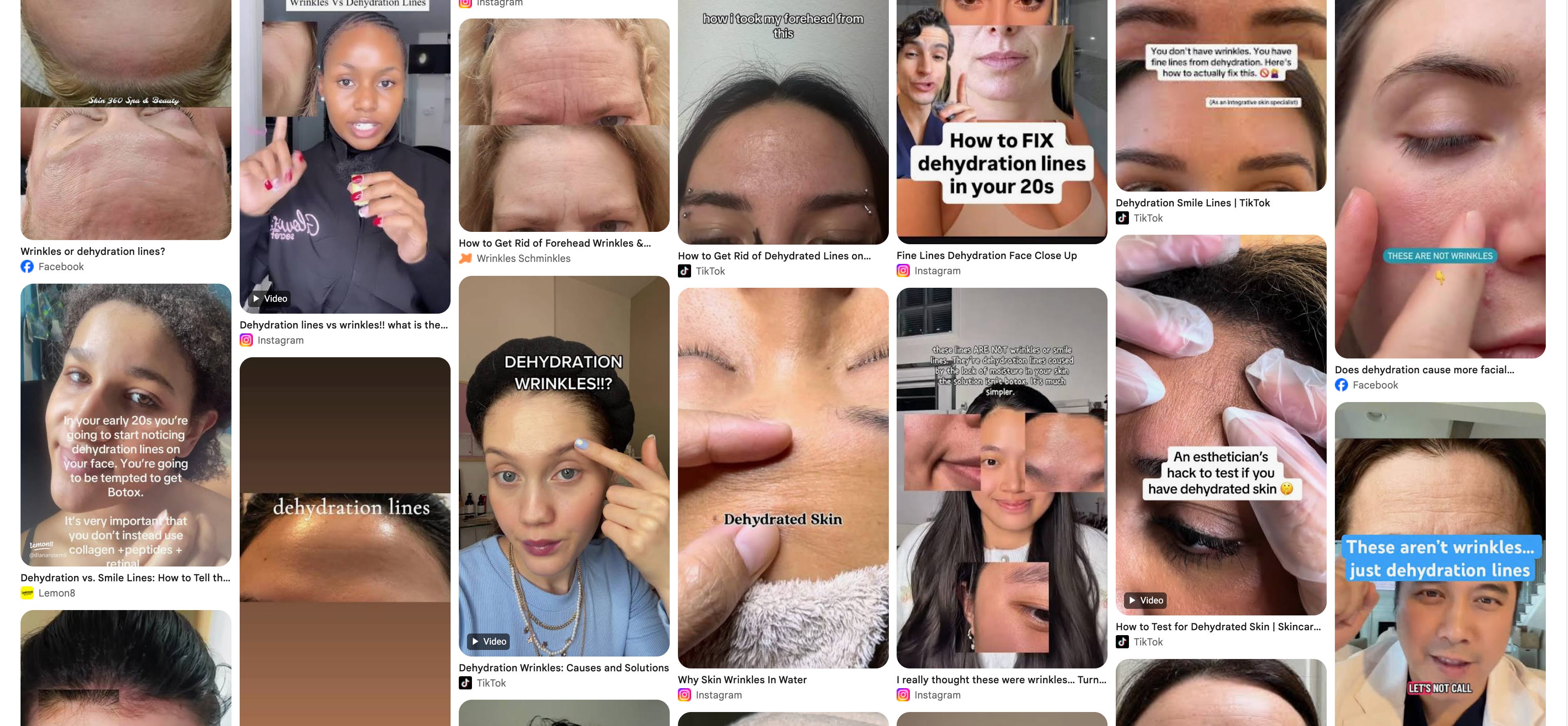
One of the most common questions I get is which products help with fine lines. Now, this question typically comes from a woman under 35, and I immediately suspect I know what’s going on because true structural wrinkles usually aren’t what we’re seeing at that age, or even before 40 or 45. Of course, genetics and other factors influence when true wrinkles begin to show up, and we aren’t meant to keep the perfectly smooth faces we had in high school forever. We’re adults, and aging is normal. But guess what isn’t? Fake wrinkles, otherwise known as dehydration wrinkles!
Fake wrinkles are fine lines that appear on the skin due to dehydration. Many younger people mistake them for actual wrinkles, but there’s a difference between structural wrinkles and surface dehydration.
Dehydrated skin is skin that’s lacking water, which can create a network of thin, shallow lines that resemble wrinkles. True wrinkles are caused by the gradual deterioration of collagen and elastin fibers deeper within the skin, and that happens naturally as we age.
Here’s what’s happening:
Loss of plumpness: A lack of water in the epidermis causes skin cells to shrink, creating tiny cracks and fine lines that look like premature wrinkles.
Shadowing: Without enough moisture, the skin loses its glow, making small creases and even real wrinkles look deeper.
Slower turnover: Dry skin cells stay on the surface longer, creating rough or flaky texture, common with mature skin, which gives the look of older skin.
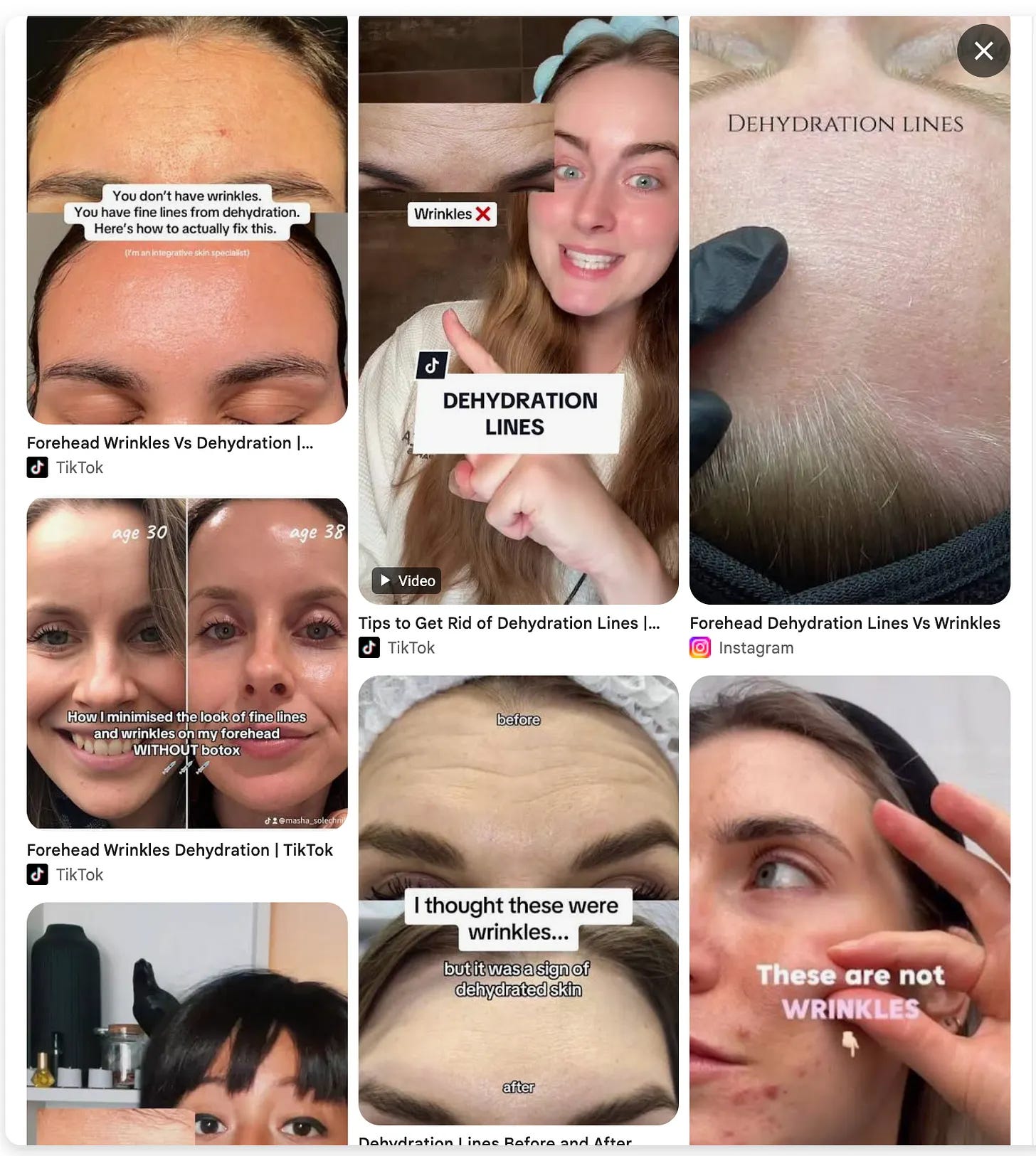
The crazy part is that many younger people see these dehydration lines and immediately reach for stronger products, like retinoids and other aggressive actives. Instead of fixing the underlying issue, these products often make the lines look worse. When dehydration is the problem, your skin doesn’t need more drying products. It needs the exact opposite: water, lipids, and barrier support.
Once that missing hydration is restored, there’s usually an almost instant “lifting” effect. The surface cells take in water and plump back up, smoothing those tiny lines and bringing that beautiful glow back to the skin. Hydrated skin reflects light evenly, while dehydrated skin looks dull, flat, and matte.
Deeper within the skin, when hydration is restored, naturally occurring molecules like hyaluronic acid bind to water like tiny sponges, helping create a cushion around collagen fibers that maintain the skin’s natural volume.
And this isn’t a temporary fix. Keeping the body and skin well hydrated is a top-tier beauty strategy.
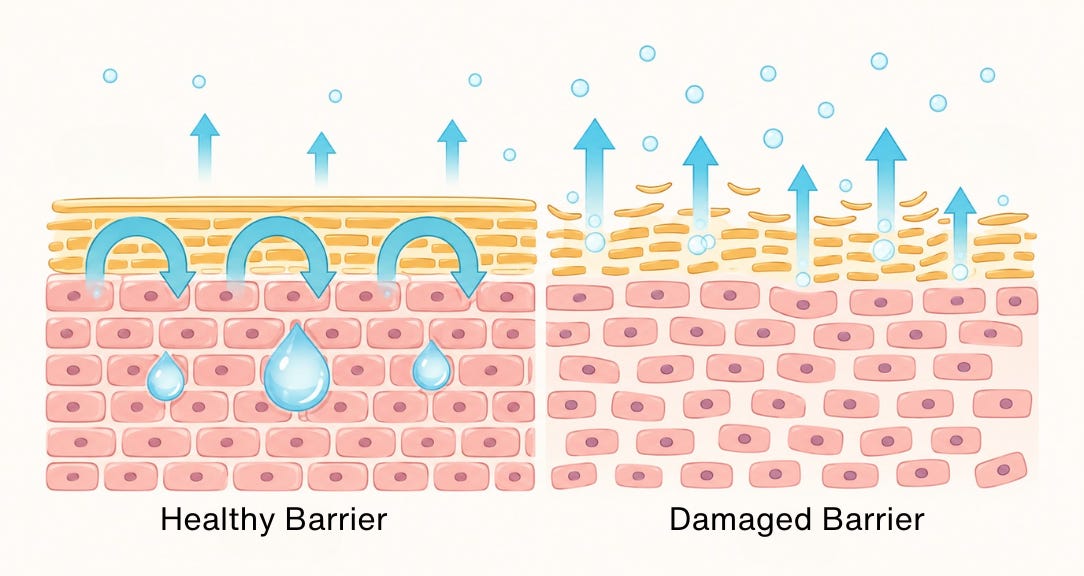
Your skin barrier works like a brick wall, with skin cells as the bricks and natural lipids, including ceramides, as the mortar. When that wall is strong, it keeps moisture in and irritants out. But when the barrier becomes damaged and that “mortar” starts to break down, water escapes more easily while irritants can get in. A damaged barrier leads to sensitivity and chronic low-level inflammation, sometimes called “inflammaging,” which can contribute to collagen damage over time.
As you can see in the image, a strong skin barrier traps water and keeps irritants out, while a weak barrier allows water to escape and irritants to pass through more easily.
The good news is that if dehydration is causing those fine lines, you probably don’t need a more aggressive anti-aging routine. You need to restore and/or nourish your skin barrier so it holds onto the missing water. And to do that properly, you have to approach hydration from both directions: externally through skincare and internally through diet and hydration.
First, let’s start with mineral water. These waters support hydration by supplying naturally occurring minerals and electrolytes that help your body maintain proper fluid balance. If you want a few good options that you can find online or at your local health food store, some of the mineral rich heavy hitters:
Evian
Icelandic
San Pellegrino
Iskild (strong)
Vichy Catalan (strong)
Gerolsteiner (strong)
Crazy Water
By strong I mean these waters have very high mineral content. Drink up to 8 oz a day, but don’t consume as your only drinking water.
Another way to hydrate through diet is by eating what I call “wet foods.” I wrote a whole series about this called The Water Kitchen, which you can go back and read here on my Substack.
The basic idea is that dry cooking methods, like baking, grilling, frying, and even sautéing, cook a lot of the water out of our food. That doesn’t mean we can never eat food cooked this way, but those meals aren’t supplying the same amount of hydration as foods cooked with water.
There’s another reason I talk so much about wet cooking: AGEs. AGEs stands for advanced glycation end products, and yes, the acronym is fitting.
AGEs can add to inflammation and oxidative stress in the body, and they can also cross-link proteins like collagen and elastin, making them stiffer and harder to repair. So dry cooking doesn’t only remove water from our food.
Wet cooking includes things like soups, stews, and crockpot meals. Because you’re eating the cooking liquid along with the food, you’re getting all of that water too. And since minerals move into the water during cooking, they stay right there in the meal as you consume it.
Eating plenty of fruit is another easy way to hydrate through your diet because fruit naturally contains water, along with minerals like potassium. Bone broth is another great option, although that really falls into the same wet-cooking category as soups and stews.
Cooking leafy greens into your stews (collards, arugula, swiss chard, etc) will extract their minerals in to the broth. You can consume or discard when the soup is finished.
You can also use electrolyte powders. I personally wouldn’t suggest taking these every day, but I do think they can be helpful on an as-needed basis, especially when you feel like plain water isn’t doing enough.
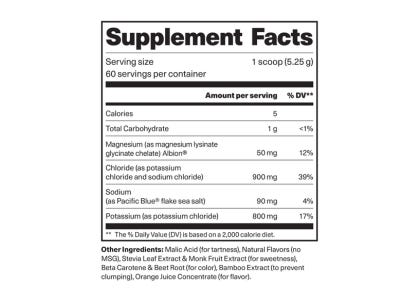
My favorite electrolyte powder is the Potassium Cocktail from Jigsaw Health. I’ll be honest, I’m not a stevia or monk fruit fan, but this formula works so well for me that I don’t even care.
I’ve tried so many electrolyte products, and this is probably the only one I can actually feel working in my body. Years ago, I used to get heart palpitations that would sometimes turn into episodes of tachycardia. My heart rate would climb to around 135 BPM, and I couldn’t seem to bring it down. Whenever I drank this particular electrolyte drink, my heart rate would regulate within about ten minutes.
At the time, I was raising three boys, and life could be intense. My little wild monkeys had mama on edge all the time. My youngest is 18 now, and they’ve all grown into wonderful young men. It does get better, mamas!
That experience is why I continue to keep the Potassium Cocktail around and use it occasionally - especially in these Arizona summers!
I do want to be clear that this is only my personal experience, not a claim that an electrolyte powder treats tachycardia. If you experience heart palpitations or a racing heart, please have it properly evaluated.
I also like that it contains both potassium and sodium, with more potassium than sodium because the ratios matter when it comes to proper hydration and this is ratio balance is well documented through scientific data.
Use code KOSSMA to save $10 when you purchase through their website.
Now we get to skincare, the part I’m most excited about as the founder of Kossma Beauty. We’re a natural, herbal, PUFA-aware skincare company, and hydration is at the core of everything we create.
The products you use matter, but so does the way you apply them. A good routine should add water to the skin, support its natural lipids, and help the barrier hold on to that moisture.
Begin by washing your face with a gentle cleanser. We want to remove makeup, sunscreen, dirt, and pollution without stripping away the natural lipids and sebum that help the skin barrier function.
Those lipids sit between the surface cells and create part of the seal that keeps water from escaping. When we repeatedly strip them away, the skin is left tight, dry, and more vulnerable to water loss.
I recommend our Chamomile Cleanser because it removes the day without stripping. It a true gel cleanser, formulated in a base of aloe vera with gentle plant based surfactants and hydrators like glycerin. One of our OG best selling products since 2019!
The next step is what I call the Damp Skin Method. This is the foundation of the Kossma skincare line because it gives the skin water and then helps seal it in for the gorgeous healthy hydrated look.
Kossma is a hydration and skin-barrier-forward company because a healthy, well-hydrated barrier is the foundation of beautiful skin. Before we reach for overhyped products with 10 actives and a million claims we need to make sure the skin has the water and lipid support it needs to function properly. That part doesn’t need to much, especially not trendy products!
Wash your face
Hydrate
Moisturize
Seal
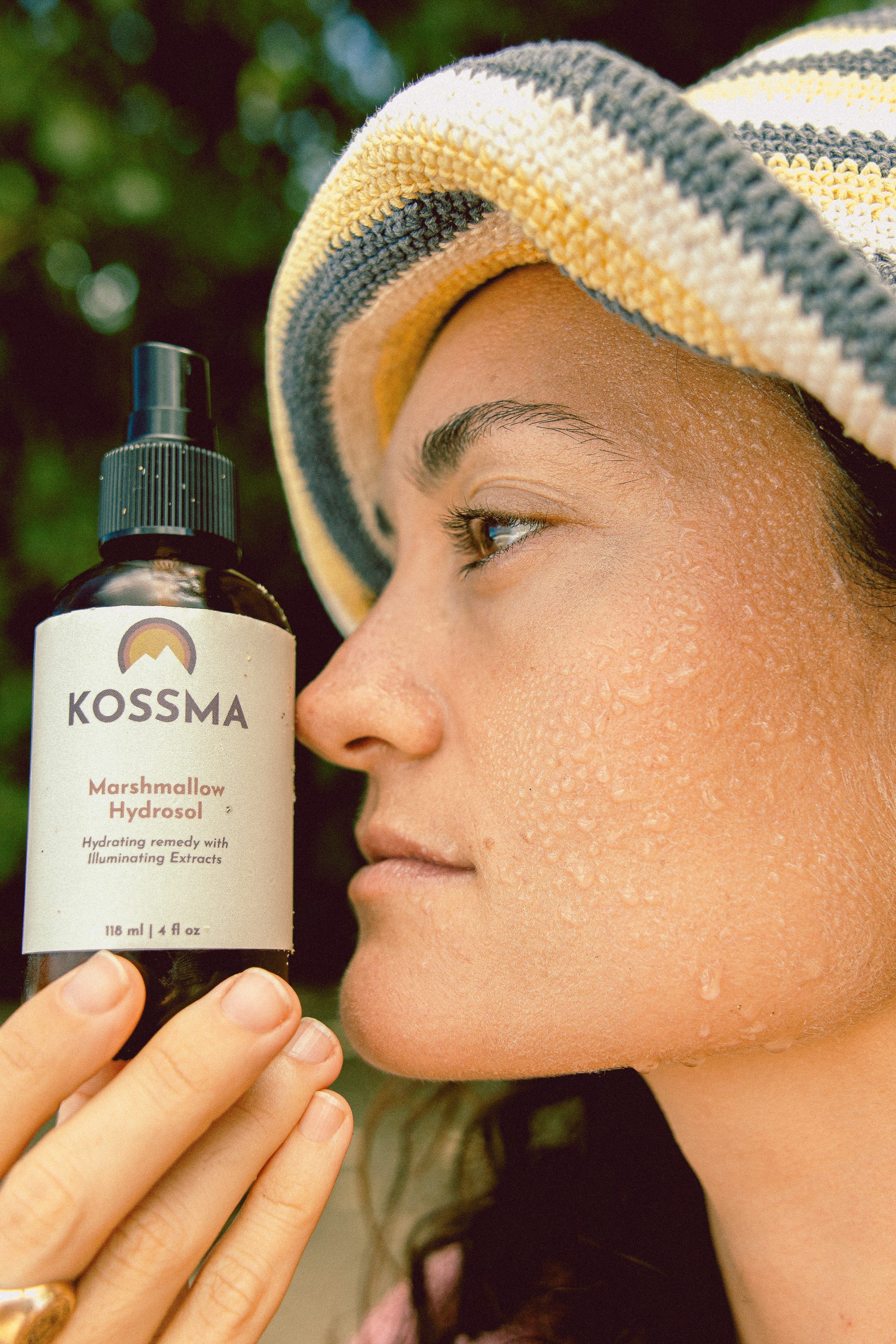
After cleansing, spritz our Marshmallow Hydrosol over your face until the skin is slightly damp. This hydrosol is special because it starts with organic frankincense resin hydrosol, distilled here in the United States just for us, and combines it with marshmallow root mucilage and glycerin. These ingredients are hydration superstars, but the water can still evaporate if we leave the skin bare. While your face is still damp from the hydrosol spritz, follow with a lipid-based moisturizer to slow water loss and help the skin hold on to that hydration.
I recommend a light nourishing oil like our Golden Yolk Oil or our Sacred Skin Oil if you have acne or are breakout prone.
Both Sacred Skin and Golden Yolk Oil are formulated with oils that complement one another, without using high-PUFA seed oils. This gives the formulas a more oxidatively stable base while still keeping them light on the skin.
Sacred Skin is especially lightweight and was created for acne-prone skin. An acne routine shouldn’t feel like it’s drying your face just to get rid of breakouts. Sacred Skin moisturizes and replenishes the skin while the herbal ingredients work to address acne at the same time. We have so many wonderful reviews from customers who love this product.
Golden Yolk Oil is a little richer, but it still feels light. It contains just a touch of ghee and lanolin, so you get that extra moisture without applying a heavy butter to your face. Lanolin has been used for centuries as an emollient, helping soften the skin and reduce moisture loss.
Golden Yolk also contains real saffron grown for us here in the United States, along with other nourishing ingredients chosen to support dry and depleted skin.
Choose the oil that fits your skin type, apply a few drops over the damp skin, and massage it in.
What you’re doing is almost like creating a fresh lotion directly on your skin. Traditional lotions and creams are made by combining water and oil with emulsifiers and preservatives to keep everything blended and stable. With the Damp Skin Method, the hydrosol supplies the water and the facial oil supplies the lipids. You combine them right on your face by massaging them together.
The oil helps slow the evaporation of the Marshmallow Hydrosol while replenishing the lipids your skin barrier needs. Instead of the water evaporating, it stays in the skin while the oil nourishes and protects the surface.
The result is skin that feels hydrated, replenished, and incredibly soft.
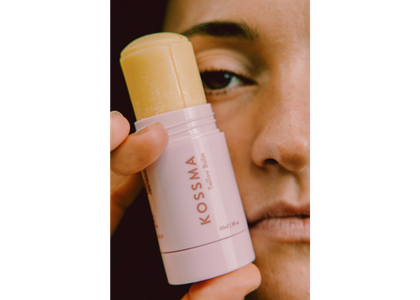
To take the Damp Skin Method one step further, finish with another one of my OG bestsellers, Tallow Beauty Balm.
Tallow Balm creates an semi-occlusive layer over the skin, deeply sealing everything in. It’s made with a touch of grass-fed suet tallow, nourishing butters, special beeswax cappings, and my trinity herbal blend. This final layer adds a richer level of moisture and is truly the chef’s kiss of the entire routine.
If your skin is prone to clogged pores or breakouts, this step may not be right for you. That said, many of our acne-prone customers use Tallow Balm successfully and absolutely love it. Apply a small amount at first and see how your skin responds or leave out entirely.
One thing I love to do with the Damp Skin Method is layer the Hydrosol and facial oil several times.
Start with a light spritz of Marshmallow Hydrosol, then massage a small amount of oil into your skin until it feels almost dry. Spritz again, add another small amount of oil, and massage it in. I’ll repeat this three or four times when my skin needs extra hydration.
The key is using tiny amounts with each layer. You don’t need to saturate your face. Just use a light mist, a few drops of oil, massage, and repeat.
After the final layer, allow your skin to dry before applying Tallow Balm. Because the balm contains beeswax and has an occlusive texture, it spreads best over dry skin. If your skin isn’t actively breaking out or easily clogged, swipe a small amount over your face and massage it in well.
I truly don’t believe you need every trendy active ingredient to have beautiful skin. You don’t need a routine overflowing with bakuchiol, hyaluronic acid, niacinamide, retinol, and whatever ingredient is popular this month.
Start with a clean, gentle, herbal routine that supports hydration and the skin barrier, then give it time to work. In my experience, this simple approach can do more for the skin than many of the complicated products lining the shelves at Sephora.
I’ve also created two ready-to-go carts with everything you need for the Damp Skin Method. One is designed for normal to dry skin, and the other is for acne-prone skin. Choose the one that fits your skin type, click the link, and your products will already be loaded into checkout and ready to go.
Normal to Dry Skin: Click here for the Damp Skin Method cart.
Acne-Prone Skin: Click here for the Damp Skin Method cart.
Of course, even if you don’t use Kossma products, you can still practice the Damp Skin Method with products you already own.
Cleanse gently, add water, and apply your oil or moisturizer while your skin is damp. It’s one of the best well-aging strategies you can add to almost any skincare routine.
If you enjoyed this article, make sure you subscribe and share it with a friend =)
Thanks for reading. I look forward to writing more for you.
Stephanie
No posts
Comments
Nothing yet. Say the first thing.
Sign in to join the conversation.