
Welcome to A Narrative of their Own, a weekly publication exploring the lives and literature of women.
This essay forms part of a series around the writing rituals of inspirational literary women. At the end of this essay, I will give three key takeaways we might all bring into our own creative lives.
*If you buy books through the links in this essay, A Narrative of Their Own may earn a small commission from Bookshop.org, whose fees support independent bookshops.
Who?
Muriel Spark (1918-2006) was a British novelist who wrote a total of twenty-two novels, produced a solid collection of poetry, and won many literary prizes. She was known as a writer of fiction, poetry, criticism and literary biography, and in 2018, Polygon re-published all twenty-two of her novels to commemorate the centenary of Sparks’ birth.
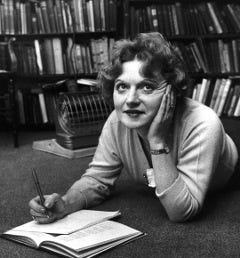
During her lifetime, Spark lived variously in Edinburgh, Southern Rhodesia (now Zimbabwe), London, New York and Tuscany. She challenged the convention of the novel when she disregarded linear time, writing in literary prolepsis, a form of foreshadowing, often in one sentence or paragraph. In this, she arguably paved the way for other unconventional writers of fiction, such as Man Booker prize winner Ali Smith, an avid fan of the late Muriel.
Spark was relatively late to the game, being thirty-nine years of age in the late 1950’s when she began working on the prose novels that would make her name. She had previously pursued poetry, including a stint working as editor for the Poetry Review, but after winning a short story competition in the Observer newspaper, she began working on her fictional prose. Developing an aesthetic of her own which challenged the neo-realist novels of the decade, as well as the current modernist style, she became known as a post-modernist writer.
Spark was one of several women novelists to begin a renaissance in women’s writing at this time, including Margaret Drabble and AS Byatt, responding to a demand for an authentically female literature. This was fuelled, in large part, by the feminist movement of the early twentieth century, as women began to seek novels focusing on issues relevant to them, central to their lives as women and artists.
By the end of the 1950’s and early 1960’s, when possibly her most abiding novel, The Prime of Miss Jean Brodie was published, second wave feminism had arrived and books by women writers such as Betty Friedan’s The Feminine Mystique (1963) had opened the door to other women artists’ responding to the literary world, focusing on issues relevant to women’s experiences of sexuality, gender and personal freedom. The 1960’s also importantly saw a rise in the emergence of feminist literary theorists.
What?
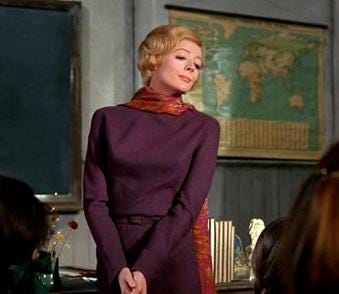
Many of Spark’s novels are well-known classics, perhaps the most famous being The Prime of Miss Jean Brodie, in which the title character is a school teacher situated somewhere in her thirties, single, but engaged in romantic liaisons of which she enjoys regaling her female pupils at the Marcia Blaine School for Girls in Edinburgh in the 1930’s. Brodie represented the left-behind spinsters created by the horrors of WWI and was played exquisitely on screen by the late Dame Maggie Smith.
Some of Spark’s other classics include A Far Cry From Kensington, Loitering With Intent, Memento Mori, The Girls of Slender Means and The Driver’s Seat.
Stylistically, it is impossible to pick up a Spark novel and mistake it for any other novelist. Yet, neither does she stick with one type of subject matter: her lens is wide-ranging, and her prose often exhibits an uncomfortable wit and dark humour. A deft ability to shift focus between assembled characters, between past, present and future, as well as inform the reader of her characters’ motivations, as she does within Miss Brodie, surprisingly causes no jarring.
Spark covered the hard subjects, though often with humour and an eye to irony. Religion was a particular favourite in many of her novels, (she converted to Catholicism in 1954), as was death, which features in both Memento Mori and Miss Brodie, amongst others.
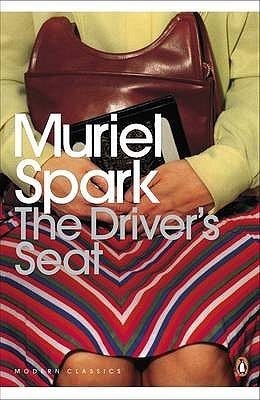
Though perhaps her most well-known book, Spark stated that Miss Brodie was not her favourite novel; in fact, she confessed to wishing people wouldn’t just remember her for that creation. Her personal favourite was The Driver’s Seat, a dark story featuring a woman pursuing a man across Rome in order that he can murder her. This novella, amongst others during the late 1960’s and 1970’s, including Not to Disturb, helped to make present-tense narration almost the default mode of contemporary fiction. Rarely used before this by novelists, these novellas baffled much of the reading public, as well as many reviewers.
The Drivers Seat features Lise, a spinster living somewhere in Northern Europe; the exact destination is never specified. She leaves her steady job as an accountant to take a holiday to Rome, where it is revealed early on that she will be murdered. Through the narration, we come to realise that Lise has a history of erratic behaviour, and it is she who will chase down an unsuspecting male whom she has identified as becoming her murderer. Spark herself referred to the story as a ‘whydunnit’, as it explores Lise’s mental thought processes as she prepares for her own murder.
Perhaps Spark’s affection for the novel lies within this confusion and bafflement. Within any Spark novel, or even her accomplished short stories, for which her biographer claimed her to have written the first example of magical realism in the UK, there is often the feeling that she is playing with the reader, making mischief, challenging what we think we know.
The unwitting victim of male violence has been well covered in fiction, both by male and female writers. But the idea of a woman orchestrating her own murder could have been anathema to readers, and Spark here has bravely tackled a unique idea to challenge us.
Whether this was progress in the development of feminist heroines is debatable. But Spark’s female characters are anything but quiet, sensible wallflowers: they burst from the pages of her books, demanding attention, standing up and standing out, demanding that we question the ideas we hold about women’s lives, very much like Dame Muriel did herself.
Where?
There is a well-known trope of the “literary wife;” an outdated notion of the wife who supports her artist husband’s labours and success, undertaking all the household tasks and drudgery in order for him to be free to create. Though this is clearly an historic, gendered stereotype, Muriel Spark came close to this ideal arrangement in her later writing life.
Spark lived for the last thirty years of her life in an old church conversion in the village of Oliveto, Tuscany. Having already achieved success and money, she lived with a secretary and companion, Penelope Jardine, moving into Jardine’s home. Jardine undertook household management and assisted Spark in typing her longhand manuscripts, as well as many other tasks.
Spark had always had men as lovers (not to mention an ill-fated husband), but rumours have remained that Penelope and Muriel were lovers. Both of them always denied this, stating simply that they both enjoyed their satisfying domestic arrangement.
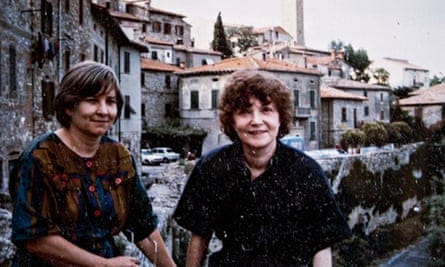
Jardine performed the supportive task of an effective “writer’s wife” for Spark, dealing not just with the minutia of running the household but speaking to agents on Spark’s behalf, overseeing translation contracts, and arranging their trips around Europe. Penelope Jardine, who herself was a visual artist and sculptor, became the sole inheritor and literary executor of Spark’s estate on her death, the author having disinherited her only son.
Jardine has spoken openly about Spark’s tendency to think about her stories for a long time, before suddenly writing out the whole book:
“It would all be in her head for about a year and then suddenly she would do what she called ‘strike’, and she’d be writing very fast.”
In the in between times, Jardine says, Spark would mooch around, and:
“often make her face up. She loved playing with disguise, putting on lipstick or combing her hair or doing it in a different way. It was vanity, yes it was, but it was also a game I think. I was always walking into her room when she was putting on her eyebrows and that would annoy her greatly. Her eyesight wasn’t terribly good – perhaps she thought the eyebrow wasn’t quite straight and then I’d walk in saying something.”
Living between several different countries during her writing life, it was from 1975 onwards that she spent the majority of her time at the home of Jardine in Tuscany. This was a house surrounded by books, cats, and olive groves, and Spark enjoyed the peace and quiet. Though her earlier literary success had seen her partying in New York and Rome, she appeared to relish in her quiet surroundings with just Jardine for company.
Which Tools?
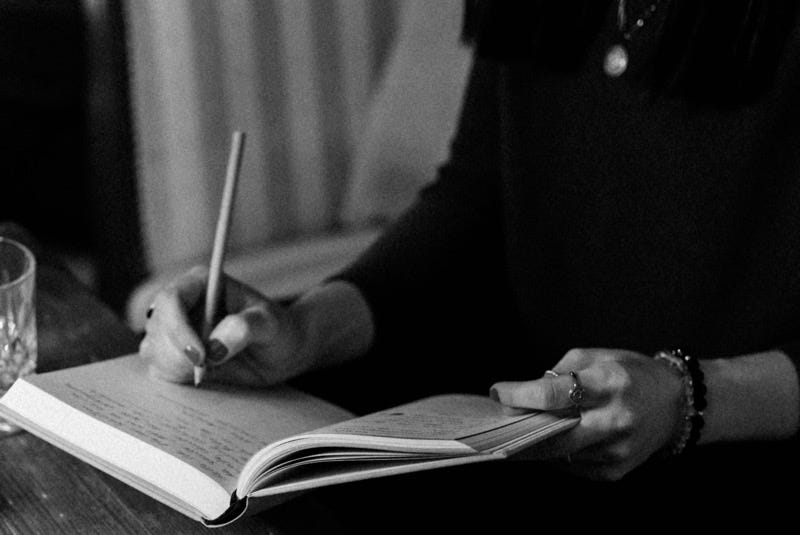
Spark liked to write the first drafts of all her novels by hand. She apparently only liked to write with pens that had never been used by anyone else, and had a fondness for specific spiral-bound, lined notebooks sold by Edinburgh stationer James Thin.
When residing abroad, Spark continued to request these specific notebooks from Edinburgh. The notebooks imposed practical constraints on her writing, such as knowing that the majority of her novels took up five James Thin notebooks. Remarkably, Spark once ordered forty-eight of these notebooks in one go, becoming so dependent on them for her writing that when they were discontinued in the early 1990s, Spark contacted the company to request them, whereupon Thin reportedly continued to produce custom-made notebooks for her.
When drafting a novel, Spark only used the right-hand side of her notebooks. The facing pages were left empty for potential revisions. Jardine proofread Spark’s drafts, revisions and final proof copies, though her editorial interventions were relatively minimal.
Spark once commented that she felt that writing was a lot like taking dictation from God.
Converting to Catholicism later in life, she often described her writing process as a form of divine dictation. She also spoke of writing as a “calling” rather than “just a job.” She felt that the profession shared something of the nun’s vocation about it, rather than it being merely a profession to pursue. She gives this idea to the protagonist of Loitering with Intent, who states:
“from there by the grace of God I go on my way rejoicing”.
In her novel A Far Cry From Kensington, set in a London publishing house, Spark gives us some unusual writing advice through the words of her protagonist, Mrs Hawkins:
“I passed him some very good advice, that if you want to concentrate deeply on some problem, and especially some piece of writing or paper-work, you should acquire a cat. Alone with the cat in the room where you work, I explained, the cat will invariably get up on your desk and settle placidly under the desk-lamp. The light from a lamp, I explained, gives a cat great satisfaction. The cat will settle down and be serene, with a serenity that passes all understanding. And the tranquility of the cat will gradually come to affect you, sitting there at your desk, so that all the excitable qualities that impede your concentration compose themselves and give your mind back the self-command it has lost. You need not watch the cat all the time. Its presence alone is enough. The effect of a cat on your concentration is remarkable, very mysterious.”
As a cat lover, I couldn’t agree more. 😂
Three Key Takeaways from the Writing Rituals of Muriel Spark
Choose your tools wisely
We may not all be quite so picky as Dame Muriel, but finding that perfect notebook, pen, or even electronic device that allows you to feel at one with your words is a joy. Once discovered: embrace it.
Find a method
When drafting a novel, Spark only used the right-hand side of her notebooks. The facing pages were left empty for potential revisions. This is something worth considering as a mode of keeping track of longhand notes and drafts.
Get a cat
Or any other furry friend that can keep you company on those long writing days.

A Narrative of their own is a weekly essay publication celebrating the lives and literature of women.
Comments
Nothing yet. Say the first thing.
Sign in to join the conversation.