
Welcome to A Narrative of their Own, a weekly publication exploring the lives and literature of women.
This essay forms part of a series around the writing rituals of inspirational literary women. At the end of this essay, I will give three key takeaways we might all bring into our own creative lives.
Kate Chopin was born in St Louis, Missouri in 1850 to a prominent St. Louis’ family, as Katherine O’Flaherty. She read widely as a girl. Marrying Oscar Chopin in 1870, a young cotton trader, she moved with him to live first in his native New Orleans, Louisiana, and then later to the family home in Cloutierville, La., near the Red River.
After Oscar died in 1882, leaving her a young widow, Chopin was forced to provide for their six children alone. Returning to St. Louis eight years later, Chopin began to write to support her children due to dwindling financial resources. She initially began drawing on the Creole society she had observed during her marriage in the South.
In the early 1890s, Chopin began publishing her short stories and sketches in periodicals, with her first novel, At Fault, appearing in 1890. This novel was fairly critically unrecognised; it was for her finely crafted short stories, numbering over one hundred, that she achieved more acclaim, and many continue to be widely anthologised.
The trouble for Chopin, and yet, ultimately her legacy, came with the publication of her second novel in 1899, The Awakening.
Written at the fin de siècle, the French term relating to a piece of work written at the end of the century, most typically the nineteenth-century, Chopin tackled the issue of the changing face of social and family life. More specifically, The Awakening explored the development of the ‘New Woman,’ who challenged traditional gender roles within the family.
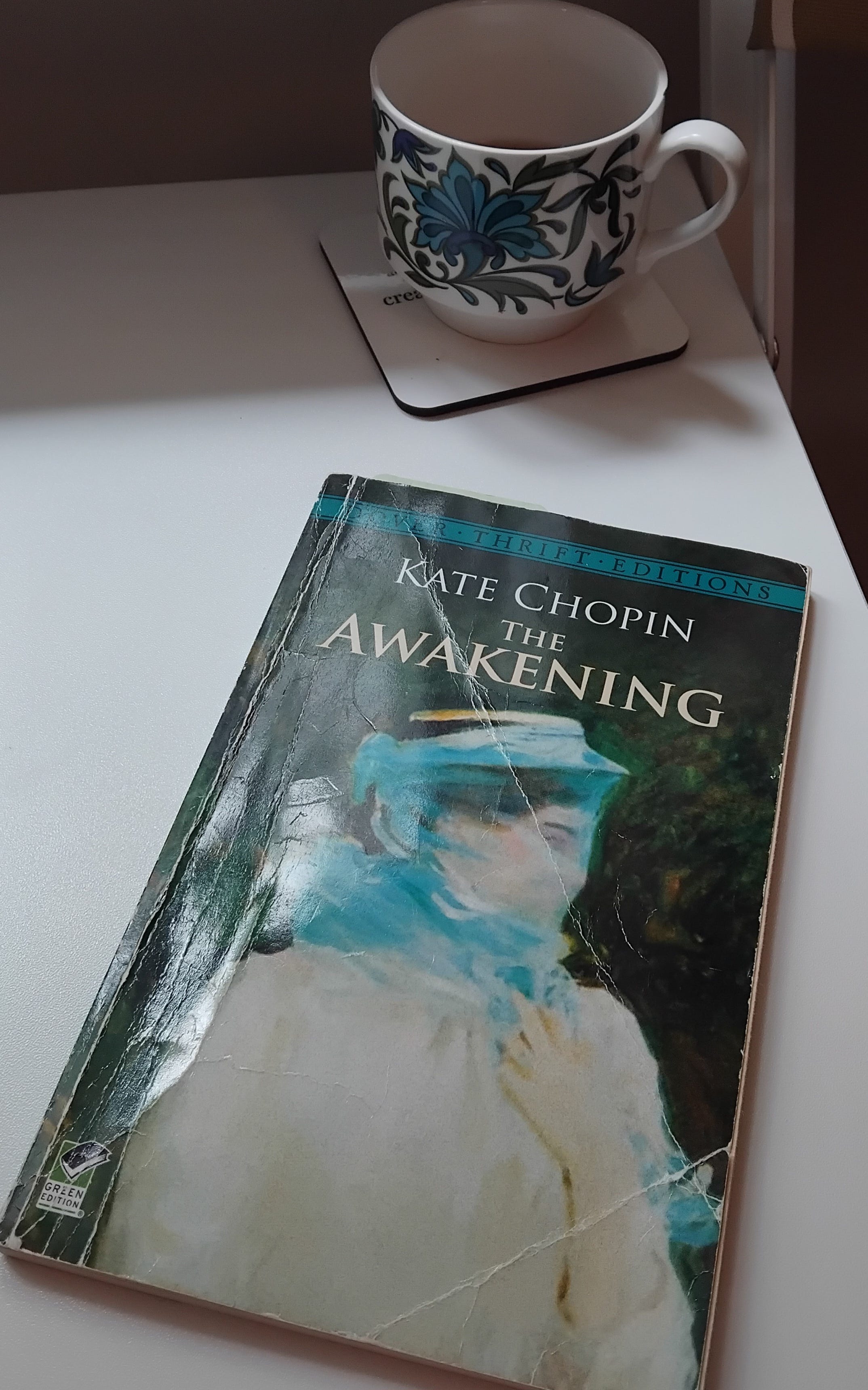
Chopin would suffer greatly for her choice to portray such a character as her protagonist in The Awakening, Edna Pontellier. The book was effectively unavailable for seventy years following its first publication, following the moral outcry on its release, with some critics claiming that Edna’s behaviour was ‘sickening and selfish’, for her transgression of moral codes.
When we consider that the general belief was that Southern white women were immune to sexual desire, it is easy to see how Chopin challenged this in her creation of Edna’s sexual awakening. Edna was a Southern white, married woman, and what was more shocking to her critics: a mother. What really struck critics was Chopin’s exploration of childbirth and motherhood within the novel, with what some saw as her refusal to offer any authorial disapproval or moral guidance as would be expected in other novels of the time.
Interestingly, cultural studies of American history have shown that more women stayed single in the late 1890’s than at any other period, possibly as they were beginning to realise that this way they could retain their own identity more easily. It seems that Chopin reflected this in her heroine who, though married with two children at the beginning of the novel, leaves the marital home and sets up another home as a single woman, in order to pursue an artistic life. Perhaps not surprisingly, this led to the book’s reclamation by the Women’s Movement during the nineteen-seventies, another period of huge change for women’s freedom.
Chopin’s novella-length book broke the lengthier works of earlier novelists, and led from a position of emphasis on characterisation and the inner life of its central protagonist. In this way, Chopin moved away from traditional Realist fiction and anticipated the Modernist movement, preceding such writers as Virginia Woolf by around 25 years. It could also be seen as a key protofeminist work.
The key to The Awakening being read as a modernist text is the fact that contains no superfluous characters, no major plot, is simply a reflection of the inner life of its central character, Edna Pontellier, and its use of symbolism, which means that the reader can infer multiple meanings from the novel.
Sadly, The Awakening was removed from sale soon after its publication, and both Chopin and the book were seen as a disgrace. She was roundly condemned for the book’s sexual frankness, as well as its portrayal of an interracial marriage. Many critics also struggled with what they saw as the unforgivable attitude of Edna Pontellier’s attitude to motherhood. The book subsequently went out of print before its reclamation by feminist critics in the latter part of the twentieth century, who recognised its modern sensibility and beautiful, symbolic style. It has rightly become a classic of feminist literature.
This came too late for Chopin, however, who had unfortunately always been sensitive to her critics. The response to The Awakening caused her to gradually lose confidence in her writing, and she ceased publishing any further work following the response to The Awakening.
It has often occurred to me that Edna was perhaps a cipher for her creator, in a way. As a female artist and mother, Chopin was tied to her own children and stifled by the convention of the time. Following her early widowhood, she was forced to publish her writing in an effort to earn money to help support her young family. And yet, her writing appears to have flourished amongst the chaos of family life despite all this, perhaps because it became a necessity to do so.
But in her character of Edna Pontellier, Chopin gets a chance to try on a different life; one that may be possible in the approaching century; that of a woman being able to discover a free life as a female artist. It seems that Chopin may have channelled some of her frustrations and longing into her most famous character Edna Pontellier, though her protagonist’s ultimate downfall (though ambiguous) perhaps anticipated that this was to be a long road.
Chopin never had a ‘room of her own,’ stating that she wrote amongst her six children, which she referred to as “swarming about her.” She utilised the living room of her busy home, amongst the detritus and chaos of family life.
Seated in a Morris chair beside a window, where she could see a few trees and a patch of sky, Chopin liked to write on a lapboard with a block of paper, similar to Virginia Woolf in the twentieth-century. She used a stub pen and a bottle of ink, which she purchased from the local grocery store.
Like many writers, Chopin favoured writing in the mornings, which she intriguingly referred to as being:
“when not too strongly drawn to struggle with the intricacies of a pattern,”
and sometimes again in the afternoons and evenings:
“if the temptation to try a new furniture polish on an old table leg is not too powerful to be denied; sometimes at night, though as I grow older I am more and more inclined to believe that night was made for sleep.”
Though Chopin claimed her writing sometimes encroached into the whole day, she actually generally spent only one or two mornings a week on the physical act of writing. Interestingly, contrary to the usual advice of ‘write every day,’ Chopin claimed to only write when the inspiration struck her.
“There are stories that seem to write themselves, and others which positively refuse to be written—which no amount of coaxing can bring to anything.”
When inspiration did strike, however, she wrote quickly, often getting a story down and off to the publisher in a couple of hours. Chopin claimed to make little in the way of revisions to her work, believing these to be counterproductive to the output. She stated she was “completely at the mercy of unconscious selection,” when it came to her writing.
Chopin cited some of her early influences as a young woman to be keeping a journal. Her journals contained early character sketches as well as literary critiques, as well as poetry, a habit a teacher had encouraged her with. Though Chopin claimed to have little discipline in her actual writing habits as compared to other writers, her journal practice appears to have helped shape her practise and ability of writing.
It seems clear that for Chopin, writing became a necessity to put food on the table for her young family. However, her early influence of writing in a journal, encouraged by her teacher, as well as her technical ability in crafting stories and beginning to develop a whole new way of writing, appears to suggest that writing had always been something that Chopin had desired to do.
Although needing to earn an income from writing can be deflating from the perspective of inspiration, I think in Chopin’s case, this need shows her commitment to getting the work done. Though she claims to have written only when inspired, her publishing record of short stories shows that she returned to the page often enough to make it count.
We are often sold the idea of ‘the pram in the hall,’ which can stunt a parents’ ability to care for their children and write. But Chopin’s method of writing whilst “swarmed” by her children shows that this is still possible. In fact, this is not an isolated example: other writers with large outputs of writing, such as Ursula K Le Guin and Grace Paley wrote around their busy households, and many women have told me they have felt their most creative when in the midst of mothering.
Chopin’s early journal practice clearly inspired her later writing. Experimenting with different journal uses can allow for a more creative practice, whether we are writers or not. I particularly liked her engagement with poetry through her journal, and the way she used these to sketch out her future characters.
Comments
Nothing yet. Say the first thing.
Sign in to join the conversation.