

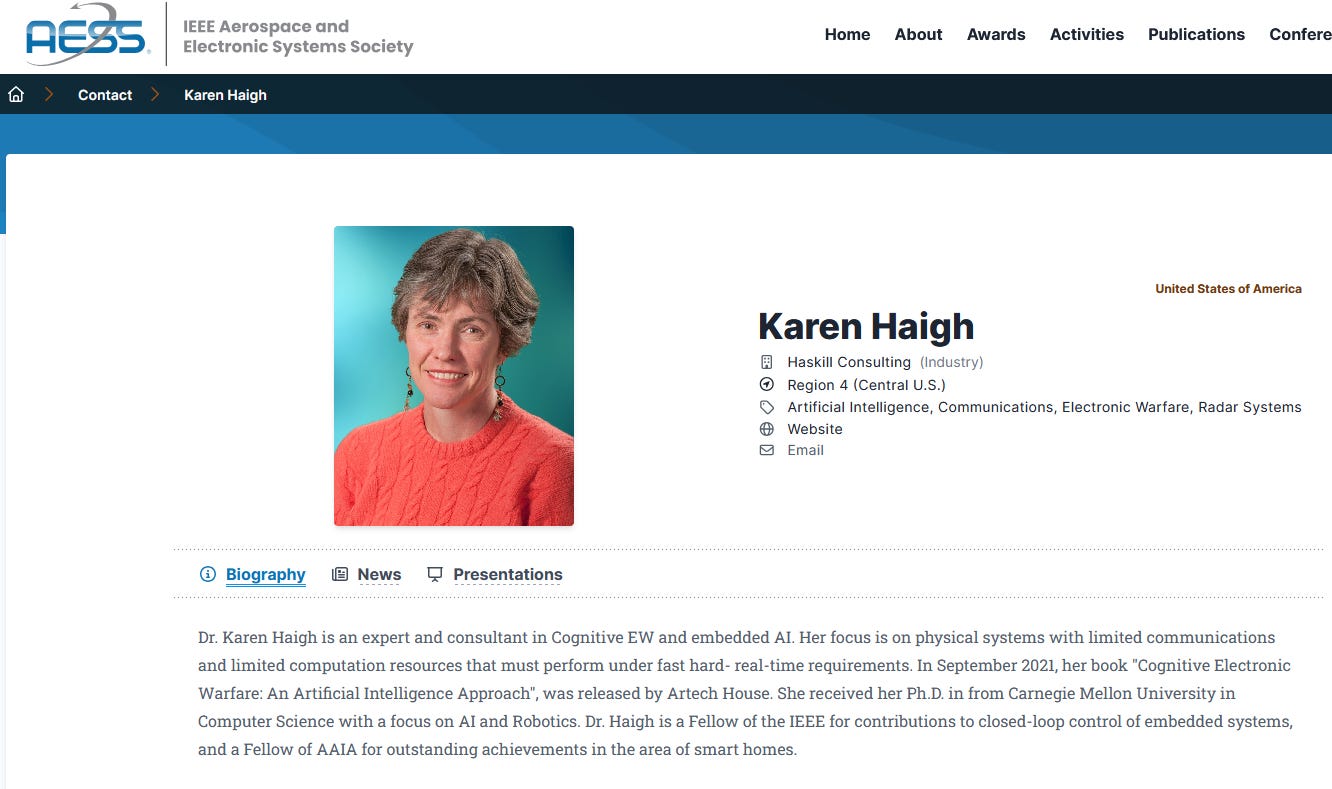
When I speak about Cognitive Warfare, many people have difficulty comprehending that such a thing exists. However, the military is actively engaged in Cognitive Warfare. Here I am posting information about an IEEE scholar who is a Cognitive Warfare expert and who wrote a book about it. The IEEE is the engineering society that created the intra body area network sensors and technologies that are now in peoples bodies.
One can even attend classes and learn more about how to hack people’s brain and how to use AI to optimize success.
Note the credentials of Karen Haigh, who worked in transformation of smart homes. I really would not want to have a cognitive warfare expert design anything in my home, there just seems to be too much concern about weaponizing such technologies, as all of them are designed to be dual purpose - meaning civilian and weapon system combined, sold as comfort in your home.
If you would like to learn more about the military programs for cognitive warfare, please refer to this substack. Human beings are the target:
Battlefields across the conflict continuum now reach beyond the physical and cyber domains: An individual’s cognition is now a target. Advances in cognitive psychology and information communication technology (ICT) enable actors to target individuals’ situational comprehension and will with precision. In light of these changes, cognitive warfare (CW) has emerged as a new war-fighting concept.
While cognitive warfare lacks a widely accepted definition, initial proposals contain at least one of three common themes:
• The intent to influence specific individuals and groups on political matters, understanding that war is a continuation of politics by other means
• The explicit targeting of human cognition—how people perceive and interpret information to gain knowledge and understanding
• The use of psychology and advanced technologies to target individuals or groups precisely
Rhode and Schwartz are putting on this webinar:
Join us on Tuesday, March 10 for our webinar “Cognitive Electronic Warfare: Beyond AI-Enabled Systems” with Dr. Karen Haigh. In this in-depth session, discover the challenges and opportunities of Cognitive Electronic Warfare (CogEW) in the field, how cognitive approaches are transforming electronic warfare, and the need for advanced testing methods to ensure adaptive systems remain reliable, effective and secure.
Key focus areas:
How cognitive systems perceive their environment and autonomously take actions
Why traditional Electronic Warfare approaches struggle in novel RF environments
How automated, adaptive learning improves operational performance
Differences between traditional machine learning and cognitive training approaches
Information flow and decision processes inside cognitive RF systems
New testing approaches focused on validating the learning process rather than static performance
Date: Tuesday, March 10, 2026
Time: 1 PM ET
Host: Dr. Karen Haigh, cognitive electronic warfare expert

Here is her book
This comprehensive book gives an overview of how cognitive systems and artificial intelligence (AI) can be used in electronic warfare (EW). Readers will learn how EW systems respond more quickly and effectively to battlefield conditions where sophisticated radars and spectrum congestion put a high priority on EW systems that can characterize and classify novel waveforms, discern intent, and devise and test countermeasures. Specific techniques are covered for optimizing a cognitive EW system as well as evaluating its ability to learn new information in real time.
The book presents AI for electronic support (ES), including characterization, classification, patterns of life, and intent recognition. Optimization techniques, including temporal tradeoffs and distributed optimization challenges are also discussed. The issues concerning real-time in-mission machine learning and suggests some approaches to address this important challenge are presented and described. The book covers electronic battle management, data management, and knowledge sharing. Evaluation approaches, including how to show that a machine learning system can learn how to handle novel environments, are also discussed. Written by experts with first-hand experience in AI-based EW, this is the first book on in-mission real-time learning and optimization.
Cognitive warfare is real. Any smart device can be used for dual purpose and target and control your mind.
For more information:
No posts
Comments
Nothing yet. Say the first thing.
Sign in to join the conversation.