

The goal of this project is to help wake up the American public and press to these truths:
Donald Trump is destroying the American economy.
Trump is destroying American democracy.
Trump is siding with Vladimir Putin on the Russian/Ukraine war.
Trump is doing 1, 2, and 3 because he’s been a Russian controlled asset since 1987, as explained earlier in this article. As a sleeper agent who has risen to the top, his cover is to behave as an erratic, bumbling, corrupt, charismatic populist authoritarian who just happens to like Putin.
Facts 1, 2, and 3 are easily seen events. 4 is a motivation arising from hard to see, well hidden events. All are what matter. These signals are obscured by a confusing distracting firehose of manufactured noise designed to hide the signal. According to research by the RAND think tank, this is a standard Russian propaganda strategy: In “the Russian ‘firehose of falsehood’ Propaganda model, …propaganda entertains, confuses and overwhelms the audience.” Here it entertains Trump’s base and confuses and overwhelms the opposition. Truth 5 is deeper than a motivation. It’s a strategy. Accepting it requires deep correct understand of system behavior. The fact this stategy exists makes it an event, but it is the hardest one to see.
Until the American public and press see these truths for what they are, wake up, and give them top priority, Trump’s path of destruction will continue. Soon the US will no longer be a democracy. It will become an authoritarian state where its citizens are controlled by propaganda and police state force, the courts and Congress are subservient to the dictator, all strong opposition is oppressed, and free and fair elections no longer prevail. Once this point is reached, it becomes difficult or impossible to remove dictator Trump or his successors.
To help prevent this outcome, this project will provide a daily signal graph that tracks the signal in US political news. If you study the graph and its supporting information every day (and share it with others), it will soon become obvious the above truths are true. The fog of propaganda noise will lift, and you can see the signal for what it is.
After that, if you want to continue living in a democracy your only course of action is to do as much as you possibly can to save American democracy (and thereby global democracy) before it is too late.

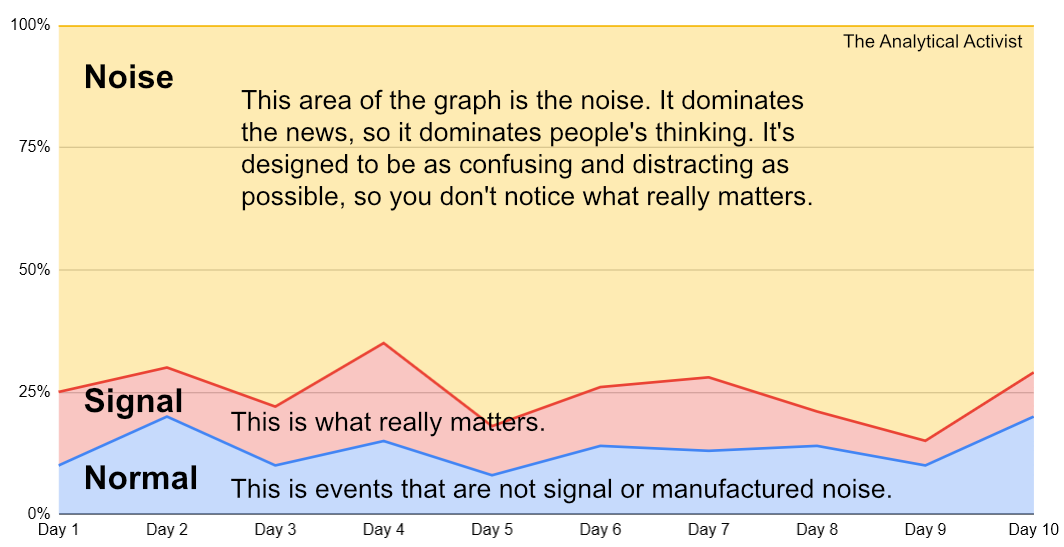
Above was our first iteration design. Suppose 20 stories were analyzed in one day. 15 are noise, 3 are signal, and 2 are normal. That data would look about like Day 1 on the graph.
But when classifying stories and writing the day 4 article, we noticed the need to track the signals separately. This led to the new graph below for day 4, which is a much richer display of data and allows more interpretation. The new graph is produced using DataWrapper.
The key pattern to notice is how the signal is sandwiched between noise and normal news. By comparison the signal is tiny. That’s why it doesn’t get to the audience who needs it the most.
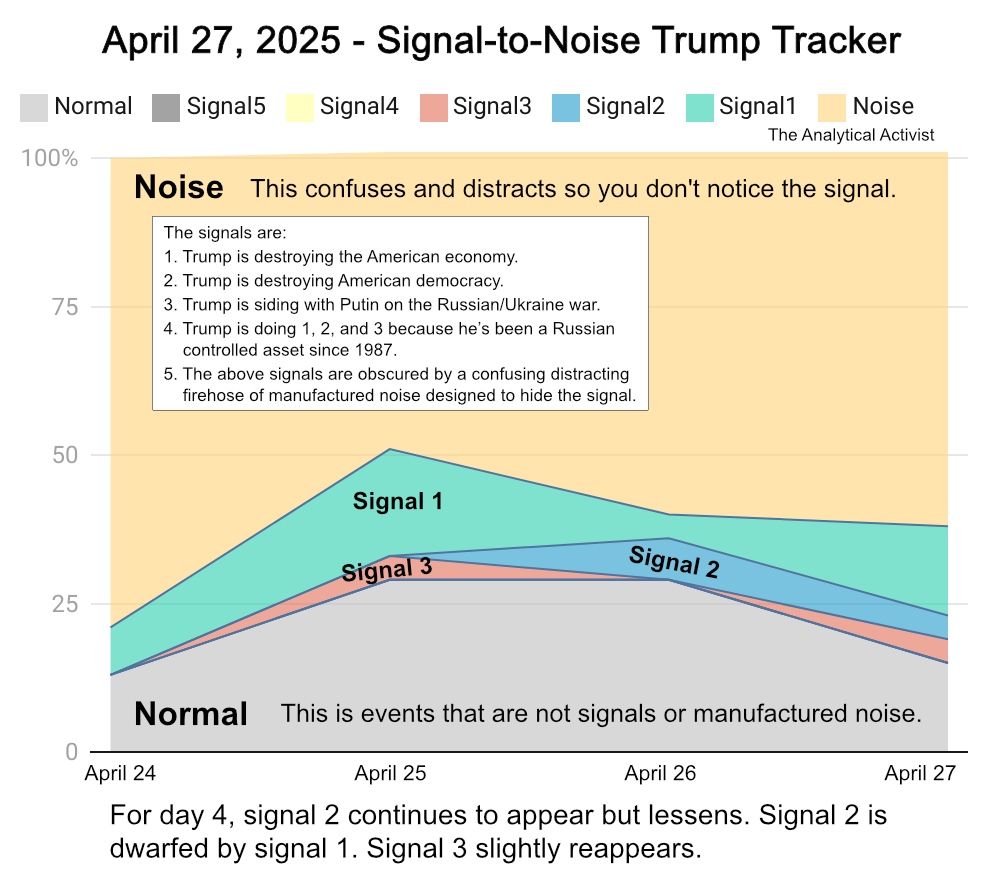
The three types of tracked data are:
Noise news events are things the Trump administration and Putin are doing to hide the signal. These events are manufactured and cleverly designed to be as confusing and distracting as possible. Examples are verbal attacks on opponents, the so-called negotiations on the Russia/Ukraine war where Trump is actually siding with Putin on everything, on-again off-again tariffs, and the actions of incompetent members of the Trump administration.
Signal news events are of the 5 types listed above. All damage the US and/or the rest of the world in some manner. Signal 2: Trump is destroying American democracy, is the outcome we are most concerned about. Democracy is damaged by eroding institutions like the courts, congress, the press, and fair election mechanisms. This begins with verbal attacks, followed by the damaging action itself.
Normal news events are things that are not signal or manufactured noise. Examples are normal administration acts like passing a budget, assisting allies, and managing internal disasters like hurricanes. If the authoritarian takeover of America was not happening, the graph would be all normal events.
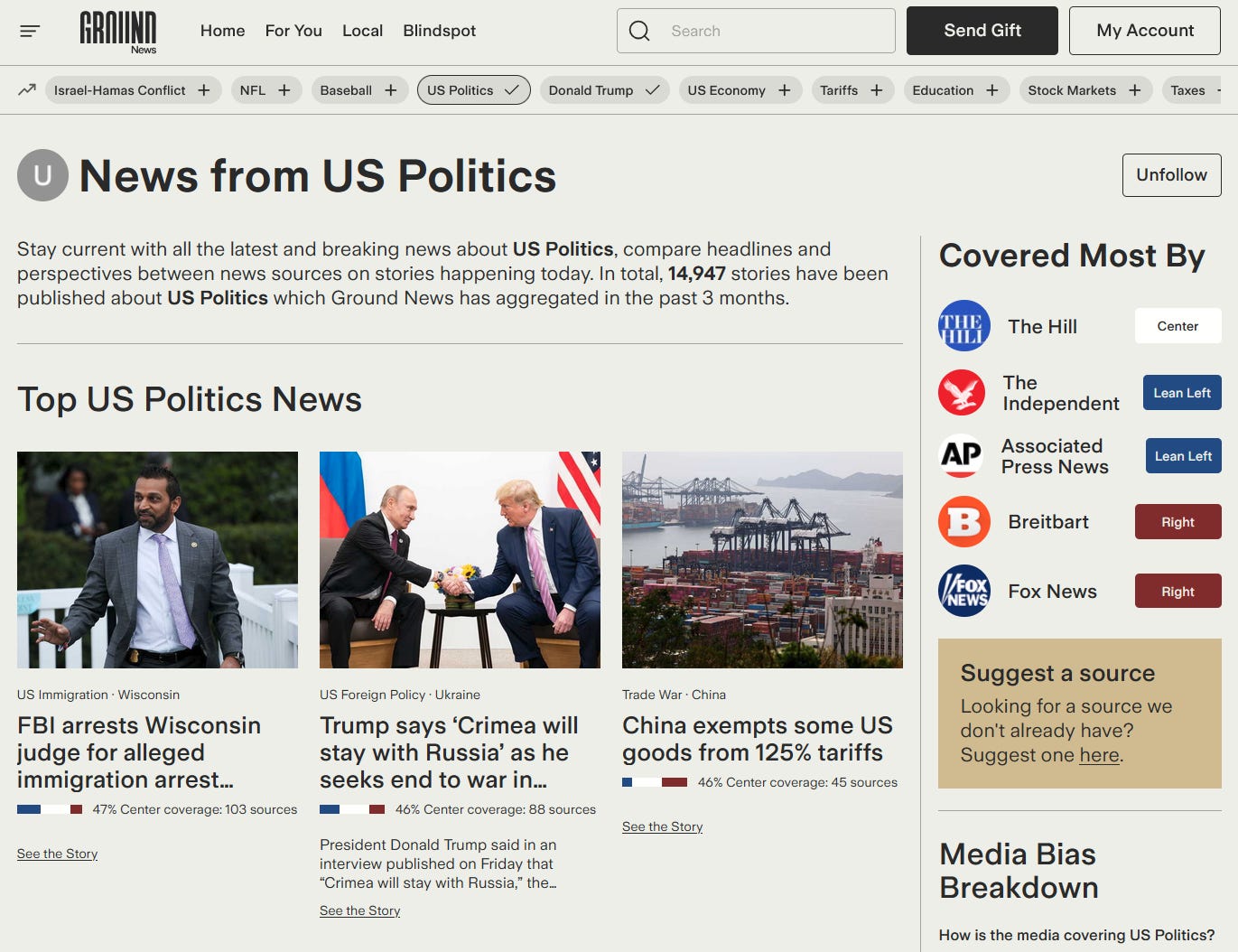
For the source of the data we selected the US Politics feed at Ground News, as shown above for April 25, 2025. No data source is perfect, but this one approximates the general new climate.
About 170 stories a day are reported in the US Politics new feed. Each story is an aggregation of many individual news articles from news organizations around the world. Ground News summarizes each story, shows you the individual articles reporting on the story, and displays the bias of each article source in a handy graphic. The factuality (truthfulness) of each article source is rated. This helps you to avoid believing false articles. As Ground News says on their About page:
Ground News is a platform that makes it easy to compare news sources, read between the lines of media bias and break free from algorithms.
Ground News was created to offer clarity in an increasingly chaotic media landscape. Our vision is positive coexistence where cooperative, civil debate is the norm, media is accountable, and critical thought is the baseline of our information consumption. We’re on a mission to well inform the world by empowering readers to think freely about the issues of our times.
[Ground News is] a better way to read the news. Every day we process nearly 60,000 news articles from over 50,000 different news sources. Articles from different outlets covering the same event are merged into a single story, making it possible to get multiple perspectives in one place.
These single stories are what is graphed, such as the typical story shown below:
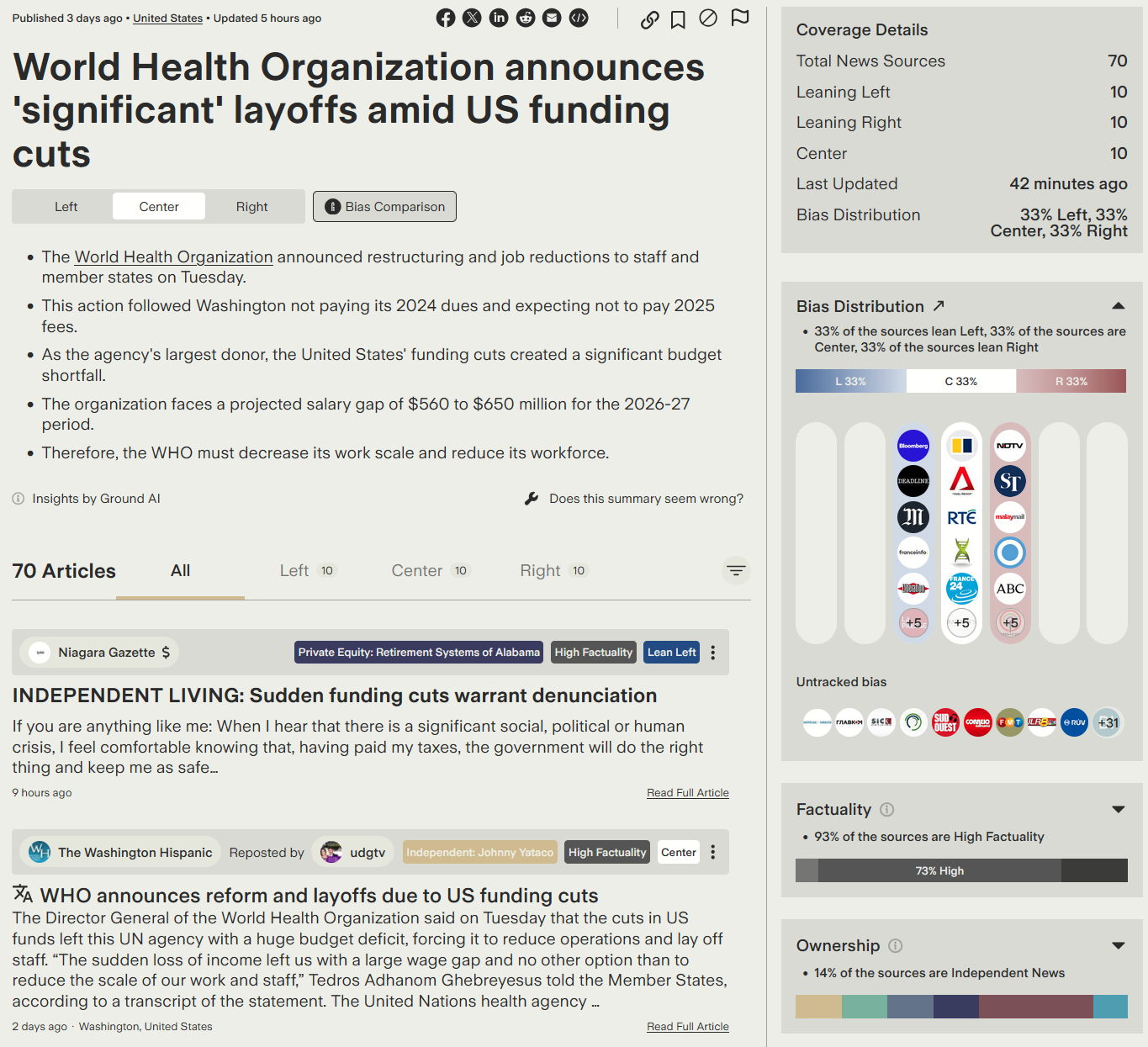
Note the story title, summary, the bias distribution graphic, and the factuality rating. This story is based on 70 articles. The first two are on the bottom left. Each has a summary, factuality rating, and bias rating.
When we examine a story to classify it as noise, signal, or normal, usually all we need is the story title and summary. If more is needed, we examine article summaries or read articles used to make up the story. Sometimes we need to read further to get the larger picture. To do this consistently and as objectively as possible, these noise patterns are used:
Noise news events follow strong manipulative behavior patterns. This makes it easier to classify a story. The noise patterns we’ve identified so far are below.
Don’t use an overly broad pattern like manufactured outrage, disinformation, chaos, or distraction. Use specific patterns for classification precision. For example, how was manufactured chaos achieved? By staff infighting.
Staff ineptitude
Staff infighting
Staff outrageous behavior
Trump's outrageous behavior
Corruption
False common enemy - Such as immigrants, LGBTQ+, leftists, the “deep state.”
Attack your enemies fallaciously
Using data to lie
Disinformation operation
Favoritism - Such as to donors, supporters, far-right movements.
Lying to hide true behavior
We’re evolving a rigorous process for classification. Below are the steps. They are designed to maximize process transparency, objectivity, and repeatability.
Step 1. Understand the basic story and its relevant context
If the story has 2 or less articles, omit it. It’s not an important widely read story.
Read the Ground News headline and summary.
If that’s not enough, skim the story headlines and summaries. These are very handy. If these conflict with the story summary, resolve the conflict.
If that’s not enough, read promising story articles, selecting the most objective and penetrating.
If even that’s not enough, search and discuss using Google or ChatGPT.
If during the above steps you discover this is not a US politics story concerning governance, omit it and you’re done. For example, it may be about tourism or a famous person.
Step 2. Is this one of the five signals?
If yes, go to the LAST STEP.
If no, proceed to the next step.
Step 3. Does this fit one or more of the noise patterns?
If yes, go to the LAST STEP.
If no, is there a new noise pattern involved?
If yes, add the new pattern to the list of patterns and go to the LAST STEP.
If no, proceed to the next step.
Step 4. Is this really a normal classification?
A normal story doesn’t hide signal and is not a signal. It’s the normal workings of governance.
If clearly yes, go to the LAST STEP.
If no, then you are in doubt about something or have discovered it’s not a US politics governance story, but something else like tourism or famous person. If the former, go upstream in the process and repeat the steps until done. If the latter, omit the story.
Step 5. LAST STEP - Write up the explanation of the classification
This should clearly explain why a story was classified this way, in as insightful a manner as possible without being wordy. It should also mention classification uncertainty if any. If AI was used, transparently describe that and include direct AI quotes as necessary.
Above is the plan and the nuts and bolts process. The project will no doubt evolve and improve as it goes along. Updates to the methodology are being be made here.
Next is the tedious but oh-so-fulfilling work of creating daily Substack articles, one for each day. At first all this will be manual. Later, we hope to move into software automation and use of AI assistance, if feasible and useful.
A particular need for improvement is to have several people doing the classification to improve accuracy and increase project credibility. If you would like to help on this in an unbiased, high-quality manner, or would like to help on the project in general, please step forward!
The first day’s graph is here.
No posts
Comments
Nothing yet. Say the first thing.
Sign in to join the conversation.