
Here’s the backstory from a New York Times article on March 13, 2025:
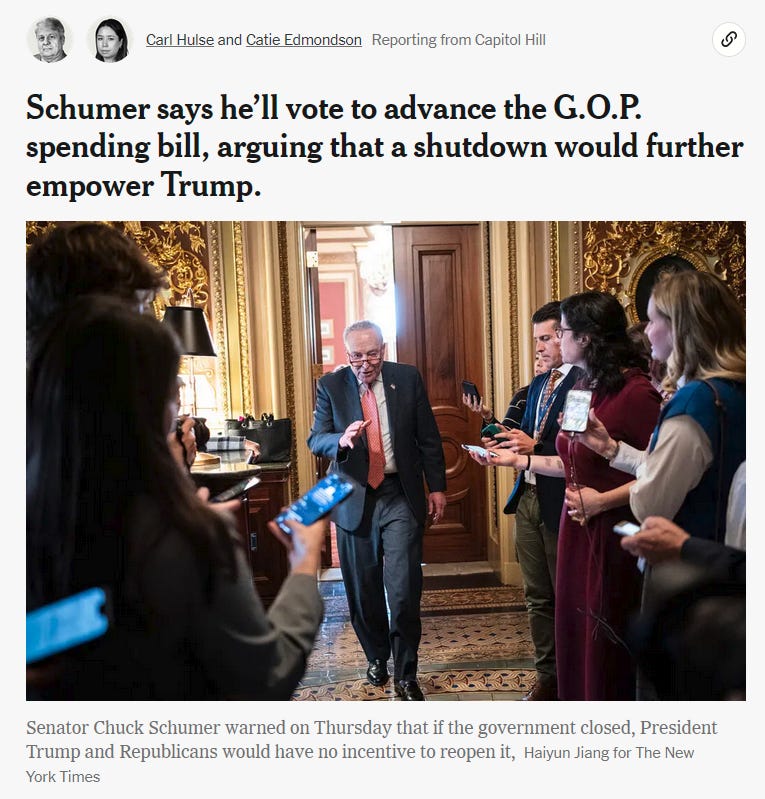
In lengthy closed-door group discussions over the past three days, Senate Democrats have agonized over how to handle the spending bill, which would keep government funding largely flat over the next six months.
Many of them described an impossible choice between two evils: supporting a bill that would give the Trump administration wide latitude to continue its unilateral efforts to slash government employees and programs, or a shutdown that would also give Mr. Trump and his team broad leeway to decide what to fund.
Several Democrats — including both centrists and progressives — declared that they could not back legislation that would give that kind of power to the president and Mr. Musk. They groused that Republicans had unilaterally drafted the legislation and refused to consider any changes to win their votes, essentially daring them to take the blame for a politically toxic shutdown.
“What everyone is wrestling with is that either outcome is terrible,” said Senator Martin Heinrich of New Mexico. “This president has put us in a position where, in either direction, lots of people’s constituents are going to get hurt and hurt badly. So people are wrestling with what is the least worst outcome.”
One day later, on March 14 the Senate passed a Continuing Resolution (CR) that averted a government shutdown. A filibuster was avoided when 10 Democrats, led by Chuck Schumer, voted with Republicans to advance the CR. The result ignited a firestorm of controversy, with considerable anger directed against Schumer, though there was some support.
That anger comes from the frustration of an impossible choice.Voting against the CR was bad, because that would lead to shutdown. But voting for it was also bad, because:
It was a partisan bill with no Democrat input. Under Trump’s orders, House Republicans stopped negotiating and designed the bill themselves.
Schumer said he and fellow Democrats "hated" the funding bill because it creates a "slush fund" for President Donald Trump, his adviser Elon Musk and Office of Management and Budget Director Russ Vought to "push around."
It increased defense spending by $6 billion and cut non-defense programs by $13 billion, which undermines essential social programs and services.
The bill granted the Trump administration significant leeway in spending decisions, raising alarms about potential misuse of funds and the undermining of legislative oversight.
Most of the anger was directed at Chuck Schumer, who made the impossible choice. When people are highly angry, they are psychologically predisposed to aggressively direct that anger at a cause of some kind, even if that behavior is not productive. Here’s how this works:
Once the person experiences frustration because they believe they are blocked from achieving a goal, they may then experience anger in relation to the perceived source of their frustration—that is, in relation to whoever or whatever they believe is blocking them from achieving their goal. Finally, the person may then behave aggressively toward the perceived source of their frustration.
In this case all that anger is unproductive. If it bleeds it leads, so the news media focused on the Democrats’ red hot anger at Schumer and their disarray, rather than the bad features of the bill that was passed. The Republicans won the news cycle.
Decision trees to the rescue!
Now suppose Democrats had analyzed the impossible choice to quantify the very complex decision they faced. Then they could have based their decision on rational reasons. Frustration and anger could have been avoided. The Democrats merely made the best decision they could. Time to move on to the next task.
This is the course business managers take routinely when faced with difficult choices. They turn to the best analysis tool for the job and apply it.
Here the best tool is a decision tree. A decision tree is a diagramming approach that let’s you put your mental thinking down on paper (or a computer screen) and see what your choices are and the relative advantages of each choice. Decision trees are similar to cost-benefit analysis.
For example, suppose you’re in high school and are faced with the choice of going to college or not. You might build a decision tree that looked something like the one below. This was built with Silver Decisions, freely available to all. Current US data was used. Red boxes are decisions. Yellow circles are the chance of one or more events happening. Green triangles are outcome events.
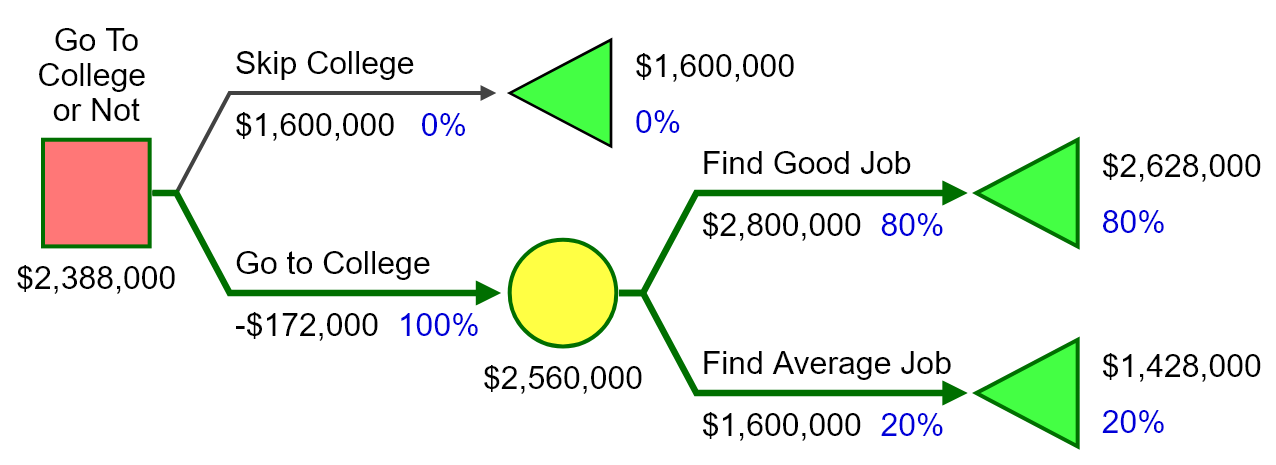
Here’s how the decision tree was built. The decision is “Go to College or Not.” You have two choices: “Skip College” or “Go to College.” If you skip college, those with only a high school diploma earn an average of $1.6 million over their lifetime.
If you go to college, there are two possible outcomes. There’s an 80% chance you find a good job and a 20% chance you find an average job. The average job pays the same as if you skipped college, $1.6 million. But a good job pays more, about $2.8 million. There’s also the cost of going to college, $172,000.
Now you’ve created your decision tree. The software automatically calculates the result. On the far right, $2,628,000 is the payoff if the “Find a Good Job” event occurs. It equals $2,800,000 minus $172,000. The value for “Find an Average Job” is calculated in the same manner.
The real trick is how the yellow circle expected value of $2,560,000 is calculated. It equals $2,800,000 times 80% plus $1,600,000 times 20%. That minus the cost of college, $172,000, equals $2,388,000, which is the expected payoff for making the decision to go to college. If you choose to not got to college, the payoff is much less, $1,600,000.
As you can see, these calculations are far too complex to do correctly in our heads. Decision trees are required, especially as the tree grows in complexity.
Decision trees capture how we think, but they do it much better. Gone is sloppy intuition and juggling lots of data and probabilities in your mind. That’s replaced by a tool that says hey, design my shape and give me the data I need, and I can calculate the expected payoff of the best decision. Then all you have to quibble about is the shape of the tree and the accuracy of the data.
Now we come to the main point of this article: That is all Democrats would have been quibbling about, if they had used a decision tree on the CR decision. Gone would be the high emotions and anger that erupted before and after the CR vote.
And maybe the Democrats would have won the news cycle.
This article is continued in Part 2. A Decision Tree for the Democrats’ Impossible Choice. That article builds the decision tree.
The Analytical Activist is working hard to help turn the tide of erosion of democracy. To receive new posts and help in this work, consider becoming a subscriber.
Comments
Nothing yet. Say the first thing.
Sign in to join the conversation.