
T tells me that moving house is one of the most stressful life events there is, ranking just behind the death of a loved one, imprisonment, divorce, and the birth of a child.
Having been through everything except prison, I can vouch for the fact that this is a lie. Moving house should be right at the top of the list.
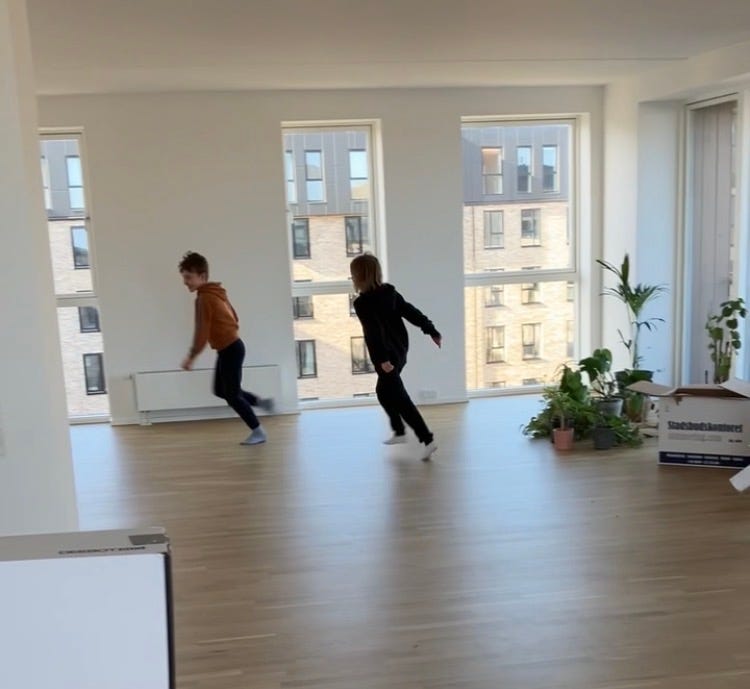
My previous house moves simply involved getting myself from point A to point B with two large suitcases containing all my belongings, and then gradually figuring out where to buy bread and how to get to work without getting lost. This time it has involved packing up furniture, children, and a cat and crossing a bridge that separates two countries which, from a distance, seem similar but are not.
It’s been so stressful that I’ve considered divorce just to avoid having to move house. I fantasised about handing over parental responsibility to C and me spending two weekends a month with my offspring and half the summer holidays. Prison would have seemed like a full-board hotel compared to the torment of having to decide what to keep and what to throw away, how to find a school for the children, and which supermarket is best for getting products similar to what we’re used to, because we can all agree that not all soya milks are the same, and drinking a cappuccino that leaves a sandy aftertaste is the surest way to start the day pissed off.
The thing is, in the end, I gritted my teeth and clenched my fists and went through the whole process only to reach the other side of the Øresund amazed at the light-heartedness and serenity with which my children had handled the move.
P spent two days crying because he missed his friends, which seemed to me to be expected. One afternoon he blurted out the inevitable “I hate you”, to which I replied, “That’s fine by me, but you’re going to have to write me an essay explaining the reasons for your hate.” He emerged from his room 20 minutes later to hand me the document in which he explained that the intensity of his disdain was because that afternoon I hadn’t let him go out on his bike on his own. I, who had imagined he was going to tell me about insurmountable traumas caused by the loss of his dearest loved ones (which did not include members of his immediate family), was glad that the altercation had such an easy solution. I handed him his helmet and a high-visibility vest and said, “Be back for dinner.” He hasn’t cried since then and has confessed to me that he likes the new school.
Then there’s E, who, after five years of listening to C and me speaking English, revealed to me at preschool that he had been paying attention all this time. Not understanding the teacher in Danish, he started speaking to him in English with the self-assurance of someone who knows that, come what may, an adult will understand him, and all his needs will be met.
CA is the one who has surprised me the most with her ability to adapt and her refusal to see any obstacles when making her way in uncharted territory. CA has the ability to laugh with her whole body, and if something is really funny, she’ll inevitably wet herself. So much so that she has to take a change of clothes to school, just in case. Don’t think she lacks discernment; CA has a very refined sense of humour, and if someone has made her laugh to the point of incontinence, they can be considered a funny person. It’s like winning the Nobel Prize for hilarity.
On the first day of school, I was walking them there and stopped dead in my tracks halfway when I realised we’d left the spare clothes at home. CA said to me very calmly: “It’s fine, Mum. As I don’t understand Danish, no one’s going to make me laugh that much.” A week later, she’d already peed herself at school, changed her clothes without any fuss and carried on playing. That day, as I put the jeans and underwear with that pungent ammonia smell into the washing machine, I thought everything was going to be well.
Before becoming a mother, I remember a lab technician I worked with in New York asking me why I wanted to be one1. Far from talking to her about an existential love one feels for one’s children (it’s a normal kind of love, my dears. Love is love, there are no degrees of intensity, but people confuse it with other emotions), I told her that what appealed to me about being a mother was having a front-row seat to witness people becoming who they are deep down. This unravelling of a human being becoming themselves is what I wanted to be privy to. To observe the struggles of growing up, the way they learn about themselves whilst learning about the world. My children are not extraordinary because they are mine; they are extraordinary because they are children.
I was 34 at the time and was thinking about having children, with my biological clock ticking away like Big Ben in my head.
Comments
Nothing yet. Say the first thing.
Sign in to join the conversation.