
Consumer businesses are, as the Acquired hosts often point to, the world’s best business model. Of the top 7 most valuable companies on the world, 5 started off primarily targeting consumers as users, and 4 continue to derive the majority of their value from their consumer businesses. These days, even pharma companies are trying to become consumer companies.
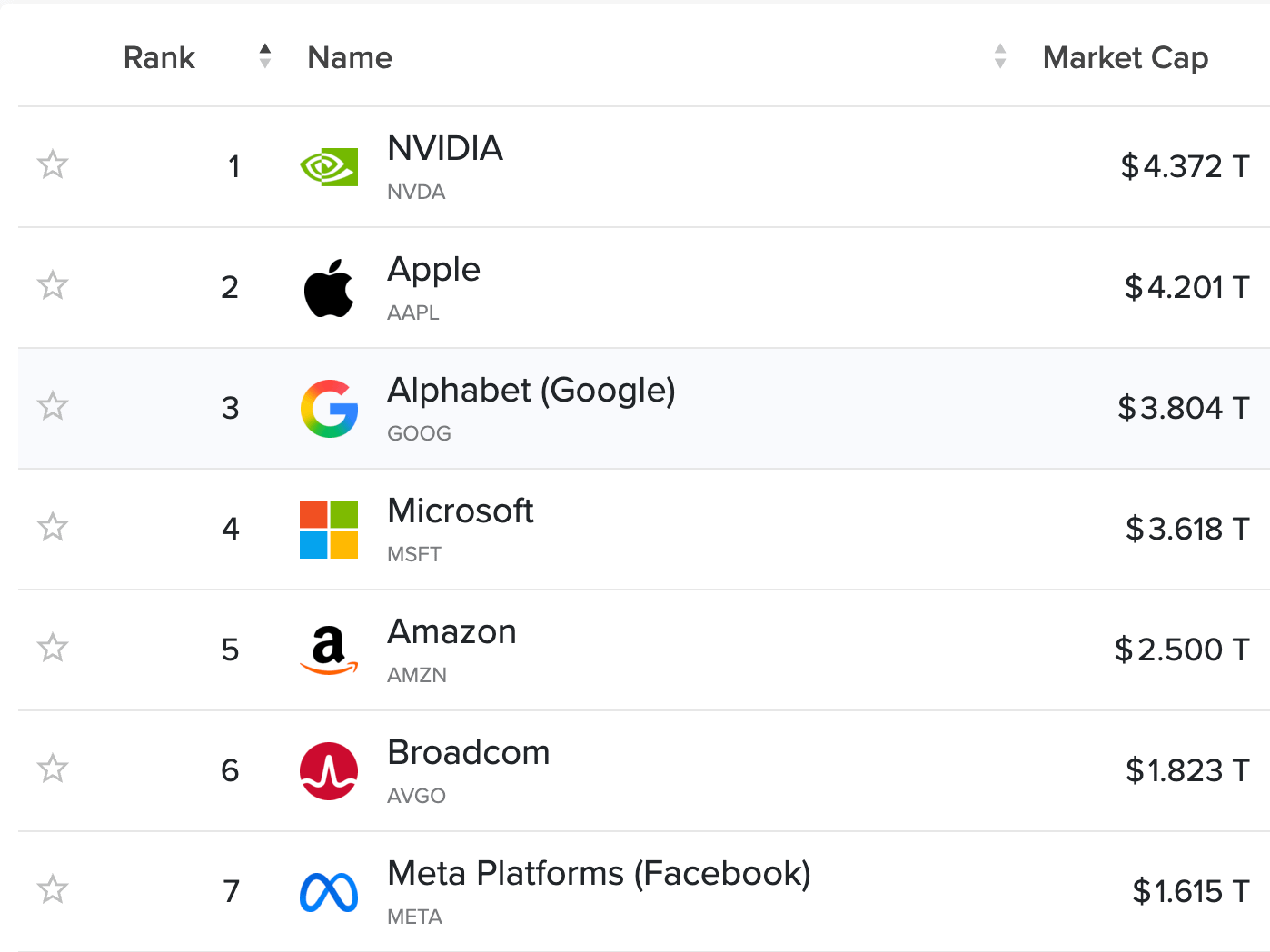
Many theories aim to explain why consumer technology has produced so many of the most valuable businesses in the world. Of them, I find Ben Thompson’s Aggregation Theory (more here) to be the most compelling. Thompson argues that many (although not all, Amazon being a notable exception) successful consumer tech companies are “aggregators” defined by three characteristics: direct relationships with users, zero marginal costs for serving them, and demand-driven network effects that decrease acquisition costs at scale. This framework has a good track record. Thompson remained bullish on Meta through multiple down cycles and was prescient on Uber and Airbnb.
Views like Thompson’s tend to put winning consumer at the center of the AI competitive story. For example, Thompson thinks OpenAI’s most important asset is its growing consumer user base (article, Sam Altman interview) and is in favor of them building an ads business. Despite my respect for Thompson and others like him, I disagree. If AI is going to be a transformative technology on the scale of electricity or the industrial revolution, the ultimate prize won’t be consumer. It will be the enterprise.
You can see the computer age everywhere but in the productivity statistics.
— Robert Solow
The Productivity Paradox highlights the discrepancy between the sense that computers and the internet have transformed our daily lives and the observation that neither meaningfully accelerated economic growth beyond prior trends. In fact, economic and productivity growth seemingly slowed during the period in which computers and the internet were invented and diffused.1
In my mind, Solow’s Productivity Paradox also helps to explain why consumer companies have been so dominant in the internet era. The internet was better at inventing new categories of consumption like social media, streaming, and e-commerce than at making existing work meaningfully more efficient. Consumer technology companies captured enormous value by dominating these new behaviors. On the other hand, while the internet and software have certainly impacted how businesses operate, the total impact on productivity has been smaller than expected and partially balanced by the distraction and alternative outlets the consumer internet has created for people’s time.
The Industrial Revolution was different. The Industrial Revolution transformed the material basis of civilization and the means by which the entire production economy operated. It took something that was scarce and hard to produce — human physical and skilled labor — and made it cheaper, more repeatable, scalable, and abundant. This fueled a transformation of the entire economy. Furthermore, unlike the internet revolution, the Industrial Revolution created a flywheel that led to sustained acceleration of growth. More energy enabled mechanization, which enabled mass production of goods. That mass production enabled the construction of better tools and machines, which allowed us to more effectively and cheaply extract additional energy, feeding right back into the process.2
This flywheel is the thing that I think was missing from the internet revolution. Yes, software has become easier to produce. Even pre-AI, we used assembly to bootstrap higher-level languages, which we then used to produce even higher-level languages. But while this undoubtedly increased productivity in software production to some degree, it hasn’t led to the same macro flywheel we saw during the Industrial Revolution.
I expect AI to look much more like the Industrial Revolution than the computer and internet revolutions. At its core, the story of AI is the story of making another very tight, scarce input to production, intelligence, cheap, abundant, and systematizable. While we aren’t all the way there yet, if AI succeeds, it will inject intelligence as a form of capital, rather than labor, into the economy at a much lower price.
No analogy is perfect, but this analogy explains a lot about why I expect AI’s impact on businesses to dwarf its (direct) impact on consumers. Cheap, abundant intelligence will enable businesses to become vastly more efficient at any task involving intelligence as an input. It will also allow them to accomplish things they were never able to before due to intelligence bottlenecks, meaning more effective R&D, faster product development, and the ability to analyze things more deeply and broadly.3
And while it is currently popular in some circles to poo-poo knowledge work (“email jobs”, “bullshit jobs”), the reality is that knowledge work is an extremely valuable, important component of the world economy. World GDP in 2024 was ~$111T. FAANG revenue was roughly $1.4T. One estimate suggests that knowledge worker compensation is between $50T and $70T globally. So, knowledge worker compensation is over an order of magnitude larger than total FAANG revenue and constitutes a meaningful fraction of total world GDP.
Moreover, I think looking at the current knowledge economy still understates the potential impact of cheap, abundant intelligence. Similar to the Industrial Revolution, if we can reduce the cost of procuring a previous bottleneck input to the entire economy by order(s) of magnitude, we expect parts of the economy downstream of that bottleneck to grow dramatically. That’s the real opportunity.
There are some counter-arguments to my view. The first is that consumer and enterprise are linked. Businesses employ people, who are also consumers. Currently, ChatGPT is the most popular consumer AI app, so the argument goes that as long as it wins the consumer, it has a huge leg up in the enterprise because people will naturally bring it into their work.
I am not sure this argument is wrong, but I bet is that it is. (To prevent someone from going and using this to claim I am bearish on OpenAI, I note that this is not a commentary on OpenAI as a business as they also have an enterprise business.) Enterprise and consumer needs are already diverging. Enterprises evaluate models on peak intelligence, reliability, latency, cost-per-token, compliance, and integration. They are increasingly focused on ability to complete or assist with high value tasks and reliability. Consumers have different needs. They value familiarity, vibes, and increasingly personalization/memory.
We saw this recently with the hysteria over the attempted retiring of ChatGPT 4o. Upset users were attached to 4o not for its intelligence, but for their (in many cases, unhealthy) relationship with it. While enterprises have their own forms of stickiness, they are typically based on switching costs rather than emotional attachments.
So, especially in the world where AI is a transformative technology, a strong hook into consumers may provide an initial gateway to enterprises, but I don’t expect it to provide a strong, sustained advantage in keeping their business.
Another counter-argument is that selling to businesses may indeed drive faster growth but will be a race to the bottom with minimal opportunity for capturing value. Whereas, similar to with the internet revolution, selling to consumers will enable massively profitable businesses (likely via ads). If this is true, even if my argument about economic growth is right, the most successful businesses might remain those that are able to capture consumer attention.
This debate quickly devolves into reference class tennis: Will AI be like Railroads or Standard Oil? Standard Oil was a great business because they were able to monopolize. Railroads turned out to be terrible businesses even though they were a huge deal. My all things considered view is that the railroad analogy is likely wrong, but I am less confident about that than I am about the overall relative size of the enterprise vs. consumer AI pies. Because I lack strong arguments, all I can do is register my view here and rely on the future to judge.
Historical analogies are a powerful tool for reasoning about ill-structured domains like business. However, picking the right analogy is vital for drawing correct conclusions. In this case, I think Ben Thompson and others who use the internet revolution as their primary reference point for forecasting value creation and capture in AI are leaning too heavily on a valid, but limited, analogy. They view AI as akin to the internet revolution and therefore understandably apply the theories that explained who won the internet revolution to make predictions about AI.
But I think something bigger is afoot, with the potential to be as or even more impactful than the industrial revolution. If I’m right, then the prize is not capturing consumer attention; it’s transforming the entire knowledge economy.
Thanks to Matt Ritter, Simon Grimm, and Nathan Frey for reading and giving feedback on drafts of this post!
As Nathan Frey points out, Japan was very slow to the internet revolution. This certainly impacted their economy by missing out on building large internet companies, but the day-to-day impact on their populace seems… relatively low? Certainly incomparable to a country that missed out on electricity or mechanization!
Sustaining this growth required major social changes as well, such as the corporation, but I don’t have the space to discuss that. More discussion of that found here.
I’m totally leaving out any discussion of robotics here, although I also expect that to be a big deal.
Comments
Nothing yet. Say the first thing.
Sign in to join the conversation.