
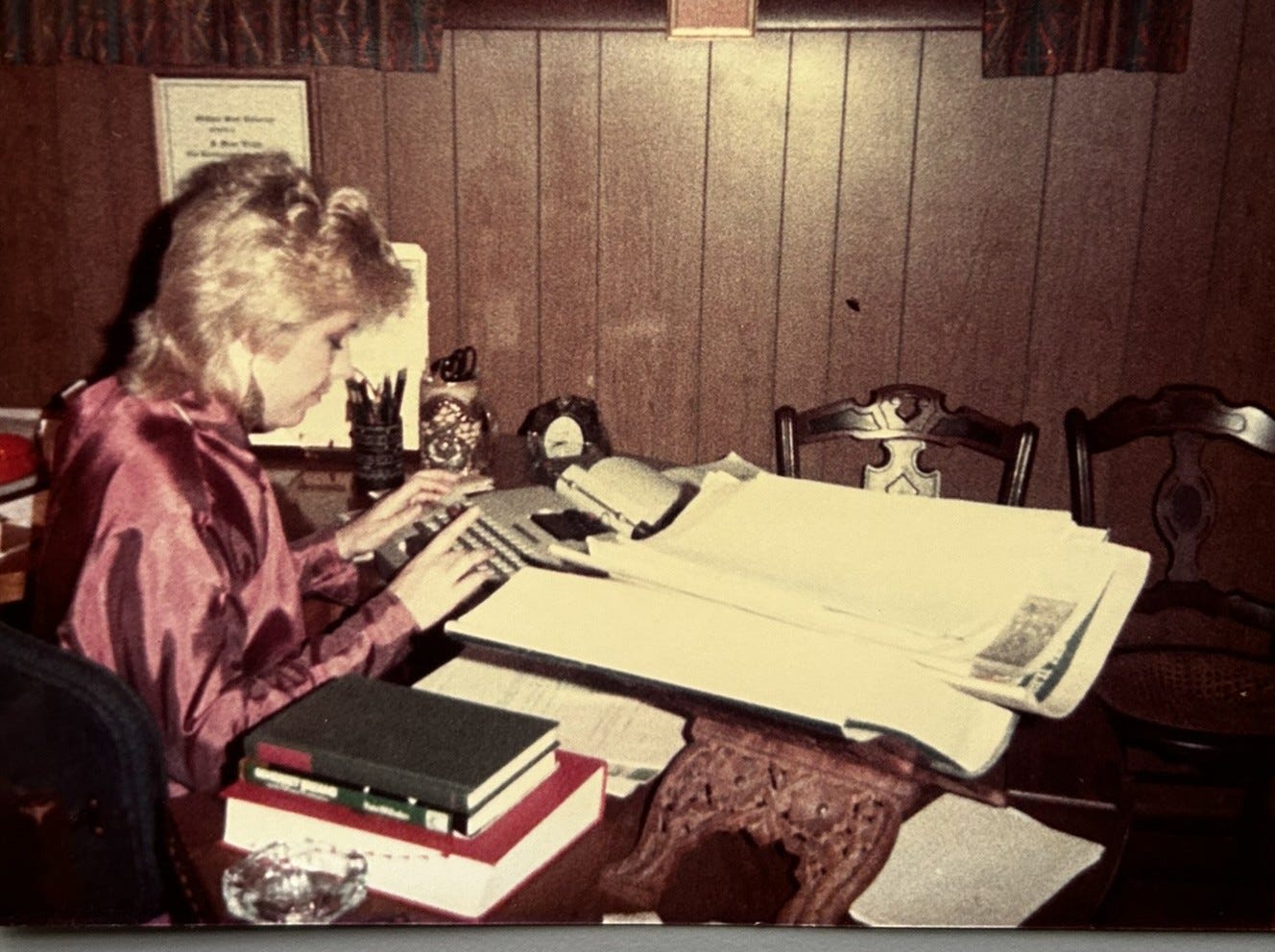
I didn’t even have time for a smoke when Glenn Wright took this picture.
An unfiltered Lucky Strike, the way we’d smoke sitting on the concrete steps outside Holmes Hall. I had no money so Glenn split his coffin nails with me.
He died of lung cancer only two years afterward.
Although he was about 5’10”, I don’t think my friend weighed more than I did. I didn’t weigh much over 125 pounds (56 kilos) back then.
Morbidly obese by 1980s standards.
Spidery little hands, Glenn’s and mine. Pink lacquered nails for me, short tobacco-stained ones for Glenn.
Sitting beside him, squeezing his hand so hard, when Harlan Ellison walked into our critique room at Holmes Hall at Michigan State University. I realized, too late, I was hurting Glenn. But he let me do it. He knew how scared I was.
Glenn told the group, and later in more depth, me, about knowing James Dean in New York City back in the 1950s. They were all aspiring actors, writers, and directors. All poor.
Not all were gay or bi. But James Dean was. And so was Glenn.
My friend.
My mother’s best friend Wally Bauer was a gay man. He taught at El Camino College in Torrance and he played clarinet in the Los Angeles Chamber Orchestra.
I search online for Wally and it’s as if he never lived.
My daughter’s best friend is a gay man.
They say a man and a woman can’t be friends, ever, but those who say this don’t even know what a friend is.
I hear Glenn’s gravelly voice across time and space; he called me Sterling, like John did, the name I wanted, not the forgotten last-minute-named child whose mother soon died.
“Sterling, you can do — ”
Deep, hacking cough. “Anything you want,” he said. “You can write anything.”
Harlan am I good enough?
Yes, damnit! Yes.
Glenn’s house was beautiful, a wood-paneled hideaway in the woods near the huge Michigan State University campus.
I’d wandered far from our dorm on my own; this massive land grant school had giant Soviet-style dorms in an outlying area.

Summer in central Michigan: steamy, green, oppressively humid. Five stories up in Holmes Hall, our dorm, I looked out daily to see my red-brown, fluffy-tailed squirrel friend, absolutely the wrong color for a squirrel, mocking me from the other side of the screen gnawing on acorns and blinking at me with his bright squirrel eyes and his little perky tufted ears and tiny black squirrel fingers.
Another morning, another thing to type, six more things to read and mark up.
I brought a manual typewriter with a faded black ribbon and a replacement ribbon that was half red and half black to the workshop.
Bang bang bang the little girl rode the playground swing.
Bang bang bang little girl swinging in the Southern California sun, higher and higher, so high —
her stomach floating inside
And then back again —
The next day it was my turn in the critique circle.
Squeezing Glenn’s hand, so hard.
A.J. Budrys was our instructor that week. He read the paragraph about the little girl — it was me — out loud.
“If you can write like that,” he said, as his wife Edna waited quietly nearby, “You can write anything.”
I squeezed Glenn’s hand. He patted my knee.
“I told you Sterling,” he whispered.
Later, smoking Lucky Strikes on the step, he slapped my back and it was my turn to cough, deep, hacking, from the bottom of my lungs.
When you smoke an unfiltered cigarette, the tobacco slips out and bits stick to your lips.
I made things.
During critiques at Holmes Hall at the Clarion workshop, we passed around an old, threadbare blue stuffed bunny, someone’s long-ago toddler lovey.
I had brought my yellow tackle box full of pens, pencils, X-Acto knives and blades, and charcoal stubs. The mysterious rolled cardboard blending stump. Soft erasers, gum erasers, and even a pink one. I used the little money I had to buy a newsprint pad at the campus store.
One day I put a charcoal drawing of the blue bunny on my dorm door, taped beneath a picture of my husband of six months, Mike, and weird postcards.
Harlan Ellison, being led down our hallway by Glenn, stopped at my door and yelled, “Who’s that? Gorgo?”
He meant Mike, who was 6’4”.
Then he lifted his glasses, looked at the blue bunny drawing and said, “It stinks!”
One second later: “No, it’s great!”
That became our Clarion 1984 t-shirt.
I still have it.
I came home from Clarion and wrote for another two years, just as hard as I had back then.
By that fall, I was working full time at the United Way: the office was conveniently right across the street from our second-floor apartment in a drafty old 1888 Victorian. Our three-room dust-filled heat trap was a big step up for Mike, who’d been living in a single room in the Mission Inn in Riverside, and not during one of its good periods.
At Clarion, I’d made friends with one of the published writers, a horror writer named Tim Swain. Tim had sold three stories to Twilight Zone.
He told me how he’d sent the stories, and what he’d done and I copied his process, although I was terrified. Just putting those pieces of paper in an envelope (what we used to do) and writing any kind of cover letter filled me with shivery dread.
This went on for a while. None of the stories were any good. This was the mid-80s and horror was big, and it’s not a natural fit.
One day, I went to the mailbox.
Great, another rejection, I thought. Of all things, it was a postcard, written in spidery handwriting.
The postcard was signed by Alan Rodgers.
I looked at this tiny card and put it in the front of a book called In Praise of What Persists, edited by Stephen Berg. This book had been given to me by my boss Art Seidenbaum at the end of my time as “the intern” at the Los Angeles Times Book Review in 1984.
It’s a collection of essays by famous writers.
I put the card in the book, shut the cover, put the book on the Ikea shelf Mike had just put up, put my ancient manual typewriter in its case, and did not write again for another eight years.
Meredith was small when I was cleaning the garage and found a box of Mike’s things from the Air Force. In the box were a couple of paperbacks. One was World of Ptavvs by Larry Niven. I started reading it while laying out in the back yard of the 3-bedroom house Mike and I had bought with all our collected money from our two jobs, him at E.R. Carpenter as a maintenance mechanic, and me at United Way as the campaign associate. Soon after, I started checking out the old sci-fi books from the library, mainly Larry Niven.
Nessus the Puppeteer! Teela Brown! General Products hulls! Ringworld!
About a year after that, I was at my first sci-fi convention in Burbank, and a medium-sized man with a puckish grin was up bright and early on a Saturday morning making Irish coffees.
Larry-Fucking-Niven.
85 rejections later, I made my first professional science fiction sale, “Jonny Punkinhead,” to The Magazine of Fantasy & Science Fiction. It was in the June 1996 “New Writers” issue, and of the group, Michael Libling and I have gone on to write and publish additional work.
For the record, I changed not one single word of that story when I sent it back to Kristine Kathryn Rusch, the editor of F&SF at that time, but I did write in the cover letter recommended by Dave Wolverton that I had revised it.
I also went to graduate school at Chapman University.
My friend Gordon McAlpine, who was the head of the graduate creative writing program there at that time, said he was astonished when I walked into my first workshop at about 4:30 p.m. wearing my executive clothing, as by this time, I’d gone from working at the United Way to being the Director of Family Service Assn.
I was appalled at the dirty, hairy feet of one of my classmates, a pretty good writer who wore Jethro Clampett overalls but declined to listen to critiques.
I was even more appalled by the purple copy paper and four-letter-word-laced bullshit passed around by another of my classmates, a nepo baby trust fund loser.
Gordon said he could not believe how tightly wound I was on that first day.
It’s a good thing later, we became friends.
“You were always typing,” he said. The office I eventually obtained in the “dungeon” lower halls at Chapman was right near his. Apparently my constant bam bam bam on the keys encouraged him to also write, and Alan later published some of his books.
Gordon wanted more than just being head of this creative writing program and he was a beautiful writer, so he got that, and he deserved so much more.
Then somebody told me James P. Blaylock was a “sci fi writer” and maybe I should contact him. I was scared to do that (same as scared to send any writing to any publication/editor/agent).
Every Thursday after that, I’d go talk with Jim in his office in an even lower level of Chapman’s dungeon environment. Jim had a massive 1 pound box of Altoids and a giant Gumby in his window.
It was a friendship meant to be.
“Did you know Judy-Lynn Del Rey was a dwarf?” he’d often greet me.
“No,” I said —
Every single time.
While I was at Chapman, I wrote “To Kiss the Star” inspired by my classmate Julie M. Jones, and started selling whatever I wrote. I published my first novel, which I could not have written without Jim and Gordon’s encouragement and help.
Gordon and I hid behind a table skirt and laughed at the noise-making poet.
I had my first poetry reading at that school and people seemed to like it.
Oh, did I mention? The “noise-making poet” was brought in by Martin Nakell, a full professor with tenure who had a Ph.D. in creative writing and an office in the heights of the Liberal Arts building, far, far, far above the dungeon.
Had I mentioned that James P. Blaylock was a multiple World Fantasy award-winner and one of the funniest, most elegant, imaginative writers ever?
Marty Nakell tortured our Department secretary by making her type handwritten “notes” that represented a dual “booklike object” “narrative” that was supposed to be printed at the same time, two separate columns, on one page.
He always had a rotating list of attractive young female grad assistants.
In these situations, Mr. B.L. Zebub was always at work. Also, Mr. R. Guile.
I was still smoking in those days.
When I went to NYC to meet with my agent Kay McCauley, she made quite a point of suggesting that I never gain weight.
Ever.
After I got to know Alan Rodgers, I realized I had read one of his books.
Bone Music.
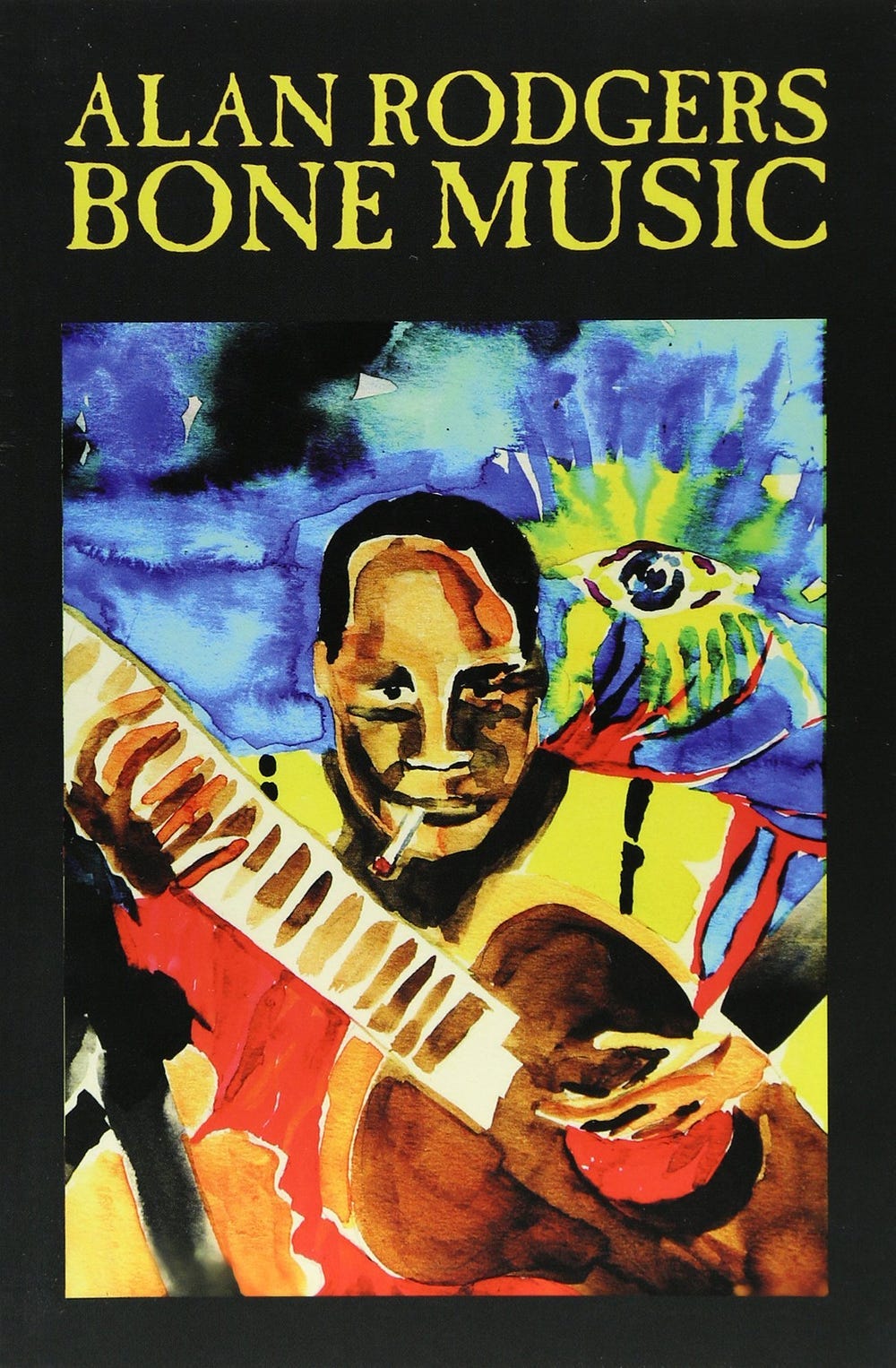
The book had looked different when I’d checked it out from the library for Mike years before, some time after I’d put the postcard from that editor at Twilight Zone into In Praise of What Persists and quit writing.
I got it for Mike because Mike loved the blues, and that was what I had gathered the book was about. There was no picture of the author on the jacket, so I surmised that Alan Rodgers was a Black southern man.
Around this time, my dad and stepmom had a couple of plane tickets they couldn’t use, so they gave them to me and Mike.
Where should we go? Mike decided, we’d fly to Memphis and visit the Mississippi Delta, the home of the blues.
I can’t describe how much, at that time, the young me did not understand or relate to blues music.
But I could relate to people and nature, so when we visited each of Robert Johnson’s three potential gravesites and yes — the crossroads — one of them was back of a small country church.
I wandered back through the gravestones, many made of cement, with names and dates and Jesus’ cross marked by hand, and saw some were covered with grass and ants.
I knelt and began to wipe some of the dirt and grass away, and the pastor came out of the church and talked with me.
In these situations, Jesus was always there too.
At first, Alan Rodgers, a Southern man, but not Black, denied ever writing the postcard rejection from Twilight Zone that inspired me to quit writing for 8 years.
When I took it out of In Praise of What Persists and showed it to him, he took it, and turned it over and over.
“You were supposed to send me your next story,” he said.
Then he said, “I only wrote four or five of those the whole time I was there. I would have bought the next story you sent.”
Jesus was there. So was Mr. B. L. Zebub and Mr. R. Guile.
I have not written fiction for about ten years.
I would like writers to understand that those of us who have to live life, and Harlan Ellison did write this to me, when I wrote him after starting writing again in the 1990s, here is what Harlan said,
You were swimming in the stream of life
So here’s a true story. Mike encouraged me to start writing again back when my daughter was small. That journey led to graduate school and my growing apart from him.
Alan Rodgers was considered a “legendary” figure in the world of horror writing and publishing. Although I never married him, we had a son, Anthony. Anthony died because his daddy left him by himself with his bottle, and he choked on the formula.
I left Alan. But I still helped him. He died of a series of devastating strokes in 2014.
After Anthony died, I didn’t quite feel —
Let’s just say the only reason I am still here able to write this is, Mike and I had a daughter, Meredith, and she needed a mother. She is healthy, happy, and 34 years old.
I’m not like other writers.
And guess what? Neither are you.
Every time you write something because you see someone else doing it, or you hear from an “influencer” or you consult anything that has anything to do with someone or thing other than yourself and those you know and love or hate — especially “telling lies for fun and profit” (thank you Mr. B.L. Zebub, or were you R. Guile this time?)
The world you live in.
The things you see, hear, taste, smell, and feel.
The swing you swung in as a little child.
The ball you played with.
The strawberry you picked and ate.
Your eyes,
Your mother’s eyes,
Your grandmother’s eyes.
In terms of my baby’s eyes, they were blue.
We all have only one life to live.
Only so many apples to eat.
Only so many peaches or plums.
Cups of coffee.
Notes to play.
Songs to sing.
I have written millions of words for pay.
But the very best ones, I wrote to learn, to feel, to imagine, to dream, to understand.
And they have made my life what it is, guided me through this stream like a fish in the river.
Shot through with time’s arrow carried into the sea.
Comments
Nothing yet. Say the first thing.
Sign in to join the conversation.