
We had the pleasure of speaking to the fabulous Rosemary Griggs back in July about her latest book. A master of historical fiction - if you have not read her Darlington Bride series I suggest you give it a try, it’s wonderful - this is Rosemary’s first major foray into the world of factual biography and I was thrilled to be sent an advanced reader copy. Kat Ashley, is like Anne Seymour in my last Tudor book, a name with whom many are familiar but few actually know anything about her. Her name is forever linked with the scandal which engulfed both Thomas Seymour and Elizabeth whilst she was, to some degree, in Kat’s charge. I was excited to find out more both about Kat’s role in this incident and about who she really was.
The blurb reads:
The name ‘Kat Ashley’, Queen Elizabeth’s ‘Governess’, is well-known to fans of Tudor history. Katherine Champernowne, later John Astley’s wife, joined Elizabeth’s household before the future queen turned three. Later she became Elizabeth’s ‘governess’, trusted with the upbringing of the King’s younger daughter. Formidably well-educated for a woman of her time, reports suggest Katherine did an excellent job. When Elizabeth came to the throne, one of her first actions was to name Katherine as Chief Gentlewoman of the Privy Chamber, a highly influential position within the court of a female monarch.
Over nearly three decades, the two women developed an unshakeable bond. Katherine served loyally during dangerous and uncertain times, enduring several spells of imprisonment. Her death in 1565, left the Queen devastated. Despite this, Katherine’s true character remains largely unknown. There has even been widespread confusion about her identity and parentage. Yet the clues are there. Katherine was not from an obscure background in rural Devon, as is sometimes claimed. Her family ties placed her amongst influential figures close to the royal court and amongst scholars, humanist thinkers, and advocates of religious reform.
Focusing on Thomas Seymour’s inappropriate behaviour towards Elizabeth while she was in the household of his wife, Catherine Parr, has led historians to conclude that Katherine showed poor judgement. Fictional portrayals and on-screen depictions often show Elizabeth’s governess as a gossipy, middle-aged nanny.
This biography offers a fresh perspective on Katherine’s significance in Elizabeth’s youth, and challenges traditional interpretations to produce a believable picture of the woman Queen Elizabeth I valued so highly.
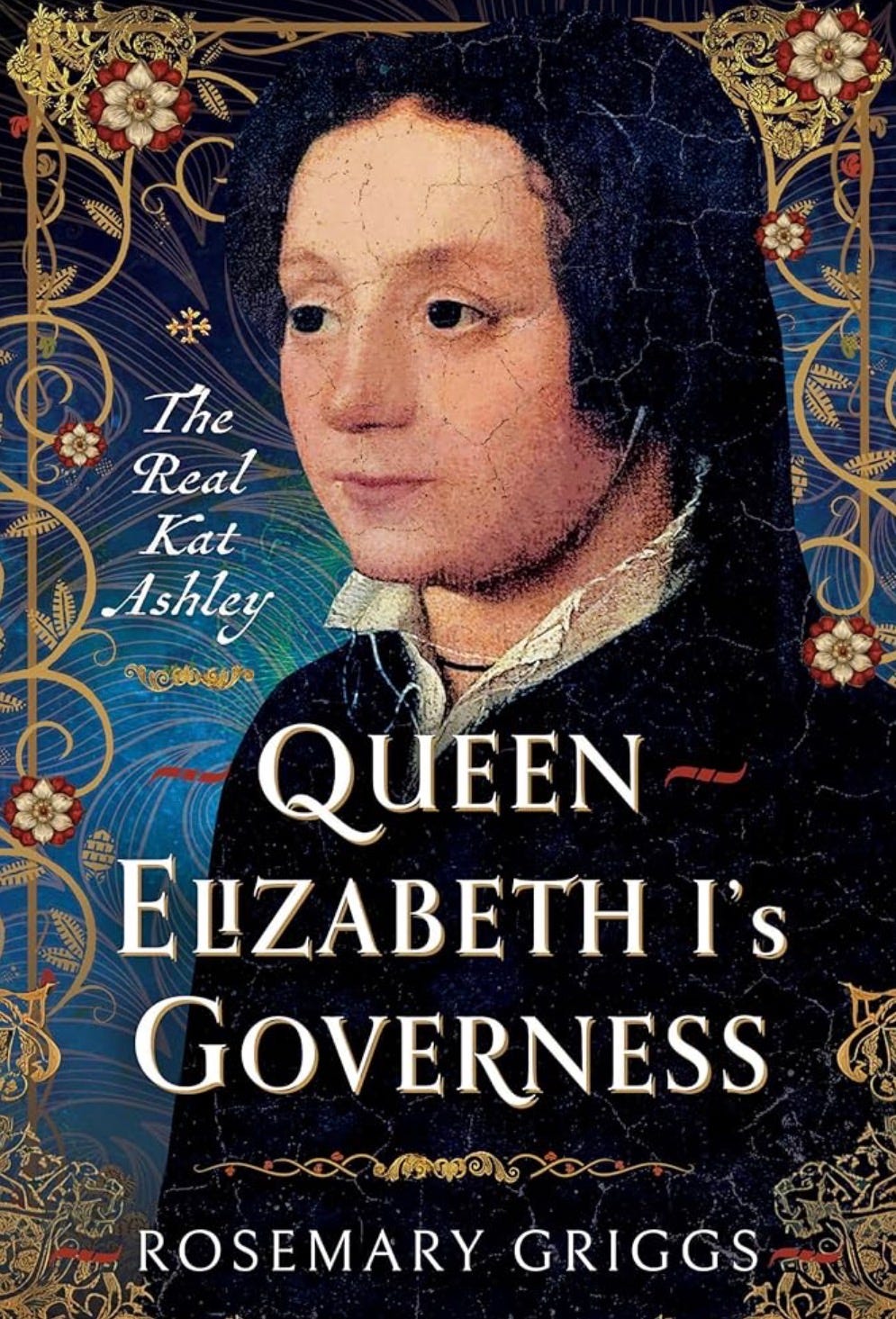
Before I begin to talk about the book I must say a word about the cover, which is absolutely beautiful and to find out more about Kat’s portraiture give our live with Rosemary a listen she has some really interesting things to say about it.
The book begins by introducing Kate, demonstrating how devastated by her death Elizabeth I was and then looking briefly at how history has interpreted Kate’s character ever since. There is something very poignant about the way in which Griggs paints a picture of the distraught Elizabeth, who shut herself away and refused to do state business for several days whilst she mourned Kat’s passing. Right from the start this felt like a very human story, and it is also clear that the research behind it is detailed and sound. The references are detailed and it would be easy to find the sources yourself if you wanted to undertake further research.
The extensive list of key personnel and the family trees included are invaluable, as the Champernownes, Kate’s birth family, are a complex lot, but here Griggs manages to untangle them admirably. It is obvious that she has undertaken a huge amount of detailed research on the family. I loved reading about Kate’s ancestors: William who escaped from St Albans only to die young and suddenly, Philip with his learned mind and Courtney connections - all were fascinating to learn about. Kate’s early life is likewise contextualised extremely well, we find out how she was connected to leading families at the Tudor court and how she came to the attention of important figures. I won’t spoil the book by giving too much away but Griggs illuminated for me a whole network of families which I only had a scant knowledge of.
The book moves through Kate’s life chronologically and one of my favourite sections was when we encountered George Carew again and events down in Devon as the ideas of the reformation began to take hold. This thorough approach allows us to place Kate, and look at her, in the full context of the world, and the family she was living in.
Part 2 moves on to look at Kate’s career, which is where we meet more familiar names such as Henry VIII and of course Elizabeth. I love the way Griggs intersperses her narrative with primary sources which illuminate her life and character - Roger Ascham’s words feature regularly as do those of men such as Sir Anthony Denny.
Of course the Thomas Seymour affair is mentioned and analysed through the eyes of Kate. Again I won’t say too much here, but I feel that Grigg’s scholarship here truly adds to our understanding of these events. There is also a fascinating Appendix which gives the best analysis of Sir Robert Tyrwhitt’s “confusing letter” of 1549 that I have ever read.
In case you haven’t guessed by now I thought this book was utterly brilliant. I really enjoyed it and it’s right up there as a contender for my book of the year. Anyone with an interest in history full stop should go out and buy it.
⭐ ⭐⭐⭐⭐
Queen Elizabeth I’s Governess: The Real Kat Ashley is released on the 30 August 2026 and can be preordered from all the usual places.
Comments
Nothing yet. Say the first thing.
Sign in to join the conversation.