
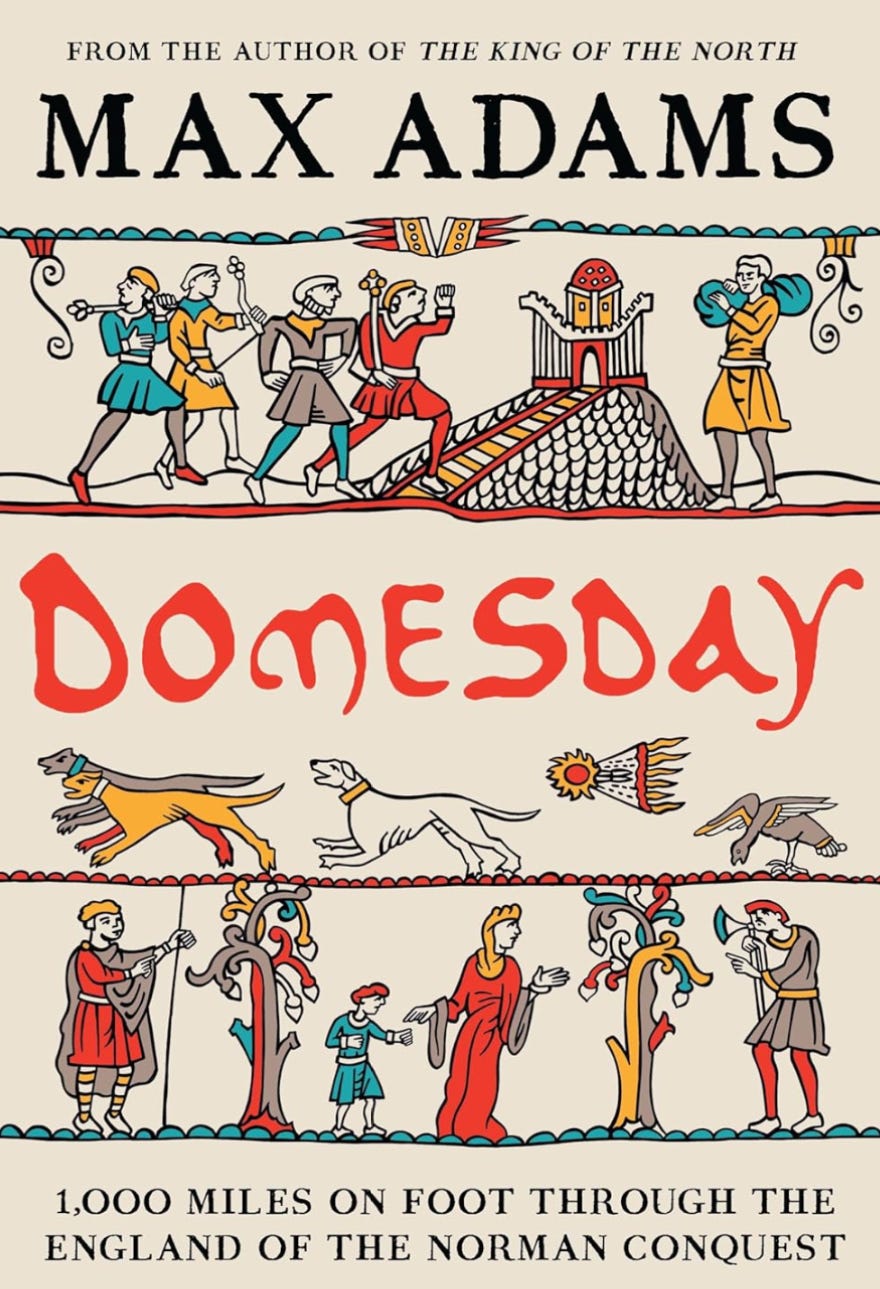
It is no secret to anyone who knows me that I love Max Adams’ work. His research on men such as Oswald, AEthelbald and Offa is second to none. He is also an archaeologist - which automatically gives him bonus points. The way in which he combines archaeological research with narrative story telling, is in my opinion, second to none. I’m sure, having said that - it is easy to imagine how keen I was to read his new book - Domesday - in which he walks through the England of the Norman conquest. I was lucky enough to be sent an ARC and the book will be released on 3rd September this year. It can already be preordered from all the usual places and I’ll pop a few links at the end of this review.
The blurb reads:
When King William I sent his agents to survey every shire in England, he asked them to list his holdings and calculate what was owed to him. The manuscript record of the resulting ‘Great Survey’ is not just a tax record, but a unique window onto the structure of English administration and economy before and immediately after the Norman Conquest: its shires and hundreds, acres, hides and townships.
In Domesday, Max Adams retreads the path taken in 1085 by King William I’s agents, taking us on foot through the very sites covered by one of the most iconic documents of English history. In this fascinating new history, Adams explores this unique portrait of a land and its people, bringing the past into intimate contact with the present.
Adams brings us face to face with this legacy in his wanderings through Domesday’s landscape, evoking eleventh-century England through contemporary eyes with the original account as his guide. Bringing together archaeology, contemporary chronicles and historical geography, Adams fleshes out the landscapes of a thousand years ago, peopling them with real actors: lords, thegns, villeins, cottars and slaves; with the millers, turners, priests and burgesses who yielded their taxes and labour to new, Norman lords. In meeting their modern counterparts - shopkeepers, farmers, craftspeople and local officials - Max casts reflective light on Englishness and the English landscape; on our ongoing relations with tax, law and authority; and with the past.
Having said how keen I was to read this, I did approach it with trepidation. This is a new approach for Adams and I personally am not usually a fan of introspective walking journeys, even historical ones. I’m not going to lie, I didn’t particularly enjoy the personal aspects of this one either, but it is a fantastic book regardless.
Adams opens by setting the scene, reminding us of the context in which the Domesday survey was undertaken and compiled. Then he moves on to the first part of his journey which was undertaken from Lincoln to King’s Lynn. The text seamlessly weaves together the archaeology and history of Domesday, comparing sights, and landscape features. Specific details such as the fact that Holbeach was shared between the monastic communities of Sr Gudlacs, Crowland and of Count Alan at the time of Domesday fill the text and the author brilliantly explains what that would have meant in reality and why - bringing a long lost world to life.
Each section of his walk is preceded by a section which outlines and explains the historical context. The story of 1066 and the events following it are well known, but through Adam’s pen the story becomes fresh and engaging.
One of the most fascinating locations Adam’s looks at here, for me, is Deerhurst with its complex and fascinating history related to the Hwiccian kings and those of Mercia. The author’s descriptions are lyrical and immersive, I almost felt like I was walking with him though the dressed stones and white washed wall. The decision to include some images was also a great one - these really helped to bring the whole journey to life for me.
Adam’s also details throughout the whole book the process by which Domesday was compiled, and he weaves this cleverly into the text. He uses numerous contemporary sources, such as the Anglo Saxon chronicle or the account of Bishop Robert Losinga which relates details of the Domesday inquisition. These are accurately referenced which would be useful if you wanted to undertake further research yourself.
This is a really well thought out, interesting and unique book. It sheds genuinely new light on the world of Domesday. Reading it I also compiled a long list of places that I would like to visit or to revisit with the book in hand. I’d highly recommend it to anyone with an interest in the Anglo-Saxon or early medieval period, or even with any interest in history at all. Everyone in the country has heard of Domesday and this book is the best way I can think of to learn more about it.
⭐️⭐️⭐️⭐️⭐️
Preorder links:
Comments
Nothing yet. Say the first thing.
Sign in to join the conversation.