
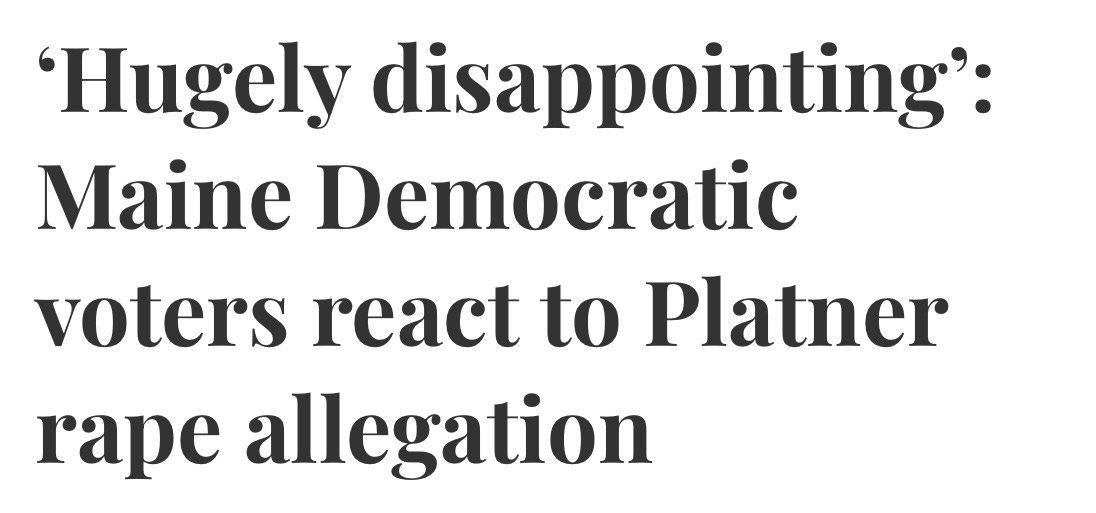
Headline: Portland Press Herald, July 7/8, 2026:
For months, Democratic Senate candidate Graham Platner inspired and mobilized tens of thousands of Mainers with his messages about class inequality and power.
While there are numerous positive lessons to draw from the Platner campaign, we should recognize its negatives. One was a culture of misogyny.
Platner’s campaign was heavily burdened by internal dysfunctions and a steady drip of troubling news about the candidate. Following a corroborated report of sexual assault, virtually every endorser rescinded their support and Platner exited the race.1
This is a very difficult moment for Maine Democrats, regardless of whether they backed Platner’s run. For many, it is painful to let go of a candidacy into which they poured massive emotional energy and many hours of volunteer labor.
Platner’s grassroots supporters bear no blame for their candidate’s deep personal flaws. Instead, they should be commended for their commitment to making our country fairer and more just.
As an eternal optimist and believer in rationality, I think we should be clear-eyed about what happened so we can learn from it.
We’re finding out more about what was going on internally and the picture isn’t pretty. “Sexist, misogynistic” Platner advisers sidelined women who worked on the campaign.
One top out-of-state advisor who actively recruited Platner, Daniel Moraff, had his own significant baggage.
Journalist Mike Elk revealed that Congresswoman Summer Lee barred Moraff from her 2022 campaign following multiple complaints of sexual misconduct. Elk also reported that Moraff pressured him to falsify reporting regarding an independent male working-class challenger in Pennsylvania to protect a preferred narrative.2
In other words, Moraff was both sexist and dishonest while working for candidates.
That mattered because Platner’s campaign was an operation largely run by male consultants from away who arrived in Maine to promote a specific brand.
Despite the reality that most working class people are women, these strategists were fixated on finding a man who fit a particular aesthetic ideal of a male blue-collar worker.
These operatives didn’t know Maine politics, and they didn’t particularly care whether Platner truly reflected Maine working class folks.
Consider this warning sign from a profile published in December 2025, quoting a prominent union leader at Bath Iron Works:
“I’m not so sure that I’m going to vote for Graham,” said Williams, the union leader in Bath who had been the original target for recruitment. To Williams, Platner looked like “a non-working-class person’s idea of a working-class person.” He added, “We have 4,300 members here... and I think the majority feel the same way.”
As the campaign developed, the internal operational chaos extended from nearly nonexistent vetting to rapid spending rates. (That left me wondering how much donor dough went into the pockets of national consultants. We’ll find out after the final filing with the FEC.)
All the while, insular staff fed the candidate a steady stream of puffery, telling him he was “the one,” a “hero of the movement,” and a “historical figure” destined to run for president in two years.
With that fluffing and flattery, it’s no surprise that Platner’s eventual withdrawal statement was a toxic mix of conspiracy-mongering, entitlement, and a total lack of personal accountability.
Strikingly, his statement contained not a single word acknowledging the profound harm of sexual violence against women.
Many Maine women have their own experiences with the Platner’s campaign’s defensiveness and lack of responsiveness. Here is mine.
When initial reporting emerged regarding Platner’s past abusive behavior, I published a piece titled “To Beat Susan Collins, Graham Platner Must Confront Misogyny.”
I contended that, by casually dismissing his actions as merely being “a bad boyfriend,” Platner failed to comprehend the systemic harm of gendered abuse. I suggested that demonstrating genuine growth on these issues and connecting them to concrete policy platforms would broaden his appeal and help him defeat Collins.
While some feedback to me from Platner backers was negative or ambivalent,3 there was also recognition that he had downplayed abuse and this was both wrong and bad politics.
Platner supporters who told me the critique was valid tried to elevate it to the campaign, as did I. However, I never received a response from top staffers, and as far as I can tell, neither did anyone else.
Nor did I see Platner take any concrete steps, like meet with sexual abuse survivors or with policy makers focused on sexual harassment and rape in the military and civilian life.
At one point I had an email conversation with a woman inside the campaign who told me that other women working for Platner thought I was right and believed it was important for Platner to learn more about gendered abuse and to be held accountable. A friend contacted the same person and, after getting the green light from her, we compiled and sent in a reading list for Platner, which seemed needed given what he was saying and because his favorite reads left out women’s issues altogether.
Once again, top leadership ignored the effort and I know I wasn’t the only Maine woman who tried making this sort of case to the campaign.
But the instinct to attack or freeze out anyone raising questions about gender was endemic to its internal culture.
With Platner’s candidacy now in the rearview mirror and the party turning to select a new nominee, it would be easy to simply move on. Indeed, with upcoming deadlines, it’s absolutely necessary to take some next steps.
Democrats’ focus should certainly not be recriminations. At the same time, they cannot afford to ignore the broader lessons of this collapse.
Having a senior staff that is misogynistic and disrespectful toward women harms a campaign that calls itself a movement and says it’s seeking profound transformation.
When candidates hire staff, how they treat women should matter. And consultants who conflate “working class” with a certain style of masculinity misunderstand the contours of class and erase working class women.
Candidates should understand women’s experiences in their hearts, minds and bones.
Women’s lives are shaped by navigating environments where they’re vulnerable to and sometimes harmed by male harassment and abuse.4 That’s true whether a woman is a waitress, factory worker or soldier, or holds a white collar job. Candidates should have policy ideas to address those issues.
It’s good to talk about the power of the oligarchy and, yes, gender isn’t everything. Class and race and other social divides also matter. But knowing and caring about women and gender is not “identity politics.” It is recognizing the realities of more than half of adults.
No candidates are above criticism.
I once heard Platner say during a Zoom town hall that he expected to be held accountable if he reached the Senate. And, he was right! Accountability and transparency matter. With his many town halls, Platner demonstrated that listening to voters is essential, but he and his own staff also derided and ignored good faith feedback.
You cannot build a durable, sustainable grassroots movement when it relies on uncritical devotion to a single leader.5
Some Platner supporters are still defending him and, like Graham Platner himself, blame others for him withdrawing from the race. However, it looks to me like overwhelmingly Platner backers have moved on because they’ve focused on the campaign’s messages and beating Collins, not one man. That’s healthy and helpful.
These are essential lessons to learn as Democrats craft a path forward.
Per Politico, “The woman, a 41-year-old Maine resident named Jenny Racicot, detailed the alleged incident to POLITICO in three interviews over the past two weeks. POLITICO also spoke with a man Racicot dated and confided in the years after the alleged incident, and reviewed documents, including emails between Racicot and her therapist and messages between Racicot and an acquaintance whom she warned against getting involved with Platner years before he ran for office.” The NYT hadn’t reported the rape in their June report on his abuse of women, but a recent article on how they corroborated their story hints that she might have told them about it off the record.
While researching the candidate, Moraff discovered past anti-Trump quotes his prospect had given to the press and explicitly asked the reporter to delete them. Reporter Mike Elk wrote “When I heard that Moraff was involved in vetting and recruiting Platner, I recalled this experience. It showed me that Moraff was willing to lie to get someone elected and to ask journalists to do unethical things to help sell those lies…As we examine what went wrong with Platner, we should question the political consultants and influencers, such as Moraff, who shape public opinion.” From a different author, note this piece on “The Platner Class.”
Some Platner backers who were critical of my piece responded very defensively, falsely claiming any criticisms of Platner were aimed at damaging his electoral prospects. The blowback occasionally veered into dark territory. One reader wrote to me directly to claim there was “something amiss” in the media coverage, stating, “There is some indication that one of the writers had an obvious bias, as a Jewish activist, which I’m sure you know all about.” The casual anti-Semitism of the comment floored me. A few supporters displayed deep ambivalence, alternating between posting angry public defenses of the candidate and sending me private messages agreeing that Platner desperately needed a feminist education.
Some readers might be thinking, “Isn’t uncritical devotion to a leader what we see from MAGA toward Donald Trump?” Well, yes.
No posts
Comments
Nothing yet. Say the first thing.
Sign in to join the conversation.