
Memorial Day is often seen as a holiday about military service and lumped together with Veterans Day. But the holiday has its own distinct history, one which today’s opponents of racial justice could call “woke.” We should appreciate how and why it was created after the Civil War.
Memorial Day also marks the start of the summer fun season of picnics and barbecues. It’s also a big occasion for sales and shopping. But that’s not what it’s about.
You might vaguely remember that Memorial Day was sometimes called Decoration Day. But was anything decorated? Well, yes.
What was decorated were the graves of Civil War soldiers. And while Southerners also did that for soldiers who fought to retain their ability to hold and trade Black people as property, Memorial Day was established by supporters of the Union.
The holiday was no race-neutral creation.
When Major General John A. Logan issued his May 5, 1868 order initiating commemorations for Memorial Day, he said his purpose was “preserving and strengthening those kind and fraternal feelings which have bound together the soldiers, sailors and marines who united to suppress the late rebellion.”
But Logan wasn’t just concerned with the South’s sedition. He also focused on slavery and race.1
What can aid more to assure this result than by cherishing tenderly the memory of our heroic dead who made their breasts a barricade between our country and its foes? Their soldier lives were the reveille of freedom to a race in chains and their deaths the tattoo of rebellious tyranny in arms. We should guard their graves with sacred vigilance.
This emphasis wasn’t new.
Two years before this first Memorial Day, Logan compared “traitors in the south” to a Black man “who has gained his liberty by the march and prowess of American arms.”
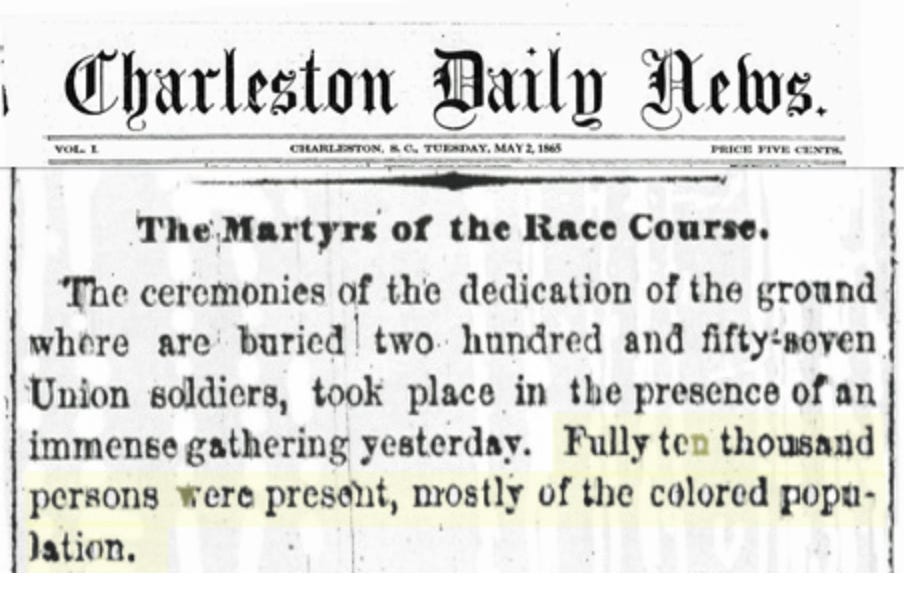
And historian David Blight observed that “the earliest and most remarkable Memorial Day” was in Charleston, SC in 1865, when “freedpeople, who then, in cooperation with white missionaries and teachers, staged a parade of 10,000” at a race course that had been a prison for Union soldier.
The procession was led by 3,000 black schoolchildren carrying armloads of roses and singing the Union marching song “John Brown’s Body.” Several hundred black women followed with baskets of flowers, wreaths and crosses. Then came black men marching in cadence, followed by contingents of Union infantrymen. Within the cemetery enclosure a black children’s choir sang “We’ll Rally Around the Flag,” the “Star-Spangled Banner” and spirituals before a series of black ministers read from the Bible.
While one Civil War cause deserved commemoration and the other condemnation, the South pushed back.
As part of what was seen as a corrupt bargain, President Rutherford B. Hayes withdrew federal troops from the South in 1877. The Supreme Court ruled against key Reconstruction laws.
Shifting the meaning of Memorial Day away from a holiday rooted in emancipatory results was part of these anti-Black developments.
Abolitionist and former slave Frederick Douglass saw and spoke out.
In a Memorial Day speech titled “There Was a Right Side in the Late War,” delivered a decade after Logan’s order, Douglass called for remembering what the war was really about and did not flinch from describing how racist systems were being reimposed.
Douglass told attendees “the great work you undertook to accomplish is still incomplete… the elective franchise has been overborne by intimidation…the Southern States, under the idea of local self-government, are endeavoring to paralyze the arm and shrivel the body of the National Government so that it cannot protect the humblest citizen in his rights.
And so Douglass proclaimed:
Yes, let us have peace, but let us have liberty, law, and justice first. Let us have the Constitution, with its thirteenth, fourteenth, and fifteenth amendments, fairly interpreted, faithfully executed, and cheerfully obeyed in the fullness of their spirit and the completeness of their letter. ..
[The Civil War] was a war of ideas, a battle of principles and ideas which united one section and divided the other: a war between the old and new, slavery and freedom, barbarism and civilization; between a government based upon the broadest and grandest declaration of human rights the world ever heard or read, and another pretended government, based upon an open, bold, and shocking denial of all rights, except the right of the strongest.
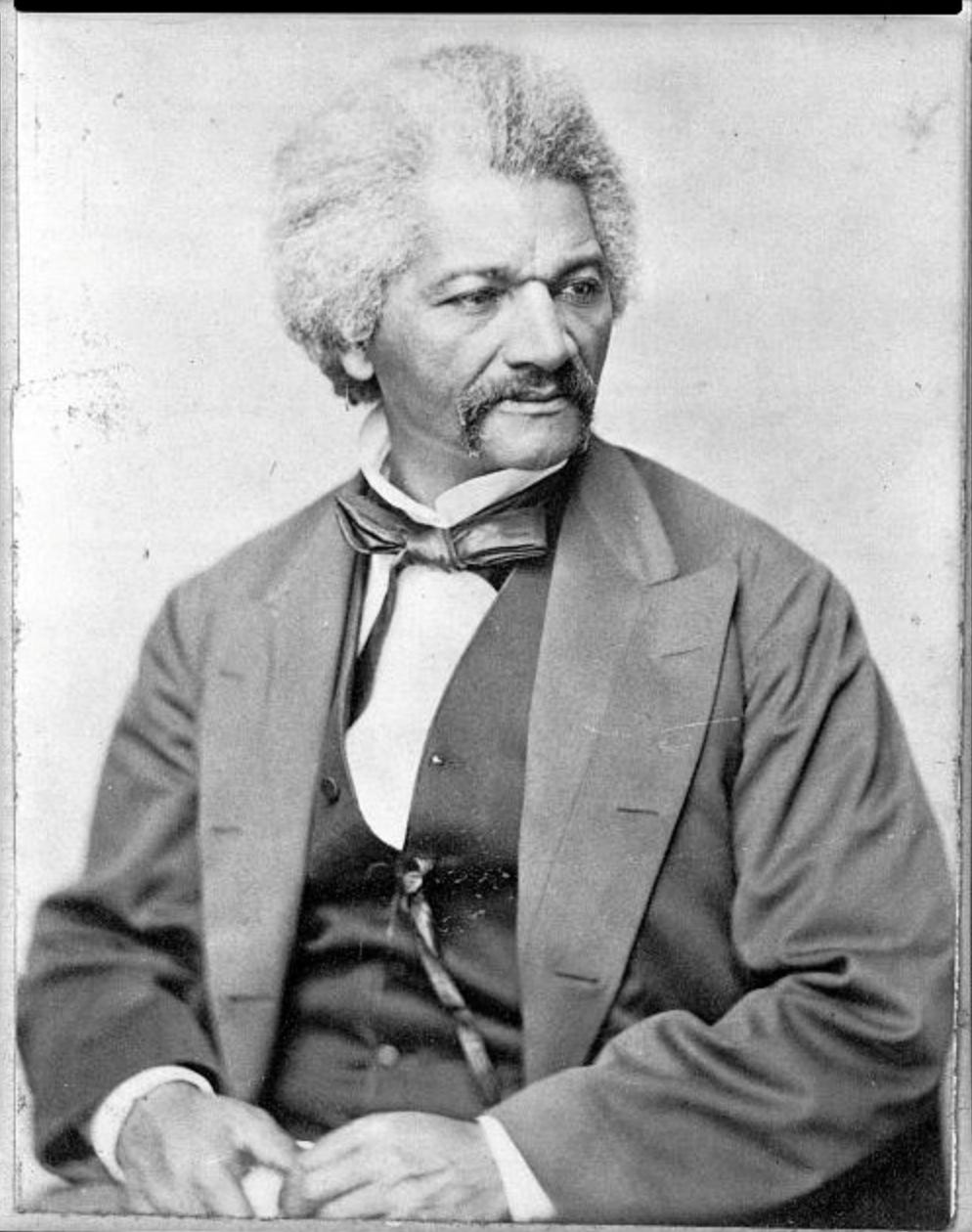
Frederick Douglass, 1870, Library of Congress.
By the end of the 19th century, Memorial Day remembrances encompassed fighters from the North and South, as part of an ill-conceived attempt at full reconciliation that papered over the realities of what it meant to live enslaved and ignored post-Reconstruction segregation, white supremacy, and voter suppression.
And later its Civil War roots became largely forgotten2
There are so many horrible projects of the Trump administration it’s hard to keep track of them all.
One involves race and power, not only today but also to define who we are and have been. Trump wants to push aside and erase past struggles against oppression.
In the early days of Trump’s second administration, signs in national parks about the history of racial oppression were taken down.3 Grants were defunded or cast aside if they talked about unequal power or focused on any marginalized group. Those and any efforts to counter discrimination were called “illegal DEI.” And the Trump Supreme Court, using bad statistics and a misunderstanding of history, has basically dismantled the Voting Rights Act.
Actively removing racial struggles from how we see American history falsifies our understanding of American political development and serves white supremacy today.
There will be an enormous amount of work to fight and recover from this damage. Properly remembering the real origins of Memorial Day is one small step worth taking.
Earlier in his life Logan was pro-slavery, but he shifted his views on race and emancipation during the Civil War. During the war, he supported including Black volunteers and afterwards, as a legislator afterwards, he backed the post-Civil War constitutional amendments ending slavery, granting birthright citizenship and enabling Black individuals to vote. He also supported women’s suffrage. Note also that Logan’s wife had some responsibility for him issuing his Memorial Day order.
A fabulous book on shifting historical memories of the Civil War, which, yes, discusses Memorial Day, is Race and Reunion: The Civil War in American Memory by David W. Blight. Professor Blight’s Yale University course on the Civil War and Reconstruction can be seen on YouTube.
In what must be an oversight of the Trumpian history erasers, an accurate view of Memorial Day’s roots can be found on the website of the National Cemetery Administration, which is part of the Department of Veterans Affairs.
No posts
Comments
Nothing yet. Say the first thing.
Sign in to join the conversation.