

Either Democratic nominee Troy Jackson or Republican Susan Collins will win the Maine Senate race but they’re not the only candidates. How could that matter?
A possibility has been causing a ripple of worry among some Democrats, that a write-in candidacy by Graham Platner could harm Troy Jackson’s chances to beat Susan Collins.
While a very small group asked the former Senate nominee to register as an official write-in, it turned out he had no interest in doing so.
Now the deadline to register as an official write-in candidate for the Senate race has come and gone and six Mainers have done so.1 Graham Platner isn’t one of them.
And with ranked choice voting available in the Maine Senate race, this wouldn’t have undermined Jackson’s vote totals if people followed organizers’ directions to rank Platner first and Jackson second.
But I’m still seeing some anxiety from people who really want to defeat Collins and are concerned about voters writing in Platner as an unregistered write-in.
It’s true that first rankings on ballots for Platner would come from voters who would almost certainly rank Jackson first instead. But if either Collins or Jackson gets under 50% initially -- and let’s remember, Collins only got 51% of the vote in 2020 -- there would be a ranked choice tally.2
With ranked choice voting, it doesn’t matter how much the vote is split initially. The winner has to get over 50%, either initially or after the ranked choice runoff.
If Maine’s laws and rules are followed, votes for Platner, an unregistered write-in, wouldn’t harm Jackson’s candidacy assuming that people who rank Platner first then rank Jackson second.
I’ll explain why.
Let’s look at different components of the process.
Registered and non-registered write-ins ranked first are treated differently.
Registered write-in candidates have those initial votes for them added up.
In contrast, first rankings for non-registered write-in candidates are considered skipped/blank votes. That doesn’t mean those ballots are automatically discarded.
If there’s a ranked choice tally, ballots with skipped/blank first place rankings aren’t ignored if there was a second ranking of a candidate who isn’t a write-in.
Here’s the rule that applies:
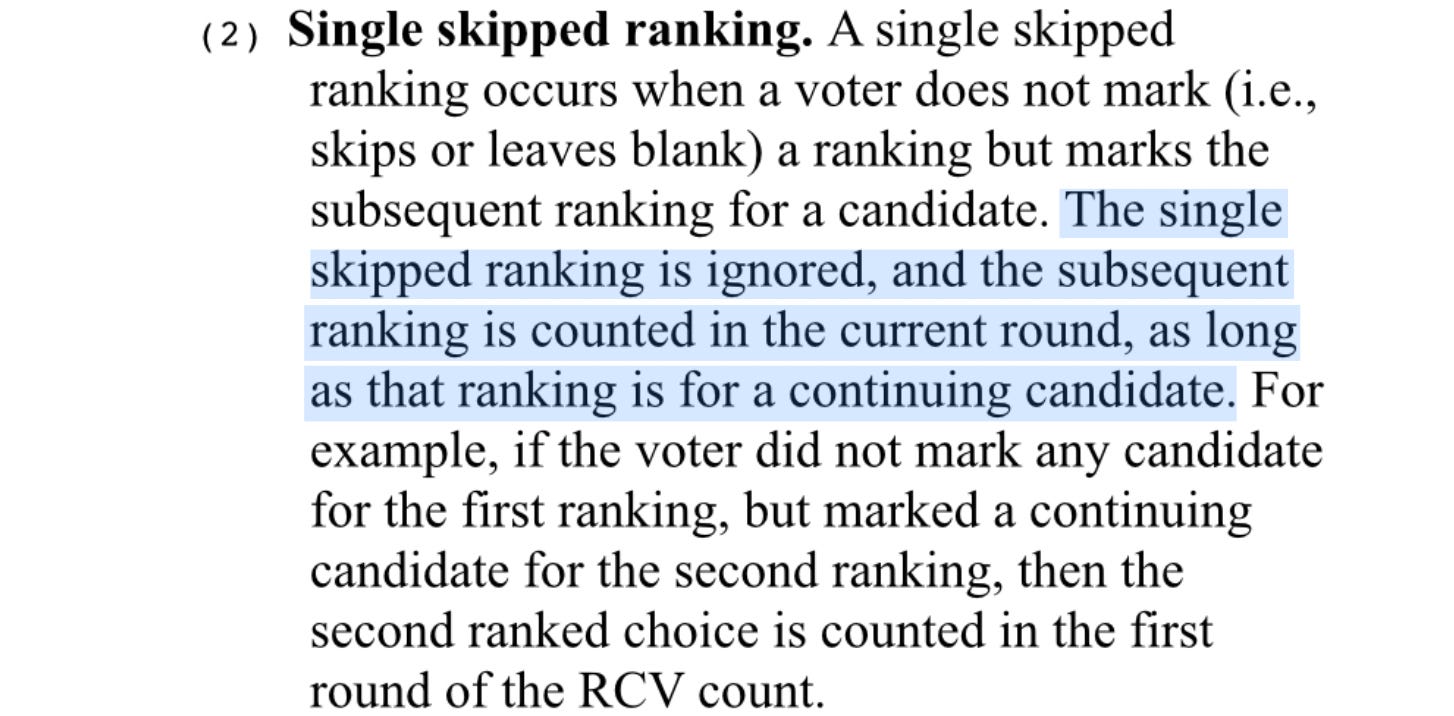
Ballots with a skipped/blank first place ranking are part of the pool examined if no candidate got over 50% on the first round.
So if there’s a ranked choice tally, any later rankings will move to candidates who haven’t been eliminated.
Maine has already seen a race decided with ballots from voters who ranked write-in candidates first then ranked another.
This happened in 2024 for the ME-2 congressional race, when neither Rep. Jared Golden nor his Republican opponent won a majority with first rankings.
Golden got 48.65% and Theriault 48.11%, about one-half of one percent apart.
There was an official write-in candidate, Diana Merenda, who got one-tenth of one percent of the vote. A little over 3% of the ballots had a blank first choice.
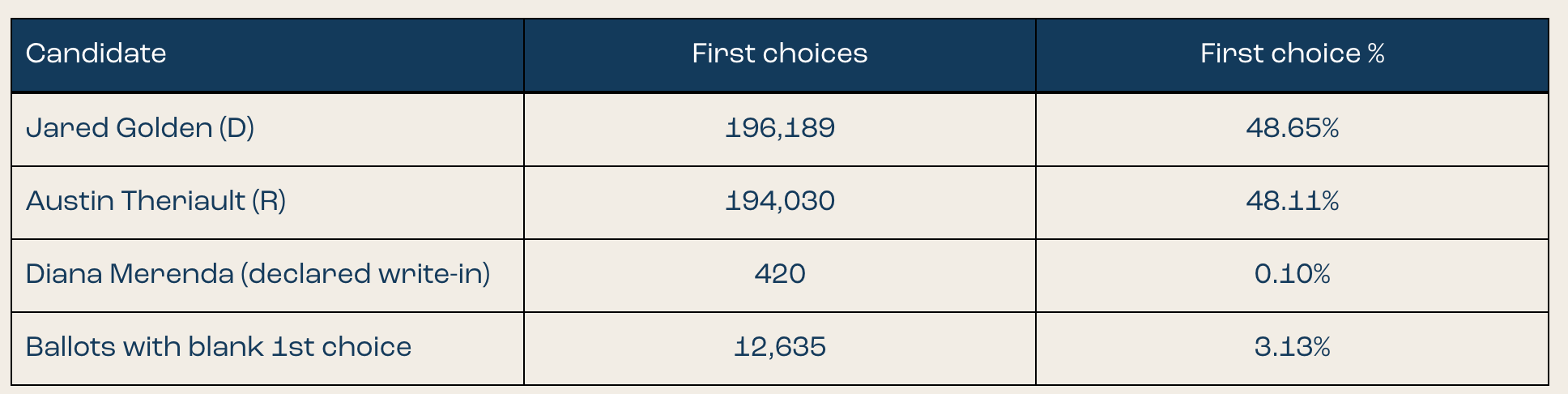
Table of ME-2 2024 first round results from FairVote.
Some of those blanks were truly blank, with voters who decided not to vote for any candidates in that race. Other ballots described as having blank first choices had votes for unofficial write-ins in that first ranking. Some included second rankings.3
If you do the math, it’s obvious that more than second rankings from voters who ranked the official write-in first were included in the final ranked choice tally.
Golden had 196,189 first round votes and Theriault had 194,030. After the ranked choice runoff, Golden had 197,151 votes, while Theriault had 194,445 votes.
The official write-candidate, Diana Merenda, received 402 first round rankings. She was eliminated and any second round rankings from ballots which ranked her first were redistributed. But more than 402 votes went to the top two candidates in the second ranked choice round.
Golden picked up 962 votes from second rankings and Theriault received 415 second rank preferences. Overall, 1377 (962+415) second rankings were included in the final tally.4 These additional votes, above the ones from voters who ranked Merenda first, came from ballots with skipped/blank initial rankings. No doubt many of those had first rankings for unofficial write-in candidates.
We can assume that write-in candidates this year again won’t do as well as either major party nominee.
Thus, if Maine Senate voters this year ranked an official or unofficial write-in candidate first and no one got over 50% initially, the write-ins would be eliminated in first round of the the ranked choice tally. Then the second rankings for both sorts of write-ins would be redistributed and determine the outcome.
For those who want to write in Platner as their first rank and then Jackson, this wouldn’t harm Jackson winning. But, as I explain below, I don’t think it’s a good idea.
Two problems come from other rules governing ranked choice in Maine.
Two blank/skipped votes at the start invalidate a person’s ballot. Also a voter can’t include more than one write-in candidate in their rankings.
Some people might not know that and would vote in a way that leads to having their ballots tossed.
I also think voters who want to defeat Susan Collins have one real choice: Troy Jackson. He’s authentically working class and supports great policies on health care, union rights, reproductive rights, fairness for all, and economic equality.
No doubt there are good people with good ideas among the write-in candidates.
But coming together now and working hard for Troy, not dividing energies, is the way forward for flipping the Senate seat, putting a real check on Trump (which Collins hasn’t and won’t do), and getting better policies.
Trump and his Department of Justice could try to interfere with any result in which Collins got a plurality and then lost in a ranked choice scenario. Would they be effective ultimately? Well, that depends on what the courts do and they’ve lost a lot of cases. But, as I note below, you can’t really count on the Supreme Court to uphold the law and the Constitution.
And then there’s the federal courts. While they’ve upheld ranked choice in the past, including for Maine races, who can really trust the Supreme Court these days? I don’t.
The Court’s majority is unabashedly partisan and has put its thumb on the scales for Trump many times. If they’re faced with a case where they can decide if Jackson or Collins wins, they could pull out some tortured reasoning, like the Supreme Court did in awarding the presidency to George W. Bush in 2000. Who knows, maybe they’d decide that only official write-in ballots can be used in the ranked choice tally, or maybe they’d throw out RCV altogether. Why take that chance?
So, while under Maine law and rules ranking a registered or unregistered write-in candidate first and then ranking Troy Jackson second wouldn’t harm Jackson’s vote totals, it opens the door to errors and divisiveness, and meddling by a politicized Supreme Court.
One: JD Vance smeared Johan Sebastián Durán Guerrero, a nonviolent, hardworking legal immigrant murdered by ICE in Biddeford. In defending this killing while in Maine trying to help Republican ME-2 candidate Paul LePage defeat Democrat Matt Dunlap, Vance invoked drug trafficking, which Vance claimed provided “perspective.”
Durán Guerrero’s family lawyer, Ben Gideon, laid into Vance and dismantled every rationale offered by the Vice President:
“Nobody—not DHS or ICE—has suggested that Johan Sebastián or anyone else who was the target of the operations that day had any connection to the drug trade…Vice President Vance went to law school. He knows that it is unlawful to arrest someone without probable cause, and in this case, there was no probable cause to believe that Johan Sebastian had committed any crime.”
Two: In response to ads asking Maine voters to thank Susan Collins, Brenda Power writes that any positive achievements are far outweighed by the negatives, rendering Collins unworthy of reelection.
Addressing Collins, Power wrote:
“You had more responsibility than almost any other legislator as the mighty Appropriations chair to advocate for Congress’ power of the purse, yet you held not even one committee oversight hearing to challenge DOGE or Trump’s executive orders rescinding funds. I’m not the greatest at math, but even I know the $1.5 billion you’ve brought to the state for worthy projects is a pittance compared to the many billions Mainers face in losses from your party’s unrelenting cuts to Medicaid, food assistance and rural hospitals.
Three: Even when the term “socialism” is viewed negatively, voters, including Republicans, consistently back policies often categorized as democratic socialist.
From Newsweek: “Recent polling has found notable Republican support for ideas including paid family leave, raising the minimum wage, taxing billionaires, expanding government health coverage and slowing the rapid expansion of AI data centers.”
This post assumes the reader understands the basics of ranked choice voting. If you don’t or want a reminder, here’s a sweet explanatory video by then Maine Secretary of State Matt Dunlap. But if you watch it, come back and read this post to learn about RCV and write-in candidates.
There may not be many ballots with skipped/blank first rank votes that also include a second vote. In 2024 FairVote noted that “In the 2022 ME-2 race, 6% of ballots that did not mark a first choice marked a valid second choice. In the 2018 ME-2 race, 9% of ballots that did not mark a first choice marked a valid second choice.”
As Rachel Ohm of the Portland Press Herald put it, “In 2024, U.S. Rep. Jared Golden was narrowly reelected following an unusual ranked-choice run-off featuring a write-in candidate. Golden won after 420 votes for write-in candidate Diana Merenda and some 12,600 ballots that were either blank or listed an undeclared write-in were redistributed based on voters’ second choices. Ranked-choice voting was used because Merenda had formally declared as a write-in, even though most of the ballots that ended up coming into play were actually blank or for undeclared write-ins on the first-round.”
No posts
Comments
Nothing yet. Say the first thing.
Sign in to join the conversation.