
A quick personal note: My role was impacted by a recent restructuring, so I'm currently looking for my next product management opportunity. The newsletter isn't changing: I'll continue publishing one free newsletter and one paid newsletter each week, including the templates and guides for paid subscribers. Thank you for being here and for your support—it means a lot.
Product managers are developing new capabilities for a faster product environment:
Builder product managers make ideas tangible faster
Product context makes thinking portable
New operating models help teams work at a faster pace
Invisible integration helps distributed work fit together
These capabilities let us move faster in product. They also mean plans change just as fast. For example:
Engineering discovers the design isn’t feasible.
Sales raises a customer problem.
A key person changes roles.
AI makes a different implementation suddenly feasible.
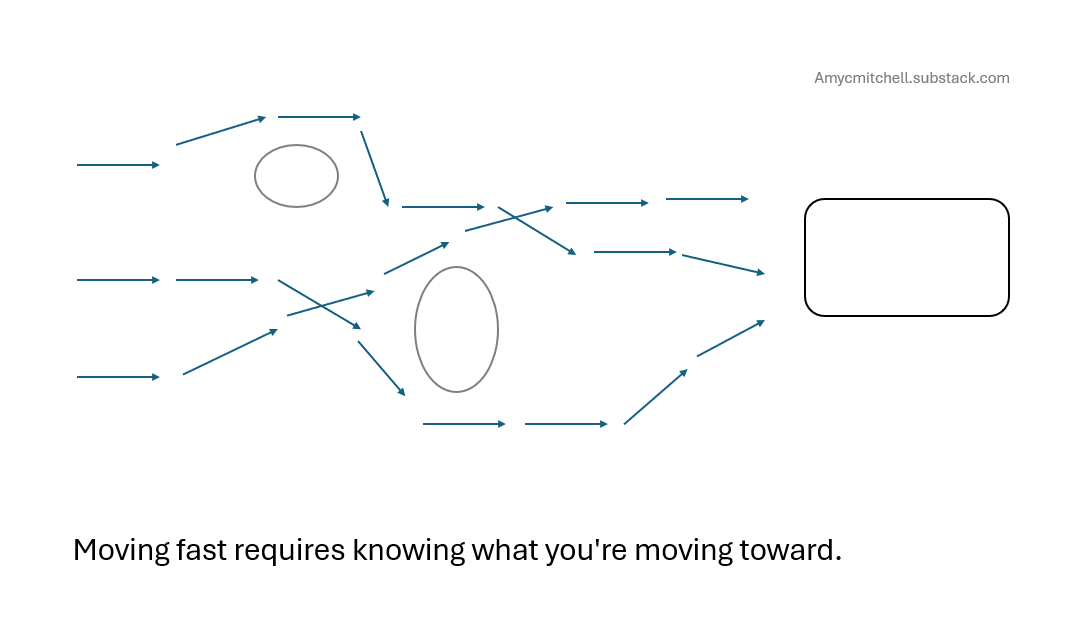
The outcome stays the same. The path changes.
The next challenge is keeping the product moving even when the path to the outcome changes.
Whether you are working on a feature or a product initiative, there are multiple ways to reach the outcome. Even with extreme time and resource constraints, product teams collaborate and find options to deliver.
After working through tradeoffs, something changes and then you have new options.
Many of these changes don’t affect the destination. The path to reach the destination changes.
If you know change is coming, then you act differently. Product management examples:
Making a directional decision: a product manager delivering a feature to onboard customers sets a direction while the lead architect is on vacation.
Creating a point of view: two product managers agree that the units of measure for a new feature are nodes instead of GPUs before meeting with customers
Target customer strategy: selecting target segments based on early adopter customers and adding segments as the product grows.
Pricing strategy: directional pricing based on customers’ willingness to pay and adjusting after a few sales
In each case, the destination stayed firm, but the path to the destination changed.
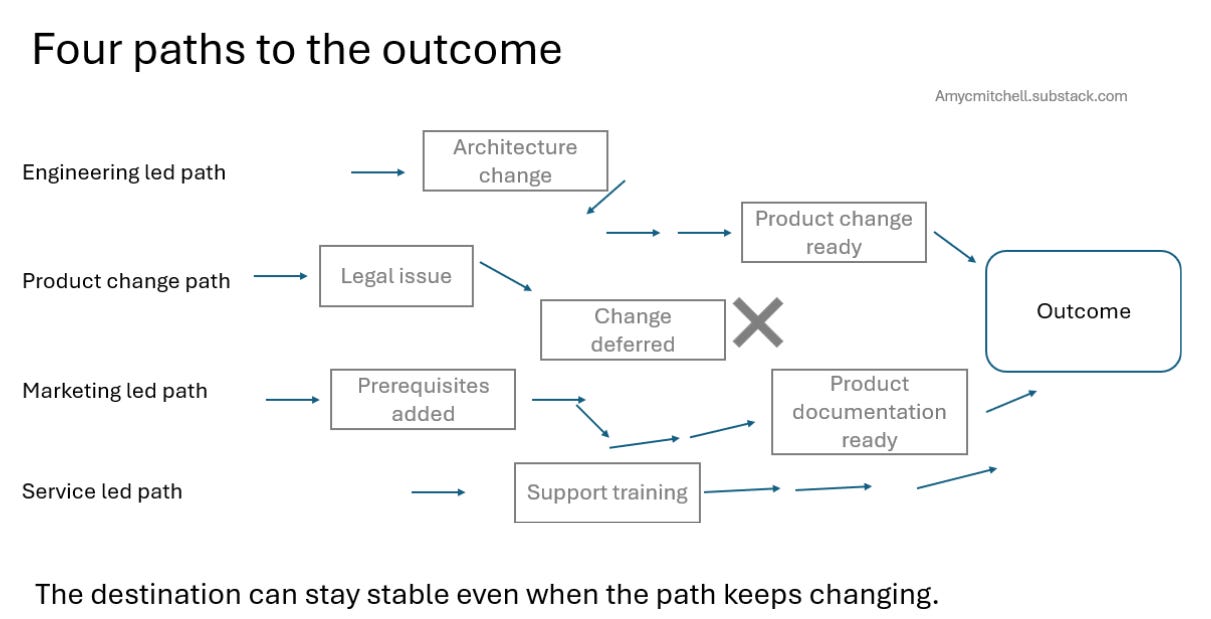
When you know the path will keep changing, your job is preserving what those decisions are trying to accomplish.
When the path feels uncertain, product managers can fall into a protective mode: preserving the plan, defending decisions, and tightening process. The instinct can become limiting when the work is moving faster than the plan can adapt.
A product guardian:
Preserves the plan
Protects the decisions
Drives consistency
A product shepherd
Protects the outcome
Watches for changing conditions
Anticipates what is needed next
Helps the right people make the next decision
Redirects when the path stops working
Guarding is useful when stability is valuable. As the product environment becomes more dynamic, then shepherding becomes more valuable.
Shepherding means protecting the destination and staying flexible about the path.
In fast-paced products, product managers deal with rapid changes. Product managers feel accountable for product success. At the same time, product managers want to prevent problems by controlling most activities.
Product managers can balance accountability with control by focusing on:
The outcome
The product intent
Critical constraints
Decisions that affect multiple teams
And product managers distribute control of:
Implementation choices
Local tradeoffs
Sequencing inside functions and teams
Solutions to new obstacles
Shepherding is the productive way to balance product direction with distributed work.
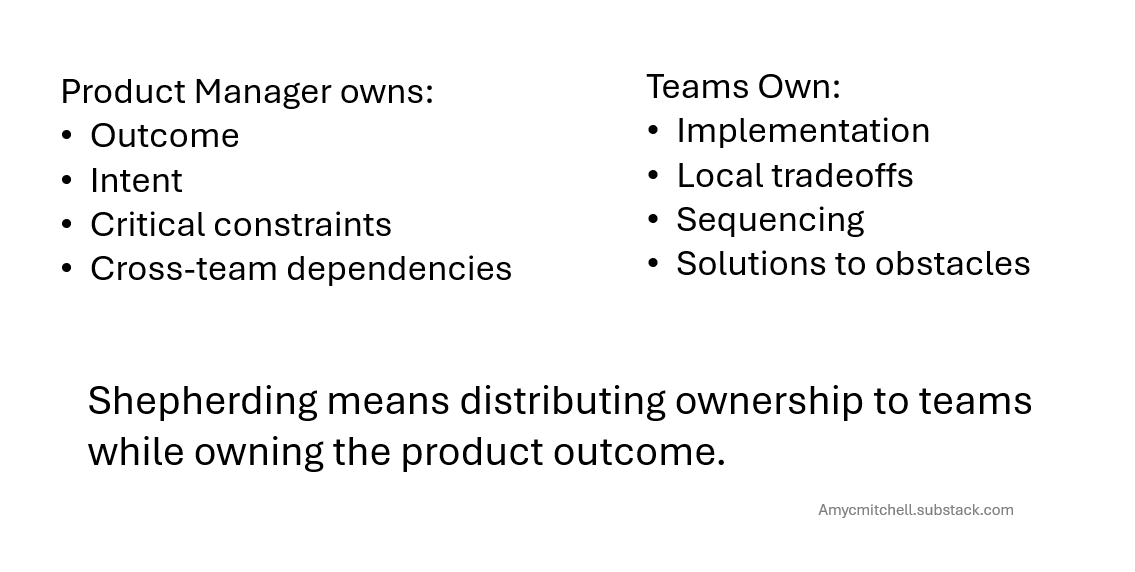
Once you know what stays under your control and what you can distribute, shepherding comes down to three jobs.
Shepherding is about focusing on the destination and distributing the path choice to teams doing the work.
Shepherding looks like this:
What happens: You learn from engineering that a requirement change needs extra eval time.
Typical instinct: Rework the plan around the extra time.
Shepherding response: Ask about options to meet the launch outcome and joint decision on changes (documentation, deferral, short-term risk)
Strategies to notice a change early enough to take a different path to the outcome:
Be proactive about changes in the team
Listen to undercurrents in 1-on-1 conversations
Dynamic approaches over static approaches to watch for changes that increase or decrease risk.
What happens: You don’t invite the UX lead to a customer meeting because she is working on the next feature.
Typical instinct: Can’t increase the schedule risk when you are in the meeting.
Shepherding response: Ask about tradeoffs and let the UX lead decide the solution
Strategies to distribute control to the team
Distribute control through coaching by exploring tradeoffs and leaving the decision in the experts’ hands
Stay close to the work and co-create solutions
Use relationships when the situation doesn’t fit the process.
What happens: A new customer needs a feature that isn’t finished before their annual blackout of IT changes
Typical instinct: Ask sales to explain the risks and tell the customer to wait.
Shepherding response: Ask about the customer's usage and explore alternatives with the team working on the feature. Provide options to the customer.
Letting others understand the intent is the foundation for enabling a diverse team to accomplish more than a single builder.
You can show the intent behind the destination by:
Connecting the work to the outcome
Showing the relation to the customer/problem
Being aware of constraints
Communicating the reasoning behind the direction
Your product context is what makes shepherding possible. By providing context and intent, you are enabling the people closest to the work to decide how to handle changes.
Shepherding means noticing what is moving, deciding what matters, and helping the team adjust. Directional awareness helps you decide what requires action, what can wait, and what the team can handle without you
When you orient to the destination, you learn to continuously ask:
What’s changing?
What is the effect of the change?
What will the team need next?
Is something missing?
Where is a missing connection?
Are we still moving toward the right outcome?
Directional awareness takes you beyond these questions into a way of staying active with the product work. Directional awareness questions become the beginning of a loop:
Notice what is changing
Interpret to decide the effect on the destination, the path or both
Redirect to a decision, if needed
Recheck the path to the outcome
Notice everything. Act on what matters.
Many times you can decide not to take action. You notice something changing and it might be too early to take action. For example, engineering decides to put a UI change at a different point in the workflow than in the specification. You wait until the demo so you can see the change through your customers’ eyes.
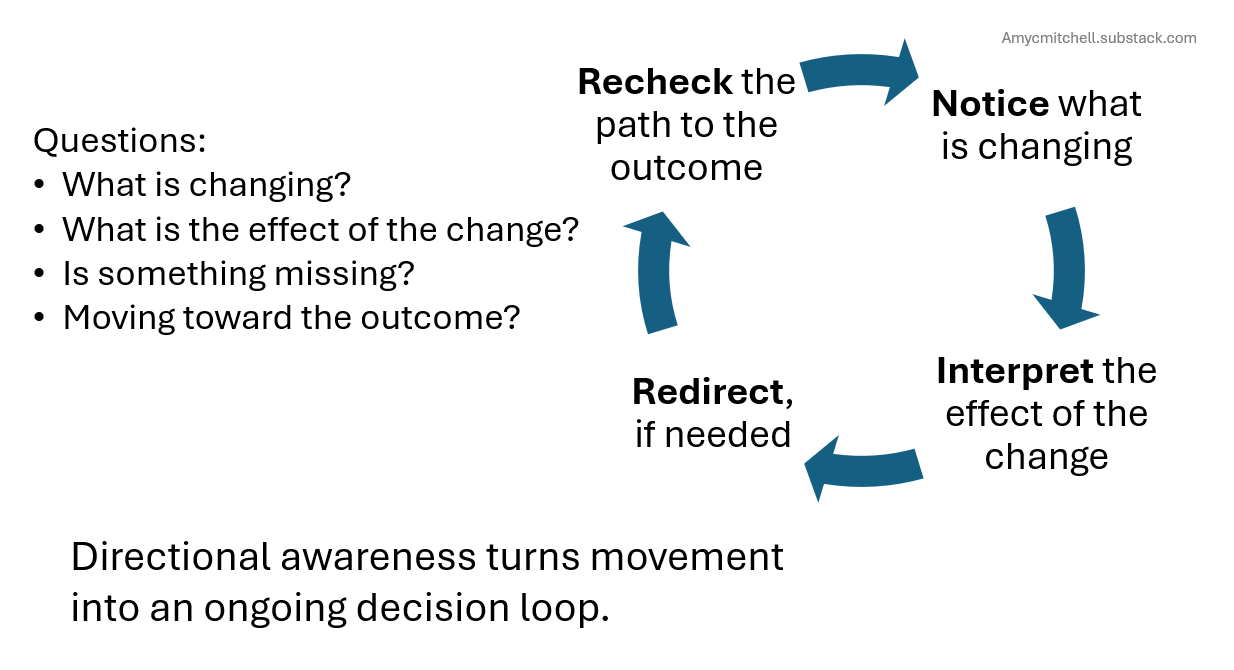
By looping through the questions and watching the changes, you have multiple chances to distinguish among:
Trends that don’t need action
Path changes that don’t affect the outcome
Changes that risk the outcome
Whether you are building a new feature, changing a workflow or supporting a new customer, directional awareness lets control flow to the teams doing the work. It gives you chances to step in if the outcome might be impacted.
Product managers are developing many new skills. Shepherding product initiatives is a new skill to keep the product team moving in the same direction.
The capability stack now looks like this:
Building helps the team create faster.
Context helps more people contribute.
Operating models help the team absorb the pace.
Invisible integration keeps distributed work connected.
Shepherding keeps all of that movement pointed toward the outcome.
Product work is becoming more distributed, more parallel, and more dynamic.
The goal is to make sure the product can keep moving in the right direction without you controlling every step.
Yes, but it looks different at different levels. The scope changes based on your level.
Feature / early-career product managers
Distributed feature and enhancement outcomes: Give engineering/design room to decide the best implementation while you understand the customer problem and constraints.
Product / mid-level product managers
Multiple teams or workstreams outcomes: Watch dependencies, changing conditions, and risk triggers while leaving teams to make local decisions.
Senior/lead product managers
Product initiative or product system outcomes: Communicate about the destination and intent, distribute authority and watch for potential incompatibilities.
No. Stakeholders provide key feedback on the outcome. Stakeholders benefit from shepherding because the cross-functional team adjusts to changing conditions to reach the outcome.
Shepherding doesn’t mean you own every decision and risk. It means making sure the right people understand the intent and make decisions for themselves.
Step in when:
The outcome is at risk
Teams are making incompatible decisions
A decision has consequences beyond the team
Otherwise, let the team own the path.
Looking for more practical tips to develop your product management skills?
Product Manager Resources from Product Management IRL
Product Management FAQ Answers to frequently asked product management questions
Premium Product Manager Resources (paid only): This month’s guide focuses on AI-assisted product initiatives. It helps you build context that your whole product team can use.
TLDR Product featured Product Management IRL articles recently! This biweekly email provides a consolidated list of recent product management articles.
drpp The Drip featured Product Management IRL articles. This newsletter handpicks product management articles every day, summarizing them to provide you with a comprehensive overview of product management and technology.
Connect with Amy on LinkedIn, Threads, Instagram, and Bluesky for daily product management insights.
Comments
Nothing yet. Say the first thing.
Sign in to join the conversation.