
A year ago, collaboration in product teams felt productive. It was common to explore adjacent ideas, loop in other functions early, and treat unfinished thinking as part of the process.
Recently, many product managers have started noticing a shift: conversations feel sharper, feedback arrives faster and more directly, and there is less patience for work that doesn’t sit on the critical path.
As organizations adapt to AI-assisted work, tighter budgets, flatter teams, and higher expectations, many product managers are noticing something else changing: the tone of collaboration.
In the past, high productivity and forward-looking collaboration were a compliment.
Today, many product managers find that the same behaviors are being interpreted differently.
Product managers often sit at the center of the resulting pressure. The question for product managers is how to stay effective while workflows settle out.
The signal: collaboration is getting sharper
At first, product managers noticed decisions getting reopened. And now the tone inside products is becoming sharper:
Feedback becomes more absolute (”you always…”, “why are you doing X at all?”)
Public correction increases
Narrowing of allowed work (”only focus on X”)
Exploration is questioned more quickly
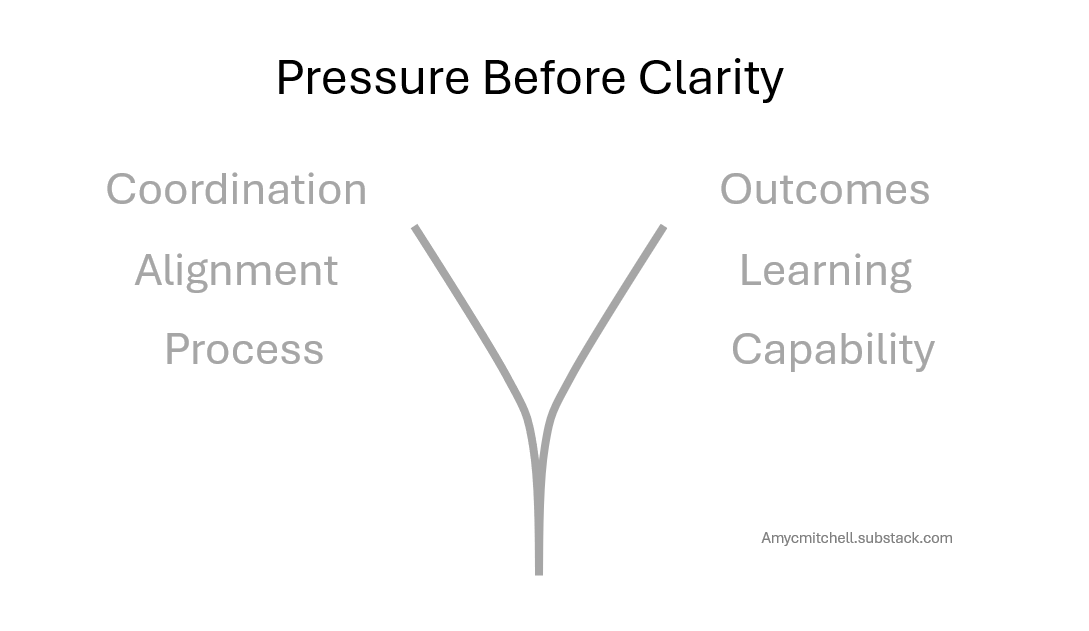
These changes often appear when pressure increases faster than teams have a way to deliver. Demands for tangible outcomes are fierce. After organizations have flattened and cut costs, there is nothing left except to show results.
While the pressure to deliver is everywhere, product managers can still be effective and avoid reacting negatively.
Being effective during the transition
The pressure on product managers is real. Business growth and outcomes matter.
Product managers are producing more than ever before. More deep work time.
But stakeholders still expect collaboration. At the same time, stakeholders want faster outcomes. The market is moving fast. Competitors are changing fast.
The old operating model isn’t ready for the rapid delivery model.
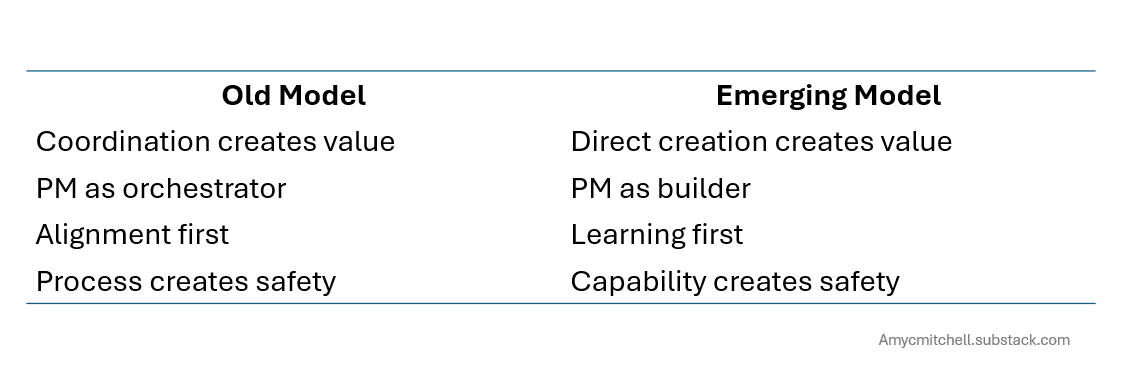
These competing models converge on product managers. This is how it shows up:
Requests to narrow focus as a default control mechanism
Pressure is a proxy for alignment
Feedback becomes more direct because leaders are balancing coaching with increasing operational demands.
When the product operating system is unclear, the communication tone becomes a substitute for clarity.
This pushes product managers to deliver outcomes through ambiguity. And forward-looking collaboration, which helped product managers reduce ambiguity in the past, can’t fit into high-focus delivery.
The challenge for product managers is staying effective without becoming reactive.
Product managers can control how they interpret pressure and how they respond to it. The following adjustments can help product managers remain effective while the operating model catches up.
How to thrive in the middle of it
The middle of a long journey is often hard. Like the transition to the new product operating model, it is a journey that product managers are living through. Fortunately, product managers have navigated operating model changes before.
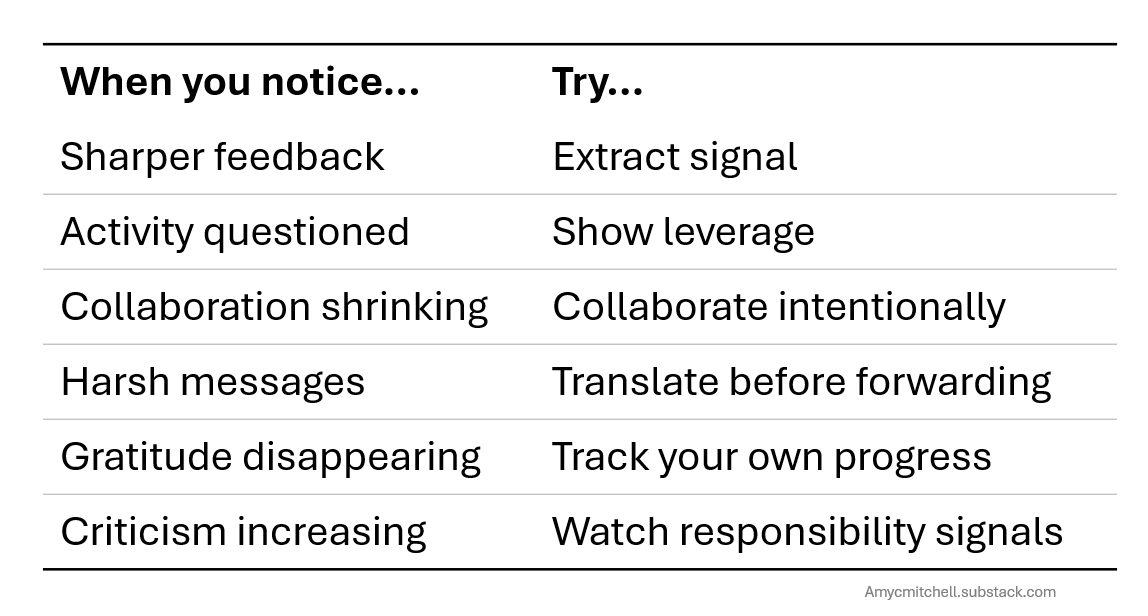
A. Stop treating tone as signal, start pulling signal out of the content
Product managers get feedback. Here’s how to handle a change in the tone of the feedback.
Signal
Feedback feels sharper and more absolute than before. Comments that used to be curious now feel critical.
Why this breaks
Product managers react to the tone by defending themselves or overexplaining. You miss the gist of the feedback by going into defensive mode.
The shift
Tone is no longer a reliable indicator of meaning. Content is.
This doesn’t excuse poor communication. It simply recognizes that reacting to tone alone can cause you to miss useful information.
What to do instead
Translate critiques into a concrete expectation (what outcome is being requested?)
Separate emotional packaging from actionable input
Ask questions that get to specifics:
What would ‘fast enough’ look like in observable terms?
What outcome is most at risk right now?
Respond to the underlying constraint, not the phrasing
Example
You are going too slow
What is needed sooner than you expect? What tradeoffs should I make?
B. Shift from “activity visibility” to “leverage visibility”
The change is making impact relative to outcome.
Signal
People interrupt explanations of activity.
Why this breaks
Activity used to imply progress.
Now, leaders want proof that activity changed an outcome.
The shift
Show the consequence of the work.
What to do instead
Reframe “I talked to sales about the forecast” into “The sales forecast would improve with a playbook.”
Head off risk by collaborating and then taking action
Prepare for 1-on-1s with focus on near-term outcomes
Example
I spoke with Sales
The Sales conversations uncovered a pricing risk that could delay launch.
C. Narrow collaboration intentionally (don’t abandon it)
Reduce “ambient collaboration” in favor of decision-making collaboration.
Signal
People don’t come to open-ended meetings. No time to discuss potential approaches to a problem.
Why this breaks
When there is pressure to deliver, then general collaboration delays results.
The shift
Be explicit about why you are engaging people. The goal isn’t less collaboration. It’s more intentional collaboration.
What to do instead
Quickly recap the near-term reason for collaboration
Focus on the “better together” outcome
Follow up on the result from the collaboration
Have a specific agenda for every meeting (even 1-on-1s and “quick calls”)
Redirect IMs to a reason for engaging
Example
Asking engineering for status of the next release
Collaborate on the ideal demo for stakeholders (you’ll get the status while working on results)
D. Don’t mirror harshness forward
Convert sharp communications into meaningful information. You can’t lead by simply passing on negative messages.
Product managers often become the transmission layer between stressed stakeholders and delivery teams.
Signal
Your stakeholders are concerned that the product team doesn’t understand the urgency of delivery.
Why this breaks
Passing on stakeholders’ requests to speed up makes the team feel underrepresented to the stakeholders. You are perceived as “not adding value”.
The shift
Dig into the reasons for the harshness. Communicate the question behind the question. Add value.
What to do instead
Translate “This needs to be done soon” into “This needs to be ready for a customer demo next week.”
Get clarity on the harsh message, then convert it to a next step in a neutral tone
Tone spreads faster than strategy. Stay calm so your message doesn’t get lost in the tone.
Example
Sales doesn’t like this feature
Several customers want a different interface and sales need to know how to handle this objection.
E. Maintain a private operating scorecard
In fast-paced environments, gratitude disappears. Measure your progress anyway.
Signal
Your contribution on a result isn’t mentioned. No one says thank you when you send notes from a customer meeting.
Why this breaks
Teams are looking for results before risks and problems. Without collaboration, teams can’t see individual contributions.
The shift
Look for progress on your goals over time. Note your contribution and learning.
What to do instead
Learning new things from tools to process prepares you for the future
Clearing up a misunderstanding that gets faster results
Reaching a decision or strategy to deal with uncertainty
Fixing near term risks
Example
You realize you could have mocked up a dashboard instead of doing it in slides
You learned that you need half the options after reviewing the slides with the architect
F. Re-anchor in responsibility signals, not emotional signals
Keep a watch on the product structure and responsibilities. Responsibility carries more weight than criticism.
Growing responsibility and growing criticism can coexist.
Signal
You and your team’s responsibility is growing despite feeling that you need to do more.
Why this breaks
Focusing on feedback before delivering on commitment hurts dependencies. If teams can’t depend on your delivery, then they avoid you.
The shift
Focus on what it takes for more responsibility. Use feedback for quality improvement and not for delay.
What to do instead
Responsibility increase means trust is increasing (even if the communication is rough)
Investigate if you are bypassed on decisions; this could be a signal to change
Evaluate structural changes for responsibility changes
Example
Your boss announces that new team members are joining the team
Align your work to the broader responsibility of the team
A note on performance
Not every sharp comment is transformation pressure.
Sometimes feedback is simply feedback. Product managers still need to understand criticism (don’t dismiss it).
The goal is to separate:
tone from content
organizational stress from capability gaps
urgency from direction
Separating tone from content does not mean accepting disrespectful behavior. It means avoiding the mistake of dismissing potentially useful feedback because it arrived imperfectly.
Conclusion
Many product managers are seeing contradictions in their work.
Responsibilities continue to grow.
Expectations continue to rise.
Yet collaboration often feels harder than it did only a few years ago.
It’s tempting to interpret every sharp comment as a judgment on your performance. Sometimes it is. Often it isn’t.
Organizations in transition frequently increase pressure before they develop clarity. Communication becomes sharper before operating models stabilize.
The product managers who thrive in this middle ground become more intentional.
They learn to:
extract signal from feedback
connect work to outcomes
collaborate with purpose
filter pressure instead of forwarding it
measure progress even when gratitude is scarce
pay attention to responsibility, not just emotion
Eventually the operating model catches up.
The middle doesn’t last forever.
But while you’re in it, these behaviors help ensure that you develop the capabilities that will matter on the other side.
Related articles:
Looking for more practical tips to develop your product management skills?
Product Manager Resources from Product Management IRL
Product Management FAQ Answers to frequently asked product management questions
Premium Product Manager Resources (paid only) Templates that I use to explain ambiguous product situations like business opportunities, customer journey and operating principles. New items monthly!
TLDR Product featured Product Management IRL articles recently! This biweekly email provides a consolidated list of recent product management articles.
drpp The Drip featured Product Management IRL articles. This newsletter has handpicked product management articles every day, summarized to give you the big picture of product management and tech.
Connect with Amy on LinkedIn, Threads, Instagram, and Bluesky for product management insights daily.
Comments
Nothing yet. Say the first thing.
Sign in to join the conversation.