
Most take it for granted that astronauts and cosmonauts live and work together in Earth’s orbit. But it was not a forgone conclusion when the two Cold War rivals met in orbit for the first time for the Apollo-Soyuz Test Project (ASTP) on July 17, 1975. Times had changed in the previous decade to make this mission possible.
Designed to test the compatibility of rendezvous and docking systems and the possibility of an international space rescue, the nine-day Apollo-Soyuz mission brought together two former spaceflight rivals: the United States and the Soviet Union.
The Apollo-Soyuz Mission
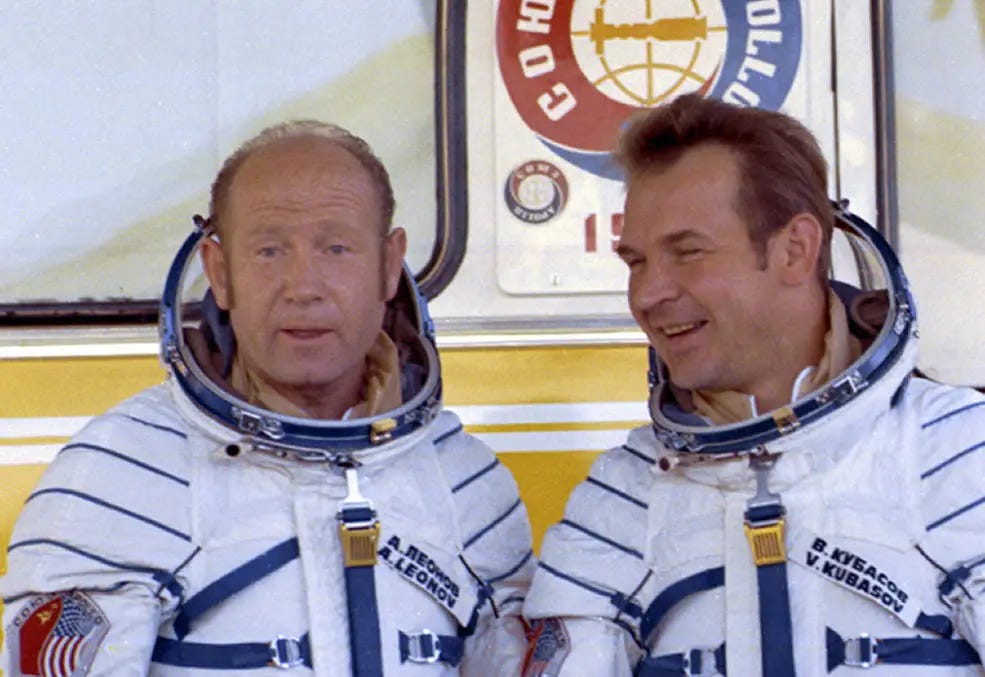
The Apollo-Soyuz mission began at Baikonur Cosmodrome in Kazakhstan. Soyuz 19 launched July 15, 1975, at 8:20 a.m. EDT, carrying cosmonauts Aleksei A. Leonov and Valeri N. Kubasov. Apollo astronauts Thomas P. Stafford, Vance D. Brand, and Donald K. “Deke” Slayton were still asleep when Leonov and Kubasov lifted off, while workers at Kennedy Space Center’s Launch Pad 39B filled the Saturn IB rocket’s liquid oxygen tanks.
The astronauts watched a replay of the Soyuz launch while eating breakfast prior to suiting up, following which they took the transfer van to the launch pad. An estimated 750,000 people lined nearby beaches and causeways to watch the launch of the final Saturn rocket. Soviet Ambassador Anatoli F. Dobrynin and his wife watched the liftoff from the Launch Control Center.
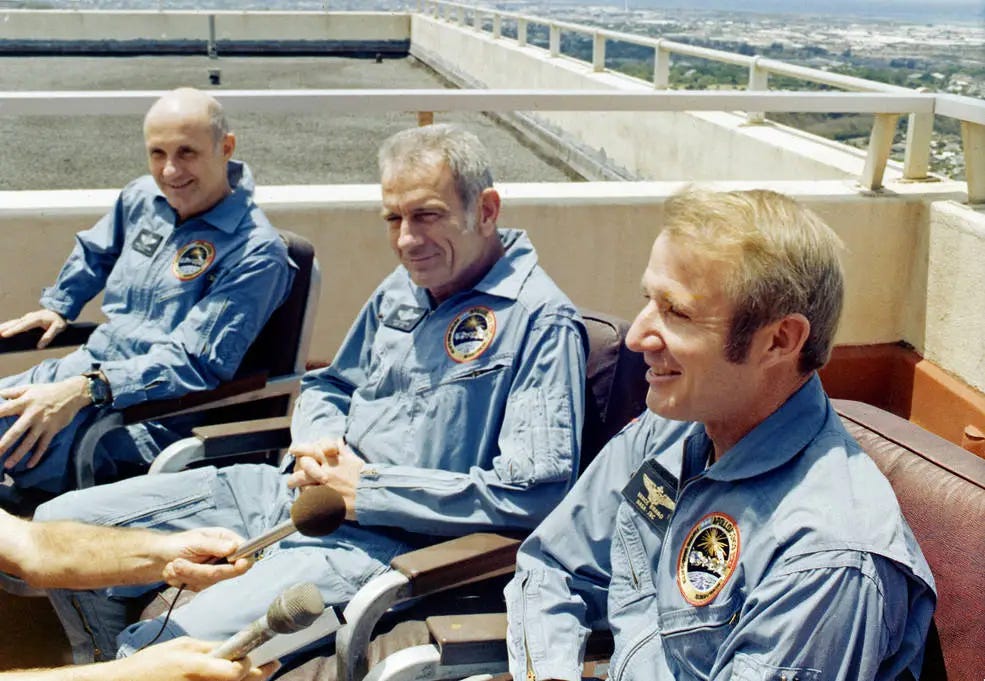
Apollo lifted off from NASA’s Kennedy Space Center at 3:50 p.m. with astronauts Thomas P. Stafford, Vance D. Brand, and Donald K. “Deke” Slayton. The two craft soared above the Atlantic Ocean as a global audience watched on television, and hard dock was achieved July 17 at 12:12 p.m.
The Handshake
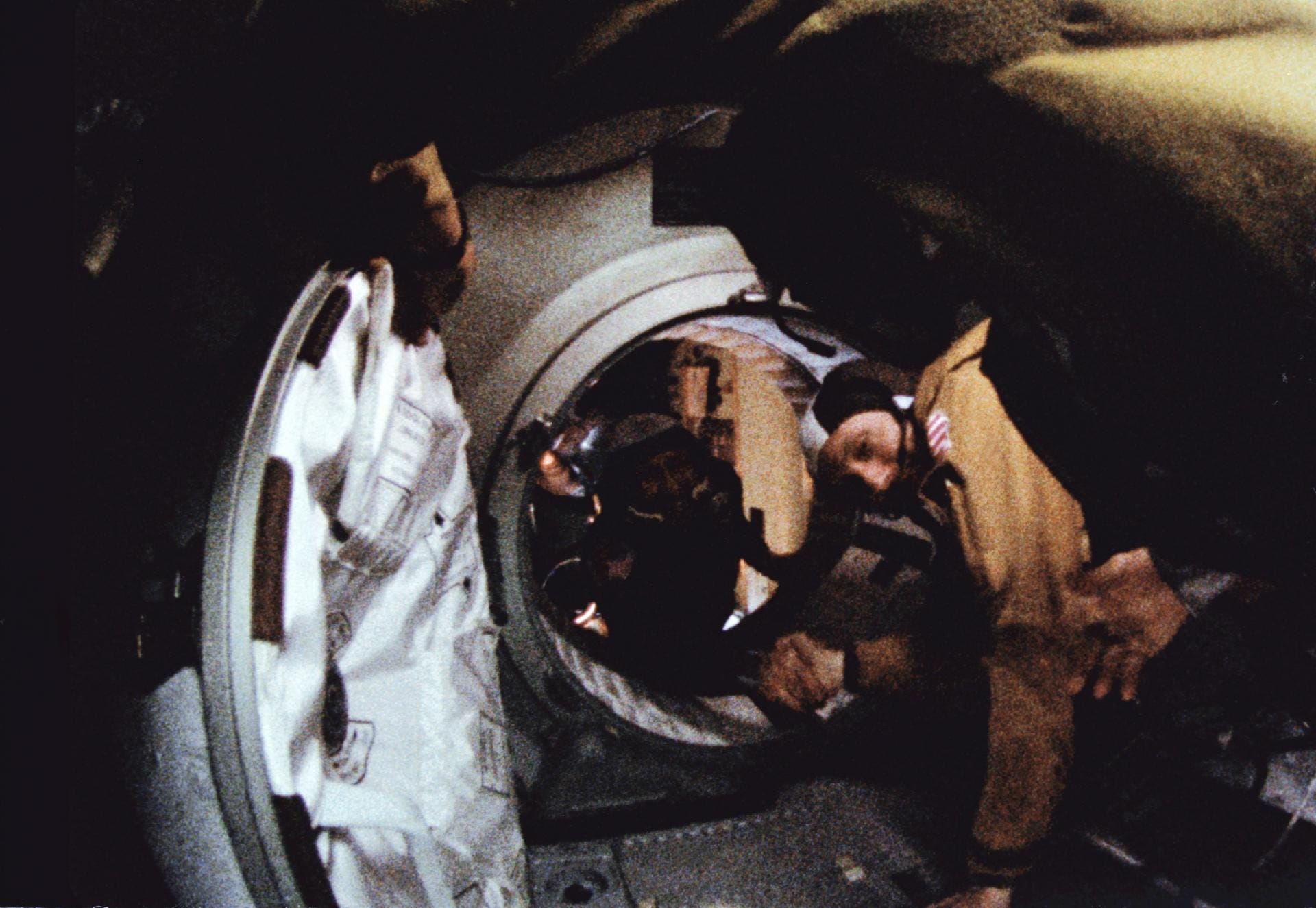
Hatches between the vehicles were opened at 3:17 p.m. and the two space crews officially began joint activities. They took congratulatory calls from Soviet Communist Party General Secretary Leonid Brezhnev and U.S. President Gerald Ford, exchanged commemorative gifts, and shared a meal before closing the hatch for the day.
The next day started with Brand joining Kubasov in the Soyuz, while Leonov joined Stafford and Slayton in the Apollo. After giving TV viewers a tour of each vehicle, the crew members conducted science experiments and had lunch. Later, Kubasov and Brand left the Soyuz to join Slayton in the Apollo, leaving room for Leonov and Stafford to spend time in the Soyuz.
By mid-afternoon, the final speeches and gift exchanges were complete, the astronauts and cosmonauts had their last handshake, the crews retreated to their respective spacecraft, and the hatches between the two vehicles were closed.
The Spacecraft Undock and Prepare to Return to Earth
The two spacecraft undocked July 19 at 8:02 a.m. As the Apollo capsule backed away, it blocked the sun from the Soyuz vehicle, creating the first human-made eclipse and enabling the cosmonauts to photograph the sun’s corona. The two spacecraft then docked once more, with final undocking at 11:26 a.m.
Leonov and Kubasov continued Earth and solar photography tasks and imaged a joint fungal growth experiment. They rehearsed the procedures for reentry and provided a televised tour of their spacecraft for Soviet audiences. On July 21 at 6:51 a.m. they had a successful landing less than seven miles from their target near Baikonur Cosmodrome. This was the first Soviet mission with a televised launch and landing.
Recovery forces flew the cosmonauts to the Baikonur Cosmodrome, where they held a press conference and rested for two days. Leonov and Kubasov returned to Moscow on July 23, greeted by a large cheering crowd at the Soviet capital’s Vnukovo Airport.
Stafford, Brand, and Slayton stayed in orbit for five days after undocking. Scientists were eager to take advantage of Apollo’s ability to stay in orbit because they expected a lengthy hiatus in American crewed space flights until the first flight of the Space Shuttle, which was expected to take place in 1979.
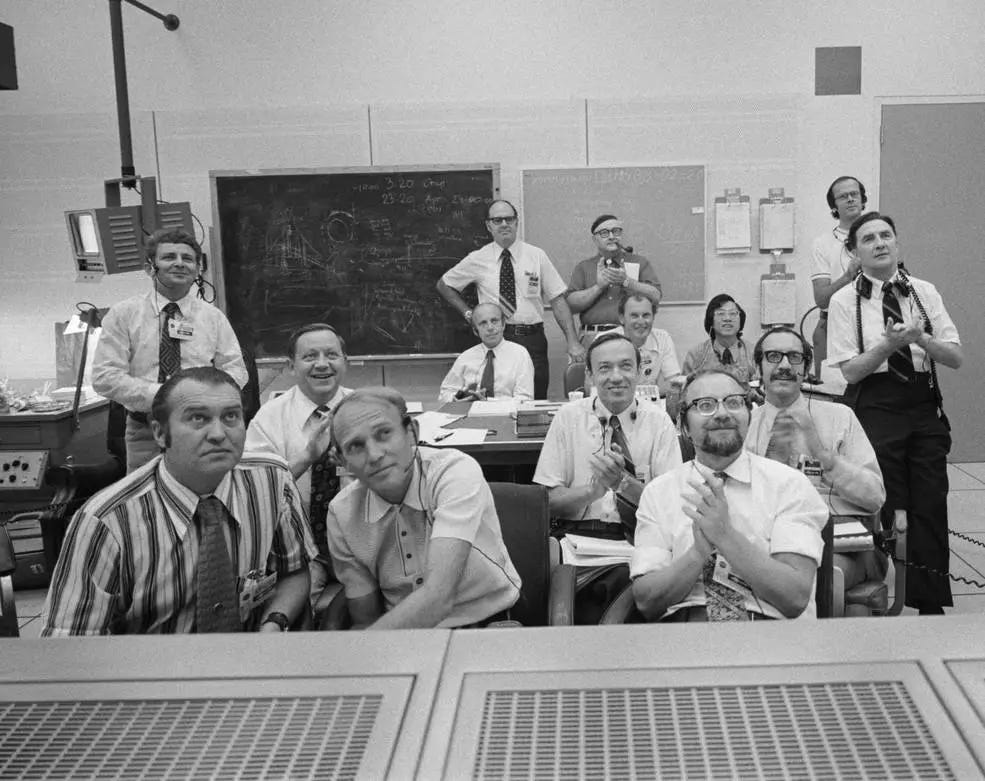
On July 20, 1975, the day after undocking from Soyuz, Stafford, Brand, and Slayton conducted several of the 23 planned independent experiments. The next day, Mission Control informed them that Leonov and Kubasov had made a successful landing and were reported to be in good health. On July 23, Stafford, Brand, and Slayton conducted the final news conference of the mission.
On July 24, the astronauts prepared to come home. After stowing all loose equipment, they fired the Service Propulsion System engine to slow their velocity enough to bring them out of orbit and then jettisoned the Service Module. The spacecraft encountered the first traces of the Earth’s atmosphere at about 400,000 feet and began slowing down, and the astronauts experienced about three times the force of gravity from the rapid deceleration.
Three drogue parachutes opened at 24,000 feet to begin slowing the spacecraft’s descent, followed by the three main parachutes at 10,000 feet. Splashdown occurred after a flight time of 217 hours and 28 minutes and less than one mile from the target point northwest of Hawaii and within sight of the prime recovery ship USS New Orleans (LPH-11). The capsule was hoisted aboard New Orleans. It was the last planned ocean landing for U.S. human spaceflight.
During the welcoming ceremony, it became apparent that they were not feeling well, and the astronauts revealed that they’d inhaled some nitrogen tetroxide propellant during the descent. The crew should have turned off the Command Module’s thrusters once descending with the parachutes, but they didn’t and the gas had been drawn into the cabin through a valve normally open to allow fresh air to enter. All ceremonies were cancelled, and the crew was taken to the ship’s sick bay.
The astronauts remained inside the carrier’s sick bay until it arrived at Pearl Harbor in Hawaii. X-rays showed the astronauts’ lungs filled with fluid as if they had pneumonia. After arriving in Honolulu, the astronauts were taken to the medical facility at Tripler Army Hospital. By July 30, the astronauts had recovered sufficiently enough to relocate to a resort at the Marine Corps Air Station at Kaneohe Bay for further recuperation.
On August 9 the astronauts flew to Washington, DC, they held their first post-mission press conference and President Gerald R. Ford received them in the White House’s Rose Garden. He presented each astronaut with a Distinguished Service Medal and promoted Stafford to Major General. They finally returned home to Houston on August 10, met by a large crowd at Ellington Air Force Base near the Johnson Space Center.
The Cosmonauts and Astronauts Tour the Soviet Union
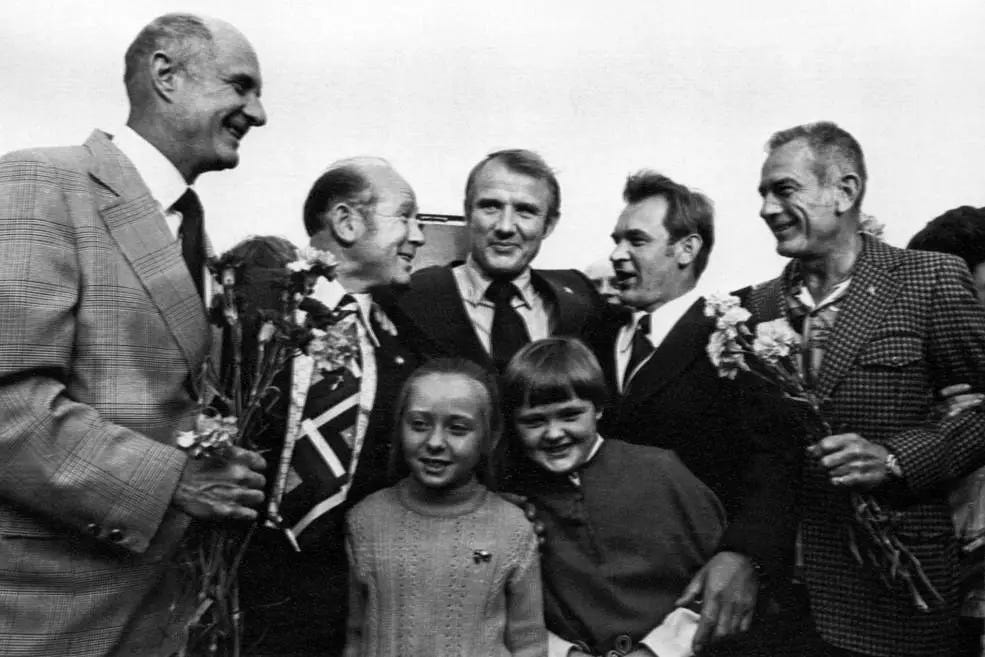
On September 20, Stafford, Brand, and Slayton and their wives arrived in Moscow for a two-week tour of the Soviet Union along with cosmonauts Leonov and Kubasov. The group visited Moscow, including a trip to the Cosmonaut Training Center in Star City—where they laid a wreath at the tomb of Yuri A. Gagarin, the first man in space—Leningrad (now St. Petersburg), Kiev, Volgograd (formerly Stalingrad), Novosibirsk in Siberia, Tblisi in Soviet Georgia, and finally the resort town of Sochi on the Black Sea, which would host the Winter Olympics in 2014.
The Cosmonauts and Astronauts Tour the United States
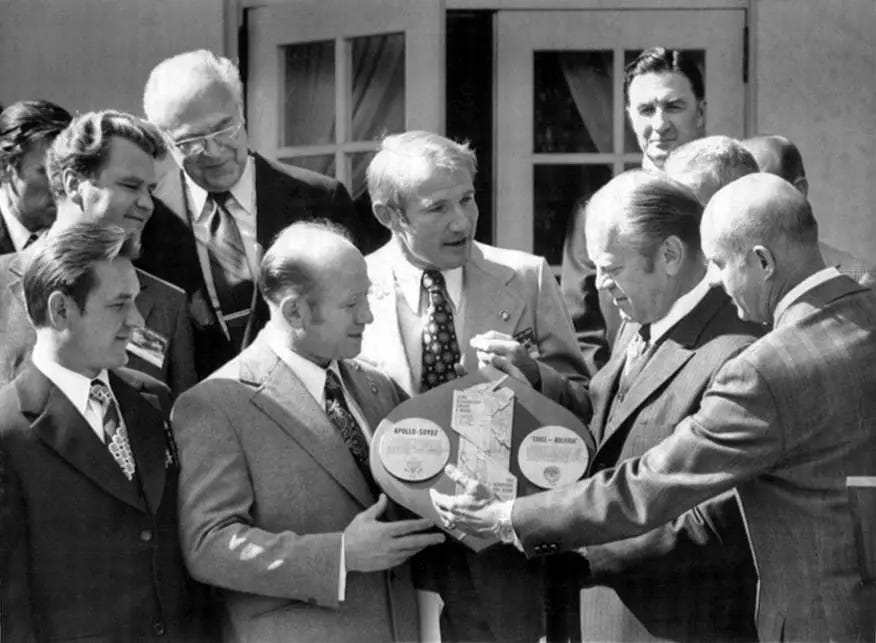
On October 12, Leonov and Kubasov arrived in the United States, and accompanied by the astronauts, began their tour of America in Washington, DC, where President Ford received them in the White House. They next visited Chicago, taking part in a motorcade with Mayor Richard J. Dailey. They continued on to Omaha, Salt Lake City, San Francisco, Reno, Lake Tahoe, and Los Angeles. After a brief stop back in Washington, DC, they visited Atlanta and Nashville and finished the two-week tour at the United Nations in New York.
Due to the deterioration of relations between the United States and the Soviet Union in the late 1970s, no follow-on missions to ASTP took place. A backup Apollo spacecraft and Saturn IB rocket were available and there were some discussions of possibly flying an Apollo to a Soviet Salyut space station, but with no government support Soviet-American space cooperation remained limited for many years.
Following the fall of the Soviet Union in 1991, both sides expressed renewed interest in collaboration, leading to agreements to fly a cosmonaut aboard the Space Shuttle, an astronaut aboard the Mir Space Station, and for a docking between the Shuttle and Mir. The latter required a common docking mechanism, and the Russians developed a derivative of the ASTP system for use in what became known as the Shuttle-Mir Program.
With the inclusion in 1993 of Russia as a partner in the International Space Station, designers adopted essentially the same joint docking apparatus. After a lengthy hiatus, many of the working relationships between engineers and scientists developed for ASTP were renewed for these newer programs.
I wrote about the Apple TV series Star City in my Friday Substack “This Week’s Intelligence” on June 19, which is an alternative reality that makes you feel you’re in the middle of the Cold War Soviet Union amongst cosmonauts and spies. It’s counterpart with the American perspective is the show that Star City is a spin off from, For All Mankind. Many of the these brave men appear in one or both series.
The Red Purse of Justice is written by Amy Benavides, the daughter of a Cold War spy who writes articles related to her life, terrorism, espionage, history, and culture that she discovers as she writes her memoir.
Subscribe to make sure you receive her articles on Tuesdays (free subscribers) and Thursdays (paid subscribers). I also have a column on Fridays about common topics to help recruiters build a rapport with their targets for paid subscribers.
No posts
Comments
Nothing yet. Say the first thing.
Sign in to join the conversation.