
If I were to attain the level of practicing Catholic to which I aspire,1 I would have a subscription to Magnificat magazine that I read every morning and every evening. I would at least immerse myself in the daily Word as often as I immerse myself in the daily Wordle.2
I would savor the publication’s Meditation of the Day which, whenever I have made the opportunity to read, frequently speaks insightfully like a Catholic fortune cookie—though I know there is nothing coincidental about the words that are put in front of me at just the right moment.3
I would learn more about saints I’ve heard of and saints I’ve never heard of.
I would find greater peace by starting and ending my day with the Lord.
I know this sounds like a paid post for Magnificat, but I assure you, it is not. If they would like to pay me, that can certainly be arranged…
As it is, I am a former Magnificat subscriber who asked for and received a year-long subscription for my birthday a couple years ago. The issues stacked up on the nightstand by my bed, on various dressers, and in other random places until my wife got fed up about a year after the subscription was over and gave them away to someone who hopefully used them more fruitfully.
All that said, I still love the idea of Magnificat, and I still get really excited whenever I become the proud owner of a one-off copy, hopeful that this will be the moment when I adopt reading it into my daily routine and begin to standardize my prayer life that has been haphazard at best for several decades now.
So you can imagine my excitement a couple weekends ago when I was on a parish weekend retreat at my beloved Mundelein Seminary—where I spent about four years as director of marketing and communications—and a copy of Magnificat was included among the retreat materials.
As the retreat ended and I came down from the mountaintop with renewed spiritual vigor, I vowed that my new fully remote work situation would be the perfect impetus to finally incorporate Magnificat reading into my daily life. I would leave it in plain sight on my desk in my basement office and read it before clocking in for the day. It was a foolproof plan, right?
Well…so far…kind of! I actually have been reading it more frequently, and if I find myself doing it regularly enough for the remainder of the month, I might convince Theresa to let me try another annual subscription. Hopefully this time the copies that I leave around will at least be dog-eared from use…
OK, that was a very long preamble, and I’m sorry. I haven’t written in a while, and I guess I miss it.4 I also have far less human interaction each day due to the aforementioned work from home situation, so maybe I feel like this writing is a way for me to talk to someone. Thanks for listening.
The point of all this is that I recently read two passages from different Magnificat Meditations of the Day that punched me right in the faith.5 I want to share them with you now.
The first one comes from Sister Mary David Totah, O.S.B., an American ex-pat currently living in a Benedictine abbey in England. Here’s some of what she had to say on the subject of “trusting in the word of the master” while reflecting on Luke 5:1-11, in which Jesus asks Peter to “put out into the deep”6, eventually prompting Peter to leave everything and follow him.
Take it away, Sister:
Openness to every ‘possibility’ is, as you recognize, truly perilous: to have an endless series of options is really to have no options, because you never embrace any one of them with your whole heart. You postpone really giving yourself—which is ultimately the source of all happiness. God invites us to build a concrete life rather than to fantasize about innumerable possible lives…
This security comes not from mapping out the whole ground of the future, nor is it given by the rejection of all risk. It arises from an inner sense of purpose. It’s the security that springs from a greater love, the security of faith…By saying yes to God we relinquish a certain control over our lives, but then our life becomes ours in a new way.
…Basing our lives on God leads to greater selflessness, availability, fruitfulness, freedom, and surrender into the only hands that can truly lift us up to him. Yes, the end is a leap. We cannot have God cheaply—we must give our all.
Dang.
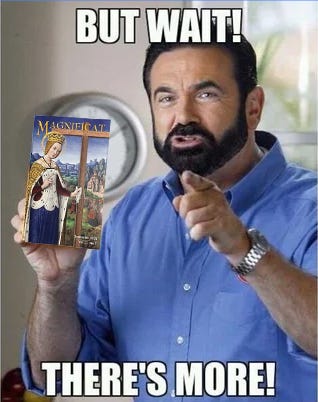
Fast forward to the Memorial of Saints Cornelius and Cyprian.7
Saint Cyprian is coming in hot with some truth bombs that converge nicely with Sister Mary David’s thoughts to make you question everything about your haphazard prayer life and a lot of the other choices you prioritize every day.
Saint Cyprian gives out very little sugar with his pronouncements:
In order that we are not entwined afresh in the snare of death through being careless, but on guard against danger, we should take possession of the immortality that we have received.
How can someone who does not do what Christ has ordered him to do say that he believes in Christ? And by what means can he reach the reward of commitment when he does not want to preserve his commitment to what is commanded? Of necessity he must waver and wander and, carried away by a spirit of error, be tossed to and fro just like the dust that the wind blows up. Casually staggering towards salvation does nothing to achieve the end of treading salvation’s true path.
Once in a while, I come across a line of prose that is so staggeringly spot-on that I have to read it multiple times, in awe of the mind that conceived it.
Let’s read it again.
Casually staggering towards salvation does nothing
to achieve the end of treading salvation’s true path.
These passages are intertwined for me because they both speak to the lackadaisical approach that comes far too easily to my faith life. I go to Mass, I talk to God, I offer up tough decisions into his hands, people know I am Christian by my love. Yada, yada.
But where am I actually exhibiting the trust of someone who will leave everything and follow him? Where is the leap that will lead me to tread salvation’s true path?
Too often I find myself wanting God cheaply and not giving my all or giving it all to him. Decisions are mine to be made. Worldly success or even just maintaining my comfortable status quo become my priorities.
Of course, I will give God some credit when blessings arrive and things are going my way, but I also always want to keep one hand on the steering wheel, because I might have to swerve at a moment’s notice. I give more credence to my human reflexes at the wheel than to following God’s will for me, even though the entire car is being carried in the palm of his hand anyway.
“Casually Staggering Towards Salvation” could be the name of my autobiography—and while that’s actually really catchy—living that way won’t help me catch the bus to heaven.
Instead, how about “Confidently Striding into the Deep?” Ever since the retreat, I’ve been thinking a lot about the idea of confidence in relation to faith.
A confidence that—fun or frightful, peaceful or chaotic—God is working all things toward my ultimate good.
A confidence in his existence and his love for me. That I was created because he loves me, and that his love and mercy extend past all the crimes and misdemeanors of my fallen nature.
A confidence to leave the limiting familiarity of my boat and live the life he has called me to live—committing to what he has commanded, as Saint Cyprian puts it.
A confidence to stop living so much for this world and start focusing on the next.
There is so much insecurity in the world at large right now, not to mention in our own personal lives and human interactions. The life described in these two passages—a concrete life that is not constantly questioning other possibilities or outcomes and is instead built firmly on the rock of Christ’s love for us—sure sounds enticing right about now.
We must continue to lean on prayer and the sacraments until our casual staggering becomes a purposeful mission that leads us to the freedom of surrender.
Jesus, take the wheel.
Thanks for reading (A)musing Catholic! Subscribe for free to receive new posts and support my work.
or to which I ought to aspire
What is your starting word? Tell me, you coward. I use “stare” a lot, but also “steak.”
I hate even having to say this, but I use a lot of emdashes and none of this was composed by AI. Why couldn’t AI have come for the semicolon? Let good writers use the emdash in peace!
Or I’m just rusty and wordy.
Let’s give it up for that pun. Come on now!
which also happens to be the theme of Word on Fire’s 25th anniversary and which I learned actually translates as “lead out into the deep,” completely enhancing the meaning of the passage, as is usually the case when I learn the original language’s intent.
whom I know about now! Thanks, Magnificat!
Comments
Nothing yet. Say the first thing.
Sign in to join the conversation.