
I started my Substack in July 2023, so I thought it time for an update on where things are going, while I take a break from the serialisation of “Orphans of Apollo”.
Before Substack, I had been working on the first draft of “Orphans of Apollo” for several years, and prior to that, listening to lots of podcasts about publishing. I knew I wanted to write a novel, so figured I needed to learn about how to get it out in the world.
One thing which kept coming up again and again was to build an email list, in order to engage with your readers. Even if you wanted to go down a traditionally published route, publishers were looking at what engagement authors had with their readers, as it makes their job easier.
I had no idea what to write about in a newsletter, so kept parking the idea. Meanwhile, I had been looking into different platforms, so at least I could select the best to use. Then Dan Carlin, the podcaster behind “Hardcore History” mentioned he was moving his email list over to Substack. So I checked it out.
I decided I could just write some articles about stuff that interested me at the time, and so I wrote a few pieces under the title “From a Certain Point of View”. While I was poking around on Substack, I found a few people who were serialising fiction. I have never been a serial fiction reader but remembered back to my middle school English teacher telling us how Charles Dickens had first published his works in serial format. I thought that sound like a good idea, so I focused my Substack efforts on this, and have been serialising “Orphans of Apollo” since July 2024.
I have currently serialised, over two seasons of roughly fifteen episodes, 49,739 words of a draft which currently stands at 99,117 words, putting us at around halfway. So where to from here? I intend to serialise the rest in the same way. As I have said from the start, I’m doing this as part of my editing process. Publishing the story as I go through and edit. The intention was when I’m finished I would be left with book one of a series. The thing is, I am learning a lot as I go. So, in reality, I think this will end up being book zero. I have plenty of ideas where I want to take the series, so I am going to use this draft as my sandpit, where I can improve my writing and lay down some of the backstory which readers of later books can come back and read should they so wish.
Along the way, I have also experimented with audio. I always loved audio books as a kid and listen to a lot of podcasts and radio still. One of the great things about audio is you can consume it while you’re doing something else. This has become even easier in recent years, which is why audio seems to be enjoying something of a renaissance. I would love to have an audio accompaniment for each episode and tried narrating some myself. I’m not a natural orator and in the end didn’t think they sounded professional enough. A professional narrator is out of the question financially at this stage, but I am closely watching the AI narration products.
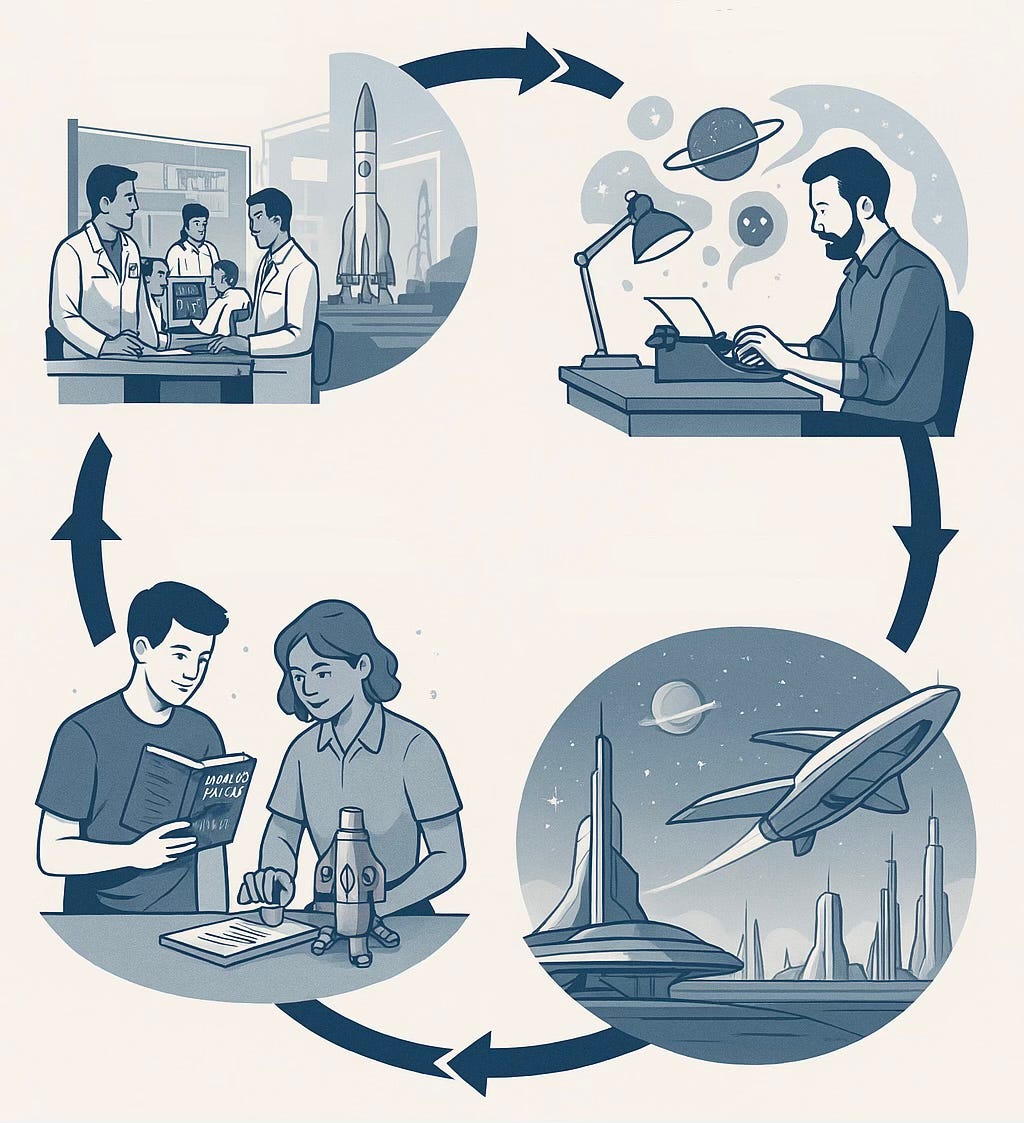
I’m a great believer in what I think of as the reality-fiction-reality-fiction cycle. Or as others have called it, the “science fiction feedback loop”. This is where science fiction authors take the reality of the day and push it forward in the stories they write. Some of their readers, inspired by ideas in the stories, will become scientists and engineers. In their work, they may make some of the concepts in the books they read a reality. They will also make discoveries which will inspire the next generation of science fiction authors, whose books will in turn provide inspiration for the next generation of scientists and engineers. And so the cycle continues. So many times I have heard scientists and engineers interviewed, and when asked what made them pursue this profession, they talk about the science fiction they read or watched as a child.
One of the best examples of this feedback loop is Arthur C. Clarke’s 1945 paper “Extra-Terrestrial Relays: Can Rocket Stations Give World-wide Radio Coverage?” Although not science fiction, Clarke was a prolific science fiction author. In the paper, he calculated that an object placed at an orbit of approximately 35,786 km would remain fixed over the same point of the equator. Therefore, three satellites could provide complete global coverage. Today hundreds of satellites operate in geostationary orbit.
In his 1914 novel “The World Set Free” H.G. Wells predicted the use of atomic bombs which would release their energy slowly. His book was read by Leo Szilard, the physicist who conceived of the idea of the nuclear chain reaction. Szilard acknowledged that reading this book had made an impression on him.
Jules Verne describes in “Twenty Thousand Leagues Under the Sea” submarine technology far in advance of its day. The use of electrolysis to separate seawater into hydrogen and oxygen for life support, diving planes and the use of blast tanks.
Science fiction inspired me as a child. However, for whatever reason, aviation attracted me more, and so I pursued that path professionally. This has been incredibly rewarding, but I have contributed nothing towards scientific discovery. So I’m hoping my part can be in the inspiration of the next generation. This is partly the reason why I’m attempting to pitch my work to the YA market.
We are all born explorers. Toddlers will touch, taste and climb anything they can as they try to make sense of their environment. Some older children maintain this curiosity, while for many it is diminished by practical concerns as they transition to adolescence.
In our modern lives, where everything seems to get harder, something we forget is that we are all standing on the shoulders of giants. Those that came before us laid the foundation for all the things many of us who are privileged to live in developed countries enjoy. Food security, dwellings we can keep warm or cool at the flick of a switch, the ability to maintain real time connection with others on the far side of the planet and visit them within hours rather than months or not at all. Perhaps taken for granted the most is our ability to have leisure time. We are not required to spend all our waking hours foraging or tending to crops or livestock. These things are only possible because of the technological advances made by the scientists and engineers that came before us.
But it is not only the scientists and engineers, it is the explorers. Throughout human history, from the earliest migrations out of Africa to the age of European colonisation and beyond, societies have repeatedly demonstrated a drive to explore beyond current boundaries, whether geographic, intellectual, or technological. This pattern, while expressing itself differently across cultures and time periods, suggests something fundamental about human nature.
Exploration has become a key concept for me to explore in my writing. The great age of exploration on earth is now over, but it is only just beginning in space. Humanity has always needed to climb the next mountain, see what lies beyond the horizon, expand the frontier. It is in our DNA.
Nuanced characters are also something which I would like to explore. Very few people are pure good or evil. Often evil is rooted in a desire to do the right thing or avert some other disaster, and characters/people do not always remain good or evil. One of my favourite characters of all time is Darth Vader. I am of an age where I first watched Star Wars as a child before episodes I-III were made, so I had to imagine in my own mind what drove Anakin Skywalker to become Darth Vader. It was always something which I enjoyed thinking about.
How societies organise and govern themselves has fascinated me since an early age. I didn't think of it in these terms as a child, but looking back, many of my interests reflected this curiosity. I always followed politics (I was a weird child), even writing to the Prime Minister when I was nine years old because I was concerned about some government policies. Similarly, I gravitated toward games like “Age of Empires”, “Sim City”, and for those who remember the Amiga, “Populous”. What particularly intrigues me is how smaller autonomous regions like city-states can, under the right circumstances, produce remarkable innovations and cultural flourishing compared to larger homogeneous empires. In my fiction, I want to explore how space colonisation might revive these alternative governance structures when communities are separated by vast distances, forcing them to develop their own solutions rather than relying on centralised authority.
I launched “Orphans of Apollo” with a speech, which I am as yet undecided where it will go in the final version of the story. It was made by one of the central characters, Christian Larsson, on June 15th 2012 entitled “The Future Belongs to the Optimists”. Let’s keep the feedback loop going and build that future.
The future belongs to the optimists.
If you know someone you think would enjoy “Orphans of Apollo” or any of the other writing in “Explorations” please share this publication with them.
Comments
Nothing yet. Say the first thing.
Sign in to join the conversation.