
An uber-important Q1 earnings season is upon us. Companies report their first ERs after months of elevated geopolitical tensions.
Join us as we help hundreds of investors navigate the rapidly evolving AI innovation landscape amid a potentially tricky Q1 earnings season, identify rock-solid businesses with strong growth trajectories & operational grit and deliver proven alpha-generating returns.
Since March, the TPO Portfolio delivered returns of 14.14%, significantly outperforming the broader indices.
The last 2 weeks came as a huge relief to markets as the S&P 500 staged an impressive 12.8% rally from its lows on March 30th, creating new all-time highs at 7126.
Diplomatic efforts to open the Hormuz Strait were welcomed by investors who were eagerly looking to switch focus from the war back to the single biggest generational opportunity in their lifetime—AI.
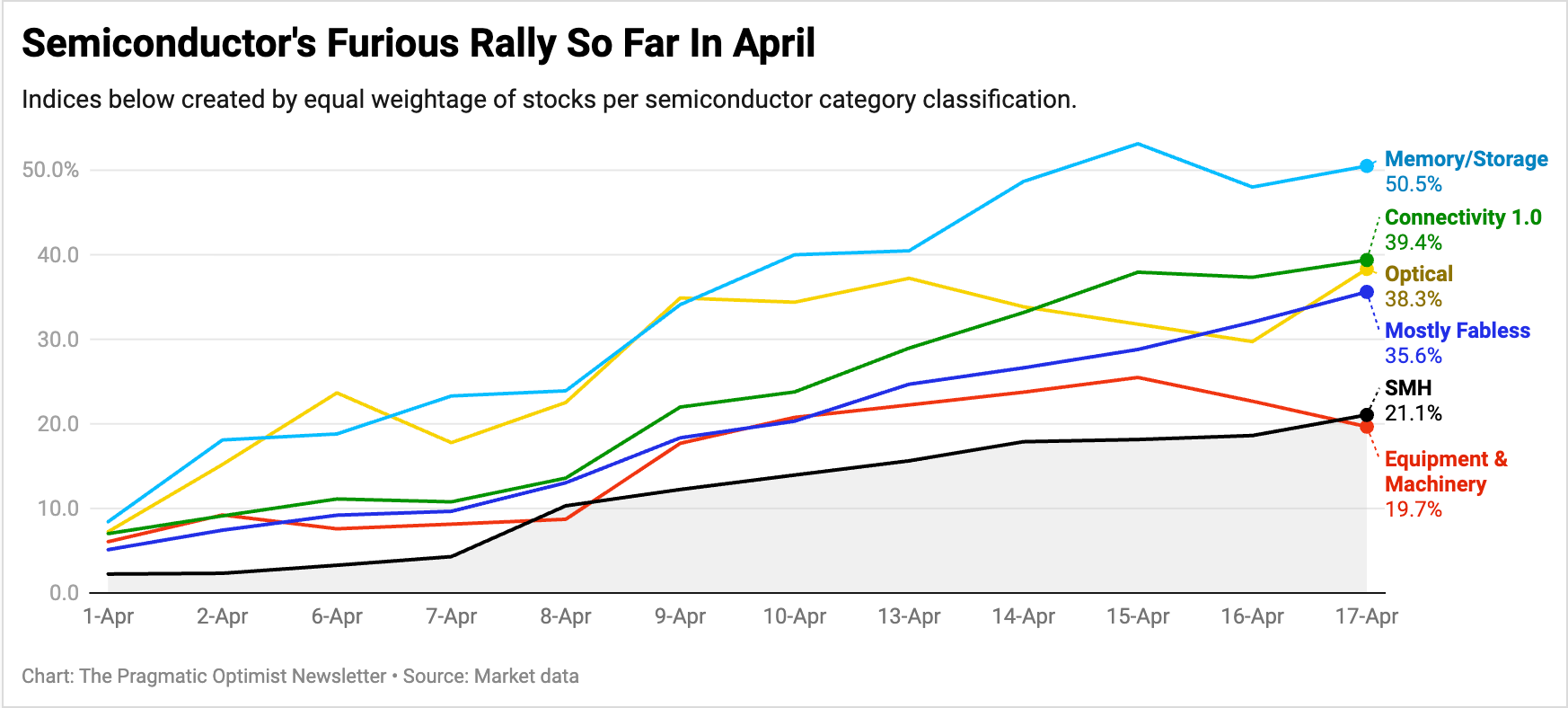
So far in April, euphoria first returned to the semiconductor cohort of stocks. And, although SaaSpocalypse fears returned with a vengeance, software stocks have since managed to put on a strong show of strength this week, following their semiconductor peers.
Yet, in all of this, the spotlight still remains on the semiconductor stocks, which continue to be viewed as the single largest sector beneficiary of AI while also being a backbone to the entire AI ecosystem.
The question is what happens to semiconductors when the industry’s 2 largest, most pivotal support structures, Taiwan Semiconductor TSM 0.00%↑ and ASML Holdings ASML 0.00%↑, fail to lift the rally further?
In this post, we tie together our opinions and observations from the ERs of Taiwan Semiconductor, or TSMC, and ASML to illustrate where the semiconductor industry may be headed next and how it impacts some of the biggest names in the industry.
There have also been some key pricing developments in the memory/storage industry, which further support our thesis about the road ahead for the semiconductor industry over the next few months.
📌The TPO Portfolio has staged an impressive rally since March 1, now up 14.14% 💪, significantly beating the S&P 500 and benchmark ETFs that include AIQ AIQ 0.00%↑, GRNY GRNY 0.00%↑, IVES IVES 0.00%↑ and SPRX SPRX 0.00%↑ during this period of time.
You can track our entire portfolio and all our live trades in the AI Stock Tracker 2.0 tool using the link below. 👇
Unlock Access to The TPO Portfolio
(Paid Members can access the AI Stock Tracker 2.0 directly from here)
💡 One of the main reasons behind our portfolio’s outperformance is driven by our selective investments that we made between February and late March in Marvell, Meta Platforms, CrowdStrike, Palantir, AppLovin, Cloudflare, AMD, MercadoLibre, Reddit, Astera Labs, and more, while also timely exiting/trimming several positions where our conviction had faded.
The relief rally seen over the past 2 weeks signalled a decisive capitulation for markets, leading to euphoria and… noise.
You see, the last 2 weeks have been incredibly noisy, in our view, with a surge of announcements from multiple sources making it difficult to maintain a fundamental grasp of the semiconductor market.
Let’s start with “bottlenecks”. In addition to the optical & memory bottlenecks, markets have recently become euphoric about potential bottleneck trades in at least 5 new areas: CPUs, GPUs, Test/Yield semi solutions, chip fabrication, and semi-equipment. The debate around Copper vs Optics still rages on. So does the debate about memory being cyclical (or not). Elon Musk recently threw his weight in the fab world with Terafab while shorts threw their weight behind shorting storage and optical stocks. Meanwhile, Jensen Huang was trying to advocate for why Nvidia NVDA 0.00%↑ is NOT a car company on last week’s fiery podcast.
At times like this, we try to look for signals through the noise, and the ERs from TSMC and ASML provide the first clues about what to expect over the next few months. This can also be seen in the performance of the semiconductor equipment complex of stocks, which failed to run further last week.
In our view, the TSMC+ASML ERs showed that there are 3 headwinds that continue to persist for the semi-industry: 1) China, 2) Margins/Profitability and 3) Expectations. We believe that only those companies that navigate around these 3 headwinds will lead the semiconductor industry higher in 2026 with strong alpha.
The rest of the industry will likely be headed for a wall if they are unable to navigate past these 3 barriers, especially as the Iran war continues to make chaotic twists and turns, complicating the global supply chain ecosystem.
Below is are our expanded views on the TSMC+ASML’s ERs followed by key updates in the memory and storage markets. We have updated our views on ASML and TSMC below along with Micron MU 0.00%↑, SanDisk SNDK 0.00%↑ while also explaining how we have/are adjusting our TPO portfolio for the road ahead.
You can also track our updated Conviction Scores and our rating history on the above stocks as well as those under our coverage in the AI Stock Tracker 2.0 tool.
If there was one takeaway from last week, it was captured by Jensen Huang’s frustration with the perception of doing business with China and the lack of regulatory certainty that is creating headwinds for the semiconductor industry as a whole.
It’s not just Jensen Huang. Many investors are feeling the angst (for example) towards semi companies with volatile China revenues, especially those that compete at the leading edge of this industry. We noted this in our ER take on Nvidia last month and observed similar patterns in TSMC and ASML’s ERs.
See the revenue exposure that TSMC, ASML, and Nvidia have towards China below and the resulting volatility that companies/investors have to deal with.
Comments
Nothing yet. Say the first thing.
Sign in to join the conversation.