

Nvidia just reported its Q1 FY27 earnings that trounced all expectations. The stock has staged quite a rally since April, up 33% since then, helping the Semiconductor ETF SMH create higher highs.
In today’s post, we present 6 key takeaways for investors based on our analysis of Nvidia’s Q1 ER, and what that means for our forward investment plans for Nvidia (and AMD, which we own in the TPO Portfolio).
Join us as we help hundreds of investors navigate the rapidly evolving AI innovation landscape, identify rock-solid businesses with strong growth trajectories & operational grit, and deliver proven alpha-generating returns.
Since March, the TPO Portfolio delivered returns of 23.5%, significantly outperforming the broader indices.
Become a paid subscriber today
Let’s Set The Stage
Nvidia reported its highly anticipated Q1 FY27 earnings results yesterday that trounced all expectations.
Unpredictability from Nvidia’s China revenues returned. But excluding China, Nvidia’s AI business is powering through all the geopolitical headlines and supply chain distortions. Nvidia’s Blackwell and Rubin ramps are in full force but Jensen Huang wants everybody to know that their CPU business is going well too.
This is why Nvidia blindsided markets with radical changes to its segment revenue reporting that enforces the view that Nvidia should not be known as a GPU company anymore. It is an AI platform company.
Nvidia’s Q1 report carried a large cherry on top for large shareholders who had been demanding more focus on shareholder value over the past few months, as we previously reported. That should keep large institutional shareholders happy for now.
In this post, we present 6 key takeaways for investors based on our analysis of Nvidia’s Q1 ER below, and what that means for our forward investment plans for Nvidia (and for AMD , which we own in The Pragmatic Optimist Portfolio.)
📌The TPO Portfolio has staged an impressive rally since March 1, now up 23.5% 💪, significantly beating the S&P 500 and benchmark ETFs that include QQQ , AIQ , GRNY , IVES , and SPRX during this period of time.
You can track our entire portfolio and all our live trades in the AI Stock Tracker 2.0 tool using the link below. 👇
Unlock Access to The TPO Portfolio
(Paid Members can access the AI Stock Tracker 2.0 directly from here)
#1: Nvidia Ups The Expectations Game
Nvidia’s Q1 FY27 results delivered record revenue of $81.6B, beating the consensus estimate of $78.9B by ~3.5%. Q1 revenues accelerated both y/y by 85% and sequentially by ~20%, which is the type of growth acceleration markets favor.
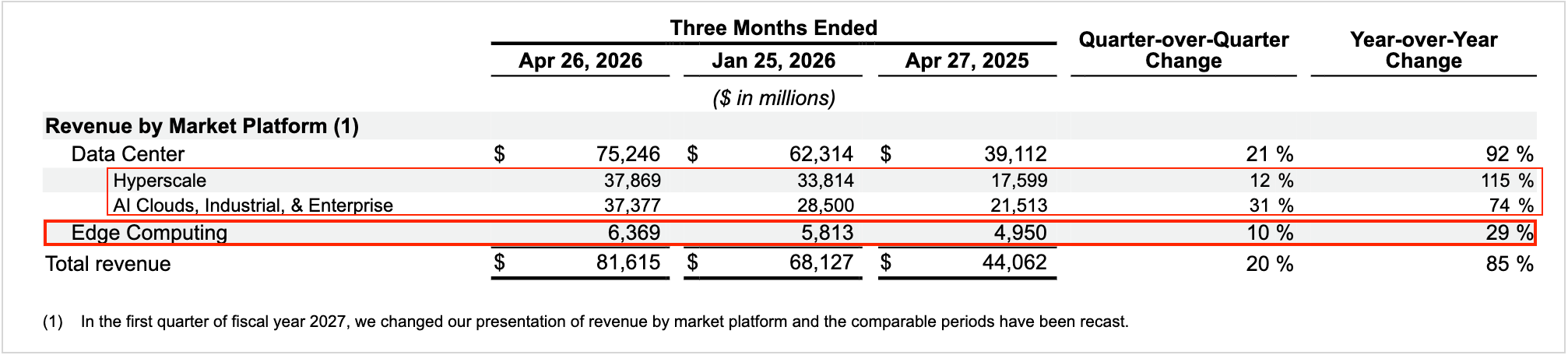
Nvidia’s explosive Q1 growth was primarily fueled by its DC (Data Center) division, which generated a record $75.2B, accelerating by 92% y/y. The expansion of networking hardware and the highly anticipated Blackwell architecture ramp were major drivers of this momentum.
Profitability metrics were strong; the chipmaker posted gross margins of 74.9% (vs. 75% in Q4 and 60.5% last year), demonstrating robust pricing power despite the transition to newer architectures. On the bottom line, the $1.87 adj. EPS represented a massive 140% YoY jump or a 15% increase over Q4 FY26, also beating expectations of $1.76 per share.
Mind you, these numbers were delivered by Nvidia, with its China segment coming in weak, which we will discuss in the next section.
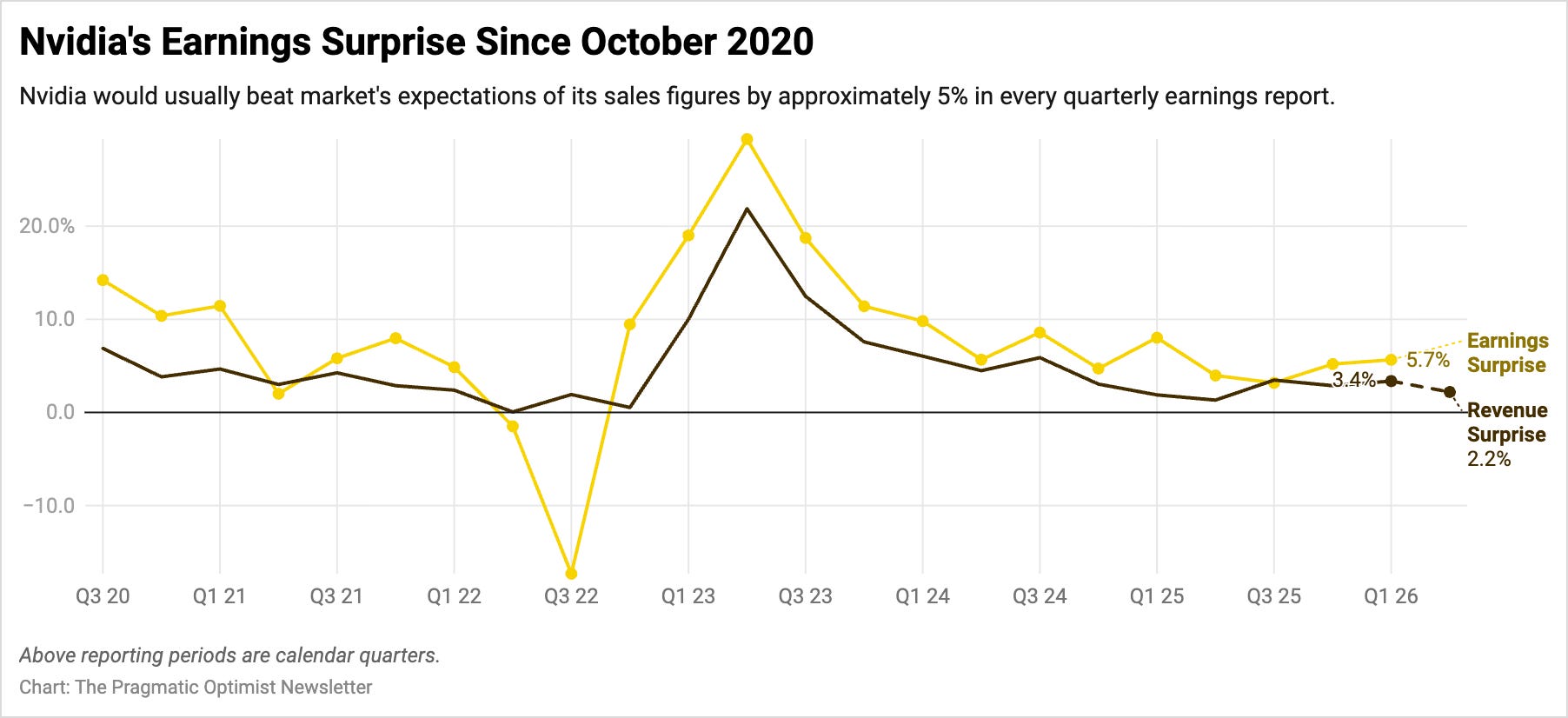
Nvidia’s guidance for Q2 was also meaningfully higher than analysts’ expectations. Management expects Q2 revenues to be ~$91B, well above the $86-87B that analysts were expecting. In fact, the highest Q2 revenue expectation was ~$91.8B. Gross margins are expected to remain stable at 74.9%, also in the ballpark range of 74.5-75.1% that was expected of Nvidia.
The new-normal caveat applies here: all Nvidia guidance is ex-China.
#2: Expect Nothing From China, Period.
Regarding China, Nvidia’s revenues from the region fell back closer to their longer-term quarterly dollar average of $3.5-4B. In Q1, China revenues fell 16.4% YoY to $4.6B, almost getting sliced in half versus their prior quarter’s China revenues of $8.4B.
Note that the US government authorized Nvidia to sell H200 GPUs to China in January. The Chinese government has also officially granted Chinese enterprises to buy Nvidia’s H200 GPUs, at least on a high level. However, the Chinese government is pushing for domestic adoption of homegrown GPUs, which makes Nvidia’s dependence on the China market extremely unreliable. Moreover, the China business appears to be margin dilutive for Nvidia since the US government takes a 25% cut on every H200 sale Nvidia makes to China.

This caused Jensen Huang to officially wave the white flag on the Chinese AI market, saying they have “conceded” the entire Chinese AI market to large native players like Huawei. That led Huang to plead with Nvidia investors to “expect nothing” from the AI platform company’s endeavors in the Chinese market and “let things work out in its own due time.”
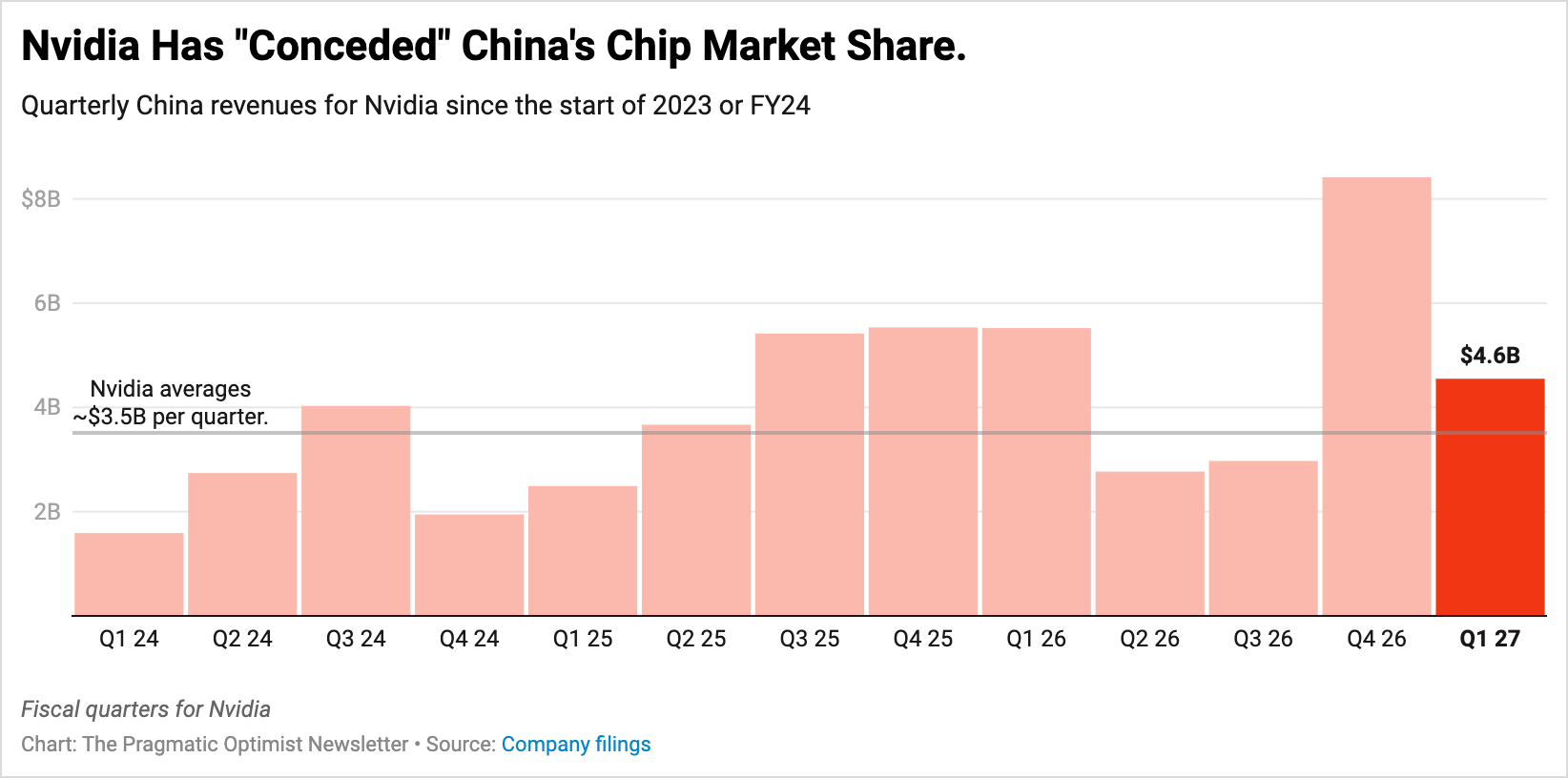
In our view, it is best for investors to rest Nvidia’s case in China. The only time Nvidia’s China revenues will matter is if quarterly revenue spikes from the geography and/or if Nvidia barely beats revenue expectations (like in the previous quarter), which would signal weakness in Nvidia’s ex-China revenues.
For now, Nvidia had a solid quarter ex-China. That’s all that matters.
Upgrade to Premium For Just $13.33/Month
#3: A Brand New Segment Reporting Structure
This is the part that caught many investors by surprise. Not many, including ourselves, were prepared for the change in revenue segment reporting.
Historically, Nvidia has always segmented its revenues along the lines of the end markets it serves. While Gaming, Automotive, and Visualization were once growth markets during Nvidia’s existence, these end markets have made way for the Data Center, with Compute and Networking being the two pillars of the DC segment.
In Q1, Nvidia surprised investors with a shiny new revenue segment reporting structure that split the AI platform company’s consolidated revenues by the 2 key market platforms to which it sells its products and solutions. While the DC segment remains intact, all other product revenue segments are now consolidated into Edge Computing.
However, Nvidia has made internal changes to how it further breaks out its DC business. Instead of reporting its DC revenues as Compute or Networking, Nvidia will now break out its DC revenue segment as Hyperscale and ACIE (AI Clouds, Industrial, & Enterprise).
This is how Huang framed Nvidia’s reasoning for reorganizing revenue segments when asked the question:
“It’s really about the fact that our business has now evolved and grown to such a large scale; it’s helpful to segment it so that you have a better understanding of how our business works.”

Over the long term, we believe this new revenue segment reporting structure is a healthy step towards helping analysts to more accurately estimate the pace of Nvidia’s market share gains towards its $3-4T market and the revenue concentration risks.
We believe Nvidia is trying to engineer a hard pivot among the investor community towards its AI platform vision, away from the widely known concept that Nvidia is just a GPU company—similar to what Apple did with its revenue segment reporting structure in 2018. Nvidia might face some confusion initially, just as Apple faced some initial issues with its reporting changes. But long-term, this will make Nvidia’s outlook even more stable as the broader AI economy that it powers keeps expanding.
#4: The AI Economy Is Accelerating
Nvidia’s Q1 report does show two things. One, the broader AI trade is not slowing. Two, the AI trade is being boosted by solid demand for AI infrastructure products, solutions, and components currently being supported by a resilient war chest of AI capex dollars that are still being deployed into the AI infrastructure ecosystem.
Amazon’s AWS is expected to become a key partner to Nvidia this year with the latter’s NVLink Fusion poised to fully open up to Nvidia’s partner ecosystem. While Nvidia’s compute solutions and networking products are on track to ramp up this year, Vera CPUs are looking to also become an integral pillar of Nvidia’s growth model.
All these ingredients are key to Nvidia powering ahead at a minimum 60% CAGR to compete for the $3-4T TAM.
#5: CPUs Are A Big Part Of That Acceleration
On the call yesterday, Huang spent a considerable amount of time explaining why CPUs have become increasingly important for Nvidia compared to the GTC26 event.
Quite frankly, we were surprised by Huang’s updated TAM estimates for the agentic CPU market and his implications for Nvidia’s dollar-based ARR number regarding CPUs. Huang’s comments shape our views on CPU TAM as well as our updated views on AMD, which we explain below.
Comments
Nothing yet. Say the first thing.
Sign in to join the conversation.