
Dear Friends,
As the decimation of cities and homes continues (and the possibility of the crisis stretching to apocalyptic proportions grows), and as landscapes of fire and ash seem to consume ever greater expanses of our inner and outer worlds, I wanted to share an old South American folk tale that I came across in Michael Meade’s Why the World Doesn’t End: Tales of Renewal in Times of Loss (2012).
It’s a story about the near-total devastation of life, and the magical, miraculous, creative (and sometimes destructive) process of manifesting new life out of the remains of ashes. Through the effort, imagination, devotion, and often unexpected instinctual responses of mortal beings, the first green shoot is reborn, and eventually the tree of life is restored.
Perhaps the story moves something in you in the way that it did for me in this time of great ravaging. In the words of Michael Meade: “People have always worried about the continuance of life on earth….and a tale like Ichanchu and the charcoal drum looks directly at the possibility of catastrophic environmental disaster and the mystery of regeneration, and the role people might play in the continuance of the world.
Some of the language has been adapted slightly to my own words.
Icanchu’s Drum
It started with the Earth heating up. The ice caps began to melt, and the deserts grew larger and larger. Eventually, everything started to become overheated, and the atmosphere itself caught on fire. Soon, this great conflagration started to spread throughout the world at such great intensity that there was absolutely nothing anyone could do to stop it. The flames raged unabated, night and day, consuming everything alive in their path. The green singing forests were reduced to cinders, and even the great mountains melted down. Nothing was left standing or moving. All that remained of the lucious earth was an endless sea of ashes, and one small thing that managed to avoid destruction.
It so happened that during this time, two beings, named Icanchu and Chuna, had been away visiting the Otherworld. When they returned to find what had happened to their beautiful planet, they were deeply shocked and grieved. As they looked out at the dark devastation left by the fire, they felt many feelings, but the greatest one was an unbelievable sense of homelessness. More than anything else, they longed to return to their original homeland. But as all the landscapes now looked the same, they could not differentiate where it was or which direction they should go to find it.
In their confusion and sadness, Trickster unexpectedly appeared before them. He greeted them and proceeded to give them instructions on how they could locate their place of origin, the home that they so desperately longed to return to. He told them that they should fly with their bird wings over the earth, and whilst doing so, point their index fingers straight ahead. Just as a pendulum moves in its own way while dowsing, Trickster told them that when they had reached their home, their fingers would move to point downwards.
The pair followed Trickster’s instructions as they trusted in him, because they knew that this old world had many tricks up its sleeve as well as many hidden resources that might only appear in times of duress. So they shifted into their bird shapes and took flight, travelling high over the ash-covered face of the earth, with their index fingers pointed outwards just as they had been guided.
Soon enough, their fingers began voluntarily quivering and moving downwards of their own accord, as they had been told to expect, and although the view below looked just like every other place they had seen, the two travellers followed their fingers and descended into the ashes of their home. Touching down, they had a sense that they had arrived back at their place of origin, but there was nothing that remained of it.
As if their instincts had been stirred by contact with the ground, Icachu and Chuna felt a hunger creeping up on them. They needed some food. Digging around in the ashes, they searched to see if they could find any scrap of something edible to eat, something that could serve as some kind of nutrition. They dug away desperately, but all they found was a single chunk of burnt-out wood. His eyes falling upon this single piece of charcoal, all that was left of their home, Icanchu was overtaken with a deep sense of longing for trees. Before the fire, he remembered how their home had been resplendent with dense forests with trees of many different species and wildlife. This little piece of charcoal must be a remainder of one of those trees, he thought.
Then another thought struck him: drums, too, were the remainder of trees. The drums his people used for their sacred ceremonies and celebrations were made from carefully harvested wood from specially chosen trees from the forests that used to be here. They would be played on special occasions throughout the year. Almost involuntarily, Icanchu started striking the piece of wood in his hands, and playing it as if it were a real drum. After some time, he got infected by his own rhythm, and naturally, he started to dance and then sing along to the primal beat. As there was nothing else to do, and since beating the drum and singing and dancing gave him a feeling of courage, Icanchu played on and on all day long in the middle of the ocean of ash, on his makeshift charcoal drum. Meanwhile, his friend Chuna simply sat and observed, almost meditating on all that was proceeding. By the time dusk arrived, in utter exhaustion from his activities, Icanchu dropped down to the floor and fell into a deep, long sleep.
The Green Tendril of Life
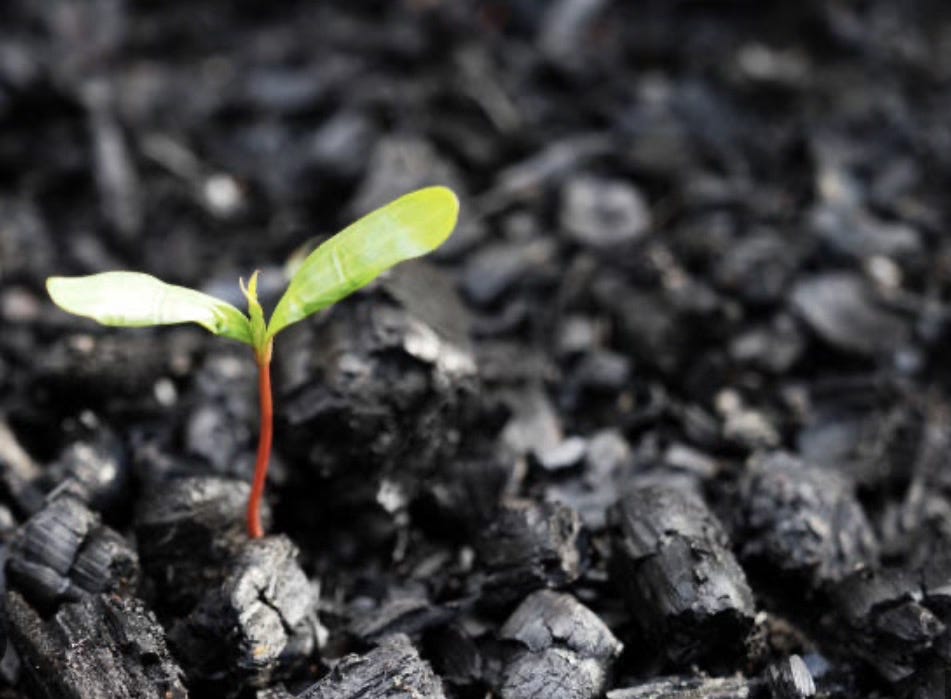
In the morning, he got up, still a bit dizzy, and searched around for his burnt-out piece-of-wood-drum. He was surprised to see a tiny, tender green shoot coming out of the blackened husk. He felt so inspired by the emergence of this tiny new green tendril that stood out almost neon-like against the endless expanse of ash, Icanchu began to sing again. Throwing all caution to the wind, he danced with abandon around that shoot and sang and sang with all his heart. As he did so, the tendril seemed to grow as if its tender life was being silently nourished by the song. Icanchu continued on devotedly singing and dancing around the green shoot, and it responded by growing larger and larger.
The tendril of life soon began to look like a slender tree. In no time at all, the trunk thickened and stood straight up and soon put forth long green branches that reached out in all four directions. What a sight it was, standing in the middle of the expanse of ashes, the only vertical expression of life, the only green intention in the world, the only tree on the face of the earth.
Witnessing how his song had transformed the shoot into a tree and awakened its life, he intensified his dance all the more. At one point, while dancing wildly around the tree, Icanchu’s foot struck a stone. He picked up the rock, and without consideration, he threw it right at the miraculous tree. It’s hard to explain this impetuous action and stark change in attitude. Perhaps the instinct for destruction is so closely tied to the creative impulse, or that the forces of creation and destruction are inextricably connected like beginnings and endings, that when one returns to the world, the other has to manifest as well. For one reason or another, Icanchu kept throwing stones at the firstborn tree.
When the dancer found another stone, he threw it again at the tree, and again and again from all directions with the same enthusiasm and abandon as when he was singing and dancing. Meanwhile, his friend Chuna, continued to sit and witness all that was transpiring.
What happened next was completely unforeseen. Each time the stone would hit the branch, and each time the branch was struck down, it fell to the ash-covered ground and immediately began to take root. Wherever they happened to fall, the branches would immediately begin to grow and soon multiply, so that each branch became not only another tree, but a new species of tree. Soon, there were countless species of trees and a full-blown forest swaying in the sunlight, growing in their green wildness towards the sky while their roots sank deeper and deeper into the old earth. It was almost as if the trees, too were dancing in the ashes in the aftermath of an apocalyptic fire. After the return of the forests, animals began to return, and eventually, people came back to the world again.
Reflections
This story contains much to chew on, with many potent lessons for our time, I think. I don’t want to overanalyse it, but there are many keys and symbols to sit with. Connection to the Otherworld as protection; finding our way back to the sacred centre or point of origin from where new life can be born; the one broken thing that remains, and the way, through imagination, it becomes a sacred object and evokes the power of longing and devotion. The rhythm, song, and dance that nourishes so that new life can miraculously be born and grow; the image of the tiny green tendril. And the instinctual counter movement of destruction that is also required for something to truly take root and grow, into the forest that it once was.
So much. I’d love to hear your reflections and responses in the comments.
No posts
Comments
Nothing yet. Say the first thing.
Sign in to join the conversation.