
It was a chilly and gray winter Washington afternoon in 2014. I sat in my therapist's waiting room, meticulously coloring in an adult coloring book.
The mandala's geometric pattern came to life as I carefully colored each distinct shape with fine-tipped Crayola markers.
Red, first. Then blue and green.
I worked from the center of the mandala out toward the edges.
While coloring, I listened to the sound of the rain falling.
“Do you ever do anything outside the lines, Alissa?” My therapist, Dee, asked as she entered the waiting room to call me in for our weekly session.
“No,” I said with a quizzical look on my face. “Why would I ever do anything outside the lines?” I asked as I stuffed my markers and coloring book into my backpack. “I’m a researcher. I live my life in Excel spreadsheets and little cells. Everything fits in nice, clean boxes.”
“Well, I challenge you …” She said as she closed her office door behind us.
“I don’t even know what that means,” I responded as I fell into her comfortable brown couch.
“Well,” she repeated, “I challenge you.”
***
The moment my therapist challenged me was a significant turning point in my life.
After our session, I stepped into the dark and rain-soaked late afternoon, still perplexed by Dee’s question.
"Do you ever do anything outside the lines?" I replayed Dee's words as I drove a mile up the road to a local art store. I wandered aimlessly through the aisles, wondering how and why I ended up there. As I did so, my eyes were drawn to the watercolor paints and brushes. Instinctively, I grabbed a box of watercolor paints, a watercolor paper pad, and paintbrushes.
"I'm not good at art," I thought as I headed to the register. I reflected on how I struggled in 7th-grade art class and knew myself not to be creative. I had never tried any sort of creative artistic outlet since.
That night, I sat with my sons at our round kitchen table and broke open all the supplies. “Let’s have a painting party,” I suggested enthusiastically.
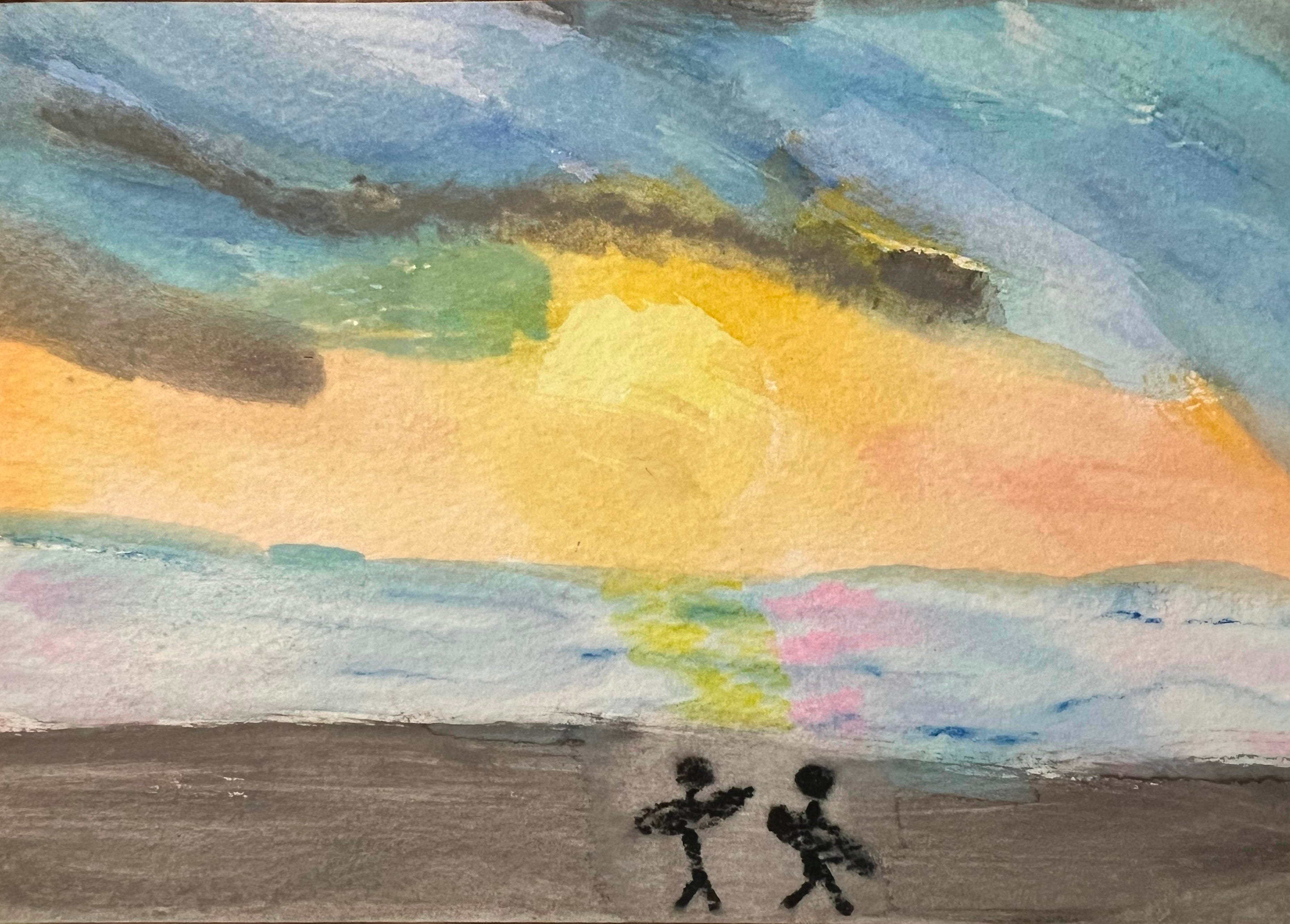
In my first creation, two tiny figures walk along the beach carrying surfboards, their images silhouetted against the setting sun. The scene is reminiscent of a Southern California sunset over the Pacific Ocean, with its beautiful blue, yellow, and pink hues. In the image, I blended a photograph I'd taken a few months prior while walking along a San Diego beach with a close friend with the thought of my children frolicking on that same beach.
By the time I saw Dee the following week, I had completed at least a half dozen paintings. At first, my paintings were mostly scenic images of places I had been or dreamed of going to.
I kept painting. I brought my paintings to Dee's office weekly to discuss their deeper meaning.
I continued honing my skills, trying advanced techniques, including drawing various cartoon characters and advancing from watercolor on paper to acrylic on canvas and other forms of art.
One afternoon, several months after I had been painting, I sat in Dee’s office. We had yet to talk about my rape. She gently asked if it was time to dig in. A chill went through me. I looked at her and said, “Dee, I don’t have the words for it.”
She smiled and said, “Well, paint it.”
Over the next several weeks, I produced a painting series that helped me describe my experience. It gave me words and helped me connect with feelings I had long stuffed away.
Why have I decided to share this story as the first post to readers?
It serves as a metaphor for our fundamental need to experience ourselves, our relationships, and the broader world with all the complex and beautiful mess it entails.
Something shifted in me as I realized that my life experiences did not need to exist within cleanly defined, inside-the-line parameters. Painting opened me to discovering who I was and what I could do. It led me to aspects of myself I would have never known existed if not for "coloring outside the lines."
Learning to color outside the lines led to the birth of Ampersands Restorative Justice. The ampersand is a metaphor for our ability to live with nuance. It means we can hold multiple truths and ideas. It means we can honor those who cause harm and those who have been harmed in the same conversation … and even in the same human being. It means we can lean into challenging dialogue. The ampersand meant I could step outside the siloed walls of the academic institution and do public-facing, community-involved work that genuinely makes a difference. I could be more than a survivor or a scholar. I could be a survivor-scholar. I could be more than an academic or a practitioner. I could be a pracademic.
If I could do it for myself, I could help others do the same.
At Ampersands Restorative Justice, we understand the need for a human-centered approach to repairing and preventing harm. We adhere to this value whether we are working with an individual survivor and harm-doer or a large institution seeking to take accountability for the harm caused by not responding appropriately to harm.
We recognize that there are no one-size-fits-all solutions. They do not work. True healing and justice require us to color outside the lines. We hope you’ll join us.
Comments
Nothing yet. Say the first thing.
Sign in to join the conversation.