
I have, in the past two years, said the words “reverse outline” to other writers so many times that I’m starting to suspect I’ve become that person at the proverbial dinner party. The one who can’t stop recommending the same restaurant. The one who has Found The Thing! and is now duty-bound to tell everyone, even the people who didn’t ask.
So here we are. You didn’t ask, but I’m telling you anyway.
I touched on The Thing briefly when I’d talked of what I’d learn in my year of writing. But I rushed past it because I was trying to cover an entire year in one essay and didn’t have room to explain the thing that genuinely held my novel together. So consider this the proper version. The one with the teeth. But of course, reverse outlining has been around forever, so I cannot—and will not—delve into deeper explanations or comprehensive instructions. This is more a pantser’s take on trying to tame her novel.
Who I am and what I did
First off the bat, and you have already guessed this—I’m a pantser. Intuitive writer, discovery writer, whatever the current word is for person-who-sits-down-to-write-a-novel-with-no-plan-but-just-vibes. Goes without saying that the first draft of any story I start is always a crime scene. I have abandoned larger works specifically because the idea of wrangling the first draft and beating into shape so it progresses into being a second draft has made me throw up.
The Manuscript (which I have now finished! wait how did that happen…) was similarly, a chaotic crime scene. Bullet points, half written scenes, snippets of dialogues and character sketches. Three different versions of the same conversation because I couldn’t decide whose POV it belonged in. Highlighted sentences that just said FIX THIS. Fully-written chapters from the middle of the book sitting next to half-finished chapters from the beginning. Notes to myself in square brackets like so: (she needs to do something here that leads him to say this). Research gaps with links to Wikipedia tabs I’d forgotten to read. An entire ending I wrote in week two and then ignored for ten months. Chaotic crime scene.
If you’re enjoying this and want more clueless-writer-figuring-out-things in your inbox, subscribe to But First, Let's Eat for free.
The structure
My novel has two timelines—1990s India and present day London—which were written into the first draft. I already knew the narrative would flit to and fro between each timeline. I wrote the most urgent things first — the scenes I couldn’t stop thinking about, the dialogue I’d had in my head for years, the character I needed on the page before I lost her. Then I wrote the slightly less urgent things. Then the least urgent things. And then I had 62,000 words with absolutely no idea what shape they were in.
The challenge was then to arrange the out-of-order scenes and events into a sequence that would work at a reasonable pace…well, reasonable enough to hold a reader’s attention.
As far as my interactions go with other writers on various social platforms, especially those that are at the same stage and calibre of creativity as I am, this is where most pantsers either give up or turn to others for help, or in my case, panic-purchase a Save the Cat book.
If you don’t stop there then I strongly suggest researching the 16 narrative structures that a plot could be written to and see if any of those make sense for your story. Although try not to make the same mistake I did at first, which was to try and force my story into a pre-defined structure rather than let the structure develop organically.
This determinedly does not apply if you’re a planner and are working to an outline already. If you’re a planner, you don’t need this post. Go in peace, you’ve already got a process that works for you. But if you’ve ever finished a first draft and immediately felt the urge to set it on fire because you have no idea what you’ve made, this is for you.
The reverse outline
It is exactly what it sounds like.
An outline you build after the writing instead of before it. You take what you’ve already written and condense each scene into a single line (or two), then look at the resulting list and ask the only useful question available to you at that stage: what shape is this thing actually in?
The first time I did this with The Manuscript, I genuinely thought I was going to cry. Not because it was bad—although it was—but because for the first time I could see the whole novel laid out in front of me. Not in my head, where it had been swirling for a year, or on the MS Word where the scenes were haphazard and disconnected. but on a screen. Forty-something one-two-line summaries. I could read the entire book in about three minutes. And I could see, immediately and brutally, where my pacing was collapsing and where a reader would have trouble connecting the gaps, that I had three scenes doing the same emotional work in slightly different clothing, that an entire subplot I’d convinced myself was essential could be cut without anyone noticing, and that the ending I’d written in week two was actually in the wrong place.
Goes without saying, you cannot see any of this from inside the draft. The draft is too close to your face. The reverse outline is what gives you the distance.
What does it look like?
The Post-it method is tried and tested and popular. It is a great structuring tool that authors have sworn by and how many times have I daydreamed of encasing my study wall in coloured sticky notes which would automatically mean that I had arrived at being A Writer? But I have found that the Post-It method works better when you’re already working to an outline and already know exactly what the novel’s structure is going to be. That way, lifting then from the wall and rearranging them in a flow that works is simpler than having to rework entire scenes and arcs. Notes are also limited in the space they provide in case you want a few more details on there.
I use a spreadsheet. Several writers I know use Scrivener cards, or Notion boards, Milanote, Trello (before) and any of those can work really, the principle is the same. You need to be able to recall every scene from the description, decide its purpose and physically rearrange them. The medium doesn’t matter. The visibility does.
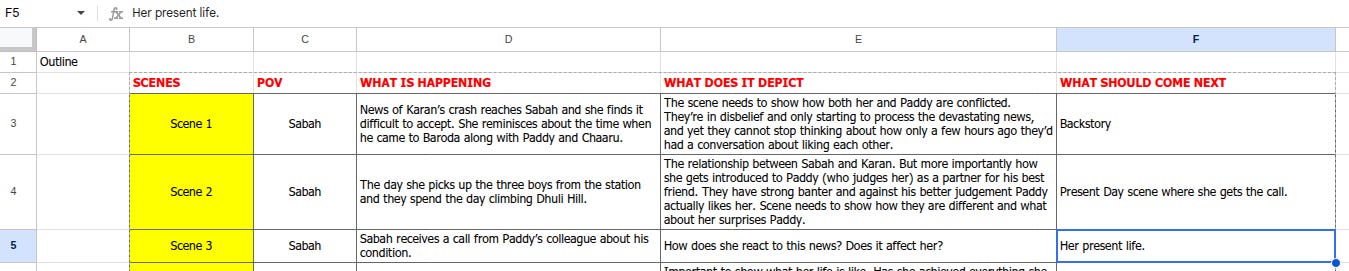
My spreadsheet is simple and has four columns to start:
Scenes: just so I can keep track.
POV: essential so I know who we’re using as the looking glass. For third person omniscient, while technically there is no POV, there will still be a character whose shoulders the readers will be standing on, essentially the focus of the scene. This is where I’ll insert that character’s name.
What is Happening: there is no requirement to name a scene. Just one to two sentences describing what it is and what happens in it. I do break this rule quite a it where I rite a few more sentences reminding myself to “add” or “remove” from a scene when I work on it again. But for the most part the descriptions are one or two sentences.
Ellie arrives at her father’s house and finds the door unlocked. She investigates, gets concerned and calls the police.
That’s it.
What Does It Depict: I have never actually seen this in any reverse outline before and it’s an extra bit I do, since the significance of the scene typed out in one or two sentences gives me perspective when rearranging them. Helps when a particular sequence of events will affect character arc or a significant reveal. This column can easily be merged with the second one (What is Happening), but separate columns keep the layout neat and my sanity intact.
What Should Come Next: Two or three sentences fleshing out what needs to happen next. Note use of the word Should. This greatly helps in giving context and allows me to change the direction of the next scene if I spot a gap—either the arc doesn’t connect, or the character POV feels out of place, or if I decide at a later stage that a scene transition or a buffer scene is required.
For a very crude example, in the first iteration of the draft, this would read:
Elle should wait for the police and answer their questions and have an emotional flashback.
But at a later iteration, this would read:
The POV should flip to Arthur’s present day situation, because that would leave a cliffhanger in the previous scene (use Chapter break) and Elle’s next steps can be in the next chapter, heightening the tension and delaying the solve.
The third or fourth draft would reflect the latter, and I would cut and paste the scenes accordingly to modify the structure.
This one is the secret weapon. Filling it in forces you to notice when nothing happens next, which is the diagnostic for a flat scene.
A few things I’ve learned along the way
Don’t reverse outline too early. Wait until the first draft is done — actually done, even if “done” means you’ve written every scene you can think of and now you’re staring at the wall. Reverse outlining a quarter-finished draft just gives you a quarter-finished outline, which is the same problem you started with.
Keep the headings short. Big words which I have had difficulty to follow, as you can tell form the screenshot above. But the truth is, if you can’t summarise a scene in one sentence, the scene is probably doing too much. Or too little. Either way, it’s extra information not required in a reverse outline.
Trust the spreadsheet over the draft. When the two disagree — when the spreadsheet says a scene is dead weight but the draft says you love the prose in it — the spreadsheet is right. The prose can be salvaged for a different scene. The structural problem cannot be loved into submission.
It’s not precious. I rebuild my reverse outline at the start of every major draft (starting with the second one, of course). Each time, the columns get a little smarter and the structure gets a little tighter. The spreadsheet for Draft 4 looks nothing like the spreadsheet for Draft 2. That’s the point.
Once the spreadsheet is built, the real work begins. Hey, it’s super fun too.
I cut and paste rows. I move scenes. I delete the duplicates. I notice the gaps. I add empty rows where new scenes need to exist—for transitions, as a calming buffer between two tensed scenes, as part of character arc if I feel like a particular arc needs padding and more personality events or backstory. By the time I’m done, the spreadsheet is the reverse outline of the book I have and the forward outline of the book I’m about to write. This is the fun part. The cutting and pasting and the exploration of structure that a story can potentially have. Writing is crafting and I feel that sentiment in my bones when manipulating a reverse outline.
If you’re enjoying this and want more clueless-writer-figuring-out-things in your inbox, subscribe to But First, Let’s Eat for free.
The free thing
Because I have been asked for my spreadsheet roughly forty times in writing groups, I’ve finally tidied it up and made it shareable. It’s the actual template I used for The Manuscript. Make sure you hit copy when the link opens so it can be saved in your Google Drive. Break it, rearrange it, add columns, delete mine, ignore the colours entirely. It is not sacred. It is a spreadsheet.
If you do use it and it helps, I’d love to hear about it. And if you use it and it ruins your life, please blame me publicly so I can use the trauma in a future blog post.
Happy writing!
Amrita
Follow along with my eating, cooking and writing adventures here, where I promise to document both the triumphs and the failures.
Comments
Nothing yet. Say the first thing.
Sign in to join the conversation.