
I’ve been arguing we were entering the “age of hybrids” for a while - in No.17 in detail and more recently in an interview with AI for Business Leaders. The profile AI most accelerates is people with one deep domain expertise becoming capable of operating across functions that previously required several specialists. The product manager who can prototype, interpret research, think through launch planning and work credibly with engineering is one example. To me, this is the deepest implication of AI for staffing and organisational design.
Well: OpenAI has now put some data behind that idea.
Its analysis of more than 800,000 work-related ChatGPT conversations finds that 43.5% of occupation-specific use involves tasks normally associated with another occupation. Marketers are doing bits of engineering and finance, salespeople are analysing data, and designers are taking on work that once sat elsewhere.
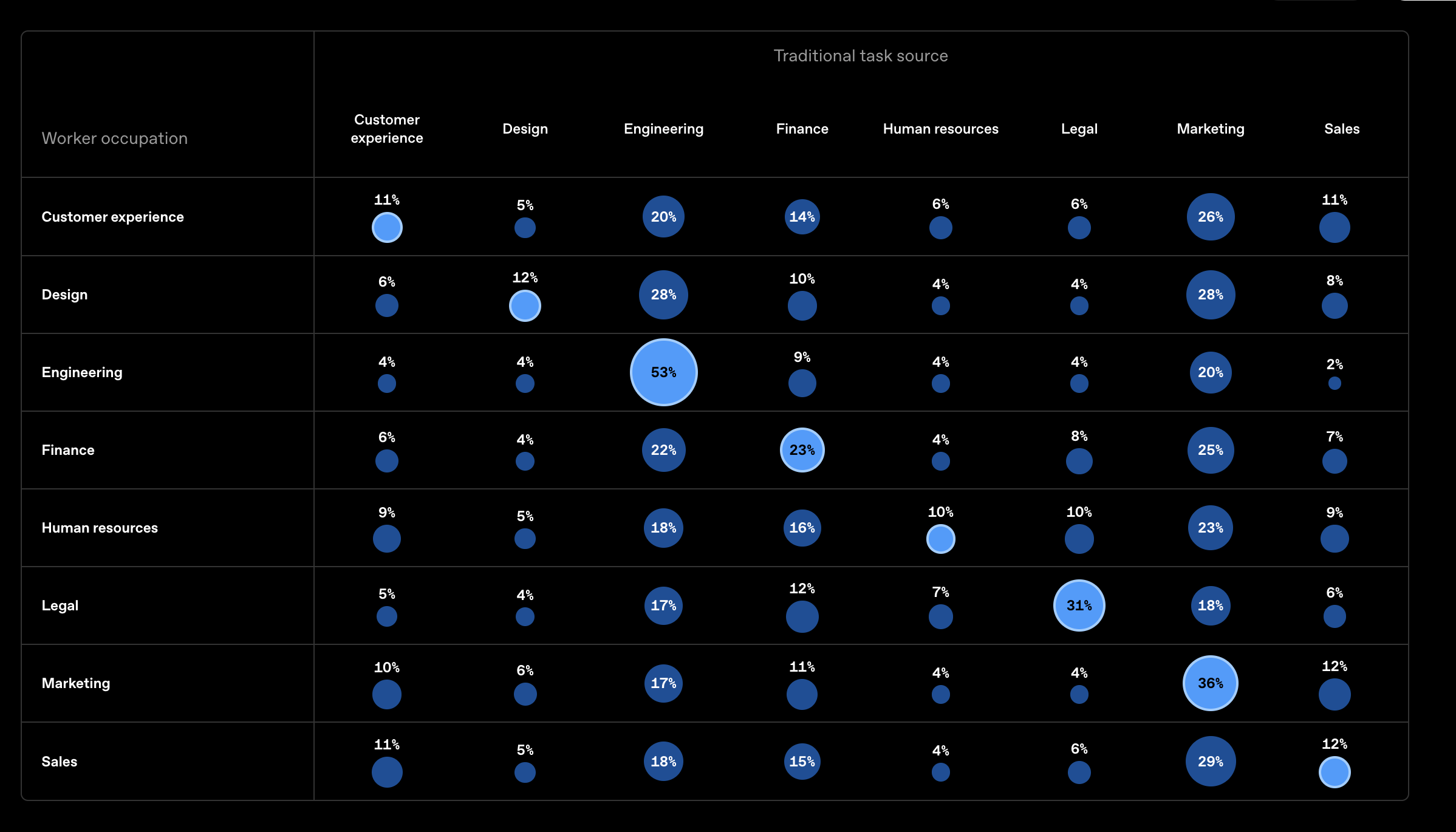
The same pattern showed up in the recent P&G experiment highlighted by Ethan Mollick. Without AI, R&D specialists produced more technical answers and commercial specialists more market-oriented ones. With AI, that distinction narrowed substantially, and individuals with AI performed about as well as two-person teams without it.
That doesn’t mean everyone becomes capable of doing everything. The winning profile still has real depth somewhere; AI simply lets that person operate credibly across a much wider set of adjacent tasks. That could mean fewer handoffs, wider jobs and more people operating across boundaries that used to define teams.
Another new study from OpenAI, Columbia and Wharton, covering more than 1,500 organisations and 17 million ChatGPT Enterprise messages, finds adoption concentrated among companies that were already larger, more productive and more heavily invested in software, R&D and organisational capability. Among firms already using ChatGPT Enterprise by June 2025, usage then grew roughly fourfold by March 2026.
As Ethan Mollick (again!) points out, that raises an uncomfortable possibility: AI may widen existing gaps between companies rather than close them. The firms best equipped to adopt it are also those with the strongest capabilities to integrate it.
The paper cannot show that AI caused their stronger performance. What it does suggest is that access to the same models does not create anything close to equal capability to exploit them.
The evidence on AI and jobs is starting to become useful, albeit much more nuanced than either side of the debate tends to suggest. Reading across the latest research, I think the emerging pattern is that AI is changing tasks faster than roles, and roles faster than employment.
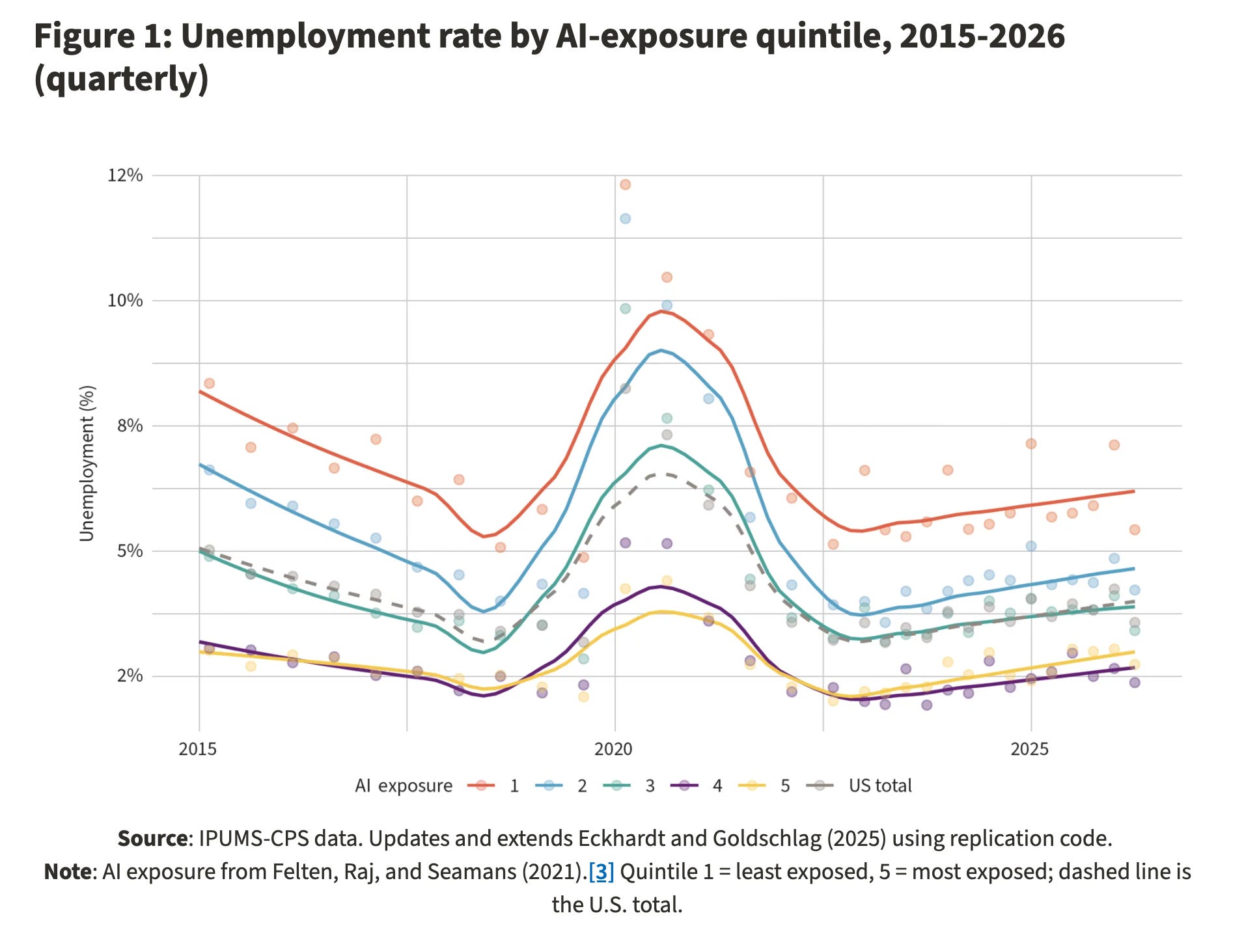
At the aggregate level, remarkably little has happened so far. A new Stanford review finds no clear evidence that AI is causing significant job losses across the US economy. Since 2022, unemployment has risen by roughly the same amount in the occupations most and least exposed to AI. Yale’s tracker reaches a similar conclusion: compared with previous technology shocks, the occupational mix has changed little, and its newer synthetic-control work still finds no clear employment effect.
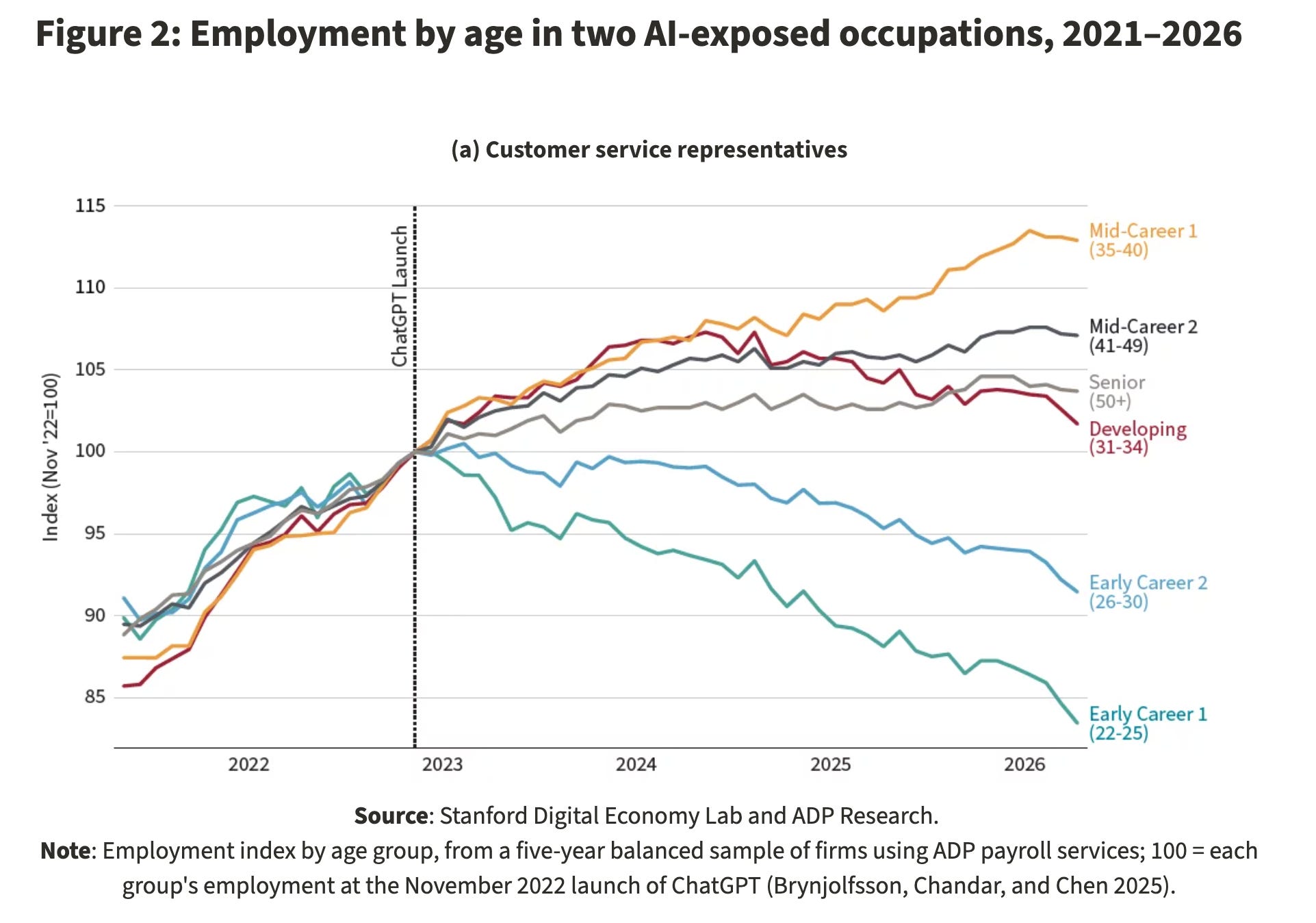
The clearest warning sits one level below. Unemployment among recent US college graduates reached 5.6% in early 2026, up around 1.6 points in three years. Stanford also reviews evidence showing early-career employment falling in highly exposed occupations such as software development and customer service while older workers in the same occupations held up better. The researchers are careful about causality: interest rates, pandemic over-hiring and the retreat from remote work all overlap with the period. The divergence becomes more pronounced from 2024, when AI capability and adoption also accelerated.
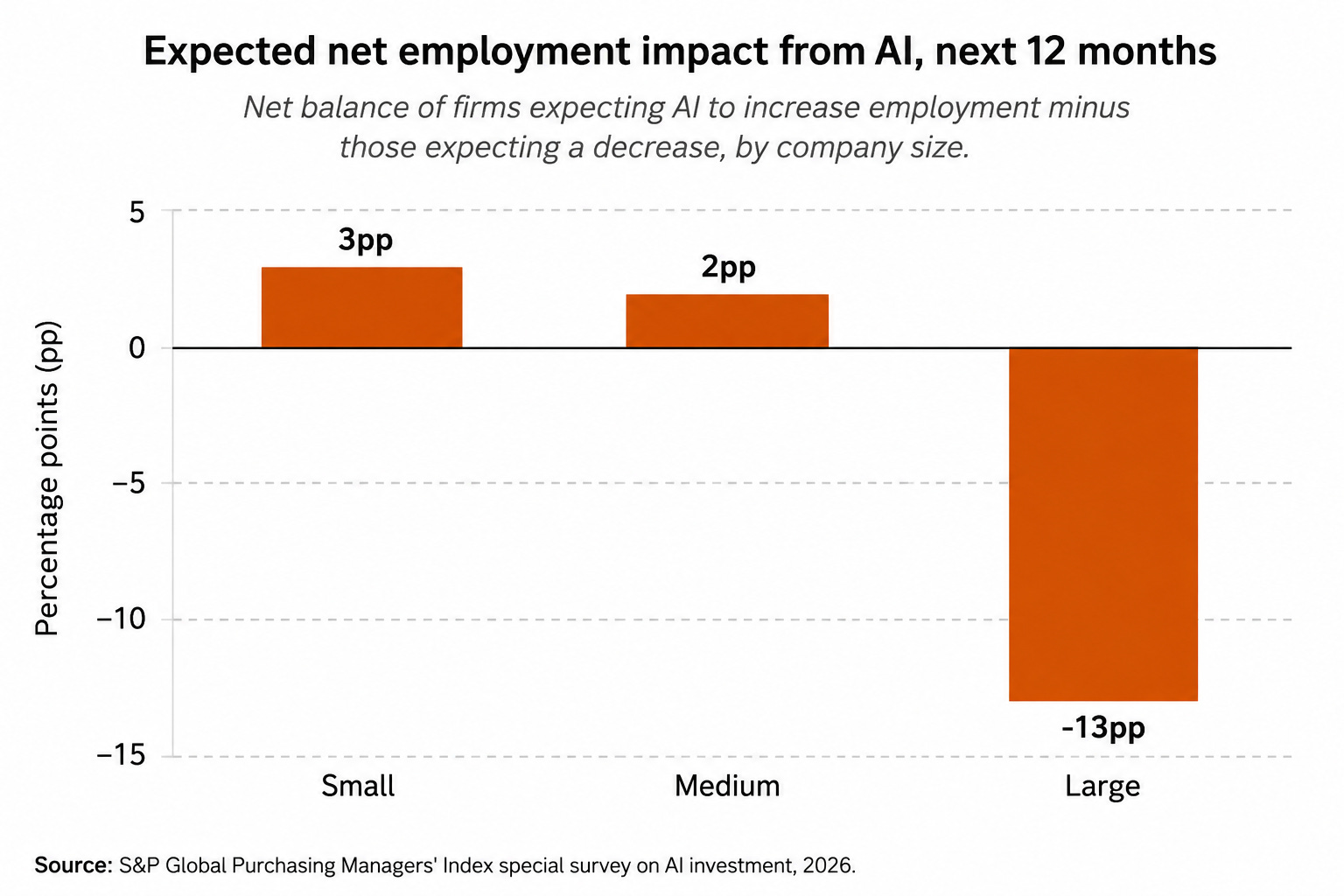
At company level however, a direction is starting to emerge clearly. S&P Global finds slightly more firms now attributing job reductions to AI than job gains, a net balance of -5 points over the past year. Among large enterprises it was -8, and they expect that to widen to -13 over the coming twelve months. Smaller firms still expect a net increase in employment.
That size split makes sense: a small company that becomes 20% more productive can use the capacity to grow. A large company doing roughly the same volume of work has much more scope to conclude it needs fewer people. S&P notes that 83% of companies in its Global 1200 already had lower headcount in January 2026 than a year earlier, so AI is only one part of a broader contraction.
The more useful signal is what firms now say it will do to future labour demand, and we know labour demand can fall long before layoffs appear in national statistics. A company can replace fewer people who leave, cancel a vacancy, hire one experienced person instead of two juniors, or grow without adding headcount.
At the task-level the evidence is clearer still.
In B2B customer support, Pylon data published by a16z shows AI resolving only about 15% of requests entirely on its own. In roughly two-thirds of cases it reads the incoming request and routes it to a person without ever speaking to the customer. When it does engage before handing over, human workload on the ticket falls by roughly a third. This is vendor telemetry from Pylon’s own customer base, published by one of its investors, but the mechanism it exposes is worth having:
It shows augmentation and substitution happening at the same time: the worker remains, while part of the work has disappeared. On a broader scale the pattern matches: S&P says only 22% of current AI projects aim for full autonomy.
Most initiatives target efficiency or employee productivity. Gallup finds that 65% of employees in organisations implementing AI say it has improved productivity, while only 14% strongly agree it has transformed how work gets done.
As it relates to wages, we’re getting conflicting signals. Apollo finds slower wage growth in occupations with high observed AI use. Chen et al., using a similar synthetic difference-in-differences approach, find the opposite: earnings rose in highly LLM-exposed occupations, with no corresponding increase in unemployment.
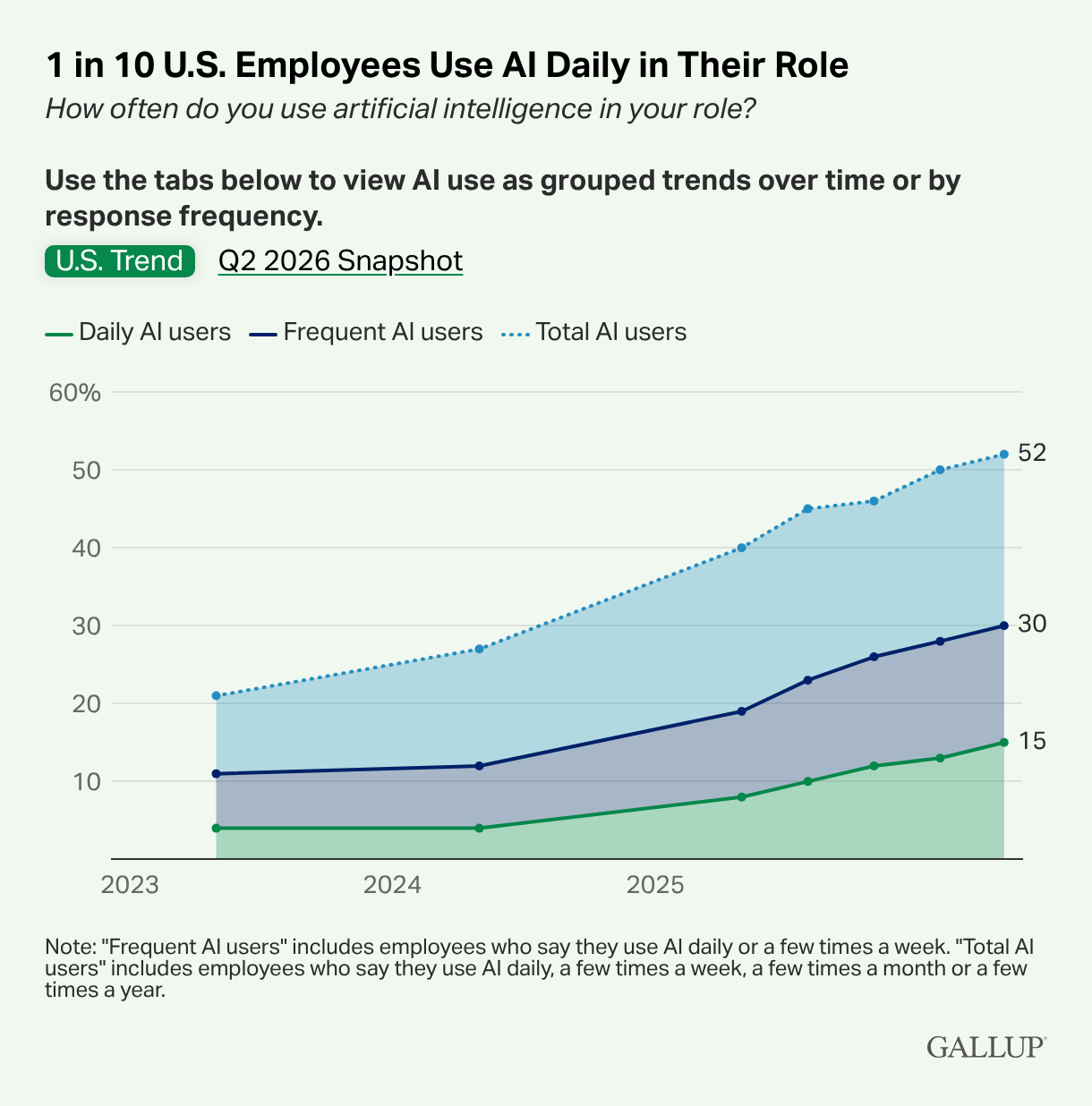
Employment is the outcome on which the evidence is most consistent: very little aggregate effect so far. Part of the explanation is simply that adoption remains shallow. Gallup finds that 52% of US employees use AI at work at least occasionally, but only 15% use it daily, up from 4% in 2023. Census Bureau data highlighted by Stanford puts firm adoption at around 20%, with deep integration rarer still. S&P finds only 37% of recent AI initiatives are live and delivering value.
So today’s employment numbers carry one finding with reasonable confidence: no broad AI jobs shock has arrived. Everything past that depends on deployment, which has barely started.
What we can see already: tasks being removed from jobs, roles being recombined, and some companies changing how many people they expect to need.
If history is any guide, today’s weak aggregate signal may tell us more about how slowly organisations change than how much AI ultimately will.
I’ve been pointing out for a while that the FDE maths doesn’t add up. Palantir, which pioneered the model, had fewer than 4,000 employees at the end of 2022. Even if you assume 20% annual churn across the entire company, that would have released only less than 3,000 Palantir employees into the market over the following three years, and only a fraction of them were FDEs.
Meanwhile, the industry has discovered FDEs everywhere. Accenture has launched forward-deployed engineering practices with Microsoft and ServiceNow, EY has created dedicated roles, the AI labs are building deployment organisations, and every consultancy and new Lab-plus-PE “DeployCo” seems to want some version of the model.
Hence I was delighted to find a new Christian & Timbers study that puts a number on the gap. It estimates roughly 17,000 people in the US now carry an FDE title, yet only about 12% have repeatedly helped enterprises generate $10m+ of cost savings or revenue from AI deployments. Around 80% of that “elite” group still works at Palantir. Demand, meanwhile, has exploded: roughly 70% of companies surveyed had hired or planned to hire FDEs by the end of Q2, versus only 10% at the start of the year.
The model is real and we know it is one of the most effective ways to make AI work - but the label has scaled much faster than the capability behind it.
The open-model race has become one of AI’s dominant narratives, as benchmark tables increasingly make the case that open-weight Chinese models are approaching frontier performance at a fraction of the token price.
But as ever, those comparisons hide a lot of underlying complexity and real-world friction. There are two main catches for me: benchmarks are useful but imperfect, and price per token is an increasingly poor measure of what AI actually costs.
AlphaSense recently tested leading US and Chinese models across 246 financial-analysis tasks. GPT-5.6 Sol cost about 13% less per completed task than Kimi K3 while scoring roughly 20% higher on quality. Opus 4.8 also beat Kimi on both measures. In other words, more expensive tokens can produce cheaper work if the model needs fewer of them, makes fewer mistakes or requires less rework.
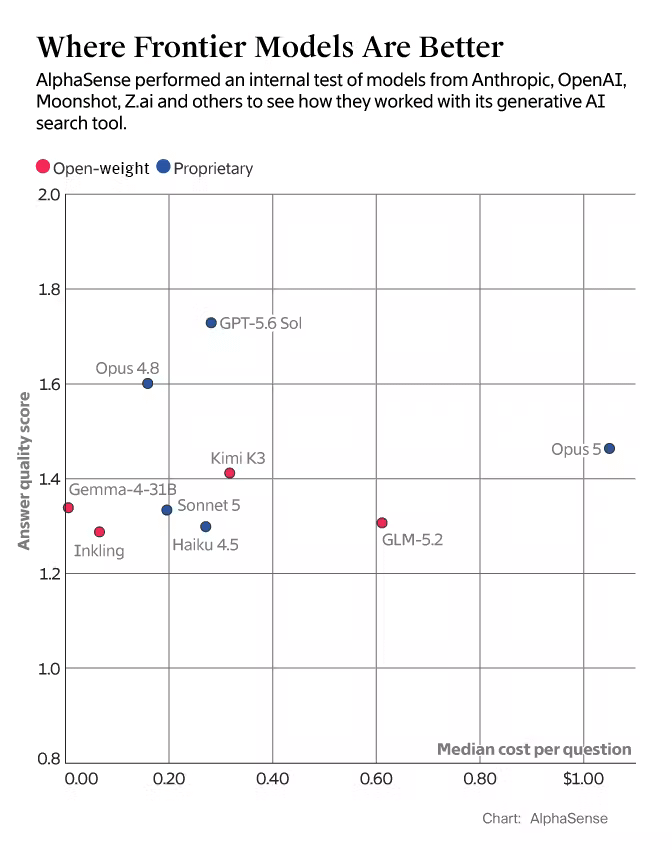
While models are compared on a cost per token basis, the better measure is indeed cost per successful task, and even that does not give us one winner. Open-weight models can still win on simpler tasks, control or self-hosting; frontier models can win where additional intelligence pays for itself.
As usual with AI, the answer is less satisfying than the leaderboard: it depends on what you are trying to do.
About
I analyse AI progress beyond the headlines, focusing on enterprise execution, incentives, and real-world economic impact.
No posts
Comments
Nothing yet. Say the first thing.
Sign in to join the conversation.