
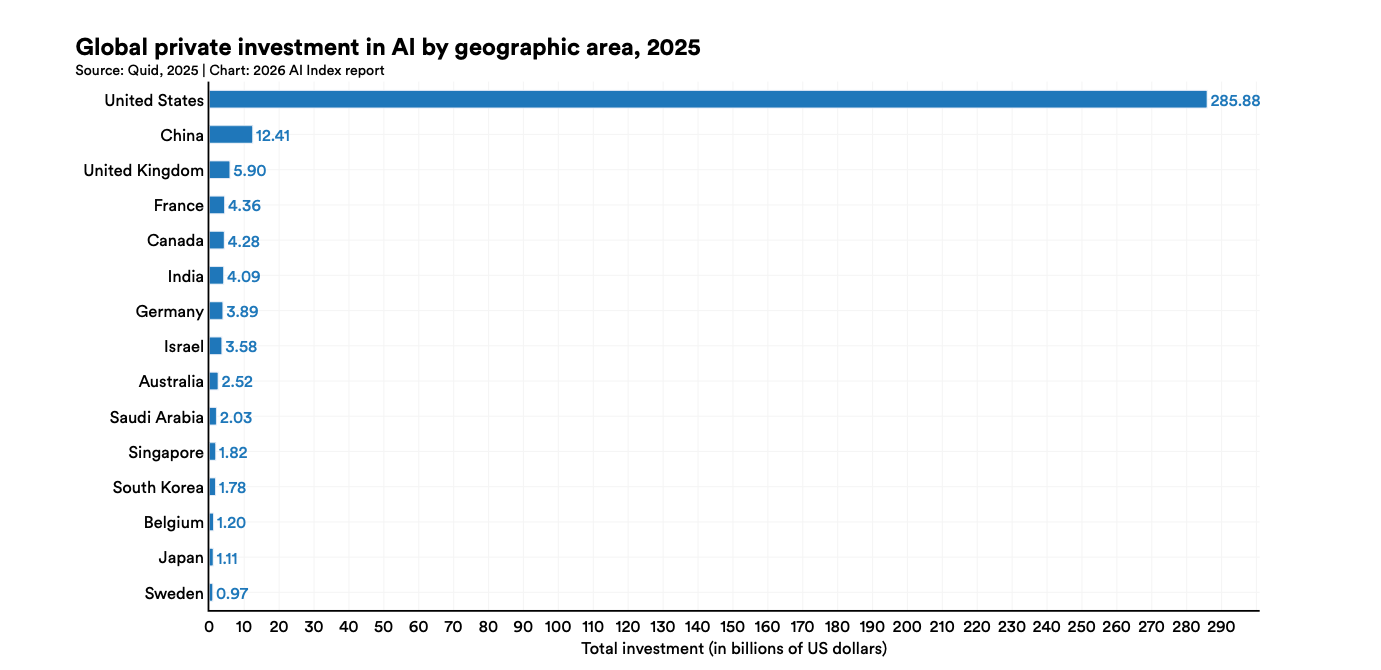
The US accounts for 86% of global private AI investment. China's $12.4 billion looks modest but much of its AI funding flows through state channels that private investment data doesn't capture.
Source: Artificial Intelligence Index Report: Stanford HAI, Quid data.
Multiple stories this week (read together) describe an industry hitting a hard supply constraint, with consequences already rippling through products, infrastructure, and competitive dynamics. Enterprise buyers beware.
For two years, the dominant narrative in AI has been relentless deflation.
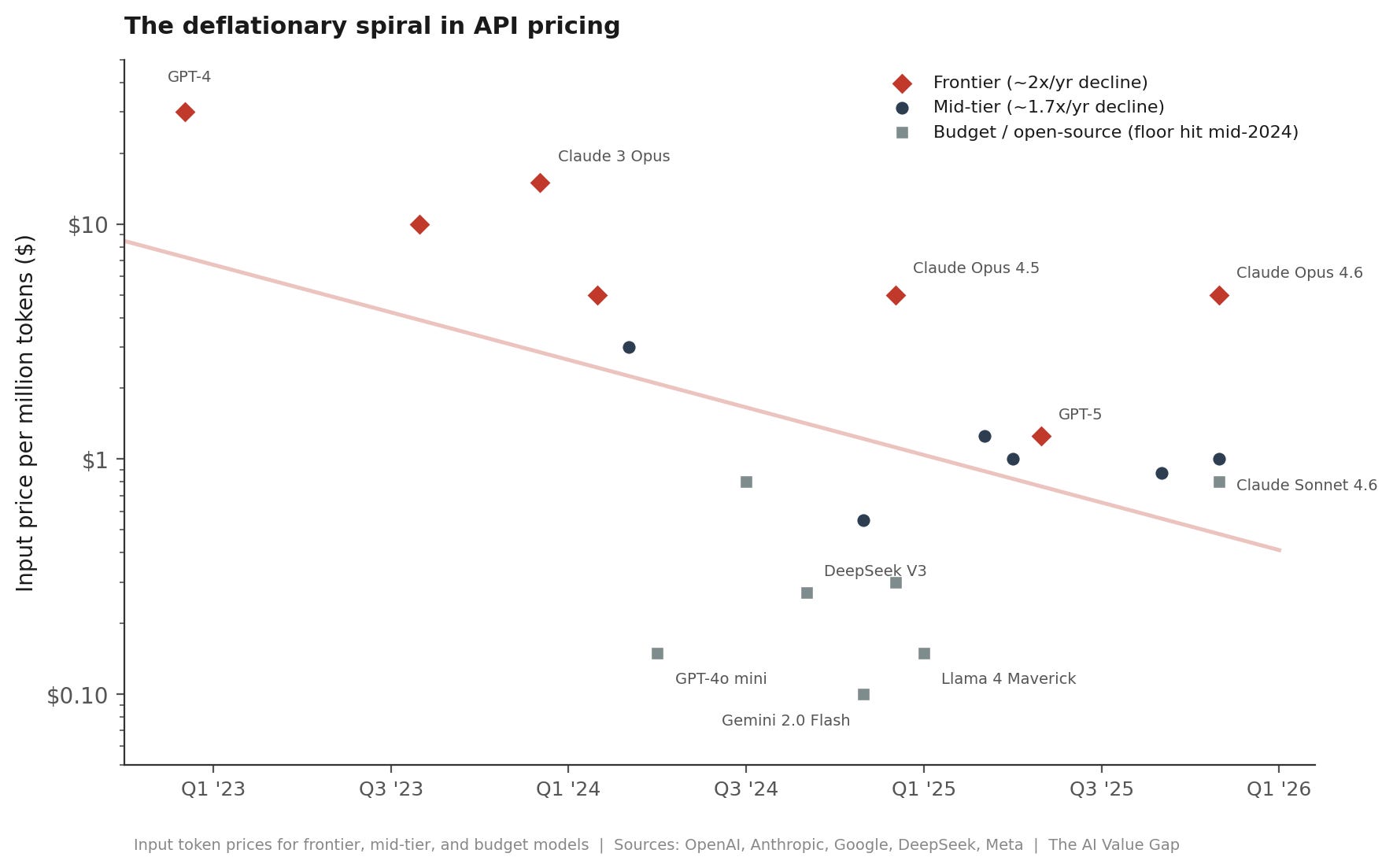
API input prices have fallen roughly 2x per year at the frontier (GPT-4 launched at $30 per million tokens in early 2023; Claude Opus 4.6 sits at $5 today), while budget models raced to a floor of $0.10-0.15 per million by mid-2024 and have barely moved since. The cost of matching GPT-3.5-level performance dropped 280x between late 2022 and late 2024 (though that figure measures a now-commoditised capability against today’s cheapest models, which flatters the decline). The direction was clear enough to fuel a commoditisation thesis that cast doubt on whether any model builder could sustain meaningful margins. That was before…
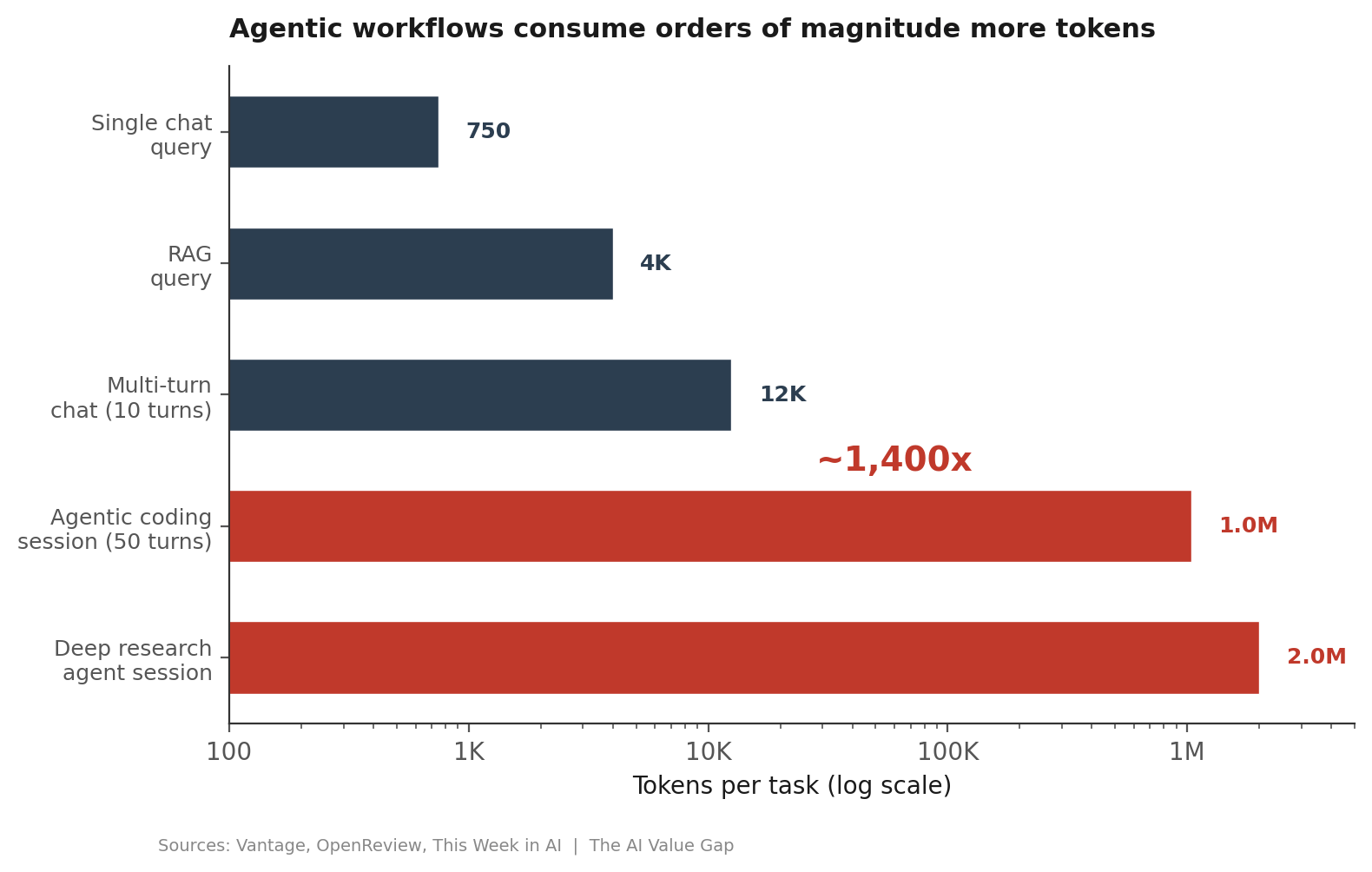
The global stock of AI chips has been growing at roughly 3.4x per year since 2022, according to Epoch AI’s analysis of revenue data and financial disclosures. The hyperscalers are planning to more than double their installed compute in 2026 and roughly triple it by the end of 2027. On paper, that looks like abundant supply. In practice, the buildout is already falling behind schedule, and demand from agentic workflows (which consume orders of magnitude more tokens per session than chat) is growing faster than the infrastructure can absorb it. The price signals have started to confirm the squeeze: Nvidia Blackwell chip rental prices hit $4.08/hour in April, up 48 per cent from just sixty days earlier, and CoreWeave raised prices by 20% while extending minimum contracts from one to three years. Tomasz Tunguz put it bluntly: “The age of abundant AI is over, and it will remain so for years.”
The evidence? Already visible from space. The FT reported this week that nearly 40% of US data centre projects due this year are at risk of falling behind schedule by more than three months.
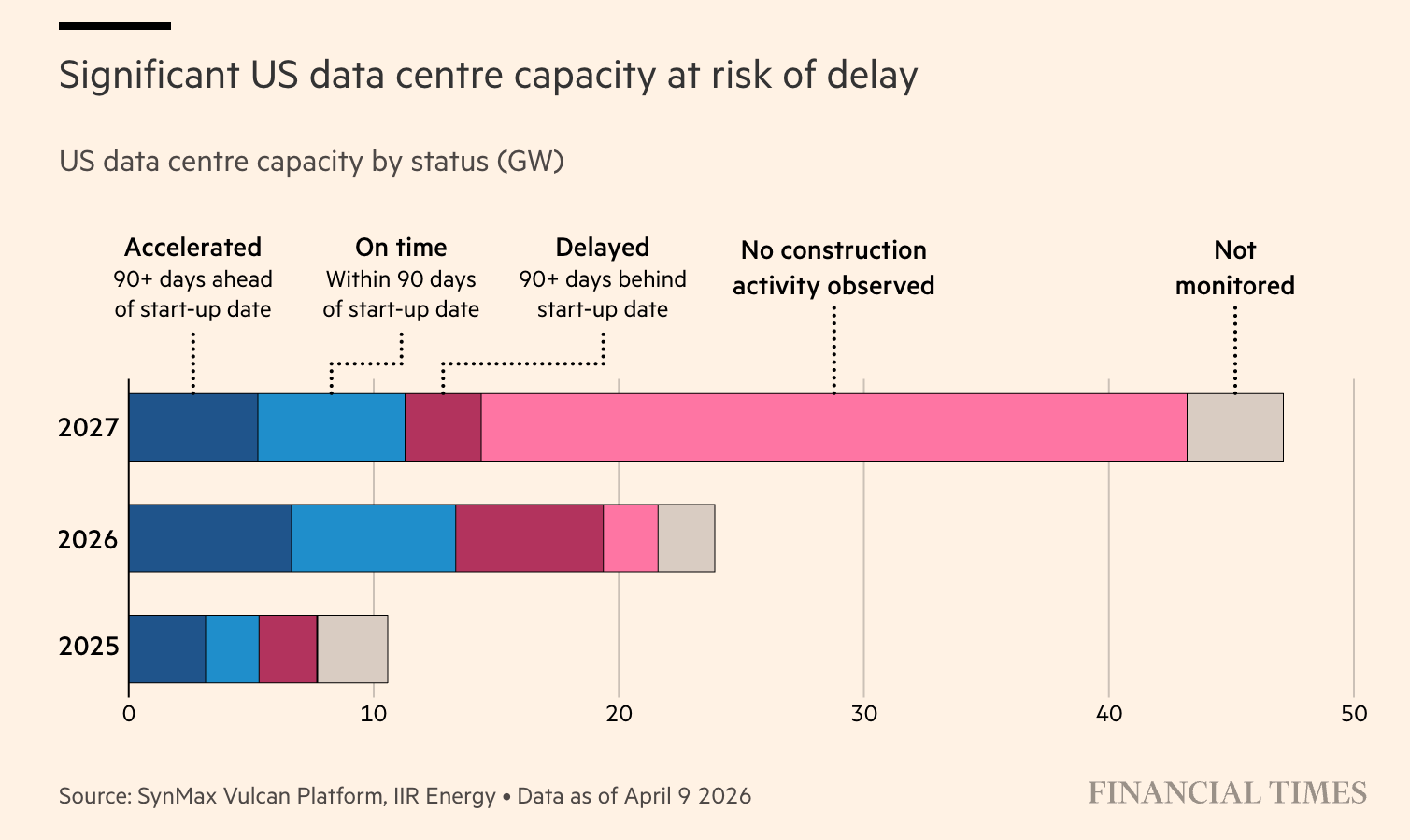
SynMax, an analytics group that tracks construction progress via satellite imagery, made public an analysis showing the gap between what companies are announcing and what satellites can see is striking. Oracle’s 1.4GW campus in Shackelford County, Texas (meant to provide capacity to OpenAI from H1 ‘26) has land cleared for six facilities but only one showing signs of development. A timeline matching comparable projects would suggest a go live date of late 2027. OpenAI said a 1.2GW site in Milam County was “taking shape”; satellite imagery shows construction begun on one facility. And the list goes on…
A good reminder that in the world of digital, the bottlenecks remain stubbornly physical. Lead times for high-power transformers have stretched from 24-30 months before 2020 to as long as five years today. Gas turbines and switchgear are in chronic shortage. There aren’t enough electricians and pipe fitters to go around, and remote locations are pushing labour costs up by 30%. Doug O’Laughlin of SemiAnalysis captured the absurdity neatly: “OpenAI is competing with OpenAI.” Workers are moving between projects chasing better pay, and double shifts still aren’t enough to hold schedules. Over 60 per cent of projects scheduled for next year haven’t broken ground. The hyperscalers are expected to spend $650-710 billion on AI infrastructure this year: cheques the physical world can’t cash fast enough.
In a supply-constrained market, rationing happens through quality before it happens through price, as many of you will now have experienced if you’re heavy Claude users. In late February, the company reduced Claude’s default “effort” level to conserve tokens. The change appeared in a change log but wasn’t flagged to users in any meaningful way. A GitHub analysis found the model had shifted from a research-first approach to an edit-first style: reading less context before making changes, producing more errors, requiring more user intervention. One developer said the model had “regressed to the point it cannot be trusted to perform complex engineering.” Fortune reported service outages as usage increased, stricter limits during peak hours, and an OpenAI internal memo claiming Anthropic had made a “strategic misstep” on compute capacity. InfoWorld confirmed separately that Anthropic had throttled subscriptions across the board to manage capacity.
The issue? (other than the operational burden of being the fastest growing software company in history): the way people use AI is changing fast. Models are increasingly deployed inside agentic workflows that run autonomously. Token consumption per user is shooting through the roof as a result, and every improvement in capability accelerates the trend rather than relieving the pressure on capacity.
Richard Waters made the sharpest argument of the week in the FT, painting new competitive dynamics in a world where compute is scarce. Anthropic released their Mythos model (see last week’s edition for a catch-up) to a small number of tech customers, framed as responsible disclosure. But the company simply didn’t have the capacity to serve broad demand. Access to frontier capabilities is becoming a source of market power, and the AI companies are the ones deciding who gets it.
The commoditisation thesis assumed abundant supply and interchangeable models, leading to margin compression and a race to the bottom. Scarcity upends both assumptions. Restricted access, capacity constraints, and allocation decisions that start to look like industrial policy would mean slower diffusion of AI, marginal use cases priced out, and meaningfully higher margins for model builders. The advantage as you head for IPO (not suggesting the shortage is manufactured): scarcity is a far more attractive story for investors.
For organisations building on these models, the implication is clear: fight for access to AI capability the way you'd fight for talent or office space in a hot market. AI labs could become gatekeepers who decide which customers get which models, at what price, and with what usage limits. Pricing can go up, access can be throttled, and frontier capabilities can be restricted to a handful of partners. Enterprises that depend on a single provider are exposed. Diversifying across model suppliers, securing capacity commitments, treating these relationships with the same care as any critical vendor, and building your AI workflows on token economics that leave margin for prices to move the wrong way: that's the new baseline.
Brynjolfsson’s Stanford Digital Economy Lab published a new study this month - The Enterprise AI Playbook - based on interviews across 51 successful AI deployments in 41 organisations. We're so early in enterprise AI that there's no established playbook and precious few case studies worth learning from, which makes a rigorous sample of real deployments genuinely useful. Every case had to show operational stability, sustained adoption, quantified value, and scalability to make the cut.
A good chunk of the findings confirm what practitioners already know. 77% of the hardest challenges were invisible costs - change management, data quality, process redesign - and technology was consistently described as the easiest part. Every single successful project used an iterative approach to development; none used waterfall. The projects that achieved organisation-wide transformation had business and technology co-sponsoring together, with sponsors who tied AI adoption to corporate OKRs rather than just approving budgets. Foundation model choice was fully interchangeable in 42% of cases. And (unfortunately) the dominant value metric remains cost reduction, with headcount cuts the single most common outcome at 45% of deployments.
Beyond that, a few things stood out to me.
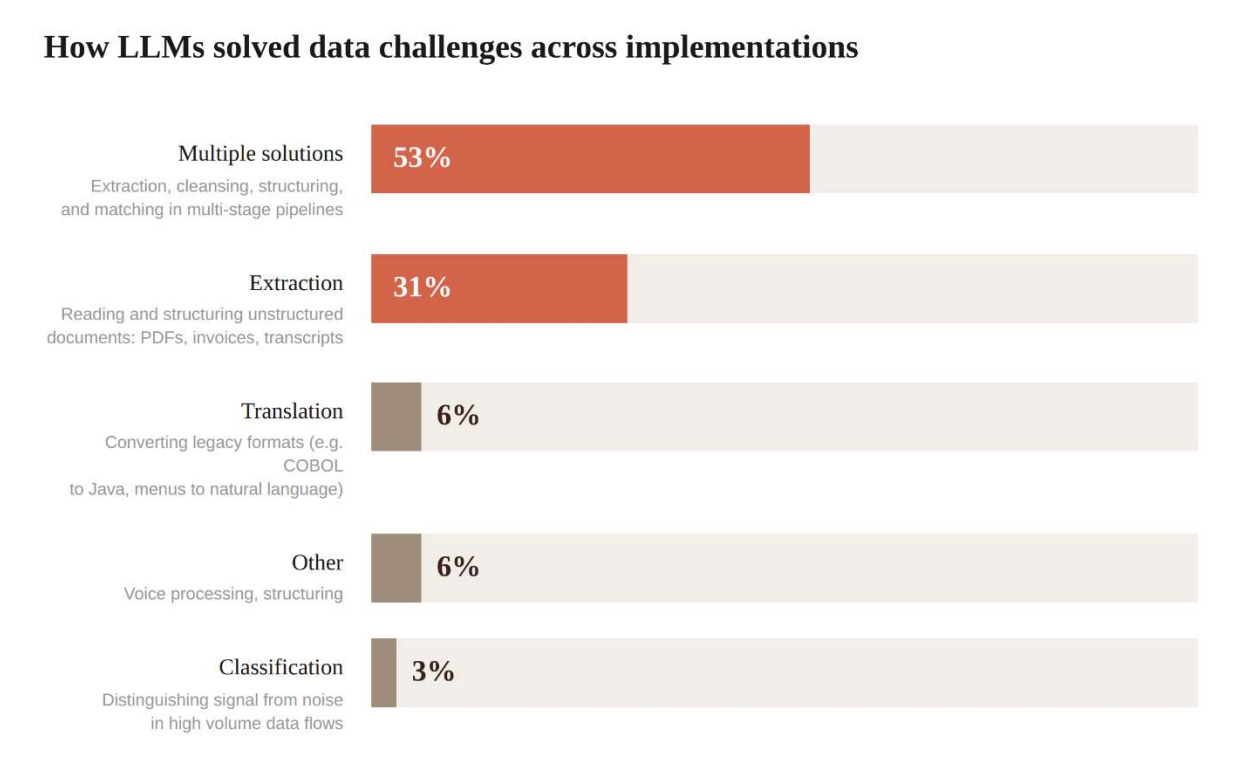
1. "Our data isn't ready for AI" is something I hear constantly from executives, and it's become one of the most common reasons to delay. The study puts hard numbers against it: only 6% of implementations had data that was fully ready for AI deployment. And yet in 88% of cases, LLMs were part of the solution to the very data problems they were expected to struggle with - processing voice transcripts, scanned documents, legacy code, and scattered knowledge bases that no prior technology could handle. The consensus framing is backwards: messy data isn't a reason to wait for AI, it's a reason to start.
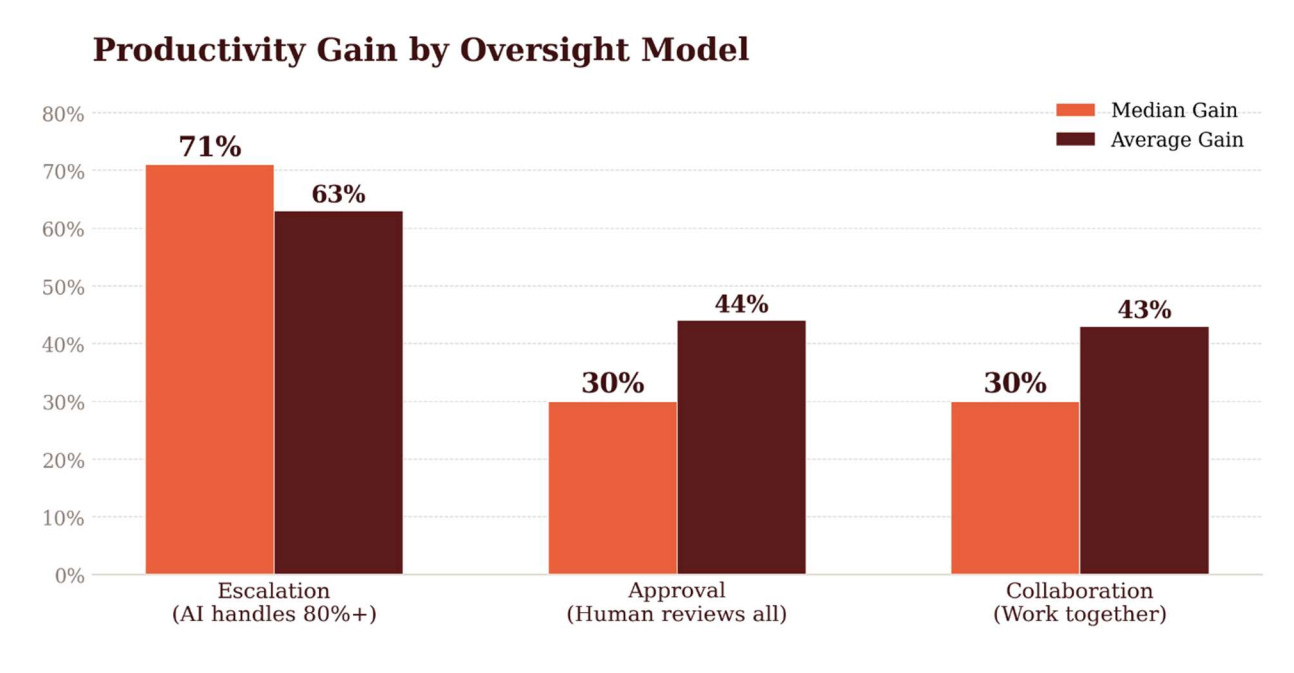
2. "You need a human in the loop" has become the default safety blanket in enterprise AI, and too often the result is bolting AI onto a process that was designed for humans to run end to end. The study breaks oversight into three models: escalation (AI handles 80%+, humans review exceptions), approval (humans review every output), and collaboration (human and AI work together continuously). Escalation-based setups delivered a median 71% productivity gain versus 30% for approval models. The biggest gains come from designing the workflow around AI autonomy with structured exception handling rather than inserting AI as an assistant for people.
3. When companies think about AI resistance, they picture frontline employees worried about their jobs. The authors found something different: back-office functions - Legal, HR, Risk, Compliance - were the most frequent source of resistance at 35%, ahead of end users at 23%. These groups have organisational authority to slow or kill projects regardless of executive support, and each resists for different reasons: Legal worries about liability, HR about change management, Risk and Compliance about regulatory exposure. The companies that broke through didn't try to persuade these teams, they gave them a governance role in the deployment, turning potential blockers into enablers with skin in the game.
A fresh batch of survey data landed recently - Gallup’s workforce survey, Gallup’s Gen Z report, an NBC News national poll, and Stanford HAI’s 2026 AI Index. Surveys that paint a picture that should worry anyone building or deploying AI in an enterprise setting.
The good news: AI adoption is accelerating. Half of US employees now use AI at work, up from 46% last quarter. 65% report productivity gains. Generative AI reached 53% population adoption in three years - faster than the PC or the internet.
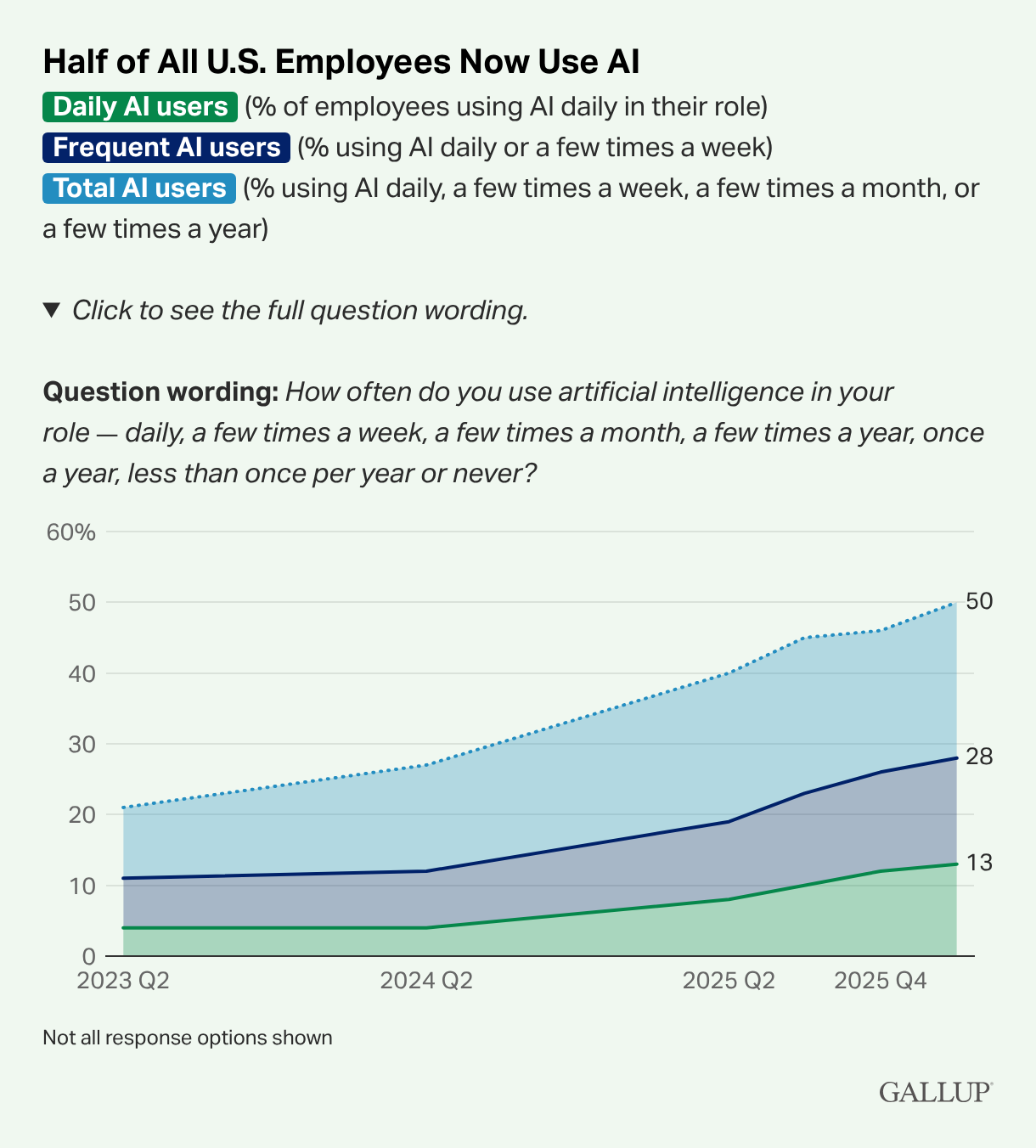
The not so good news: trust is moving in the opposite direction. NBC found 57% of voters believe the risks of AI outweigh the benefits, with only 26% holding positive views. Stanford’s AI Index reveals a staggering perception gap: 73% of US experts view AI’s job market impact positively versus 23% of the general public.
The generational picture is even more telling: 51% of Gen Z use AI weekly, but excitement has dropped 14 points year-on-year, hopefulness is down 9, and anger is up 9. Even among daily users, excitement fell 18 points. 80% believe AI use will make future learning harder.
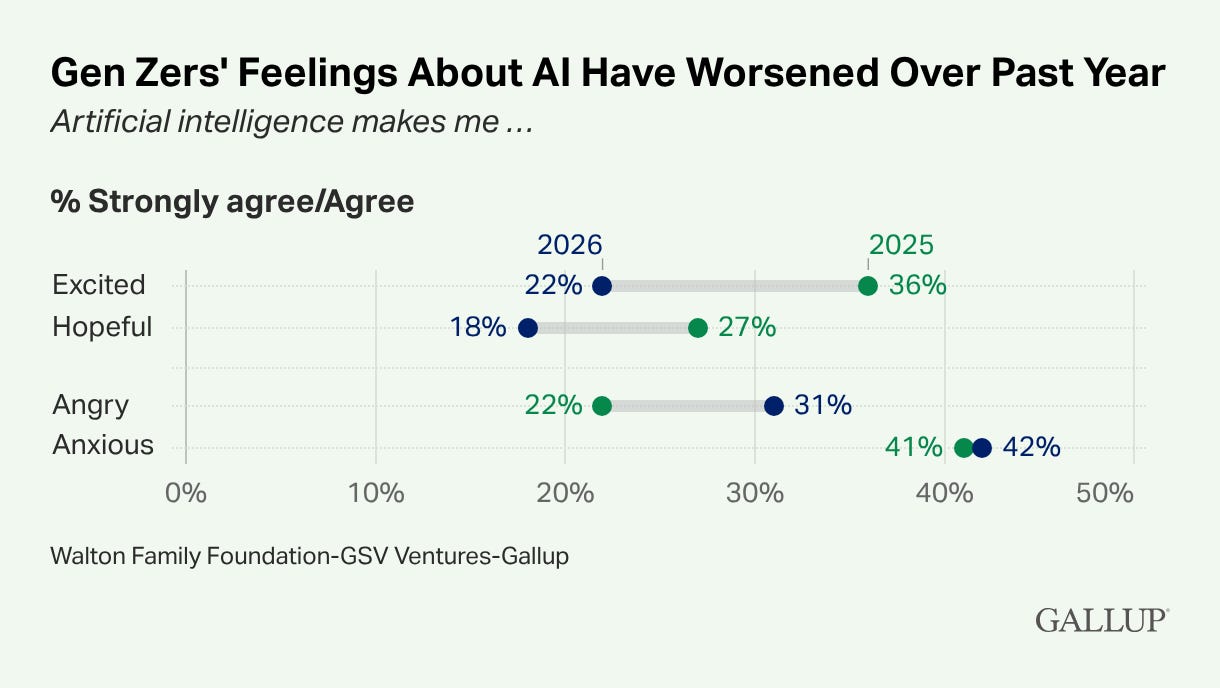
The generation building their careers alongside AI is the one that trusts it least.
Clearly the gap between what AI delivers in practice and how people feel about it is now wide enough to become a strategic problem. If the public doesn't trust AI and experts do, the policy response will be shaped by whoever can credibly claim to represent “safety”, which, today, largely means the labs themselves. It is time corporate leaders step in with transparency on how they’re deploying AI and what it means for their people. Governments need to step in with regulatory frameworks that build confidence rather than theatre (although I wouldn’t hold my breath on this one). Right now the loudest voices in this conversation are running agendas that serve no one trying to make practical decisions about this technology.
About
I analyse AI progress beyond the headlines, focusing on enterprise execution, incentives, and real-world economic impact.
No posts
Comments
Nothing yet. Say the first thing.
Sign in to join the conversation.