
It's been a while since the last batch of fresh AI-productivity / AI employment impact data. A LOT has dropped in the last couple weeks so let's get into it.
First, a large-scale forecasting exercise from the Forecasting Research Institute (FRI) (with co-authors at the Chicago Fed, Yale, Stanford, and Penn) surveyed leading economists, AI experts, superforecasters and the general public on where AI takes the U.S. economy. The headline finding is as unremarkable as the underlying data is interesting. Economists assign a 47% probability to a “moderate” AI progress scenario by 2030, defined by “AI being an effective collaborator across domains” and 14% to a “rapid” one, defined as “AI systems surpass humans in most cognitive and physical tasks”. If you squint, it is a sophisticated way of saying “roughly even odds things don’t change much or things change a lot” - i.e. we don’t know. We can see the capability shift, but not how it translates into economic output.
Which is probably why they forecast GDP and total factor productivity tracking close to historical trends:
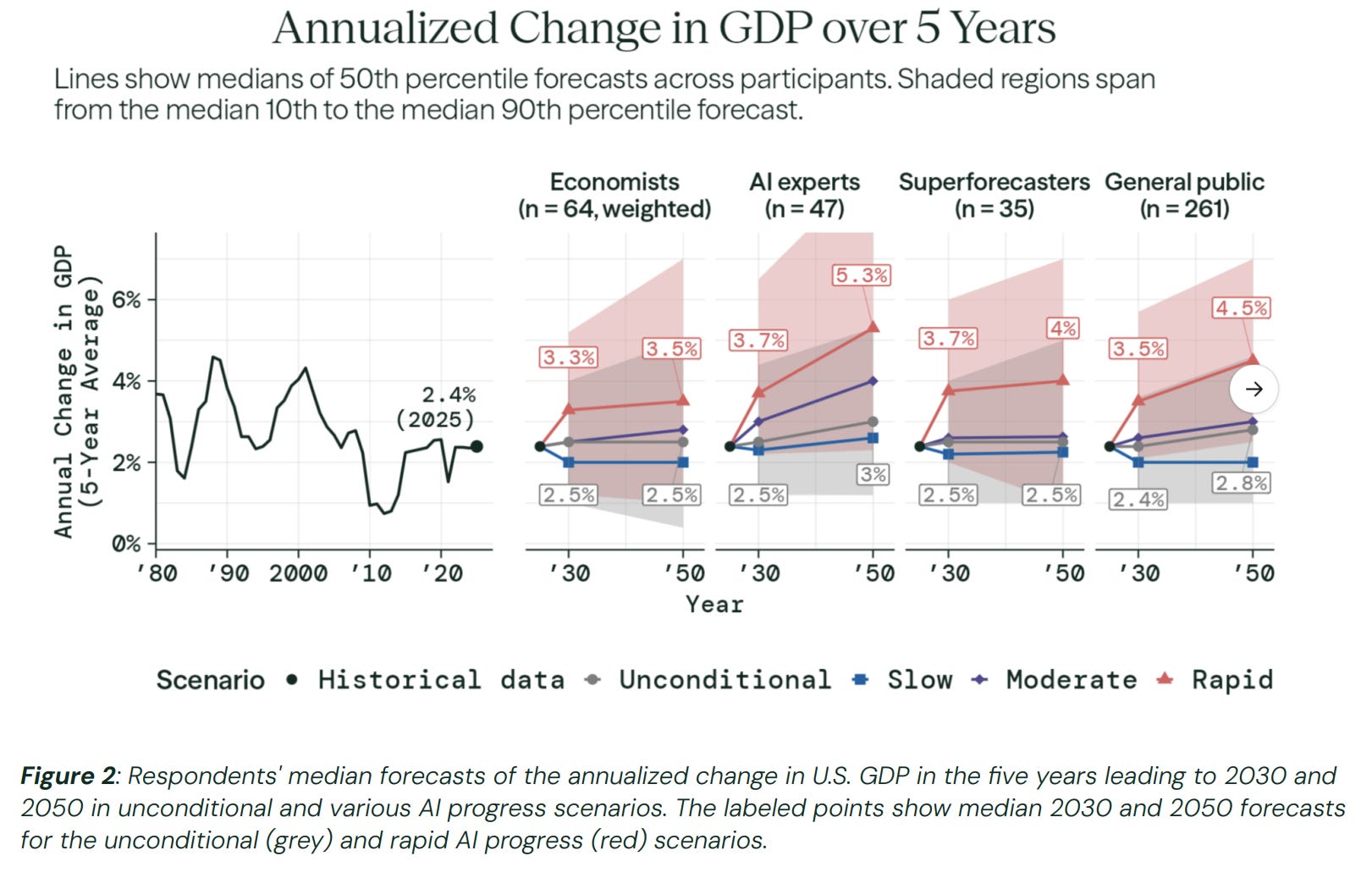
Even in the rapid scenario the median economist forecasts GDP growth of 3.3-3.5%, which roughly matches the late 1990s.
The labour force participation numbers are more arresting: economists forecast a drop from 62.6% to 59.1% by 2030 in that scenario, with roughly half the decline - around 10 million jobs - attributable to AI. A rate below 60% hasn’t been seen since the 1960s, when women’s participation in the workforce was a fraction of what it is today.
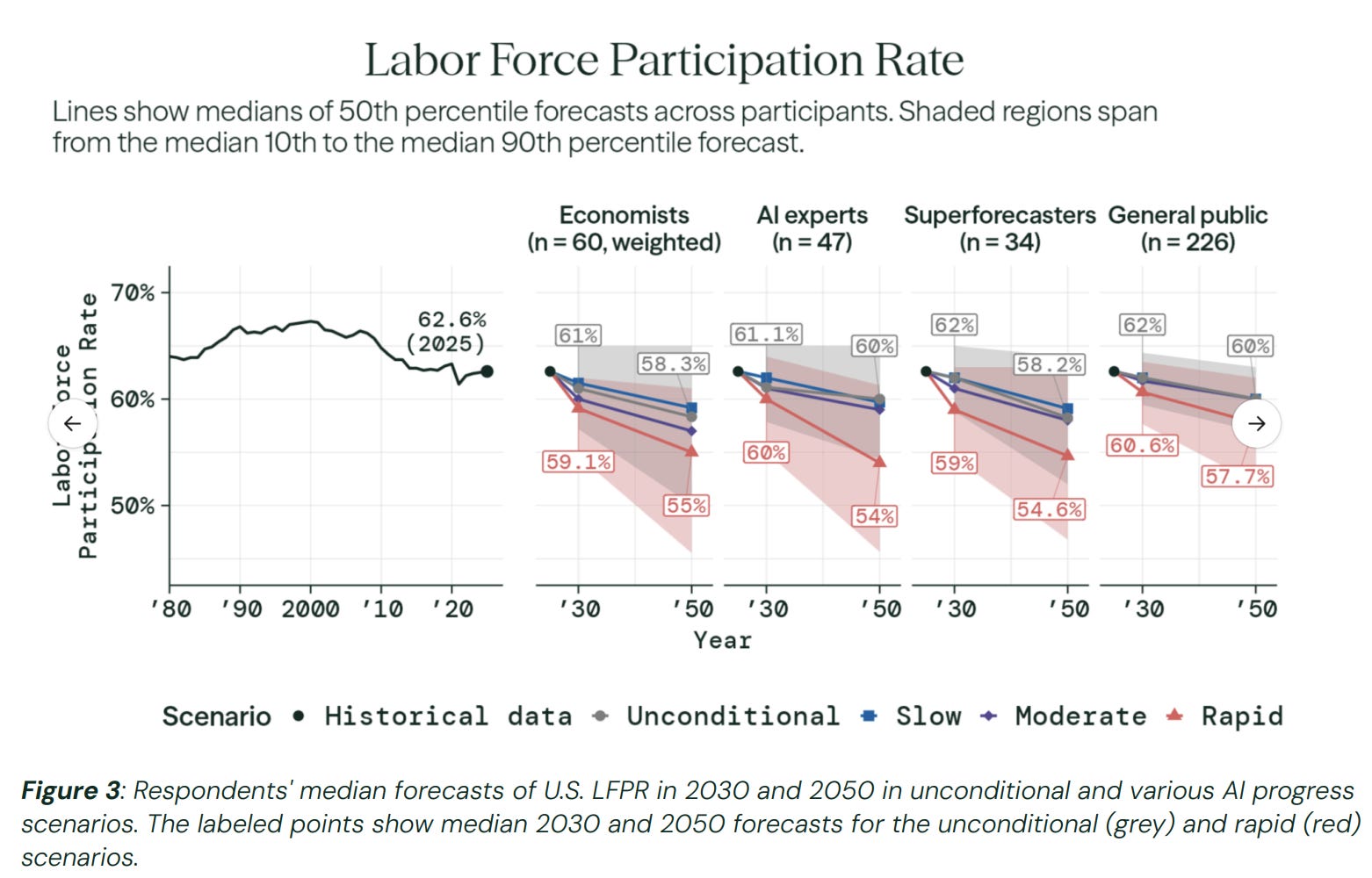
To me the central tendency of these forecasts is essentially a revealed prior that AI will diffuse like previous general-purpose technologies (GPTs) - electrification, PCs, the internet - with multi-decade lags between adoption and productivity impact. If you want a forecast that doesn’t track with anything that’s happened before, don’t ask an economist. AI experts have a better feel for how the technology might evolve and where it can be deployed to what effect but as we know the binding constraint is not technology but human adjustment speed. Interesting that the general public is basically the average between economists and AI experts: is that the new wisdom of the crowds?
No one will be blamed for assuming historical patterns hold and aligning with the consensus today on AI-driven unemployment: I think that’s short-sighted: my bet remains on our well-proven ability to find new problems to solve and create new demand. Muted productivity and a meaningful shrinkage in the labour force are difficult to square: there is no sustained >4% growth path to 2050 with participation rates drifting back to the 1950s unless productivity does far more work than these forecasts allow.
A separate NBER working paper based on a Duke/Fed survey of nearly 750 corporate executives, puts empirical flesh on why the macro numbers are stubbornly flat. Perceived productivity gains from AI are consistently larger than measured ones - a gap the authors attribute to delays in revenue realisation. Goldman Sachs’ Ronnie Walker confirms the pattern: the firm still cannot find a meaningful relationship between productivity and AI adoption at the economy-wide level. Solow’s 1987 line about seeing the computer age everywhere except in the productivity statistics has aged well.
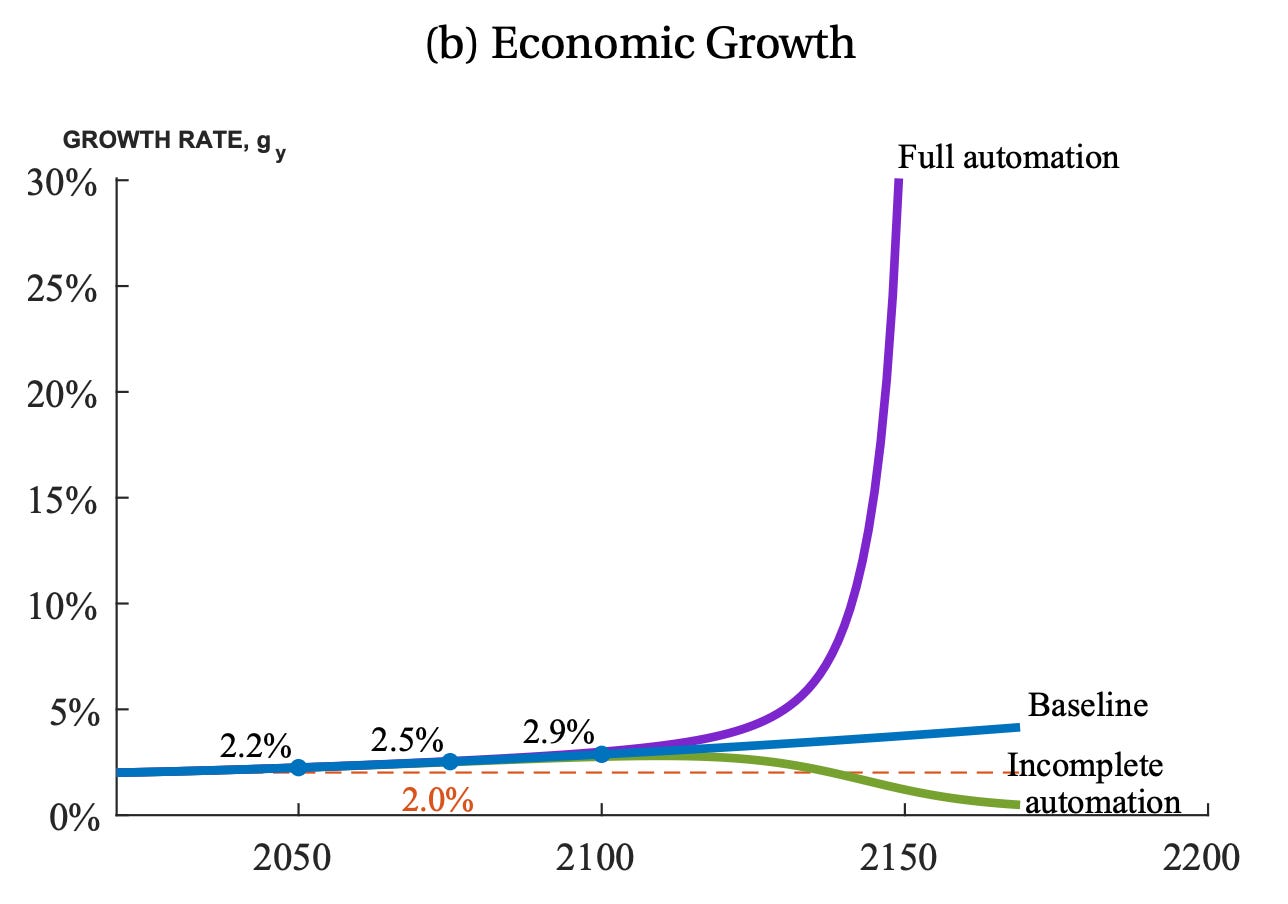
A Stanford model from Chad Jones and Christopher Tonetti formalises the intuition, showing that “weak link” tasks requiring human labour constrain growth regardless of how capable AI becomes - across three AI scenarios, the economic paths are essentially indistinguishable for the next 75 years.
Penn’s Daniel Rock summed up the mood: “I don’t think AI has hit the labor market yet, and I don’t think it’s radically changed corporate productivity yet, either, but I think it’s coming.”
So far, so calm. But the aggregate picture is doing what aggregates always do: hiding the distributional story underneath.
The same Duke/Fed CFO survey, reported separately by the WSJ, shows AI could drag down U.S. employment by roughly 0.4% in 2026 - about 502,000 jobs, a ninefold increase from 2025’s 55,000 AI-attributed layoffs (NB: I’ve shared my thoughts on AI-washing so won’t re-litigate). The cuts concentrate in administrative and clerical functions: scheduling, document prep, expense processing, data entry. The full paper’s Negative Exposure Index, constructed from CFOs’ open-ended descriptions of which roles AI is replacing vs. enhancing, confirms the pattern: office and administrative support is the only occupation group where replacement mentions outnumber enhancement mentions, and by a ratio of 2:1. Every other category (business and financial, IT, legal, sales, management, engineering) sits well below 1.0, meaning firms describe AI as augmenting those roles. CFOs also confirm companies are managing the headline numbers through attrition, which keeps them tidy while the composition of work shifts underneath.
A new Brookings/Opportunity@Work report reframes the question entirely. Instead of asking whether AI kills jobs, they ask whether it kills the pathway to better jobs. Their framework maps how 70 million U.S. workers without four-year degrees - “STARs,” skilled through alternative routes - progress from low-paid origin roles through gateway occupations (admin assistants, bookkeeping clerks, customer service) into better-paid destination jobs. Over the past decade, more than 23 million non-college workers used these stepping-stone transitions to reach higher-paid work.
The problem: 11 million STARs currently sit in gateway occupations with high AI exposure, and only half of the pathways into higher-wage work avoid it. The FT’s John Burn-Murdoch paired these findings with work from Manning and Aguirre showing the most vulnerable workers are precisely those in less-specialised white-collar roles where exposure is high and adaptive capacity is low - the gateway jobs. A Harvard framework from Maasoum and Lichtinger adds a useful lens: where AI enhances individual productivity it widens inequality by multiplying returns to specialist skills; where it lowers barriers to entry it narrows inequality. Those two dynamics partially cancelling out at the macro level could help explain why the aggregate data looks placid while our lived experiences diverge.
The positive side of the AI employment story does exist, although it deserves scrutiny. A WSJ analysis of LinkedIn data shows AI created 640,000 jobs in the U.S. between 2023 and 2025, with head of AI roles up 49% over three years and AI-related postings doubling from 1.6% to 3.4% of all job listings. But nearly half the total are data annotators, people labelling images, tagging text, and grading model outputs. As models improve and synthetic data pipelines mature, the long-term demand for this work is far from guaranteed. And within the “head of AI” category the question is how many of these represent genuinely new functions versus relabelling of existing ones to match the zeitgeist?
David Autor's thesis - that AI could restore the middle of the labour market by enabling non-experts to perform higher-stakes work, remains the most hopeful structural argument, but the early evidence from software points the other way: demand is rising fastest for the most skilled. The economists in the FRI study back that instinct: 72% support job retraining as the right policy response; they assign only a 10% probability it gets implemented.
The gap between what economists recommend and what they expect to happen is where the risk sits: not in the technology, but in whether institutions can move fast enough to respond to it.
Talking about responding: a new St. Louis Fed paper puts hard numbers on something we suspected: 5.2% of all U.S. work hours in early 2026 were spent using AI, more than double the UK, Sweden, and the Netherlands, and more than triple Germany, France, and Italy. 43% of American workers now use AI on the job versus 32% of European workers.
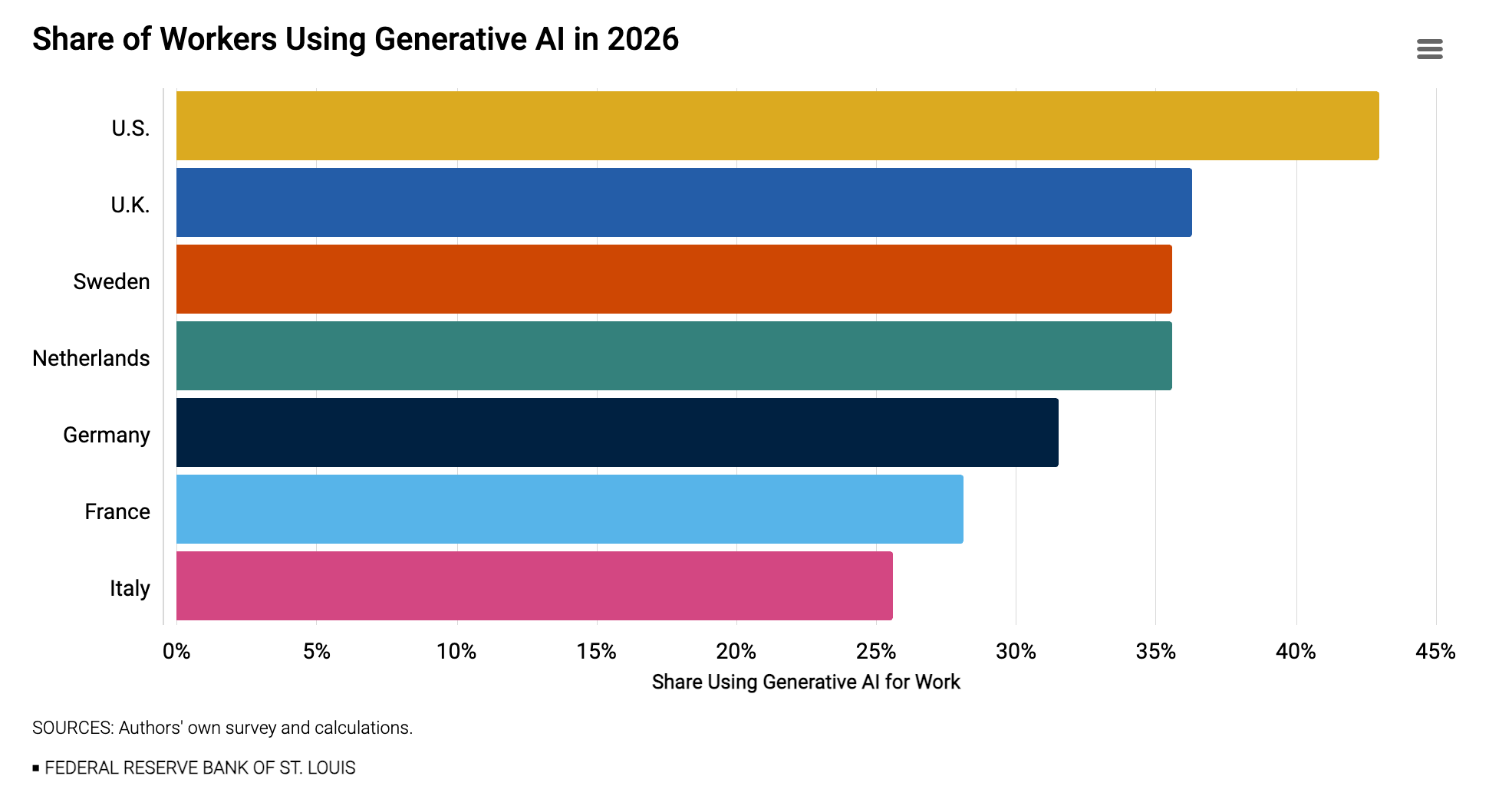
The firm-level gap is just as wide - 7% of U.S. firms use AI in production against 4% of EU firms. The paper also claims that industries with higher adoption are seeing faster productivity growth on both continents - though this correlation is not causal, and the adoption period is still too short to rule out that high-adopting industries were already outperforming for other reasons. The authors’ argument is that the pattern holds across different data sources and methods, which makes coincidence a harder sell. If the relationship is real, Europe is falling behind (again).
Sierra announced “Agents as a Service” this week. The headline feature is Ghostwriter, an agent that builds other agents. You upload your operating procedures, call transcripts, process documentation - or just describe the outcome you want in plain English - and Ghostwriter constructs a production-ready agent, deploys it across voice, chat, and email in over 30 languages, then continuously improves it by analysing real customer interactions and shipping updates through a sandboxed testing loop. Sierra calls it the “agent assembly line” and Bret Taylor (OpenAI Chairman, ex-Facebook CTO), who co-founded Sierra with Google Labs veteran Clay Bavor less than two years ago, frames the shift as unlocking “the atomic unit of productivity in AI”.
Sierra hit $100 million in ARR in under two years and now serves 40% of the Fortune 50, with some clients reporting 70-90% case automation rates. The structural significance is in what Ghostwriter does to the deployment bottleneck. Building a production-grade AI agent today still requires engineers, training data, integration work, and months of iteration. An agent that builds other agents compresses that timeline and could make agentic AI accessible to companies without in-house AI teams. If Sierra's outcome-based pricing is the demand unlock (you only pay when it works), Ghostwriter is the supply unlock (anyone can build one). But removing the build bottleneck does not remove the operating one. Building agents is becoming easy; running them inside a business is the hard part everyone has to solve for themselves.
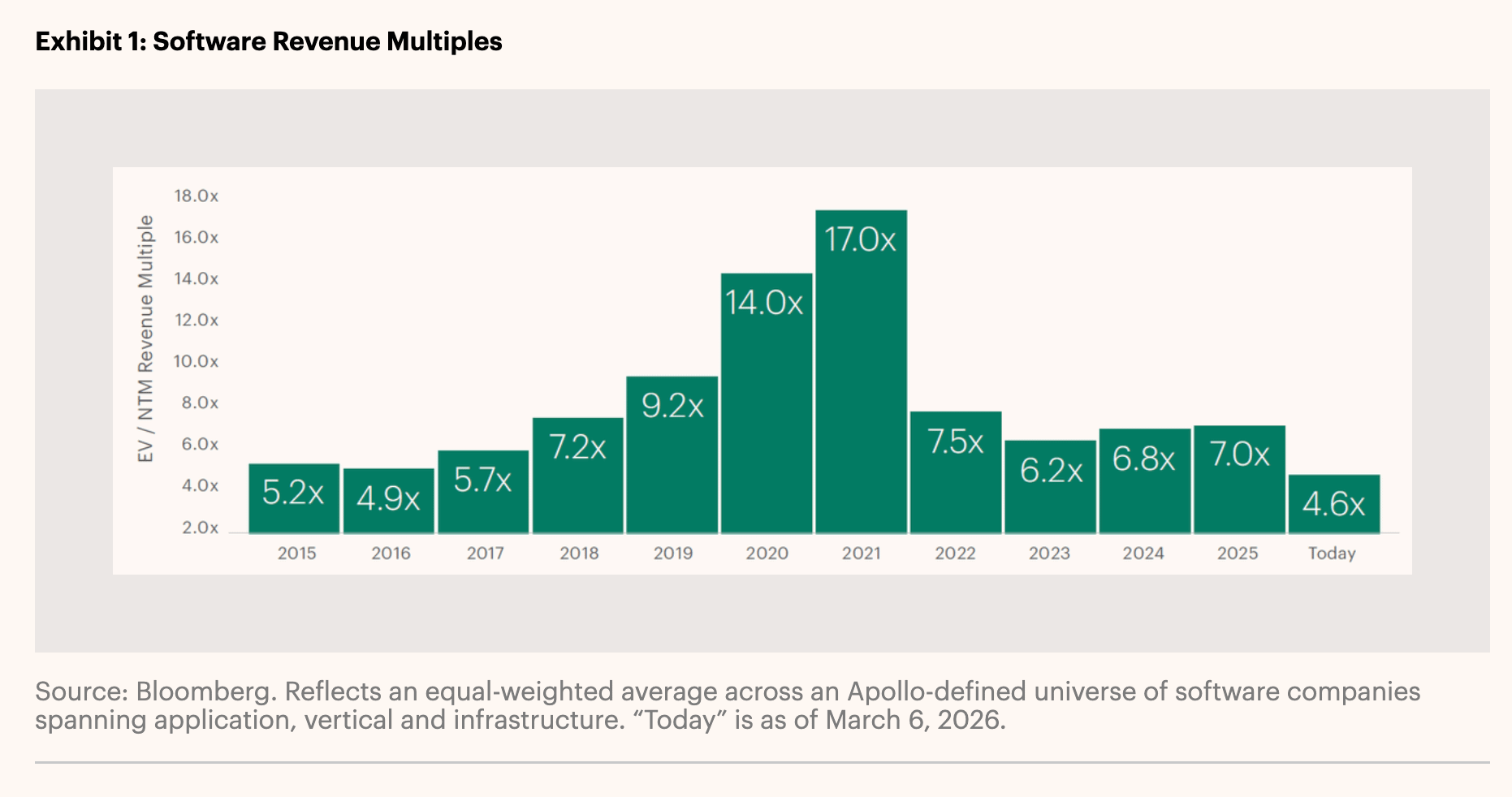
A few weeks ago I wrote about hyperscaler capex dynamics and tried to answer what level of AI revenue the Big 5 need to generate a 15% return. I landed on $2.9 trillion. Last week Apollo ran the numbers and arrived at $1.5–2 trillion just to break even.
The question I failed to address is where that revenue actually comes from. At this scale, the only plausible denominator is the global knowledge workforce, roughly $60 trillion in annual compensation. AI monetises by replacing or augmenting paid cognitive labour, that is the pool it is competing for. On that basis, $2 trillion implies around 3% penetration. Framed that way, the target looks less fantastical than “2x global software revenue” or “40x current AI revenue in five years.”
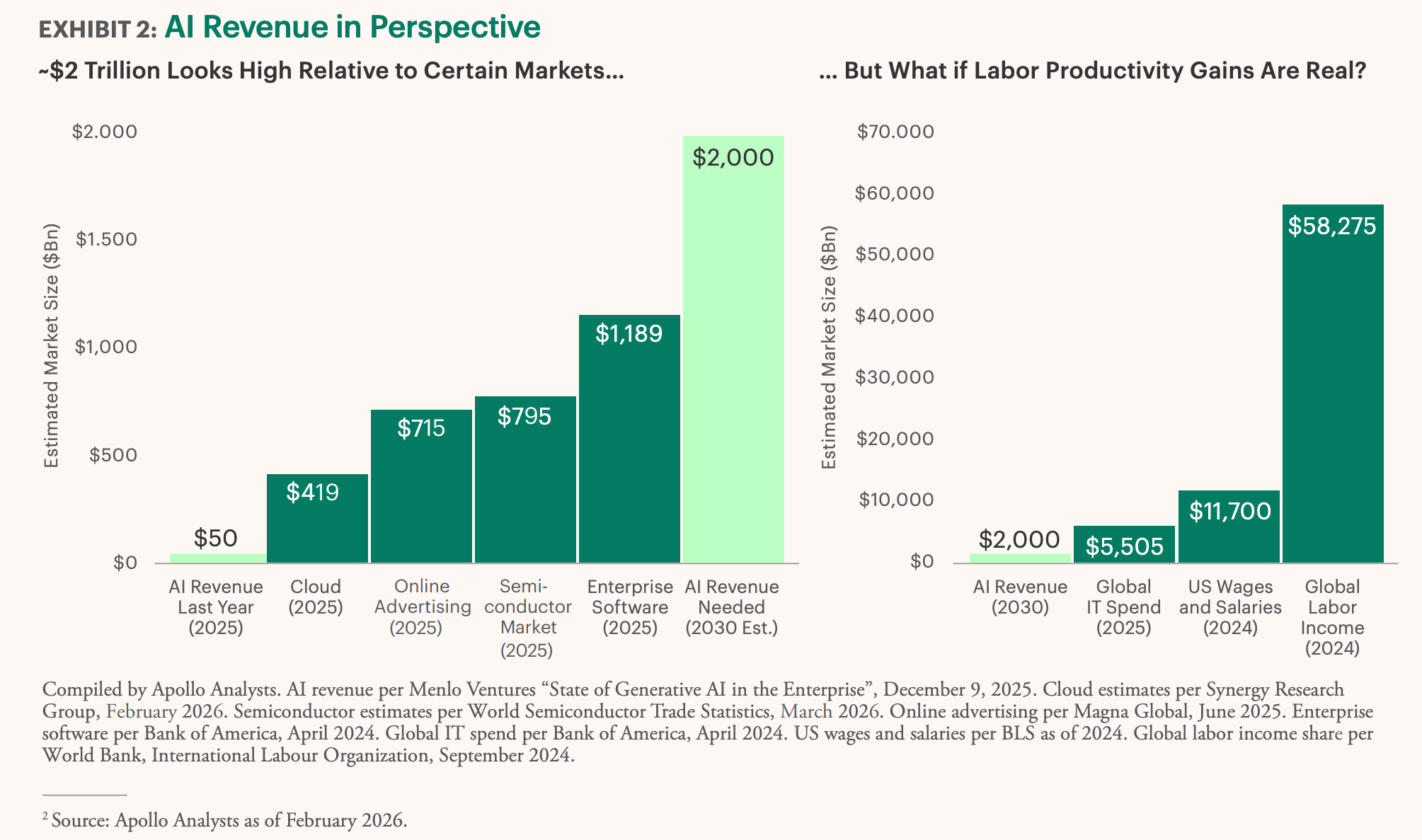
But arithmetic that’s easier to digest doesn’t make for a simpler problem: hyperscalers do not capture labour value directly. AI reduces labour costs, but those savings do not automatically convert into external spend. Much of the value shows up as margin expansion or internal reinvestment, not revenue flowing to the infrastructure layer.
The money exists. The question is how quickly it can be converted into revenue at the layers hyperscalers control.
Anthropic launched computer use in Claude last week: the ability for Claude to see, navigate, and control your desktop directly, clicking through applications, filling spreadsheets, completing multi-step workflows across any software you have open. Instead of requiring every application to build an integration “MCP-style” or connect via API, Claude just uses the software the way you would. It is a brute-force path to universal connectivity, and a crossing of a capability threshold. An agent that can operate any software through the same interface a human uses is no longer an assistant, it is a prototype of something much more general. Ethan Mollick (AI researcher at Wharton) made a sharp observation about why this matters: AI capability has dramatically outpaced AI accessibility, and the chatbot, the interface most people use to interact with these models, is actively working against them. His argument is that much of the perceived "AI disappointment" in enterprises is an interface failure, and that the real unlock comes when agents operate on actual files using actual tools through communication channels people already use. Anthropic's Dispatch feature: message Claude from your phone, it controls your desktop, is a bet on that thesis. Chatbots were never a product; they were a placeholder.
Sequoia and Jack Dorsey (Block CEO, ex-Twitter CEO) published an ambitious reimagining of the enterprise in the age of AI. The thesis: 2,000 years of organisational hierarchy existed because humans couldn’t coordinate at scale without chains of command. AI breaks that constraint by replacing middle management’s core function - information routing - with a company-wide “intelligence layer” that gives every individual contributor real-time operational context.
Block is (supposedly) restructuring around this idea, replacing traditional product roadmaps with a system that autonomously composes atomic financial capabilities (payments, lending, payroll) into customer solutions based on live transaction signals. The compression of middle management, the incorporation of customer signals into a continuously learning “world model” (their words), and the distribution of decision-making context via AI rather than through human hierarchies: the intellectual architecture is genuinely compelling.
The execution case, however, is entirely absent. Dorsey’s primary evidence is having cut Block from over 10,000 people to under 6,000 in February. There is no detail on what has actually been built, what’s working, what customer outcomes have changed, or how the “intelligence layer” performs in practice. The thesis also flattens what middle management actually does. Routing information is the part AI can replicate; judgement under uncertainty, conflict resolution, and deciding who owns what when things go wrong are the parts it can't.
Until now Dorsey’s contribution to management theory was limited to “what not to do as a CEO” - from preferring fashion design classes over office time, silent retreats in Myanmar while Twitter was Trump's megaphone, to sabbaticals in Africa while CEO of two companies - you wouldn’t be blamed for not enthusiastically embracing his new treatise on organisational design. But the ideas are worth engaging with independently of the messenger, and his closing question is one every operator should sit with: what does your company understand that is genuinely hard to understand, and is that understanding getting deeper every day?
About
I analyse AI progress beyond the headlines, focusing on enterprise execution, incentives, and real-world economic impact.
No posts
Comments
Nothing yet. Say the first thing.
Sign in to join the conversation.