
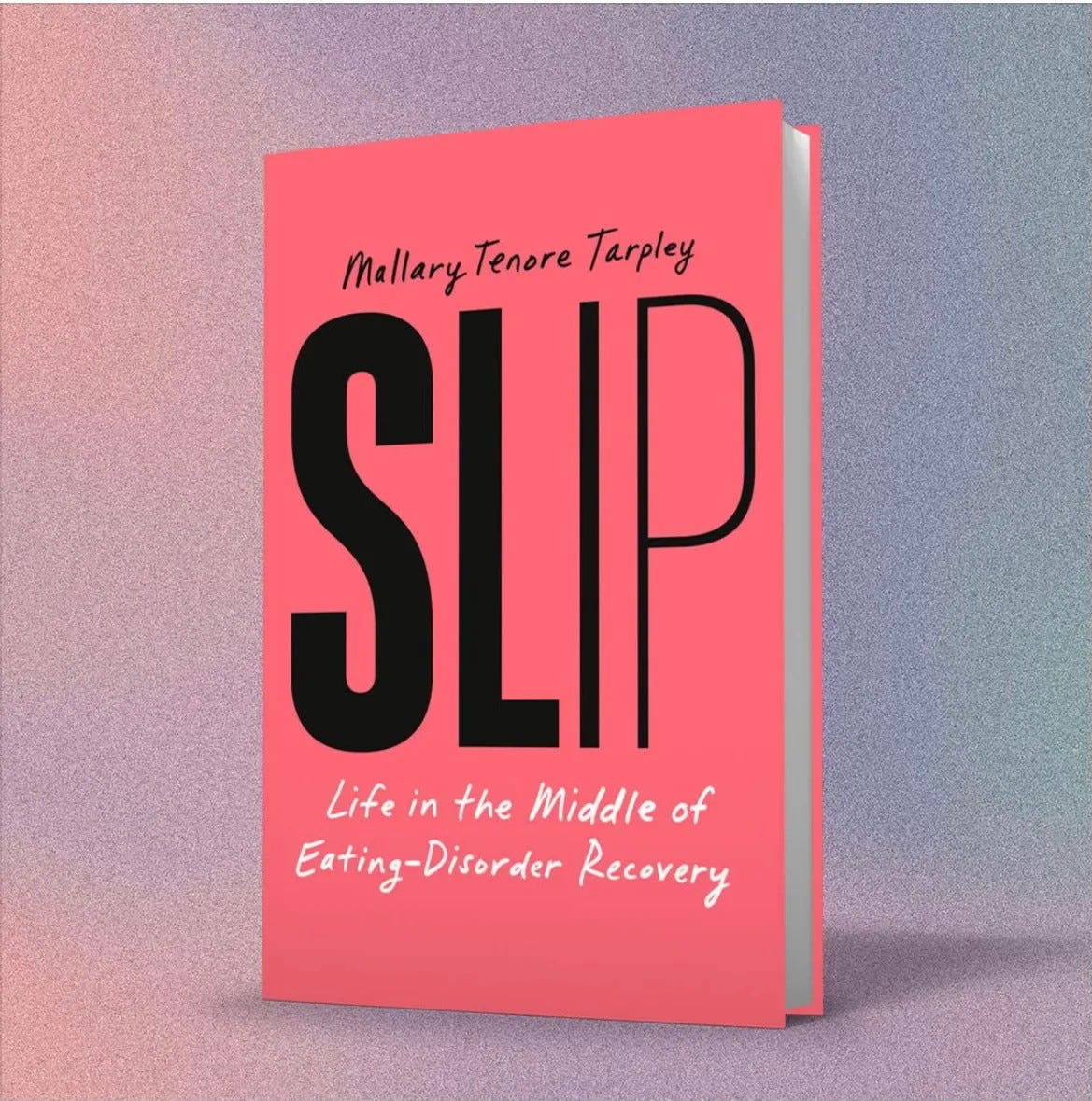
I was honored to interview Mallary Tenore Tarpley, author and journalism and writing professor at the University of Texas at Austin, about her new book, “Slip: Life in the Middle of Eating Disorder Recovery.” The book, part memoir and part reportage, details her own experiences with eating disorders, starting at 11 years old after her mother died of breast cancer, through high school, college, and into adulthood. Tarpley writes poignantly about how she’s grappled with the idea of recovery from eating disorders in her own life, but zooms out to identify, through original reporting and research, how to understand eating disorders, treatment, and what recovery may look like. She ultimately arrives at a groundbreaking concept for many of us who have suffered from eating disorders throughout our lives: full recovery from an eating disorder is complicated, and there can be a “middle place” between sickness and recovery where slips happen that do not need to be defined as failure.
Toward the end of my interview with Tarpley, she shared a story with me. Just before heading off on a short book tour, Mallary’s nine-year-old daughter gives her a gift of a beaded bracelet that says “slip” and tells her, “Sometimes we slip, Mommy. But we get back up again.” It’s a beautiful reflection of her daughter’s compassion for Mallary’s experiences (though her children don’t know the particulars of her lifelong battle with eating disorders, they know she wrote a book about grief, loss, challenges, and how we allow ourselves the grace to “slip” as we heal). But it also speaks to the heart and soul of Mallary’s book—a gift to all of us who have struggled with what healing and recovery from eating disorders look like and how we offer ourselves compassion and love along the way. We are not perfect within the depths of our eating disorders, nor will we be perfect on our recovery journeys.
Amie: Thank you for meeting with me! I am grateful for this book, especially as I work on the anthology I am editing about midlife and older women’s experiences with eating disorders. You beautifully weave together comprehensive research and reporting on eating disorders with your personal experiences, from your childhood struggles with anorexia to your present-day experiences grappling with recovery. I think you make a groundbreaking case for rethinking what recovery from eating disorders looks like. The idea of “recovery” for so many of us with eating disorders can feel like trying to hold onto the wind. We may often feel like we are falling short repeatedly. Could you share more about why this might be the case?
Mallary: Yes! Thank you so much for having this conversation with me. When I think about recovery from eating disorders, I am keen on trying to figure out what that actually looks like. For so many years in my own life, I struggled to define what full recovery meant.
As I began to look into the research and talk with clinicians and researchers, I realized that there are as many definitions of full recovery as there are studies about it.
As well, the rates of people who fully recover—according to the research—vary so wildly as to be comical. The different parameters that researchers are using to define full recovery vary so greatly, and there is a lack of a consensus definition.
So, it makes it hard to know what percentage of people with eating disorders fully recover. And that's problematic in a field that really pushes for full recovery for everyone. We’re pushing for something that we haven't yet defined. From a research perspective, that consensus definition is certainly important, so we can compare data across studies. But individually, I think we can each come up with our own definitions of what full recovery means.
For a long time, it felt to me that the only term was full recovery. I kept striving for full recovery, and in my mind, and in the absence of a definition, I really thought of it as this perfectionistic ideal, which felt impossible to attain. Yet, as a perfectionist and overachiever, I thought, well, that's what I'm supposed to do. I was supposed to be fully recovered.
As I share in the book, even in this period of relapse in college and beyond, I kept saying that I was fully recovered, because I was ashamed to admit anything but.
I also didn't really believe that there could be this space in between full recovery and the acute sickness that I had experienced as an adolescent.
My eating disorder certainly morphed during that time, and when I was sort of caught in that binge-restrict cycle, I felt like I was failing at recovery and failing at anorexia. And it wasn't until over a decade later, after having struggled with that binge-restrict cycle for 10 plus years, that I realized there was this middle place.
Amie: Yes! I love this idea of the middle place, which you write about in the book. Can you explain more about this concept as it applies to eating disorder recovery?
Mallary: I arrived at this idea after working with journalists and trying to help them tell restorative narratives—stories that show how people and communities can make meaningful progress in the aftermath of illness or trauma. And it occurred to me when I was working with these journalists that this messy middle framework could apply to my own recovery narrative. So that's when I began to really explore these questions of what it would mean if I slipped and didn't see it as grounds for failure, but saw it as opportunities for growth.
What would it mean if, when I slipped, I didn't use that as an opportunity to then slide, but rather as an opportunity to get back up?
I really tried to think about this idea of destigmatizing slips, and that's not something that anyone externally had done for me. It took me a long time to realize that that's what I needed to actually get out of that binge-restrict cycle and really move forward in my recovery. And that framing has been so helpful for me, because it's this imperfect way of looking at recovery, and it allows room for progress.
It’s a place where progress and slips can coexist. One doesn't have to negate the other.
Amie: As a child and a teenager, you were in treatment multiple times for anorexia. In college, you began bingeing. But you didn’t see it as a relapse because the behaviors were so different than when you had anorexia as a child. I had bulimia in college, then struggled for years with restrictive eating, purging, and compulsive exercise,e but didn’t see any of that as a return of my original eating disorder. At 54 years old, I was treated for an eating disorder for which I needed partial hospitalization. But they couldn’t really seem to land on a diagnosis – sometimes they said it was bulimia, and other times they said it was OSFED (Other Specified Food and Eating Disorder). I remember thinking, if we couldn’t land on what it was, how are we supposed to treat it? You write in the book that these diagnoses can be artificial and confusing for many of us. Can you explain why it’s so important that we talk about this?
Mallary: Yes, so that was something I was unprepared for. I didn't realize that this diagnostic crossover, as it's called, is quite common. More than 50% of people with eating disorders experience this crossover. Meaning that someone who struggles with anorexia, for instance, may end up developing characteristics of someone with bulimia or a binge eating disorder. So, they may begin to purge, they may begin to binge eat, and their eating disorder may morph over time, and often that crossover happens during periods of partial recovery, or in the early stages of recovery, when someone's not necessarily acutely sick, but they're very early on in the recovery and trying to find their way through that.
And we don't really talk about that very much. Certainly, it didn't come up when I was in treatment, and it can be terrifying for people to learn that while they're in the early stages of recovery, their eating disorder may morph and change, and they may develop these behaviors. I think we don't have these conversations because we don't want to alarm people. But if we don't talk about it, then people are not prepared, and that further stigmatizes us and confuses us when we do find ourselves in these situations where we think, Why am I binge eating? After years of anorexia, for instance, what is going on? And there's this feeling of being out of control that comes with it. There are feelings of shame and real confusion around what is going on.
Interestingly, I talked to a lot of people who said that they felt like they had struggled with two, three, and sometimes even four eating disorders.
That was how they described it to me. Having anorexia, for instance, and then binge eating disorder or bulimia. Some of the doctors I talked with said that, more commonly, they refer to these as a subtype. So, maybe someone is struggling with anorexia, but then they have a binge-purge subtype, for instance.
They think of it as more of a manifestation of the original disorder. This often happens, and so the more we can speak to this reality, I think the more we can then empower people to speak up when they do find themselves beginning to engage in some of these behaviors. So that they don't get stuck in this cycle, or stuck with these behaviors for ten plus years, like I did.
Amie: You write in the book that “...little has changed since I was a child, in terms of both health curricula and medical awareness of eating disorders. In 1998, my pediatrician didn’t recognize that I needed help…” You call the current situation, in terms of what the medical community knows about eating disorders, a “systemic crisis.” Can you share more about this?
Mallary: Yes, it's unfortunate, and it makes me sad when I think about how little has changed since I was acutely sick in the 1990s. I was writing this book, hoping that maybe nowadays medical doctors would be trained on how to treat and diagnose eating disorders, but they're really not.
The average medical doctor gets zero to two hours of training on eating disorders in medical school and in residency.
And that's problematic on so many different levels. For one, it means that doctors often are not aware of a lot of different eating disorders, like atypical anorexia, or ARFID (Avoidant/Restrictive Food Intake Disorder), or other disorders that we haven't heard about as much. Or that they may not have ever heard about in medical school. Also, because they're not getting trained, it's easier for the medical community to fall back on stereotypes about who does and doesn't struggle with eating disorders. Typically, eating disorders have been thought of as a young, white, teenage girl's issue that one grows out of.
But we know that eating disorders don't discriminate.
I talked with so many individuals, including men, people in larger bodies, and people of all different races and ethnicities and genders, who essentially said that they were denied treatment or told that they didn't have a problem when they sought help. Either because they were not clinically underweight, or because of their gender, or the color of their skin.
It was eye-opening to hear about other people's experiences because, in many ways, I fit the stereotypical mold of someone with an eating disorder. And years ago, even I couldn't get help. You think about individuals who don't fit that stereotype, and how many barriers they're up against when seeking treatment.
I think doctors are certainly well-intentioned, and so this is not to blame doctors individually, but more so to blame the system. This is a systemic issue where we need to get more training in medical schools around eating disorders. 30 million Americans will struggle with an eating disorder at some point in their lifetime. That’s not a small number, and it's probably even more than that, right? Because a lot of people go undiagnosed, and so many people also struggle with disordered eating and never end up meeting the criteria for a fully-fledged eating disorder. We know that disordered eating is quite rampant as well.
There are a lot of people falling through the cracks. It’s particularly pernicious when we think about younger individuals struggling, but older ones as well. Research shows that the sooner someone receives treatment, the better the long-term prognosis.
There are many older women now who never got that intervention, never got treatment years ago. Now, they are still either struggling or they are in a kind of risky territory, where they may be in this middle place that I write about, or unsure of how to make progress.
And there are individuals who are farther along in the middle place, but they aren't necessarily getting the help that they need, right? Because they never got it in the first place. That complicates things, particularly when you think about any transition involving the body. With menopause, for instance, we know that can be a trigger for women who've had lived experience with an eating disorder, or even women who haven't, because so often the first recommendation is weight loss. We have to be really careful about that, and it’s often medical doctors who are prescribing weight loss without screening individuals for prior history or current history of an eating disorder. Unfortunately, we see this systemic issue playing out everywhere—from adolescents to folks in middle age and beyond. It really is having this effect on people of all ages.
Amie Newman: I also think about the fact that more older women are getting diagnosed with ADHD, and many ADHD medications are stimulants, which can be a trigger for people with eating disorders. I was diagnosed with ADHD this year, but I happened to be lucky enough to have a provider whom I could feel very comfortable opening up to about my history of eating disorders. She was extremely vigilant as we navigated the process of finding the right medication for me.
Mallary: I definitely interviewed women who have ADHD who said that the medications were triggering for them and led them to restrict more.
Amie: As I’ve spoken with people about the anthology I’m editing about midlife and older women’s experiences with eating disorders (“This Is Not Your Mother’s Eating Disorder”), women have shared about their own experiences with eating disorders and disordered eating. But I get confused, honestly, about how we differentiate between the two. Sometimes, someone will share with me that they would purge in college, but just gave it up after college and went on with their lives. Did that person have an eating disorder? I just can’t imagine being able to do that and then moving on and not engaging in that behavior ever again.
Mallary: I know. It is so interesting, and I, quite frankly, sometimes get confused by it as well. There was one practitioner I interviewed, and she said, “Sometimes the eating disorder is just a blip on the radar for someone, and then for others, it's how they see themselves.” And for me to think about an eating disorder as a blip on the radar is hard to conceive of, given how all-consuming these disorders are. But I was talking with a woman recently who said, “Well, yeah, I restricted severely and then I purged for a year or two in high school, but then I just stopped.” And then she said, “But now, looking back on it, I wonder, did I even have an eating disorder?”
I do think that there are people who are able to move out of it. I think about Joan Jacobs Brumberg, who wrote that book, “Fasting Girls”, and she talks about how there are two phases of anorexia (but I think you could apply this to all eating disorders).
There is the recruitment phase and then the stage at which it becomes a career. So, there are some who are recruited to it, but who don't necessarily adopt it, if you will, as a career.
There are many people who do struggle with disordered eating, and maybe it's something that they engage in every so often. Perhaps, if there's a particularly stressful moment in life, or prior to a wedding, where they want their body to look a certain way, for example.
So there can be these phases where people engage in disordered eating, but the difference with disordered eating and an eating disorder is that typically with an eating disorder, you have all-consuming thoughts that are really leading you to get stuck in these cognitive ruts, and those distorted thoughts are very much dictating your behaviors in such a way that you're putting your body at risk, physically.
It’s usually to the point where it's really hard to hold any other thoughts, right? The eating disorder voice really takes up your mental space and controls your behaviors.
But I’ve talked with some doctors who have said the criteria for eating disorder diagnoses are quite stringent. And this adds to the overall confusion. I do think that there may be individuals who say that they struggle with disordered eating, but if they sought help, it may be the case that they have an eating disorder.
So, it becomes murky territory when we look at disordered eating versus actual eating disorders. And I think, too, sometimes people don't realize how serious eating disorders are, either. I remember I was talking with someone, and she just flippantly said, “Well, everyone has an eating disorder in college!” I just thought, well, one--no, that is not true. And two, if you only knew how debilitating these disorders are, you may be less likely to say that. It gets at the idea that sometimes people think they're just some passing fad that kids or college students engage with for this period.
I think that part of it also stems from the lack of awareness about what it means to struggle with an eating disorder. I don’t want to put folks who are struggling with an eating disorder on a pedestal, but I do think that there is sometimes a misunderstanding around what that actually means and looks like.
Amie: I am curious about how you protected yourself and took care of yourself while writing the book, and also now, so that your eating disorder behaviors weren’t or aren’t triggered. I have been thinking about this a lot lately as I put together and edit the anthology of women’s stories about eating disorders. I spent time at a writing residency last month, and my 23-year-old daughter came to spend one night with me. I interviewed her about her experiences of watching me fall into and get treated for an eating disorder when she was 21 years old. She expressed concern about my editing this book and opening myself up to all the traumas. Frankly, I'm embarrassed to say that I had not thought about it before she shared her worry. It was a light bulb moment for me.
Mallary: Yeah, I mean, it was very difficult at times, because I was really excavating my past in a lot of ways and having to go through old medical records and old journals and revisiting the treatment centers and the hospital where I spent time as a child and teen. That was all really difficult. Not to mention that I interviewed about 175 individuals, many of whom have lived experience. At times, it felt like I was a therapist in a lot of ways, on the receiving end of these stories, and in some cases, these individuals really hadn't talked with anyone else about their eating disorder.
I had a couple of folks who told me that was the first time they had talked about it. I felt like that was a great privilege to be on the receiving end of their stories and to know that they trusted me. At the same time, I realized I needed to also be able to take care of myself in those moments. So, I did make a conscious decision to go back to therapy and to start working with a dietitian too, so that I could have that extra structural support; so that I wouldn't crumble in this process.
Then, usually, too, I would talk with my husband. I would try to rely on him in the in-between moments and talk about what the process felt like.
There were moments where I was writing about binge eating, for instance, and I found myself binge eating. I felt out of control, and I thought, Okay, I need to watch that. I can't reenact these experiences and try to re-inhabit my younger self just for the sake of being able to write about it in a more accessible way.
I also thought it would be more effective if I could write about it from a distance. I know what that felt like to experience the restriction or the binging. I don't need to put myself back in that situation just to write about it.
So, I was careful about that, particularly when writing about the years when I was acutely sick and hospitalized. I did not want to fall back into those behaviors as a writer or as a woman in recovery. It's within us to want to write about our experiences in this way as writers, but sometimes it's not until we're in the thick of it that we realize, oh, we actually need to work on protecting ourselves and making sure that it isn't triggering.
Amie Newman: The number of women over 50 years old who exhibit eating disorder symptoms is growing, which breaks my heart. Is there anything you would say to those of us who are in midlife or older who have had or are struggling with eating disorders or recovery?
Mallary: I would say it is never too late to seek help, and I say that with the caveat that sometimes it can be difficult, for instance, if older women need to go back into a treatment center. I have interviewed individuals who have said that it was challenging because, depending on the program, there may not be as many older patients. Many of them may be quite young, even in adult programs. There are a lot of 18-year-olds or folks in their early 20s, and we don't see nearly as many people who are middle-aged and beyond. So, I recognize that that can be a challenge. But even if it means seeking help from a therapist, talk to someone about your experiences.
That is so important because the older we get, the more shame and secrecy there tends to be around eating disorders. We tend to think, well, we are of a certain age, we should be over this by now, why are we still struggling, or what is going on? Why am I beginning to struggle with this?
We may normalize it to an extent, because we think, well, this is just part of what it means to be a woman in our society. But that normalization can be really dangerous, particularly if we are engaging in really detrimental behaviors that are putting us at risk health-wise.
So, it's never too late to seek help, and I always encourage people to find someone they can talk to about their slips. We know that secrets keep us stuck and sick, and for a long time, I was very secretive about any slips that I had.
Once I started to talk more about my slips, particularly with my partner (now husband), I was forced to look at the slip and figure out, okay, why did that happen? And who can I talk to about it? How do I try to get back up now?
Because it's so easy when we are silent about our slips to just stay down and to not get back up. Or to say, well, we'll get back up next week after we get through these deadlines, or we'll get back up next month after our kids have visited, or whatever the case may be.
So, to be able to say, “What tools do I need to get back up now?” is important.
And lastly, I'll just say, too, when we talk to others, and when we seek help from someone, I think it's really important to tell that person what kind of help we need. There are moments when we may reach out to someone for help and then they don't necessarily give us the help that we need. Maybe, for instance, they come at it in an accusatory way, or they come at it in a way that feels insensitive.
Being able to articulate the help we need can strengthen relationships, and it can also help us to more easily feel comfortable talking about the slip, so we can get back up and continue healing.
Information on where to buy Slip: Life in the Middle of Eating Disorder Recovery.
You can subscribe to Mallary’s weekly newsletter, Write at the Edge, here.
And if you’d like to submit to “This Is Not Your Mother’s Eating Disorder”, the anthology on midlife and older women’s experiences with eating disorders, find more information here.
Comments
Nothing yet. Say the first thing.
Sign in to join the conversation.