
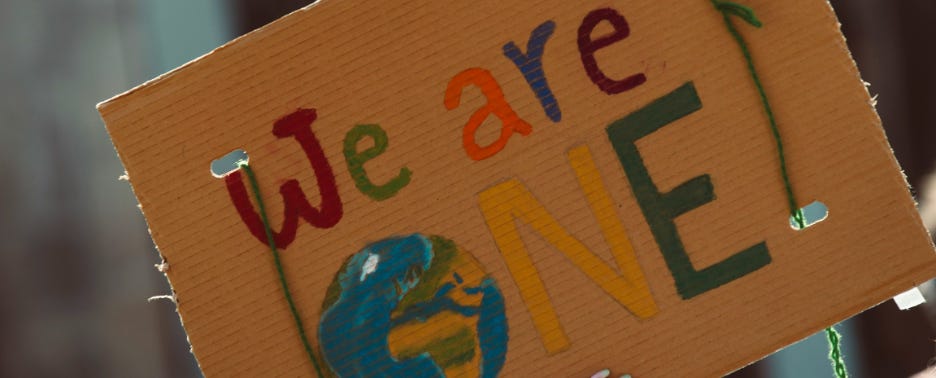
Photo by Markus Spiske on Unsplash
On my computer screen, her face is framed by two halos: the first, a brown headscarf; the second, an aura of light from the bedroom window behind her. But the glow is all her own. Eyes shining with kindness, she asks earnestly in accented English, “Deh-neese, how are you?”
I can’t save her. I can’t save her. I can’t save her.
And so, I turn to the page.
Given the depth of our connection, it seems longer than fourteen months ago that a local immigrant services organization matched me with Ayse.* Never having tutored English but wanting to support immigrants, I’ve met with her online, weekly, to perfect her already-good English.
A professor in her own country and prolific writer with fifty-five articles in international scientific journals, Ayse and her family have been in my city for her two-year post-doctorate fellowship. Besides working with me, she attends two community English classes per week, parents her three children, conducts research, publishes, supervises graduate students in her home country, and participates in university courses and colloquia here. Her drive to strengthen her language skills is fueled by her belief that her life and the lives of her husband and children depend on her English.
As our friendship has grown, Ayse and I have spoken about topics ranging from our anxiety in raising teens, to our views about women’s rights, to our shared trust in things unseen and the surprising ways our spiritual beliefs overlap. Her religion is Islam; my spirituality is a motley mix closest to Buddhism.
Recently, we’ve discussed her inability to eat due to fear of returning to her home country. Unable to get asylum since they entered my country brimming with hope, the family has visas that are expiring. Continuously seeking another English-speaking country to receive them, Ayse and family will return to her dangerous home country.
A country:
—that jailed her husband for a year for not speaking out against others opposing the government. When he was released, charges were dropped.
—with limited rights for women and a Cato Institute Human Freedom Ranking in the bottom 15% of all countries
—where she fears her husband will be jailed upon return, even though she and her family had permission to come to the U.S. and have followed all her country’s rules in being here. Yet, police in her home city have begun asking relatives about her husband’s return.
Six Days
Only six days until she leaves.
I ask anxious Ayse how I can help. I fret. I discuss outlandish options with friends. Why not invite the family to hide in my basement? But the children need to attend school. Her husband needs citizenship to be employed. Ayse needs her work. Repeatedly, I arrive at the same answer.
I can’t save her. I can’t save her. I can’t save her.
And so, I turn to the page.
First, I write a gift poem, an idea from AWA facilitator Katie Marshall Flaherty at last year’s annual AWA retreat. Ayse doesn’t need another thing to pack, but a poem on firm cardstock honoring her resilience will transport easily and remind her of my love and admiration. When I read the poem aloud during the writing process, I cry about her departure for the first time.
A few days later, I turn to my journal.
Another day, I write a second poem—about Ayse, although not for her—and cry again as I share it with my poetry circle.
Ayse is the main character of this story; she’s the one in danger. I’m only a safe observer, an ally. But my grief is real, a consequence of my privilege in loving her. Writing allows grief - and all feelings - an outlet. If I can’t save Ayse—if all I can do is listen to her, love her, pray for her—writing at least helps me save myself. And my second poem moves my fellow poets. Isn’t that part of what writing is about—to use the fuel of grief, of other emotions, of our experiences—to offer what is real, to open our own hearts and the hearts of others?

Photo by cyrus gomez on Unsplash
Pat Schneider, a Radical
I never met the extraordinary Pat Schneider, founder of AWA. She was no longer living when I trained as a facilitator in her writing methods. But, influenced as I am by her method of radical listening and her commitment to courage, kindness, and the disenfranchised, I can’t help but wonder what Pat would do in these extraordinary times.
I’m confident of this: Pat—who claimed that telling one’s truth is a political act and remaining silent is also a political act, who insisted that “the privilege of voice carries with it a responsibility to speak for social justice”—this Pat would be bravely writing and sharing her words.
And so, I turn my writing toward the expressly political on behalf of Ayse. I write to my Senators and Congresswoman, not because it will save Ayse, not because her tale is unusual, but because her specific story personalizes our national immigration cruelty and resists her erasure. Perhaps I’ll also write another essay, another poem. And I’ve invited others to care about her through this essay.
We are the ones we have been waiting for. These words—perhaps first spoken by a Hopi elder, perhaps coined by poet June Jordan—are woven into the fabric of our collective consciousness and remind us that we are powerful agents of change.
All It Takes is 3.5%
Like Pat, Harvard professor Erica Chenoweth believes in the power of citizens who use the privilege of their voices. Having researched successful peaceful campaigns against authoritarian governments, Dr. Chenoweth found that when 3.5% of a country’s citizens actively participated in ongoing, non-violent protest, they rarely failed to bring serious political change.
The 3.5% principle gives me hope for my country and for people like Ayse. Knowing Ayse has intensified my activism. The 3.5% call has never rung louder.
Many of you engage in non-violent resistance by showing up to peaceful demonstrations and by using your writing voices, whether on protest signs or in poetry, in fiction or factual essays, on agendas for activist organizations or written testimony about state legislation, in letters to the editor or letters to legislators. The 3.5% call reaches each of us in our own way.

Photo by Yukon Haughton on Unsplash
We are the ones we have been waiting for. These words—perhaps first spoken by a Hopi elder, perhaps coined by poet June Jordan—are woven into the fabric of our collective consciousness and remind us that we are powerful agents of change.
Our words matter. We writers—in the U.S., in neighboring countries, around the world—can be part of the 3.5%. Our writing not only helps us save ourselves; it might help save democracy. As we use the privilege of our voices to stand up for the marginalized and oppressed, we honor the legacy of Pat Schneider and contribute to a more empathic, democratic, and peaceful world.
She Chooses to Fly
For Ayse
Her life is certainly uncertain.
Where will she live, work?
Her life is uncertainly certain.
She will live. She will die.
Why not, then,
become a cliff swallow,
and soar into the vast, open spaces
of the heart?
She’ll ride high on the updrafts,
veer in an instant,
zoom in intricate patterns,
dive with ease,
savor each tiny, tasty
morsel of her days.
Give her a precipice,
and she’ll build a nest.
She’ll sing, always sing,
her guttural and holy song,
calling out for her tragic country,
her flock of friends, family,
herself.
She’ll sing,
Inshallah will always be singing,
her perpetual prayer
of Love.
Notes
* Not her real name, but she has approved this article
Are there ways you save yourself or democracy through writing? We’d love to learn through your comments below.
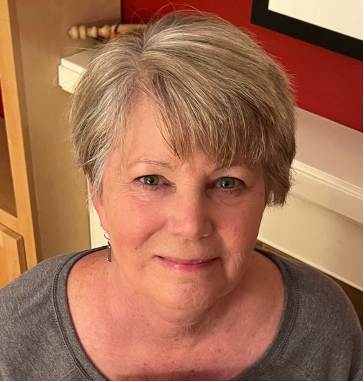
Denise Jessup is a retired somatic psychotherapist in Oregon. Forever a journaler, she turned to writing fiction as a form of self-expression on a Lithuania trip, after an idea for a novel popped into her mind. These days, she’s a poet, with poems about self-compassion and softening grief published in Meditations on Life: A Tuesday Circle Anthology. An AWA facilitator, Denise loves AWA’s encouraging beliefs and methods. As an activist, Denise longs for and works toward a world of universal compassion.
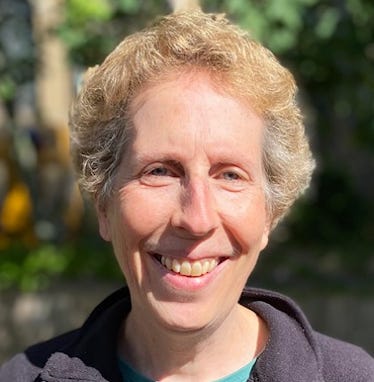
Sue Mapel is a poet, educator, and activist living in Cambridge, MA. She has been studying with poet Rosemerry Wahtola Trommer since 2023, writing with AWA since 2024, and was trained as an AWA workshop facilitator in 2025—all these endeavors occurring decades after her years as an English major in college. Enlivened by the wonderful and creative people she has had the privilege to write with, Sue finds inspiration in the heart spaces of grief, the communion of fellow writers, the beauty of the natural world, and the mysteries of the here and not here. Several of her poems have been published in anthologies and magazines.
Together, Denise and Sue offer AWA workshops called The Joyful Activist: Writing to Nurture Ourselves.
Here are the links to their next two offerings:
September 16, 2026, workshop 4 PM- 6 PM PDT
October 14, 2026, workshop 4 PM- 6 PM PDT
AWA’s next monthly online write is Saturday, August 8, at 1 p.m. EDT with ALEXIS M. COLLAZO.
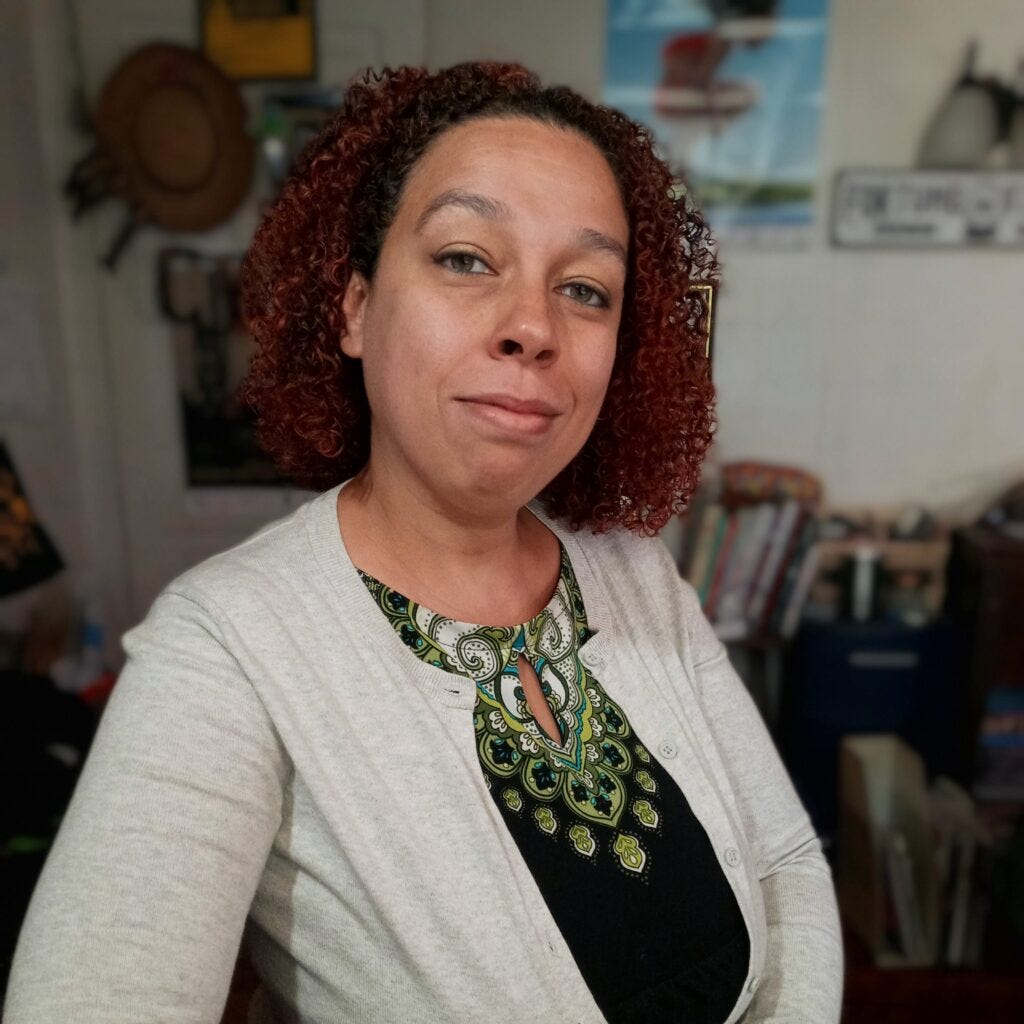
Alexis is a Brooklyn-bred writer living in Pennsylvania. She writes in a variety of forms and genres inspired by a wide range of interests, including horror, music, and other creative arts. Her poetry has appeared in Common Unity: An anthology, Gnashing Teeth’s Making Room Zine, and Trashlight Press. She is the PDF designer and a reader for Painted Pebble Lit Mag. In August of 2021, she was certified as an Amherst Writers and Artists workshop facilitator and has offered a variety of online workshops, including Tarot Tuesdays, Poetry As Spiritual Practice, the Creative Chaos Workshop, and more.
Thanks for reading Writing Alone and With Others! This post is public, so feel free to share it.
Comments
Nothing yet. Say the first thing.
Sign in to join the conversation.