
You’ve probably read writing that feels like a fresh-paved highway. You enter the world, and nothing jostles you out of it (unless your dog vomits on the carpet). Others feel like they could use a road crew to fix a few potholes and put up some road signs where the story veers off.
We want our readers to have the fresh highway experience, riding along with the text for miles.
How do we find and patch our own potholes? The problem is it’s hard to tell what’s trimming the fat (the stuff potholes are made of) and what’s pouring out the gravy (the good stuff smoothly propelling our reader onward). That’s where Ann Patchett comes to the rescue. (She would also tell me not to mix my metaphors.)
Before you say it, I know, my use of a “hatchet” to describe repairing a text is overstating. The gleeful child in me loves a serendipitous rhyme. So, if it isn’t a hatchet, what is it we need when editing our work?
Her commentary enables us to read between the lines, illuminating elements of craft.
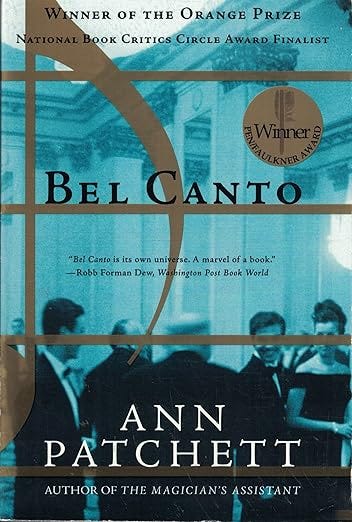
Ann Patchett’s beloved fourth novel, Bel Canto, is the story of South American guerrillas who take the guests of a lavish party hostage. The novel begins with a dramatic siege, a death, and a tense standoff. It soon melts into affectionate relationships among the hostages and the hostage-takers, and between the two groups. There is no villain in the traditional sense—everyone is portrayed as fully human. We become immersed in their world, we feel what they feel, and we despair when the end comes.
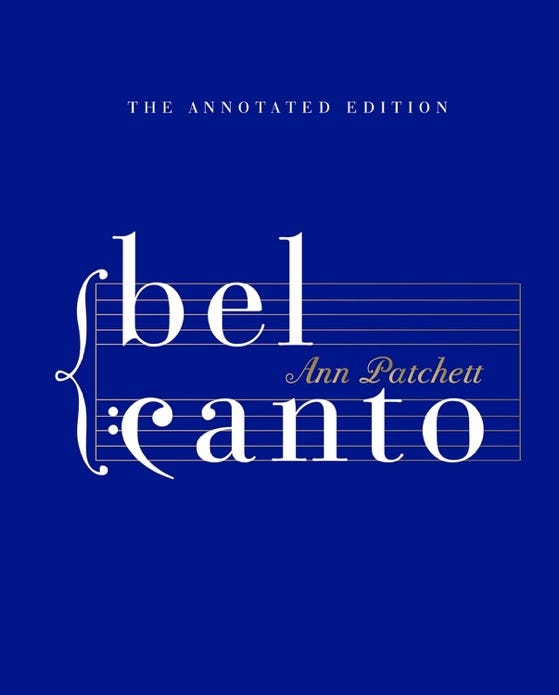
Readers of Bel Canto: The Annotated Edition (HarperCollins, 2024) see ink in the margins and over the typed, professionally edited, and published text. Ann lovingly went through the entire novel and added her thoughts (and edits): key points about the construction of the story, inspiration, fun facts, what she likes and dislikes in retrospect, overuses (in Ann’s case, hair scents), repeated words or ideas, what she would trim or rewrite, and even readers’ qualms (she received many letters about the epilogue, which she stands by).
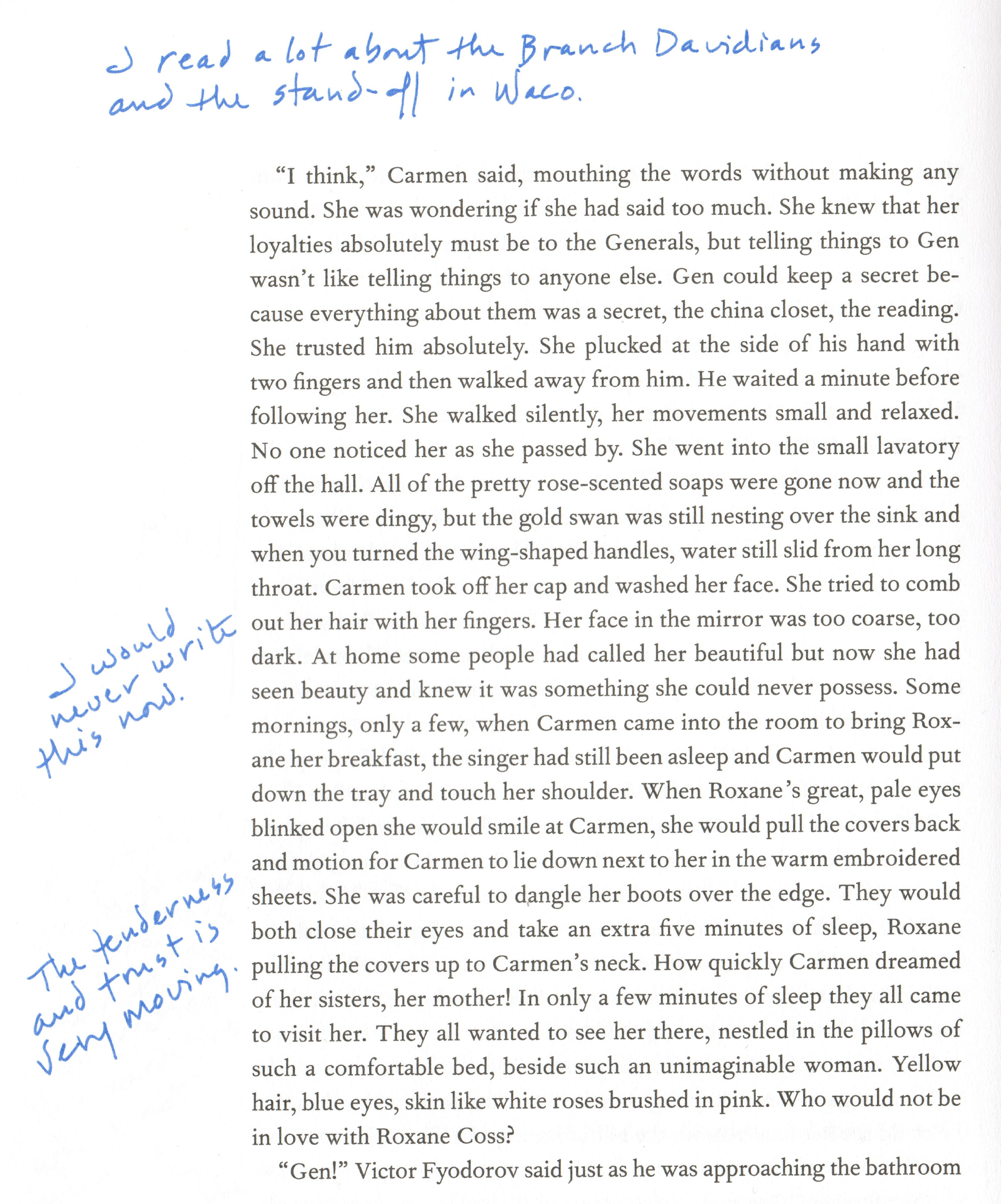
Here are a couple of sample pages. The first tells us about what Ann researched to capture the experience of being in a standoff with law enforcement. We see her view of the text as a more experienced writer (or her self-critical side, depending on your perspective). Finally, she shows us what she still loves. Her commentary enables us to read between the lines, illuminating elements of craft. The influence of the standoff between the FBI and David Koresh and the Branch Davidians is revealed, as well as the ways Ann went beyond a general model to adapt her scenes to the setting and characters she’d created. We can look for what makes the “never write” paragraph less effective than the one she finds moving.
In the second sample, Ann visualizes the scene, only to realize a key detail is missing. It’s a great reminder to re-read our text while conjuring what’s described in our mind. Often, we find something we envisioned as we were writing doesn’t appear in the text. We learn how to look for extraneous words that bog down, rather than enhance, the story, indicated by the [square brackets]. From Ann, I learned I love the words “but” and “that.” In the final stages of editing, I search for those words and ask myself if they are necessary (if no, then cut) or if an alternative will work better (hello “instead,” “whereas,” and even a “whereto for” if I’m feeling feisty).
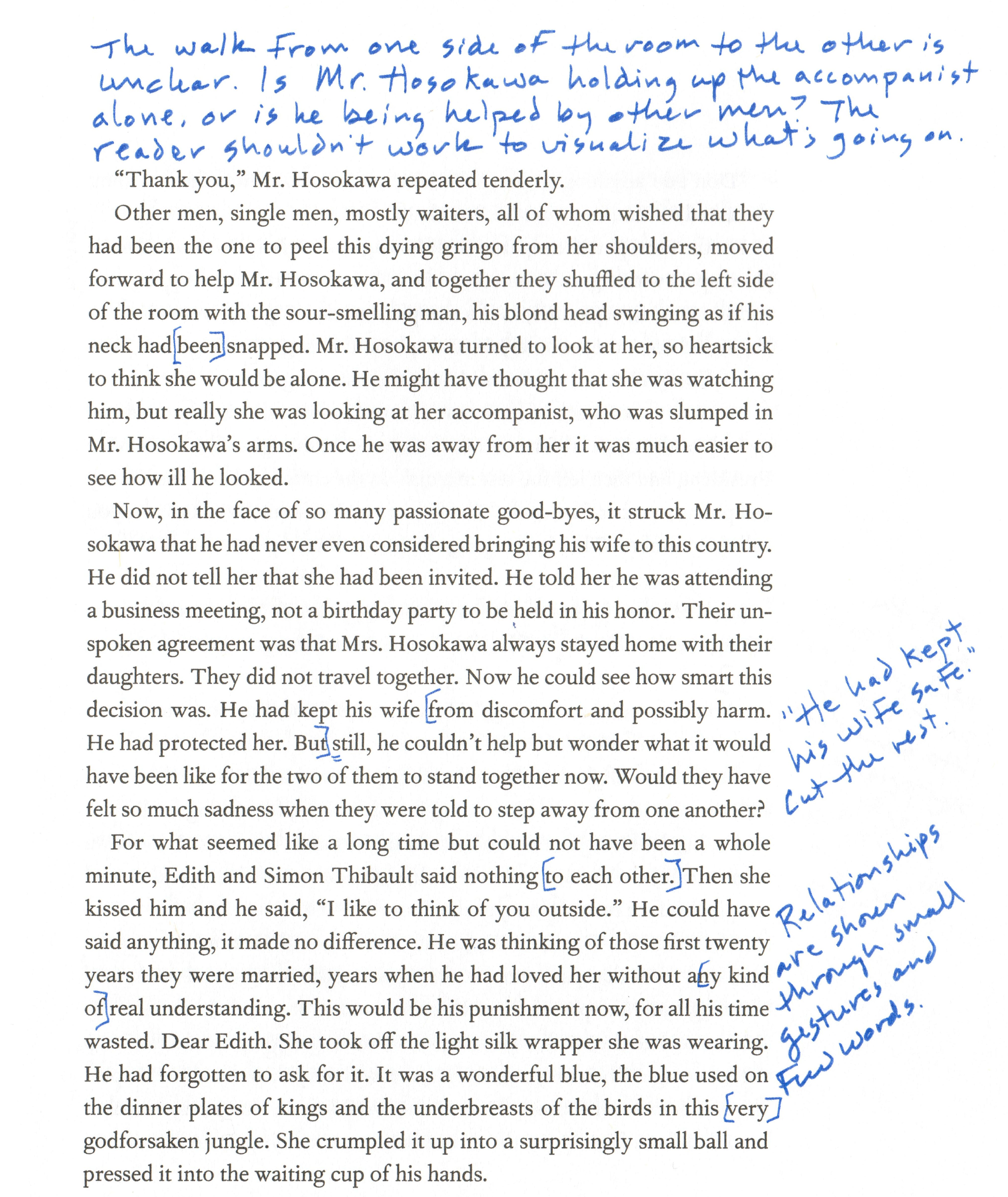
One of the great strengths of Bel Canto is the tender relationships that develop between characters: romances, apprenticeships, and parent-child-like bonds. How, we wonder, does Ann so masterfully make us feel deeply for these characters and their attachments? Love is shown in small gestures, rather than words, she counsels. Instead of drafting Romeo-esque declarations of love, we can describe a gentle touch.
Here are a few writing suggestions from Ann Patchett:
· When deciding on point of view, “what matters is the narrative serves the story” (p. xv). Each POV has its strengths and its challenges. Try different ones to find out what’s right for your story.
· “Sentence fiddling,” which involves “writing and rewriting one sentence dozens of times, spending an entire day on a single paragraph until it sounds right,” is part of writing. It’s a practice Ann wishes she’d started sooner in her writing career.
· Try removing words and phrases from your sentences. Does it make them stronger, or is something lost?
· “Small details are how we get to know people” (p. 168).
· Give the backstory with “the fewest words possible” (p. 3).
· “By only giving a few details, the reader is allowed to imagine a scene more beautiful and opulent than anything I could describe” (p. 9).
· “Practicality provides depth to the scene. It makes the reader slow down and see things” (p. 38).
· Use adverbs sparingly (see p.104).
For perfectionists (raise your hand), we also see that a text doesn’t have to be perfect to be great. It can have factual inaccuracies (an opera singer would never sing three days in a row), typos (Roxane Coss, one of the main characters, has an extra n in her name at the top of page 168), characters can teleport across the page, sentences can have awkward wording, and the novel can still be a smash success.
Millions have read Bel Canto with the extra words, factual inaccuracies, overwrought metaphors, and jumbled analogies and delighted in the experience.
Take heart, dear writer, editing is never an easy process. Yet, with a loving, methodical examination of our words and a good deal of experimentation, we can make a good story great, especially when we know what to look for.
What are your best editing tips? We invite you to share them in the comments below.

Susan Wingert holds a dusty doctorate in sociology from Western University, where she was the managing editor of The International Indigenous Policy Journal. She is a student in the Narrative Medicine program at Columbia University. She is Vice Chair of the Amherst Writers & Artists Board of Directors and has led writing workshops with health professionals and students, cancer patients, caregivers, and middle schoolers. She has published in DarkWinter, Peregrine, and The White Wall Review. Her story, “Mending Fences,” was nominated for Best of the Net Anthology.
You can find more about Susan and what she offers here.
Patchett, Ann. Bel Canto: The Annotated Edition. New York, HarperCollins, 2024. http://www.annpatchett.com/annotatedbelcanto
Thanks for reading Writing Alone and With Others! This post is public, so feel free to share it.
Comments
Nothing yet. Say the first thing.
Sign in to join the conversation.