
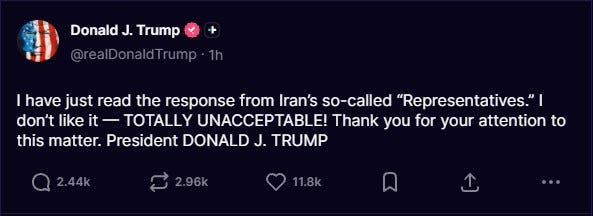
As of 12:00 PM Eastern Standard Time, President Trump rejected Iran’s latest offer of a deal to end the war. What are his options? Start up the bombing campaign, try again on face-to-face negotiations, wait Iran out in the hopes that the blockade will bring them to their knees? The Strait of Hormuz remains closed, with the world teetering on the brink of mass fossil fuel shortages and skyrocketing fuel prices.
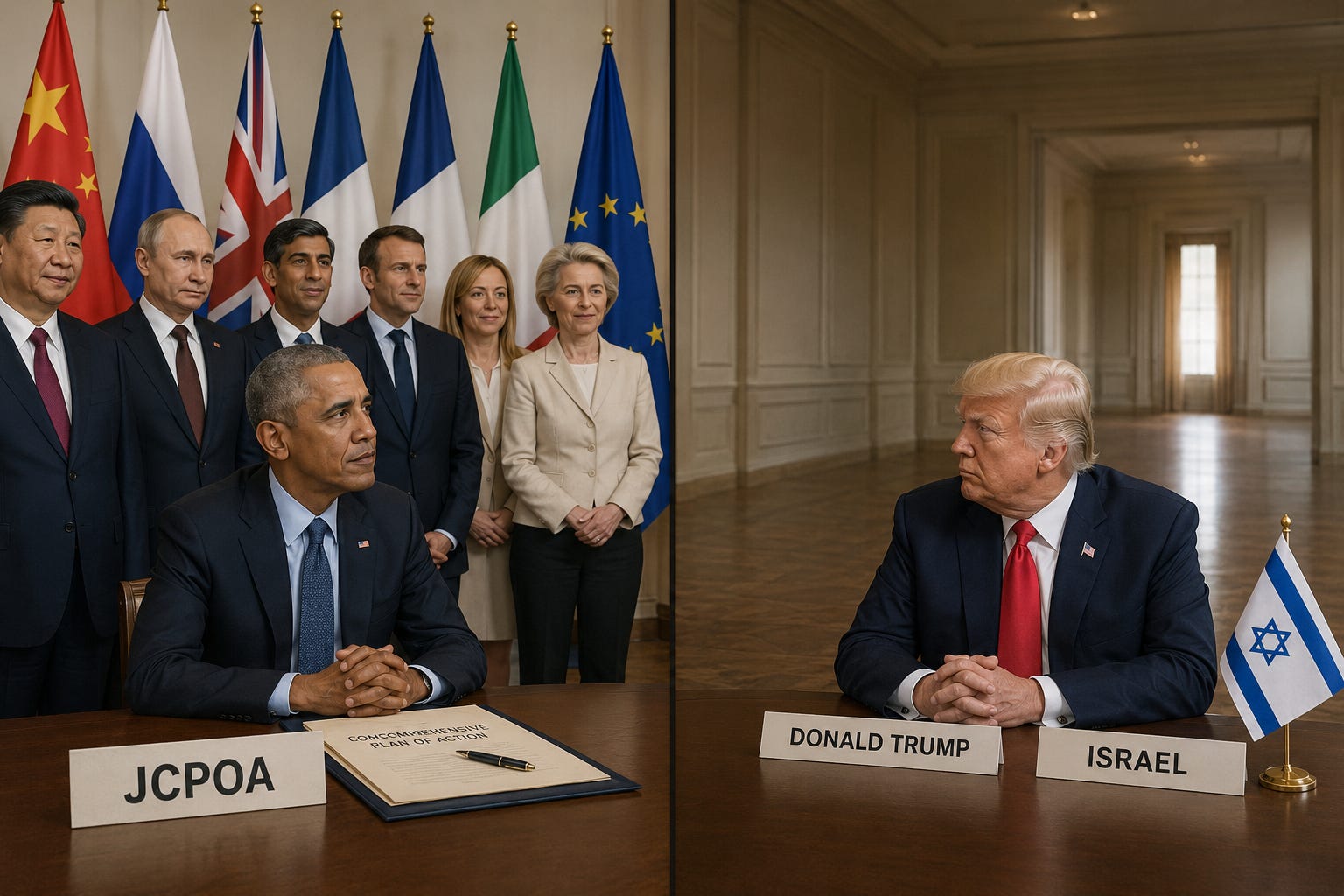
Any agreement from the upcoming talks between J.D. Vance, Jared Kushner, Steve Witkoff, and the Iranian team will be compared to the previous deal negotiated over ten years ago by John Kerry and his massive team of subject-area experts, diplomats, and a coalition of nations. Had Trump not pulled out of the JCPOA in his first term, would the U.S. be in a state of war with Iran, with the world held hostage by their blockade of the Strait of Hormuz?
President Trump, in his first term, ripped up the JCPOA, but offered nothing to replace it, only screaming that it was the worst deal ever.
The Joint Comprehensive Plan of Action (JCPOA), commonly called the Iran nuclear deal, had these 10 major hallmarks:
Uranium enrichment capped at 3.67%
Iran agreed to keep enrichment far below weapons-grade levels.Large reduction in centrifuges
Iran reduced the number of operating centrifuges at Natanz from about 19,000 to roughly 5,060.300 kg uranium stockpile limit
Iran reduced its enriched uranium stockpile by about 98%.Fordow facility restrictions
The Fordow underground site could no longer enrich uranium and was converted largely to research activities.Arak reactor redesign
Iran modified the Arak heavy-water reactor to prevent theproduction of weapons-grade plutonium.
Extensive IAEA inspections
The International Atomic Energy Agency received expanded access to monitoring and verification.Sanctions relief for Iran
In exchange, U.S., EU, and UN nuclear-related sanctions were lifted or suspended.“Snapback” sanctions mechanism
UN sanctions could automatically return if Iran violated the agreement.Breakout time extended
The agreement aimed to increase Iran’s estimated nuclear breakout time to about one year.Sunset clauses
Many restrictions expired after 10–15 years, which became one of the deal’s biggest criticisms.
Was the JCPOA perfect? Not by a long shot, but it dealt with the most pressing problem of the time rather than needlessly trying to be everything to everyone and muddying the waters that would have stalled any progress.
The so-called pallets of cash were, in fact, refunds to Iran for military hardware they paid for, but never received, as well as frozen assets that were released as part of the deal. Sanctions were lifted, but with a “Snapback” should Iran violate the deal.
The deal was working with inspectors in place, enriched Uranium sent to Russia, and restrictions on facilities and enrichment limits.
Whatever deal comes out of the Administration, if they can even convince Iran’s new, younger, and more conservative leadership will be measured against the previous deal. Why should they trust Trump when he ripped up the last deal?
The toll of this war: 13 American lives lost, nearly 400 injured, dozens of strategic US military facilities destroyed or severely damaged throughout the Middle East, half of our high-tech weapons expended, gas at nearly $5/gal, world oil supplies dwindling, thousands of Iranians and Lebanese killed, and the Strait of Hormuz is closed with thousands of tankers, cargo ships, and vital commodities held hostage. Nothing as yet to show for this world-shattering, in Trump’s words, “Excursion”.
Comments
Nothing yet. Say the first thing.
Sign in to join the conversation.