
“But the Jews’ fault and their misfortune is that they do not open their eyes to the cause of these age-old and unprecedented persecutions. Throughout history, we have seen many peoples fall prey to other peoples. […] The persecutions of the Jews have had this twofold characteristic: perpetuity and universality. It is a unique phenomenon — one that cannot be explained humanly; it is too vast to be traced back to a limited cause. If you attribute it to intolerance, you would have to go back to the cause of this intolerance, and not blame Catholicism alone; for the same persecutions have been incessant among pagans, among Protestants, among Greeks, among Muslims, at all times, in all places, under all forms of government.”
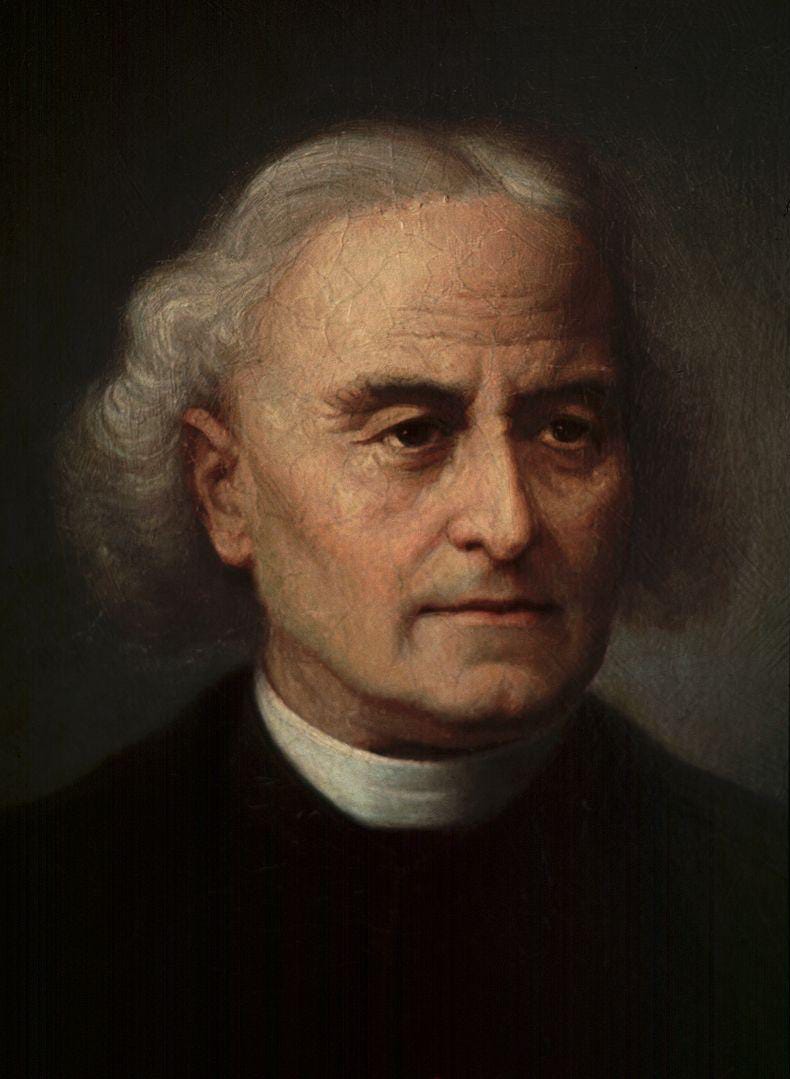
The Tragedy of the Jewish Race
There is a famous Latin maxim corruptio optimi pessima “the corruption of the best is the worst.” It perfectly applies to the Jewish race, a singularly unique people who Monsignor Léon Meurin observed in 1893:
What a strange figure in humanity is this people of Israel! How great and majestic it is in its history, as long as it walks with the Lord! How great it is also and above all terrible in its hatred against its Messiah, whom it misunderstood and killed on the cross!
In the pages of The Journal of American Reform we have observed the latter reality; the extreme corruption of the Jews, the evil of Talmudism and the universal conspiracy of the Synagogue against true Israel. However, the inverse of the maxim is no less true and it must be said with Monsignor Meurin that, “How great and majestic it is in its history, as long as [Israel] walks with the Lord!” The greatest saints of the Catholic Church, Our Blessed Lady first among them, have been of Jewish extraction. The apostles were no different.
The King of the Universe, Our Divine Lord, belonged to the line of David and Abraham (Matt. I, 1, 16). Jesus Christ lived as a Jew and is the God-man. This profound truth should not discomfort Catholics, even when it is weaponized by “neo-Judaizers” or “neo-pagans,” as happens with increasing frequency today. Any misguided antisemitism that seeks to deny this reality about Our Lord is not only a grave error but an affront to Catholic dogma. At the same time, the circumstances of Our Lord’s conception were utterly unique, to say nothing of His Divinity.
Father Ludwig Ruland explained this well in his 1942 work on social questions:
Christ had a human mother of the house of David, but no human father, so that our Lord is not biologically the descendant of one particular race in the same sense as all other men are of theirs. By His supernatural origin and incarnation Christ belongs to no race at all, and it is only those that deny Christ’s divinity who find any difficulty on this point.1
Further, as Catholics, we do not celebrate the Great Patriarchs of the Old Testament, all of whom looked forward to the coming of the true Messias, because of the eminent characteristics of the Jewish-Semitic race. Rather, as Father Constantinus, O.F.M., noted in his illuminating Catholicism and the Race Question, it was:
Because of their free, personal, heroic cooperation with the supernatural graces of salvation, because of their personal supernatural (and not because of their racial) merits and their faith in the coming Redeemer, not as (and insofar as He was) a Jew, a Semite, but the Son of God, the Redeemer of all races.
This is the true meaning of Saint Paul’s admonition to the early Church (Rom. X, 12), “For there is no difference between the Jew and the Greek: for the same Lord over all is rich unto all that call upon him.” How badly this has been obscured today.
Forgotten Jewish Converts
The nineteenth century saw a number of Hebrew converts enter the bosom of the Catholic Church, notably among their intellectual, social and religious elite. Father Edgardo Mortara, devoted servant to Pope Pius IX, and Father Augustin Lémann, tireless missionary to the Jewish people, stand out as examples, to say nothing of David Paul Drach. To this list we are obliged to add Father Marie-Théodore Ratisbonne, the saintly focus of this essay.
Born Marie-Théodore Ratisbonne in 1802 to a wealthy Jewish family in Paris,2 after the conversion of his friends and careful study, a young Ratisbonne was moved by the grace of God to seek baptism in 1826. Ordained in 1830, now Father Ratisbonne served in his home diocese before moving to Paris in 1840, where the miraculous conversion of his fiercely anti-Christian brother Alphonse in 1842 inspired him to devote himself to the education and conversion of Jews.3 With the backing of Pope Gregory XVI, he founded the houses of Our Lady of Sion for the Christian education of Jewish children, a mission that earned him the continued favor of Popes Pius IX and Leo XIII. Father Ratisbonne died in 1884 having received the last sacraments from the Archbishop of Paris and the final blessing of Leo XIII who had by then made him an Apostolic Protonotary. He left behind a substantial body of written work covering many topics, most of which remains untranslated into English today:
1828 — Essai sur l’Éducation Morale (Essay on Moral Education)
1841 — Histoire de Saint-Bernard (The Life and Times of Saint Bernard)
1853 — Méditations de Saint-Bernard sur le Présent et Futur (Saint Bernard’s Meditations on the Present and Future)
1860 — Le Manuel de la Mère Chrétienne (The Manual of the Christian Mother)
1870 — Nouveau Manuel des Mères Chrétiennes (New Manual for Christian Mothers)
1870 — Le Pape (The Pope)
1872 — Miettes Évangéliques (Evangelical Crumbs)
1878 — Réponse aux Questions d’un Israélite de Notre Temps (Reply to the Questions of an Israelite of Our Time)
Now, without further ado, The Journal of American Reform is pleased to present Father Marie-Théodore Ratisbonne’s 1868 treatment of “The Jewish Question.”
Key Passages
France must have sunk very low into the darkness of unbelief to suddenly find itself at the level of Jewish infidelity. But Providence, which makes everything work together for its impenetrable designs, seems to have chosen the moment when the social edifice was collapsing with a crash to shake the age-old walls that separated the Jews from Christian society.
A prophetic people, put on display before the world and destined to serve as an example to all other nations, their influence upon society can never be a matter of indifference; indeed, in our own day, it has acquired an unprecedented power. Naturally skillful and ingenious, and possessed by the instinct for domination, the Jews have gradually invaded all the avenues that lead to wealth, honors, and power; their spirit has gradually infiltrated modern civilization; they control the stock market, the press, the theater, literature, government offices, and the major communication routes on land and sea; and by the ascendancy of their wealth and their shrewdness, they have at present taken, as in a hidden snare, all of Christian society.
They no longer want Judaism; that much is certain; but they do not yet want Christianity; and the proof is that, while rejecting the Revelation of Moses wholesale, they relentlessly pursue those among them who embrace the Catholic faith. The latter, as we have already said, do not renounce any point of the Old Testament; those, on the contrary, who accuse them, deny all the teachings of the faith and all the traditions of their fathers. To whom, then, does the epithet of apostate logically apply?
The children of Israel who have the immense good fortune of embracing the Christian faith do, it is true, disavow the Talmudic superstitions of those among their fathers who fell into the darkness of unbelief; but thanks be to God, they count other ancestors among the Israelites who remained faithful, and through them they attach themselves to the faith of the most worthy and most illustrious of their fathers.
The Jews in general do not read the Holy Scriptures; or else they defer to the interpretations of their rabbis, who refuse to open their eyes. But how could one fail to be struck by these testimonies, when one hears them with an upright heart?
The Journal of American Reform is a reader-supported publication. To receive new posts become a free subscriber and, if you want to support my work, kindly consider a paid subscription.
THE JEWISH QUESTION
I.
From a social standpoint, as from a religious one, the Jews have always occupied a unique position; and it is with good reason that today, more than ever, they attract the world’s attention. When one considers the static state in which they remained for nearly 2,000 years, one is astonished by the unusual movement that suddenly spread among them; and one wonders what the tendency of this movement is, and what end it will reach. Until recently, iron barriers separated this imperishable race from all the peoples among whom it languished; and contrary to the law of assimilation, which blends together in a single society the various elements of subjugated nations, the Jews alone persisted in their isolation, inaccessible to the light of the Gospel and the progress of Christian civilization.
This state of drowsiness lasted until the beginning of our century; and during this long course of events, the Jews, turned inward and visibly rejected, show in their lamentable history no vitality, no change, no point of contact with Christians. They are stagnant water that does not mingle with any of the rivers that surround them.
The purpose of this writing is not to recall the cause of this dazzling decline; it is written in the Old and New Testaments; it is the mystery of God’s justice, the most memorable and significant of all historical phenomena.
Nothing less than a social upheaval, the most terrible recorded in history, was needed to give the Israelite people the first sign of awakening.
An astonishing thing, and yet very little noticed! Of all the acts that emanated, like thunderbolts, from the heart of the French Revolution, only one survived in all its consequences; and it is precisely this one to which the least attention was paid. On September 28, 1791, the Constituent Assembly, intoxicated by its omnipotence, decreed the emancipation of the Jews and admitted them to the exercise of all the civil and political rights of French citizens. This initiative was imposed successively, but not without resistance, first on all the Catholic states, then on the Protestant and schismatic states, even in Turkish and Arab countries.
Editors’ Note: interestingly, it was our revolution and 1788 Constitution which first emancipated the Jews, a striking departure from the constant practice of Catholic states and even Protestant regimes. Until then, the civil equality of Hebrews had always been denied: chiefly on religious grounds and in the name of the common good, though also — secondarily — by the resistance of the latter to assimilate among gentile nations.
In the newly created liberal, masonic republic, the very first president, George Washington, boasted that the American project rejected the European practice of religious “toleration,” embracing instead the “enlarged and liberal policy” of religious liberty in which all citizens are equally free to exercise. He noted in 1790 to the Hebrew Congregation of Rhode Island, approvingly, that the “Government of the United States… gives to bigotry no sanction, to persecution no assistance.”
France must have sunk very low into the darkness of unbelief to suddenly find itself at the level of Jewish infidelity. But Providence, which makes everything work together for its impenetrable designs, seems to have chosen the moment when the social edifice was collapsing with a crash to shake the age-old walls that separated the Jews from Christian society. Beneath the thick clouds of dust that so many ruins had heaped up everywhere, the emancipation of the Jews was accomplished in an almost unnoticed manner. And indeed, when, after the dark night, Israelites and Christians found themselves facing one another, living the same social life, they remained surprised and for a long time embarrassed by this impromptu fraternity. The dividing line, legally abolished, persisted in habits, in customs, in instincts; and the Jews, always rejected, kept themselves apart for some time, not using their freedom except to increase the opportunities of their trade. Fifteen years of hesitation passed after the famous act of emancipation; and during this period, no significant change can be noted in the actual situation of the Jews. A principle had been promulgated; the consequences were to follow later. It was Napoleon, the powerful architect of the new era, who conceived the idea of making the merging of Jewish nationality into French nationality possible. By a decree of May 30, 1806, he convened an assembly of Jews from France, Italy, and Holland in Paris to address a series of issues, all aimed at reconciling the teachings of Moses with the requirements of French law. The Jewish deputies had too much to gain from preserving their titles and rights as citizens not to carefully consider the terms of their profession of faith. More concerned with their own well-being than with the law of Sinai, they concealed the inflexible conditions of their religious beliefs and sacrificed several fundamental tenets so as not to alienate the Emperor’s favor. Thus, in their declaration of August 1806, they began by stating as a principle that their religion commanded them to regard as: “supreme law, the law of the prince in civil and political matters; that, consequently, even if their religious code, or the interpretations given to it, contained civil or political provisions that were not in harmony with the French code, these provisions would cease to govern them, since they must above all recognize the law of the prince and obey it.”
This strange preamble placed the Napoleonic Code above the Code of Moses in a single stroke. We see in it, first of all, the intentions that motivated the Jewish deputies charged with resolving, in the name of their coreligionists, the questions submitted to them. The declaration containing their official answers must have fully satisfied the Emperor; and the latter, wishing to give the doctrine of this new Judaism a sanction and an authority it did not possess, conceived of transforming the assembly of Israelite deputies into a kind of council, under the name of the Great Sanhedrin.
The Hebrew council convened in Paris in the first days of February 1807 confirmed the previous decisions and formulated nine articles relating to marriage, divorce, polygamy, and the civil and political relations of Jews with Christians.
We will speak later of the article concerning rabbinism. Let us simply note that the decisions of the Great Sanhedrin, despite the support given to them by the Emperor’s government, never gained any credence among Orthodox Jews.
Napoleon, unwittingly pursuing the plan of Providence, persisted in increasingly dissolving Jewish nationality in the French Empire; and to this end, he decreed several measures that were organized on new grounds the ancient remnants of the cult of Moses. On May 17, 1808, he established consistories, appointed rabbis, sanctioned the decisions of the Great Sanhedrin, and broadly regulated the affairs of the synagogue. On July 20 of the same year, another decree ordered Jews to adopt, within three months, a given name and a surname that were not derived from the Old Testament. While imperial power did not succeed in changing the characters and physical appearances of the Jews, it nevertheless produced undeniable results in the long run; for all these innovations, stripping the Jews of their distinctive form and introducing heterogeneous elements into their religion, gradually led to the total disintegration of the old Judaism.
Other causes contributed to this crisis. The Jews, having entered a licentious society, soon adopted its doctrines and customs. The philosophy of the 18th century became the guide for those among them who wished to educate themselves and pass for enlightened men; life in the camps caused many others to forget religious practices; finally, the example of bad Christians and the almost general indifference to religion that then prevailed in France, completed the extinguishing, in the vast majority of Jews, of the sparks of faith they had inherited from their fathers.
At the time we are speaking of, the corrosive influence of unbelief was undermining the faith of both Jews and Christians; it seemed to have produced a general leveling. But on this blank slate, Providence was opening new means of salvation to human frailty; and one could sense the fulfillment of a mysterious saying of Saint Paul: “Conclusit Deus omnia in incredulitale, ut omnium miserealur.”
“God let them all fall into unbelief, so that He might exercise His mercy toward all.”4
From then on, the influence of Christianity began to be felt; it did not yet prevail, but it became irresistible. Judaism, which had remained motionless through the centuries, like a corpse reduced to a mummy, hardened and invulnerable under the hammer of persecution, crumbled to pieces as it drew closer to the Christian atmosphere; and from that moment appeared the first signs of regeneration. Like the seeds of ancient Egypt rediscovered in our time, which have yielded a new harvest, the seeds of Judaism sprouted in various countries, flowers full of hope. These first fruits were not shown in the mass of the people, but one could already observe a few rare fruits of the mysterious work of grace. The transformation was taking place slowly within people’s minds, while outwardly, nothing was yet visible but chaos — the dismal entourage of license and irreligion. The Jewish generation that vanished with the passing century carried away with it the traditions, the inveterate prejudices, and the obscure practices of the Talmud; the generation that followed it — and which grew old under the Restoration — thought only of enjoying earthly life, without concerning itself with the conditions of future happiness; and finally, the Israelites of later times — most of whom were educated in Christian schools or entirely devoid of religious instruction — seem to have become strangers even to the very memories of the antiquated worship of the synagogue.
Hence a situation that inaugurates a new phase, obviously abnormal and transitory. The Jews are no longer Jews; they are not yet Christians. They float aimlessly between the past and the future. Could it be possible that this situation could befit the descendants of Abraham, the father of believers? A prophetic people, put on display before the world and destined to serve as an example to all other nations, their influence upon society can never be a matter of indifference; indeed, in our own day, it has acquired an unprecedented power. Naturally skillful and ingenious, and possessed by the instinct for domination, the Jews have gradually invaded all the avenues that lead to wealth, honors, and power; their spirit has gradually infiltrated modern civilization; they control the stock market, the press, the theater, literature, government offices, and the major communication routes on land and sea; and by the ascendancy of their wealth and their shrewdness, they have at present taken, as in a hidden snare, all of Christian society. The government of 1830 gave the synagogue an impetus that has never ceased. One of his first acts, on February 8, 1831, was to place the rabbis on the same footing as ministers of other faiths and to assign them a salary from the public treasury. This innovation created a kind of Israelite clergy from a legal standpoint; but in the eyes of religion, the rabbis have never been and could never be ministers of the Old Testament. It is known that, according to the Law of Moses, only the sons of Aaron and the descendants of the tribe of Levi had the authority to perform priestly functions; so much so that, after the dispersion and the mixing of the tribes, the Jews no longer had priests or sacrifices. This is the literal fulfillment of the prophecy of Hosea: “For many days Israel will be without king, without prince, without sacrifice, without altar, without ephod, and without teraphim.”5 The rabbis, whose name means masters or preceptors were merely scribes, more or less learned in the Law; or casuists versed in the Talmud, who taught commentaries on religion; later, they received a small salary from the synagogue for rendering rulings on doubtful cases of Talmudic morality. Such were their only attributes; and they never presented themselves as pastors or ministers of their religion. An interesting note on French rabbinism can be found in the June 1846 issue of a Jewish publication entitled The Archives of the Israelites. The current institution of rabbis as ministers of their faith dates only from 1808. It is due to the Jewish deputies, who, ashamed to proclaim to France the nullity and uselessness of rabbinical functions, attributed to the rabbis of that time a fictitious character contradicting the formal law of the Old Testament.6
The royal decree of 1831 sanctioned this singular anomaly by endowing the synagogue with an impossible priesthood. But in fact, the rabbis, transformed into priests by civil law, and although salaried by the State, remained without authority among the Jews; and they found themselves the target of sarcasm from both their friends and their enemies. It had been hoped that the creation of the rabbinate would breathe some life back into the dying synagogue; changes in ceremonies, modifications in services, and progress in interpretations were expected; some wanted reforms, others opposed them; all pretended to regenerate, by various means, the affairs of religion. But the rabbis, vested with an illusory power, incapable moreover of fulfilling the role assigned to them, and perfectly content with their lot, offered only inertia to the discordant demands of their coreligionists.
Then the Jews divided into several very distinct parties. Some, whom we can call the Indifferent, and they are the vast majority, abandoned the synagogue and religious practices. These are the men of the day who know no other life than that of this world, and devote their entire activity to the pursuit of pleasures and interests. Others are the Reformers, belated disciples of the school of Voltaire; and yet still attached by instinct rather than by conviction to the faith of their ancestors. They would like, as they say, to bring religion up to the level of the age; That is to say, a Judaism dressed in modern fashion, with a dogma that does not offend the senses, and a form of worship that does not disrupt customs. The reformers are distinguished from the indifferent in that the latter, no longer even possessing religious feeling, are in no way concerned with the decline or rehabilitation of the synagogue; while the former cling to beliefs they do not practice and seek to harmonize them with human systems. Too preoccupied with earthly matters to rise to the divine idea of religion, they would like to bring it down to themselves, thus satisfying both their unreflective pride and their blinded conscience.
The third party, called Orthodox or Conservative, consists of a fairly large number of obstinate Jews who, either out of conviction or a spirit of opposition, reject all reform projects and loudly demand the maintenance of Talmudic customs and precepts. The men of this category are diminishing every day; for they are scarcely recruited from among the young; and there is much ignorance and hypocrisy among them.
There is another party called by the Jews themselves the party of the Christianizers.7 These Israelites, who repudiate the name of Jews, admire the Catholic faith; but most stop at the threshold of the Church. Nourished by futile or erroneous readings, they imagine that the God of the Christians is a different God from the God of Israel, and dare not embrace the serious study of Christianity, for fear of being led to abandon the religion of their fathers. As if modern Judaism were the religion of Moses! As if they had not long ago broken the chain that bound them to the faith of the patriarchs! As if the Christian faith did not contain the entirety of the Jewish faith! Moreover, mysteriously drawn to the Church, they reverently pronounce the name of Jesus Christ; they praise evangelical morality; they associate with priests and attend sermons; they openly express the wish and the hope of soon seeing all of Israel within Christianity. Many of them have indeed received the sacrament of regeneration: some publicly, others in secret; and today there are Christian members in all the principal Israelite families of Europe.
Finally, the party that prevails today over all other shades, both in the number of its adherents and in their distinction, is the one that openly denies the Bible and the Hebrew cult, to devote themselves to the pursuit of a progress they call the Idea. By this word, we recognize the more or less disillusioned disciples of Saint-Simon, Fourier, and other inventors of religions, who, as we know, made their first conquests among the most eminent Israelites. This party, which calls itself the Progressive Party, has noble aspirations: it foresees a universal fusion; and to achieve this goal, it earnestly demands the convocation of a synod composed of representatives from all the synagogues of the world. And what will be the mission of this new great Sanhedrin? Heavens, hear, and you, earth, lend an ear! Its mission will be to proclaim to the world the unity of God and the immortality of the soul. Whoever accepts these two dogmas, they say, will thereby be recognized as an Israelite.
This, verbatim, is the sum of their theology. It is certainly to reduce religion to its simplest expression; and one would have to suppose a great deal of ill will on the part of unbelievers in all countries to doubt their acquiescence to such an easy religion. However, it is not new; and it is not necessary for a synod of rabbis to come and reveal it to us. Already paganism, weary of idols, had risen to the level of this vague deism. Aristotle, Plato, Seneca, spoke of the unity of God. Cicero, among others, wrote these words: “Although God is one, he is designated by various names; to deny his existence would be an absurdity.”8 And without dwelling on the pagans, let us simply recall that monotheism also found an apostle in Robespierre, who, in the midst of the Synod of the Convention, deigned to grant the supreme being a patent of existence and a certificate of life.
We know the influence this abstract dogma has exerted on the morality and prosperity of France.
Is this the idea of progress contained in what is strangely called liberal Judaism? I cannot believe it; I have too high an opinion of progressives; but I wonder how men of good faith and talent can be satisfied with such a vague and vain theory. Do they not sense that if there is a God, creator and father of humankind, there must be a living relationship between humankind and its Creator? What is this relationship? Why was it broken? How can it be restored? These are the vital questions of religion that concern our future destiny; they have not been left to the disputes of men; they have been resolved by the Old and New Testaments To reject these sacred books is to condemn oneself to eternal doubt, even if one were to adorn this doubt with the titles of science, progress, idea, monotheism, or liberal Judaism.
Let us be frank. These men know what they do not want; but they do not know what they do want. They no longer want Judaism; that much is certain; but they do not yet want Christianity; and the proof is that, while rejecting the Revelation of Moses wholesale, they relentlessly pursue those among them who embrace the Catholic faith. The latter, as we have already said, do not renounce any point of the Old Testament; those, on the contrary, who accuse them, deny all the teachings of the faith and all the traditions of their fathers. To whom, then, does the epithet of apostate logically apply?
The various parties we have identified, despite their profound differences, nevertheless have one point of contact. All retain the bitter memory of the persecutions to which the Jews have been subjected for eighteen centuries; for the shadow of these calamities still haunts them. Indeed, it would take a virtue more than magnanimous to erase with generous oblivion the bloody testimonies of their history. But the Jews’ fault and their misfortune is that they do not open their eyes to the cause of these age-old and unprecedented persecutions. Throughout history, we have seen many peoples fall prey to other peoples. But these unjust aggressions had limits; they only stained certain periods and certain regions; they lasted only a time; they were not carried out simultaneously or alternately in all the countries of the world. The persecutions of the Jews have had this twofold characteristic: perpetuity and universality. It is a unique phenomenon — one that cannot be explained humanly; it is too vast to be traced back to a limited cause. If you attribute it to intolerance, you would have to go back to the cause of this intolerance, and not blame Catholicism alone; for the same persecutions have been incessant among pagans, among Protestants, among Greeks, among Muslims, at all times, in all places, under all forms of government.
Editors’ Note: Notice how similar the above observation of the Jewish nation is to Father Ballerini’s — “[Of] those who do not believe in the divinity of the Scriptures and reject the prophecies of the two Testaments, it must seem inexplicably strange to see the fact, unique in the history of mankind, of a people, for more than nineteen centuries, dispersed and wandering, without a king, without a temple, without a priesthood, without a homeland; and yet always subsisting, mingled with the nations of the globe, with none of which it has ever been related, and always by all the same nations, sometimes more sometimes less, disliked, hostile or rejected.”
If one does not wish to open the Gospel to penetrate this somber mystery, let one read the prophets of Israel. We will quote only Moses: If you render my covenant void and useless, I will break the hardness of your pride; the heavens will be like iron to you, and the earth like bronze. I will ravage your land; I will make it a horror even to your enemies; I will scatter you among the nations... And if a few of you remain, they will wither in the midst of their iniquities, in the land of their enemies, and they will be overwhelmed with afflictions because of the sins of their fathers and their own sins, until they confess their iniquities and those of their ancestors...9
We will not continue with these quotations; they are terrible; and they are found even more frightening in the other prophetic books. But by comparing them with the history of the Jews, could one fail to recognize the intervention of God’s hand in the explosion of a catastrophe that lasted nearly two thousand years?
Does this mean that the Catholic Church was the sword of divine justice? No, that was not its mission. On the contrary, it moderated the spontaneous furies of the people; it energetically condemned, through the pontiffs, the instigators of these cruel enmities, even when they were acts of reprisal. It sheltered the trembling Jews under its aegis; and it did not merely rescue them from popular passions; it opened inviolable sanctuaries for them where they found security. It was Rome that set the example of this protective charity; it granted the Jews a separate quarter; and several other cities imitated the initiative of the Roman pontiffs. Thanks to these places of refuge, the Jews lived together around their synagogue, in accordance with their laws, under the authority of their spiritual leaders; and they had the full and complete enjoyment of the practice of their religion. Hence the Ghettos, whose origin is linked to a hospitable spirit, too often forgotten and too often maligned today. Philanthropy paints a grim picture of them and rightly deplores their dilapidation and filth. But it is forgotten that they date from a time when generally all cities had the same appearance. In the Middle Ages, Christian civilization did not pride itself on transforming the palaces, the fragile dwellings of this world. Christians, sojourners on earth, aspired only to the splendors of the heavenly Jerusalem. If, with the progress of the century, the cities of the earthly city have been singularly embellished, it should not be surprising that the Jews did not follow this movement. The Ghettos remained stationary, like the populations who dwelt there. It is the Jews who have maintained them in their present state; and it even seems that these dilapidated dwellings did not displease them; for even today they prefer them to others. Since the beginning of his reign, Pius IX has placed all the districts of Rome at their disposal; and yet they persist in not leaving the Ghetto, and they remain voluntarily attached to it.
The Israelites are obviously committing an injustice and an act of ingratitude when they rebel today against an institution that once saved them.
II.
The digressions we felt compelled to make concerning the various parties that divide the Jews have not led us astray from our subject; for they clarify what remains for us to say about the crisis that results from the confusion of so many disparate elements.
The supporters of reform, as well as the orthodox, have their mouthpieces in the press. But in general, Jewish publications do not reveal the internal turmoil of the synagogue; and they avoid, as much as possible, confiding in the Christian world. What is remarkable is the care with which they shun all serious and dogmatic discussion. Above all, they avoid the great question of the Messiah, the only one that stands between Jews and Christians! For once this question is resolved, and Jesus Christ is recognized as the Holy One of Israel promised to the patriarchs and foretold by the prophets, the wall of separation would instantly fall, and the word of the Messiah would be the light of the Jews as it is the law of the Christians. This is what those among them who concern themselves with religious matters fear; and it seems that the fear of being enlightened leads them not only to distort the meaning of their sacred prophecies, but also to deny, against the very text of the Old Testament, the dogma of the Messiah and the Redemption of the world. Today, Jews no longer accept this fundamental point of the religion of their fathers; they reject both the mystery of original sin and the promise of the Redeemer. Or, if they still invoke the Messiah in the obligatory recitation of the psalms and prophetic books read every Saturday at synagogue services, they attach no meaning to their words; they regard them as outdated formulas; they even declare that one should no longer expect anything from the Messiah, nor ask for any other liberation than that which they have obtained in their political situation. The Messiah came for us on February 28, 1790, with the Declaration of the Rights of Man. Thus spoke one of the most authoritative voices of modern Jews, Mr. Calien, the translator of the Bible.10
In this state of decadence of Judaism, influential Israelites turned to the July Monarchy to solicit support that they no longer found in their faith.
Thanks to the sympathy they enjoyed, they obtained a constitution which, in the form of a royal decree, was a true civil constitution for the Jewish faith. This document, dated May 25, 1844, attracted very little public attention; few seemed to grasp the immense significance of an organization that placed Judaism under the direct and immediate authority of the Christian minister in charge of religious affairs in France. The Bishop of Langres was the only one at that time to point out its consequences in a famous pamphlet entitled The Tendencies. A glance at the main provisions of this royal decree is enough to reveal the profound attacks it dealt on the traditions and hierarchy of the synagogue. Thus, it was decreed that the religion of French Jews would henceforth have its center in Paris. A central consistory composed of laymen, and placed, like the Holy Synod of Russia, under the control of the government, directs the spiritual and temporal aspects of worship; it can be dissolved by decree; and in that case, the reins of the synagogue are entrusted to a provisional administration formed by the minister. Below this supreme consistory are departmental consistories which report on their administration to the prefects.
This organization, so contrary to the spirit and the letter of the Old Testament, resulted in the complete secularization of the Jewish religion. Judaism, absorbed into the political sphere, now found itself governed as a mere branch of civil administration. But the Israelites, increasingly fascinated by the official protection they found themselves receiving, applauded this strange situation, which they called progress; and they refused to understand that human support is a very fragile foundation, all in a time when the whole of society is prey to perpetual vicissitudes.
The same constitution, with some changes, was applied soon after, by a new ordinance dated November 9, 1845, to the Israelites of Algeria; and what is strange about this last act is that Algeria, being placed under military rule, the administration of the Mosaic faith was in fact found to fall within the purview of the Minister of War; and thus, it is an army general who exercises over the Algerian synagogue the supremacy that the high priest exercised in Jerusalem
However, the consistories themselves eliminate rabbis as much as possible. They recruit from among merchants, lawyers, artists, and the wealthy — whoever they may be, all undoubtedly very honorable, and we grant that they are versed in the study of the humanities; but in general, they are completely unfamiliar with theological studies and synagogue services. Is it from there that enlightenment will come?
Let us also note that these upheavals are not unique to France; they are occurring with greater fervor in other countries; and if the scope of this writing allowed it, we would mention here the rabbinical schisms already fully realized in England, Austria, Prussia, Russia, and Poland. Everywhere a new spirit is stirring the remnants of Israel; everywhere, across the entire surface of the globe where they are scattered, they are restless and yearn for a new order of things. The present time is evidently a transition between the state of immobility of the past eighteen centuries and a future regeneration that will only be brought about by the Gospel. The civil and political emancipation of the Jews was only the prelude of a higher and more complete liberation. Beneath the ruins of the synagogue, the materials for a new edifice are taking shape, and it is already beginning to rise; and although scarcely risen from the ground, it is visible to all.
What will be the consequences of this crisis? On the one hand, the inevitable contact of the Israelites with the Christians is causing the old repugnance to fall away day by day. The Jews now find themselves mingled with civilization, with religious discussions, with the general life of Christian society; so that, despite themselves, they are enveloped and as if invaded by the breath of Christianity, which is constantly at work, penetrating, enriching, and enlivening all social elements. On the other hand, Providence, having cleared the way, has brought forth on the soil of the Church works destined to meet the new needs. It has chosen instruments even from among the children of Israel; And today, one could no longer count the number of those who have sought and found in the Church light, peace, and happiness. The apostolic zeal that so earnestly urged Saint Peter and Saint Paul has been reawakened to set to work; immense charity is being shown to the Jews. Everything leads one to believe that, with the blessing of the common Father of the faithful, with the help of prayer, divine grace will bring the lost sheep back to the paths of truth. The time of the mercies promised to Zion has come; it is the signal of the consolations announced to the Church. “Thou shalt arise and have mercy on Sion: for it is time to have mercy on it, for the time is come.”11
III.
We have said that the principal obstacle which distances the Jews from the great Catholic family is the fear of renouncing the faith of their fathers, and the instinctive horror they feel at the thought of worshipping a God other than the God of Abraham. This obstacle arises from nothing but a lack of study; for they imagine that Christianity is a different religion from Judaism — a notion entirely contrary to the truth. The Gospel, far from abolishing the doctrines of the Old Testament, has spread them among all the nations of the earth; and Christianity is in reality nothing other than the fulfillment of the promises made to Abraham and to the patriarchs of Israel: “All the nations of the earth shall be blessed in Him who shall come forth from your race.”12 It is therefore a grave error to believe that in embracing the Christian faith, the child of Israel renounces the God of his ancestors. On the contrary, he acknowledges and proclaims that this God of goodness is faithful to His promises, and that what He solemnly announced has been magnificently fulfilled.
An institution,” says Cardinal Gousset, “can develop and grow according to the plan of its author without ceasing to be substantially the same. Such is the Christian religion. We see it always the same from the origin of the world; always the same God has been recognized as its author, the same Christ as its mediator; the same end, the same means, the same truths — in figure or in reality, according to the reach of the human mind. God has never taught men one thing at one time and the contrary at another. The belief of the patriarchs was not changed by the teachings of Moses; the creed of Christians, though more expansive, is in no way opposed to that of the Hebrews; but the primitive teachings given to the patriarchs were renewed and developed under the Written Law, explained and completed by Jesus Christ, who came not to destroy but to fulfill the law and the prophets: “Non veni solvere legem aut prophetas, sed adimplere.”13
Bossuet explains this same truth in different terms: “The Catholic Church fills all the preceding centuries by a succession that cannot be contested. The Law comes before the Gospel. The succession of Moses and the patriarchs forms but one continuous line with that of Jesus Christ. To be awaited, to come, to be recognized by a posterity that endures as long as the world — this is the character of the Messiah in whom we believe. Jesus Christ is the same today as He was yesterday, and He is so for ages upon ages.”14
Thus the Israelites, in entering the Church, find themselves again within their own family. It is through the Jews that the Gospel was spread throughout the world; the Apostles of Jesus Christ, messengers of the divine word, were all Jews; the primitive church of Jerusalem was composed only of Jews; and even today, what is most great, most honored, most beloved in Rome and in the Catholic world is the Immaculate Virgin Mary, daughter of Israel; it is the Holy Pontiff, seated upon the supreme throne of the Church, successor of Simon Peter, the first of the popes, descended from the race of Jacob; it is the Apostle Saint Paul, who carried the light of the Gospel to the ends of the earth, and who, speaking of the Jews, wrote the following words: “Are they Hebrews? So am I. Are they Israelites? So am I. Are they of the race of Abraham? I am of the same race.”15
The children of Israel who have the immense good fortune of embracing the Christian faith do, it is true, disavow the Talmudic superstitions of those among their fathers who fell into the darkness of unbelief; but thanks be to God, they count other ancestors among the Israelites who remained faithful, and through them they attach themselves to the faith of the most worthy and most illustrious of their fathers.
There is another very common objection, which can be attributed only to culpable ignorance: it is the one that reproaches Christians with worshipping three gods. We place it on the same level as the accusation of adoring the Blessed Virgin. The Catholic Church adores but one single God — the thrice-holy God, the God of Abraham, of Isaac, and of Jacob. It is the Christian apostolate which, overturning idols and polytheism in its path, has carried everywhere the knowledge of the God of Israel. The dogma of the unity of God had to remain in its mysterious simplicity until such time as a more mature humanity became capable of a higher initiation. Yet even in the very text of the promulgation of this sacred dogma, Moses employs three terms: Hear, O Israel, the LORD our God, the LORD is one. Always, and even today, the Jews invoke the name of the one God by a triple invocation: “Holy, holy, holy is the God of hosts.” We do not propose here to cite the passages of the Old Testament which veil in sacred mystery the doctrine of the Trinity; for our purpose is not to publish a theological treatise. We content ourselves with saying that this unfathomable dogma in no way alters the dogma of the Unity of God, and that it has been manifestly revealed in the Holy Scriptures. It does not belong to the human mind to penetrate it. If the intimate nature of visible things escapes the investigations of reason, who then should wonder at finding himself before an august mystery when it concerns the Invisible, the Incomprehensible, the Eternal Being?
Yet those among the Israelites who have shed many of their prejudices still stumble before another truth they do not comprehend. They acknowledge that Jesus Christ was the wisest of philosophers and the holiest of men; they admire the sublimity of his moral teaching; but they do not admit his divinity. This denial contains a glaring contradiction; for if one truly pays homage to the holiness of the life and teachings of Jesus Christ, how can one suppose that he could have authorized the adoration of his own person? That would have been an idolatry more ruinous than the one he came to abolish. And if he taught the world a wholly divine morality, how can one believe that he founded that morality upon illusion and falsehood? There is no middle ground: Jesus Christ is what he revealed himself to be — he is the Son of God incarnate in human nature, the truth upon which all of Christianity rests; or else he is nothing but an impostor, and the Gospel must be torn apart. Moreover, the Old Testament manifestly attests to the divinity of the Messiah. Relevant passages abound in the Psalms of David and in the prophets. It is of him that Isaiah said in chapter VII: “A Virgin shall conceive and bear a Son who shall be called Emmanuel, that is to say, God with us. This prophecy accords with those that follow: “God himself will come to save you.”16 “A voice cries in the desert: say to Jerusalem, say to the cities of Judah: behold your God.”17 “On that day,“ continues the same prophet, “my people shall know my name, for I myself shall be present, I who spoke to them in former times.”18 And the prophet Zechariah expresses himself in these terms: “Daughters of Zion, sing canticles of praise and be joyful, for I myself am coming to dwell in your midst, saith the Lord.”19
The Jews in general do not read the Holy Scriptures; or else they defer to the interpretations of their rabbis, who refuse to open their eyes. But how could one fail to be struck by these testimonies, when one hears them with an upright heart? It is probable that at the time when Jesus Christ came upon the earth, the doctors of the Law did not misapprehend the divine character which the Scriptures attribute to the Messiah; their blindness consisted in denying that character to Jesus Christ. This is so true that the high priest, addressing Christ, said to him: “I adjure you by the living God to tell us whether you are the Christ, the Son of God.” And on another occasion, Jesus Christ himself asked his Apostles what men thought of him; and when Simon Peter answered: “You are the Christ, the Son of the living God,“ this profession of faith caused no surprise among the disciples, among whom was widespread the tradition concerning the divinity of the Messiah.
The true reason this mystery is hidden from the Jews is that they have no conception of the immense love that is in God. For God himself is nothing but love; and that love poured itself forth, was incarnated, in order to unite itself to man. Union is the end of love. All of Christian doctrine flows from this initial truth.
Let us address yet another objection. The Jews who read their prophecies maintain that these have not been fulfilled. What! they say — our sacred books announce that the Messiah would bring peace to the world, that he would abolish all war, all division, and that he would unite all peoples under his peaceable scepter! At what epoch, in what country, have these wonders been witnessed? Never has peace, any more than virtue, reigned in the world.
So speak, with an appearance of reason, the adversaries of Christianity. Their error is an ancient one; it springs from the false idea they had formed of the messianic work. They hoped for an earthly triumph, and asked of their Messiah nothing but the goods of this world; whereas his divine mission consists in rehabilitating man, reconciling him with God his Father, and bringing him back to the heavenly homeland. The Old Testament, no less than the Gospel, moreover makes mention of two very distinct comings of the Messiah. The first was to be accomplished in the humblest of circumstances: it is the birth of the God-man who, by his abasements, his sufferings, and his death, expiates the sins of the world. The second coming will take place with great splendor and great majesty. It is no longer as Savior and as victim of expiation that Jesus Christ will appear in the world; but he will manifest himself as Judge of the living and the dead. Only then will we see the full and complete fulfillment of the magnificent words that proclaim the glory of the Church. The Jews attach themselves to the prophecies concerning the second coming, and take no account of those that precede it. It is this confusion that clouds their eyes and shelters their unbelief.
One will understand, I repeat, that we have no intention of peremptorily refuting in these brief pages all the objections which prejudice, ignorance, or bad faith have accumulated against the Catholic faith. Our sole desire is to call the attention of serious minds to a vital question. We are not, needless to say, addressing those frivolous men who regard life as nothing but a game. We have in view those upright hearts who would embrace the truth with joy, were it clearly set before them. Those people have often put to us an argument to which we wish to respond in closing. They say to us: Christians are no better than Jews; their way of life does not differ from ours, and so why not remain what we are? I concede that there is some truth in this assertion, and I grant even more; for assuredly, there exists a good number of Christians who are worth less than the Jews. But what does this argument signify? Do the clouds that veil the sun contest its light and its fruitfulness? Can the holiness of a religion be compromised by those who reject its precepts and transgress its moral teaching? Doubtless, if the Israelites of our day had the good fortune to live in a truly Christian society, they would judge the tree by its fruits; they would not resist the attractions of the Christian spirit; they would savor with delight the teachings that produce an inexhaustible flowering of holy works; they would depart without effort from a hollow and sterile Judaism, to taste the peace and the life-giving consolations which piety pours into souls.
It must be acknowledged that the conduct of degenerate Christians, more than all other contradictions, distances the Israelites from Christianity. Those who read the Gospel have intelligence enough to grasp its import; and when they perceive on all sides, in their social relations, realities that contrast with its teachings; when they observe devotion allied with disorder, frivolity, and worldly vanity, they lose confidence and are scandalized by the very ones who ought to be drawing them to God. How edified they would be if they were to encounter along their path some few of those truly faithful souls whose entire lives are like a blossoming of the evangelical word! The apostolate of example would make upon them an irresistible impression.
Yet, despite all obstacles, Israel will be converted. Such is the faith of the Church. “The day will come,” says the prophet, “when they shall seek the Lord their God and David their king; and in the last days, they shall receive with reverent fear the Lord and the blessings he shall bestow upon them.”20 An infinite number of other passages from the Old and New Testaments clearly announce this return which will renew the world; and the unanimous teaching of the doctors points to the blessed consequences of this great act of the Mercy of God. “Have the Jews fallen in such a way that their fall is without remedy?“ cries the great Apostle. “God forbid! But their fall has become the occasion of the salvation of the Gentiles; so that the example of the Gentiles might in turn inspire them with a salutary emulation. And if their fall has enriched the world, how much more shall their restoration enrich it still! And if their loss has become the reconciliation of the world, what shall their recall be, if not a return from death to life? For since the first-fruits of the Jews have been holy, the mass is holy also; and if the root is holy, so likewise are the branches... Now, if some of the branches have been cut off, and if you, who were but a wild olive tree, have been grafted among those that remained on the cultivated olive tree; if you have been made partakers of the sap and substance that flows from the root, do not presume to exalt yourself above the natural branches. Know that it is not you who bear the root, but the root that bears you.”
“But you will say, those natural branches were cut off so that I might be grafted in their place. That is true; they fell because of their unbelief; and you have remained firm in the faith. Nevertheless, take heed lest you exalt yourself, and be vigilant; for if God did not spare the natural branches, you must fear that he will not spare you either. But if they themselves do not persist in their unbelief, they shall be grafted again upon their own stock; for God is all-powerful to graft them on once more. And if you yourself have been cut from the wild olive tree, your natural stock, to be grafted contrary to nature upon the cultivated olive tree, how much more shall the natural branches of the olive tree be grafted upon their own stock!”
The Apostle continues:
“I would have you know, my brethren, this mystery and this secret, lest you be wise in your own eyes: that a part of the Jews has fallen into blindness, until the multitude of nations shall have entered into the Church; and that then all Israel shall be saved, according as it is written: there shall come out of Zion a deliverer, who shall banish impiety from Jacob.
Such is the covenant I will make with them, when I shall have blotted out their sins. Thus, as regards the Gospel, they are now enemies, for your sake; but as regards election, they are still beloved, for the sake of their fathers. For the gifts and the calling of God are without repentance.”21
Yes, we shall repeat here what we have said elsewhere: the time draws near when God, emerging from his impenetrable mystery, as Jacob once from his troubled sleep, will remember the prodigal child: “He has received Israel his child, remembering his mercy.” He will arise, and with a mother’s voice he will say to the children of the Church: This son was lost, and he is found again! He was dead, and he is risen! And the humbled bones of Israel shall thrill with new life. “And the humbled bones will rejoice.” Then the ancient people of God, hastening from the south and from the north, shall fall at the foot of the cross; and the Savior of the world shall wipe from their brow the stain of blood.
And since, according to the Apostle, the callings of God are irrevocable, the people of Israel, having furnished the first stones of the Church, shall reappear in the last days as the crowning of that immortal edifice.
END.
Thanks for reading The Journal of American Reform! This post is public so feel free to share it.
CONSIDER SUPPORTING THE JOURNAL OF AMERICAN REFORM!
As I intend to devote more and more time to this political project, I want to continue to provide free, educational material, whether visual (graphics) or written (essays, translations and a forthcoming book) content. If you have benefited from my work in any way, kindly consider supporting The Journal financially. On a personal note, I am married and duty-bound to provide for my family, so any help, big or small, is appreciated. Subscribe or make a one-time donation.
Regardless, the production of free material will continue, hopefully with ever-increasing quality, and I will keep all my subscribers notified of my plans.
In addition to Substack, the home of The Journal, my work, graphics and commentary can be found on the following platforms:
X: @AmericanReform_
Telegram: @American_Reform
Fr. Ludwig Ruland, Morality and the Social Order, (1942), p. 33.
Hehir, Martin. “Maria Theodor Ratisbonne.” The Catholic Encyclopedia. Vol. 12. New York: Robert Appleton Company, 1911.
Ibid.
Rom., XXXI, XXXII.
Hos., III, 4.
This is the sacred text of the Law of Moses: “You shall appoint Aaron and his sons to the priesthood. — Anyone else who interferes in the duties of the holy ministry shall be put to death.” (Num. III, 10)
One can read in this regard curious lamentations in a collection entitled: Univers israelite, issue of July 1845, p. 470
On the Nature of the Gods, IV, 48.
Lev., XXVI.
Archives israélites, October 1847 issue, p. 801
Ps., CI.
Gen., XXII, 18.
Matth., V, 17. — Théologie dogmatique, vol. I, part 1.
Discours sur l’histoire universelle, Part II, no. 43.
II Cor., XI, 22.
Isa., XXXV, 4.
Isa., XL, 3.
Isa., LII, 6.
Zech., II, 10.
Hos., III.
Rom., XI.
Comments
Nothing yet. Say the first thing.
Sign in to join the conversation.