
“Moreover, even when the criteria of freedom are fully applied, nevertheless the minimum problem that follows is this: that the State ceases from its many duties toward religion, nor are those rights of the Church recognized which she ought to enjoy before the faithful even as gathered in civil society: for she cannot rightly be said to enjoy true and full freedom whose every right is not recognized.”
“This system is called impious: for its foundation is found in those very principles which are as it were the hinges of state indifferentism and atheism; and it entirely alienates civil society from that piety by which, and by itself, it ought publicly to worship God, with true worship and with the sacred ministry of the true Church.”
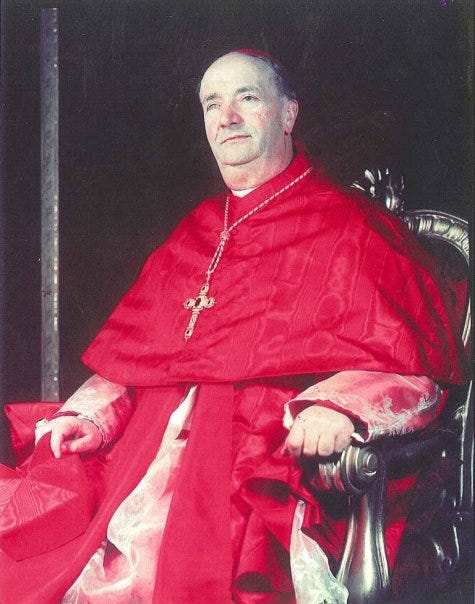
Before introducing Cardinal Ottaviani’s 1935 treatment of the union of Church and State — its full implications, and the system of Liberalism that sets itself against this divine and natural ordering of the two powers — we pause first to recount an instructive episode from American history. Do not worry, the detour is short, and we trust it will prove worthwhile.
In September of 1960, America’s first Catholic1 president, John F. Kennedy, delivered a speech to convince his countryman that he was a good American, reassuring them that he was committed to a vision “where religious liberty is so indivisible that an act against one church is treated as an act against all.”2 In the same address he proudly stated, “I believe in an America where the separation of church and state is absolute — where no Catholic prelate would tell the President (should he be Catholic) how to act,”3 after which he looked forward to “an America where religious intolerance will someday end… and where Catholics, Protestants and Jews… [will] promote instead the American ideal of brotherhood.”4
By all accounts, President Kennedy had succeeded: he proved his American bona fides. It was an impressive commitment to the American notion of religious freedom (a right to religious freedom in the external and public forum, i.e. a right to publicly profess the religion of one’s choice) coupled with the ending of religious discrimination, all in an effort to secure the “American ideal of brotherhood.”5 However, what was the cost to the superior society Kennedy ostensibly belonged to, namely the Catholic Church?
Tragically and no less shamefully, Kennedy had “conceive[d] and would have the Church in America to be different from what it is in the rest of the world,”6 the Church of which he claimed to be a member of and whose baptismal promises he was absolutely bound to follow. Instead, gripped by a poisonous political ecumenism, he left his “Catholicism outside the door so as not to alarm his comrades,”7 preferring to abhor doctrinal intolerance even though it is the immune system of the Church and the sine qua non of adhering to Catholic dogma. This speech was emblematic of his short-lived presidency. It was also the exact opposite of the admonition of Pope Leo XIII in his 1885 encyclical “On The Christian Constitution of States,” Immortale Dei:
Further, it is unlawful to follow one line of conduct in private life and another in public, respecting privately the authority of the Church, but publicly rejecting it; for this would amount to joining together good and evil, and to putting man in conflict with himself; whereas he ought always to be consistent, and never in the least point nor in any condition of life to swerve from Christian virtue (emphasis added).8
Like the famous American prelate decades before, Bishop John Ireland,9 President Kennedy had succumbed to an ever-present temptation for those of us living in the United States; that is to view the relations between our Church and government as normal, natural and the best possible arrangement for the two powers, which is to say “dissevered and divorced.”10 It is for this reason we worked so hard to compose our essay, “The Godless Constitution: America’s Original Sin”, in order to prick the conscience of otherwise good Catholics, our own being pricked some time ago.
Born in 1890, Alfredo Ottaviani was an Italian prelate, theologian and head of the Holy Office. Educated at the Pontifical Roman Athenaeum S. Apollinare, he received doctorates in philosophy, theology and canon law. In 1916, Ottaviani was ordained to the priesthood. After faithfully serving the Church for decades, he was made a Cardinal in 1953 by Pope Pius XII. Outside of his opposition (noble, albeit largely unsuccessful) to the revolutionaries at the Second Vatican Council, Cardinal Alfredo Ottaviani is best known for his delivery, along with Cardinal Antonio Bacci, of a critique of the Novus Ordo Missae (NOM) to Paul VI on September 25, 1969. Colloquially referred to as “The Ottaviani Intervention,” this theological study and critique was authored principally by the French Dominican theologian, M.L. Guérard des Lauriers. Perhaps anticipating what would later become the NOM, Cardinal Ottaviani had warned in 1962 against substantial changes to the Catholic liturgy:
Are we seeking to stir up wonder, or perhaps scandal, among the Christian people, by introducing changes in so venerable a rite [the Tridentine liturgy], that has been approved for so many centuries and is now so familiar? The rite of Holy Mass should not be treated as if it were a piece of cloth to be refashioned according to the whim of each generation (emphasis added).11
In light of the revolution which took place at the Council and in the subsequent reforms, especially with the universal imposition of the NOM and its well-documented effects, a more prescient statement could hardly have been made. In fact, in an introductory biography of the Cardinal, he wrote in his private diary “I pray God to allow me to die before the end of this Council. Thus, at least I shall die a Catholic.”
As for matters of Church-State relations, attentive readers will recall Cardinal Ottaviani being mentioned in our essay “Catholic Doctrine and “The Religion of the State” — Shea, 1950.” Along with Fathers Shea, Connell and Fenton, Cardinal Ottaviani had engaged in a tireless battle against the liberalizing theses of Fr. John Courtney Murray.12 For his part, Father Shea had drawn on the expertise of the learned Roman theologian, the foremost expert of his time on the principles of public ecclesiastical law. Eventually, after much back and forth, this counterrevolutionary campaign achieved success — however short-lived it may have been. Father Murray was censored in 1954, forced to correct his theological errors13 and the Holy Office had identified four erroneous propositions associated with his activism:
a) The Catholic confessional State, professing itself as such, is not an ideal to which organized political society is universally obliged.
b) Full religious liberty can be considered as a valid political ideal in a truly democratic State.
c) The State organized on a genuinely democratic basis must be considered to have done its duty when it has guaranteed the freedom of the Church by a general guarantee of liberty of religion.
d) It is true that Leo XIII has said: “States...are bound absolutely to worship God in that way which He has shown to be His will” (Enc. Immortale Dei). Words such as these can be understood as referring to the State considered as organized on a basis other than that of the perfectly democratic State but to this latter strictly speaking are not applicable.14
Ottaviani deserves no small credit for this success, although he was surely horrified to see the same Murray rehabilitated after the death of Pope Pius XII and, naturally, made a peritus (theological expert) by Cardinal Francis Spellman at the Council. Murray’s influence on what would become Dignitatis Humanae was decisive, as we have mentioned before.15 One year after the Council in 1966, arguably, the tragic legacy of Cardinal Ottaviani was cemented. In a private letter to fellow prelates, he attempted to stave off “abuses regarding the interpretation of the conciliar doctrine that are taking hold,” unfortunately failing to see that the “abuses” were — in fact — the official clarification proceeding from the very authority he recognized,16 the same with the exclusive right to develop the doctrines, now regularly confirmed for six decades.17
It is with great delight we share this text from Cardinal Ottaviani, translated now for the first time into English. Rich in doctrine and with typical neo-scholastic precision, it will serve as a useful companion to another treatment of Church-State relations we published last year:
Some readers, perhaps, may not have the time or interest to analyze the whole text — and that is fine. However, for those having both, we promise it will be worthwhile. With mastery of all the relevant pontifical texts, notably Libertas and Immortale Dei of Pope Leo XIII, along with a thorough knowledge of the manuals of public ecclesiastical law, there is no better guide on modern Church-State relations than Cardinal Ottaviani.
Now, without further ado, The Journal of American Reform is pleased to present this lengthy excerpt from volume two of the “Institutiones iuris publici ecclesiastici.”
Those who profess relative indifferentism and freedom of worship do not necessarily deny the juridical relations of the State with the Churches, for the state can act together with various religious societies, establish juridical relations, and deal with the religious authorities of each religion. But in truth, it is easy to pass from indifferentism to the system of separation; in which case, while civil society professes religious freedom, and in a certain way also permeates public life with religious acts, it nevertheless separates itself from churches and juridical societies, and deals with their religious authorities only in the same way as with other citizens.
This situation arises in certain countries. It is a state of affairs which, if it has its numerous and grave inconveniences, also offers some advantages, especially when the legislator, by a fortunate inconsistency, does not fail to draw inspiration from Christian principles; and these advantages, although they cannot justify the false principle of separation, nor authorize one to defend it, nevertheless render worthy of toleration a state of affairs which, practically speaking, is not the worst of all.” Leo XIII, Litt. Enc. Au milieu, 16 Feb. 1892 (Acta Leonis XIII, vol. XII, p. 39).
The fundamental error upon which the juridical edifice of the separation of Church and State rests is the perverse manner in which freedom of conscience is understood (n. 268). For when it is posited as an asserted duty of the State to legally protect any opinion of citizens, even an erroneous one, and to leave subjects the free faculty of speaking and teaching whatever they please, and of worshipping God even with false rites, it is logically posited also as a duty of the State to avoid whatever could be considered in conflict with opinions and religions, the violation of that neutrality which the State ought to preserve so as not to favor one class of citizens more than another, since it represents all.
The Separation of Church and State is altogether to be condemned. — For such a system in the theoretical order coheres so closely with erroneous principles that in its presuppositions, in its consequences, and in its entire complex it turns out to be most false; in the practical order, moreover, it cannot be reconciled with the true and genuine freedom of the Church. The Supreme Pontiffs indeed, with the most solid arguments, condemned the separation of Church and State as a doctrinal system, rejecting it as impious, irrational, and unjust; and as a practical system they tolerated it only when, in determined circumstances, greater evils would otherwise threaten the Church; and even in such a hypothesis, they taught it not to be tolerated, if the criteria of freedom are not fully and sincerely applied with respect to all affairs of the Catholic Church; for in practice the same system usually falls into foul oppression of the Church.
Finally the Church would have to accommodate herself, in order to enjoy freedom, to such a practice which is, taken in itself and generally, not without the greatest dangers: for not only do all the rights of the Church not remain intact by this path, but those which are preserved, at the price of being equated with other religions, would have to be amended: therefore the freedom of error would have to be held as necessary, in order that truth might enjoy freedom.
Liberal Catholics therefore hold separation as an ordinary and good system for our times; but Catholics who are purely and simply Catholic hold separation as a lesser evil, to be tolerated only when no other practical way remains to be tried for vindicating the rights and freedom of the Church.
274. — Negative system. — All those who consider the separation of Church and State to be promoted, rather than the juridical relations between both societies, they speak of separating the Church from the State, and therefore argue that all legal contacts between both powers must be severed. The State ignores the Church as a society existing in its own right; it protects the freedom of conscience of individual citizens, but it recognizes no rights for them in the civil order, by which they constitute a certain religious body.
1. Those who assert that the State should be entirely secular or atheistic are prone to deny, consequently, even all reason for legal contact between the states and religious societies as such. If the State is entirely secular, it should have no concern for the Churches, whatever they may be, because insofar as they are societies concerned with religious matters, they concern themselves with matters of religion, which the State has no concern for.
2. Those who profess relative indifferentism and freedom of worship do not necessarily deny the juridical relations of the State with the Churches, for the state can act together with various religious societies, establish juridical relations, and deal with the religious authorities of each religion.18 But in truth, it is easy to pass from indifferentism to the system of separation; in which case, while civil society professes religious freedom, and in a certain way also permeates public life with religious acts, it nevertheless separates itself from churches and juridical societies, and deals with their religious authorities only in the same way as with other citizens.19
3. Furthermore, there can be a negative system of separation even when the State fosters religiosity in such a way that it accepts one cult for the time being and uses it in public acts; it is, however, separated from the Church or from a religious organization as such, completely cutting itself off from its social rights and from its social authority; the State neither claims rights nor undertakes any duties before this society, which is a religious society.
275. The principal forms of liberalism. — If one were to enumerate the individual opinions of liberals concerning the juridical condition of the Church, one would have to adduce almost innumerable opinions; indeed, it is rare to find a consistent or well-defined doctrine in one and the same writer. Hence it is clear that it is difficult to assign each of them to a specific class of liberals. However, three principal systems of liberals can be defined with respect to religious matters: rigorous or pure liberalism, moderate liberalism, and liberal Catholicism.
1° Rigorous liberals only consider the State to be a juridical society by its nature, from which all rights emanate; hence “they act toward the Church in such a way as to strip it of the character and rights of a perfect society, they have it fully similar to the other communities which the republic contains: and for this reason, if it possesses any right, if it possesses any faculty to act lawfully, it is said to possess it by the consent and benefaction of the princes of the city.”20
2° Moderate liberals do not deny the juridical nature of the Church; they certainly grant it its right to exist and act independently of the State, but in turn the State is bound by no duty towards it and is completely ignorant of it, so that in establishing all civil law “in institutions, morals, laws, the duties of the republic, the education of youth, they do not consider it necessary to have more regard for the Church than if it were completely non-existent.”21
3° Liberal Catholics admit in the abstract the superiority of the Church and the subordination of civil society, since they understand that this is required per se by the supreme reason of the ultimate end; but in practice they insist on the separation of both.
276. — But the errors of the liberals have a twofold explanation or reason for themselves, first of all: for they proceed either from the fact that they do not admit revelation, or from the fact that they do not adequately accept the dogmas of revelation.22 Hence, in general, a theological debate with liberals should be preceded, when it is appropriate and possible. Otherwise, it must be argued from the very principles of freedom of which they themselves wish to be seen as the champions.
Cavagnis23 notes that absolute liberalism denies the fact of divine revelation, the existence of a supernatural order, and the divine origin of the Church; for it does not admit other rights than those which emanate from civil society and therefore from a natural source.24
Indeed, he must also deny the possibility of revelation; for if he were to admit it, he would not be claiming all rights from civil society absolutely, but only on the hypothesis of the non-existence of revelation; and then he would at least arrive at a probable knowledge of it, or at least he should admit that it could seem probable to his subjects, and therefore that account of it ought to be taken in public legislation, lest force be brought to bear upon the legitimate freedom of conscience.
But if the possibility of revelation is denied, it automatically follows that the existence of a personal God must also be denied; and then the very foundations of morality and social order are shaken (n. 264 ff.).
Moderate liberalism, however, proceeds both from an exaggerated consideration of the rights of the State, and from an inadequate concept of its end; and also from an incorrect and incomplete acceptance of revelation: hence, in the face of such liberals, the genuine nature of the Church and its social power must be vindicated (vol. I), and the rights and end of the State must be correctly delimited (n. 260 ff.).
Liberalism is also directly attacked by arguing against the opinion, which is common to all liberals of every kind, of the separation of Church and State.
277. — Separation of Church and State: A) how it is conceived. — The most widely disseminated system of separation is that expressed by the well-known formula: A Free Church in a Free State.25
Asserting the full autonomy of the State even from any religious law, the separatists assert that each society, namely the ecclesiastical and the civil, must proceed separately on its own path. The State proposes to itself law in its social activity, the Church religion; therefore, since the activity of one is concerned with a certain circumscribed sphere in which the activity of the other should not be concerned,26 there is no reason why the two societies should be bound together with the restriction of the freedom of each: they are distinct and insociable.
Therefore, the State will legislate about its own affairs, without being concerned about the social demands of the Church; it will not claim rights regarding sacred things for itself, of course,27 but at the same time it will not allow anyone, due to religious requirements, their free right to act in all matters that in any way affect the civil and political order. For the State will legislate with equal right, e.g. on Christian marriage and on other juridical matters which, like marriage, are connected with the civil order. Conversely, if there is anything having a purely religious character, the State will declare itself incompetent in that regard and will leave it entirely to the Church, reserving to itself the social function of protecting the freedom and right of every citizen to profess and exercise his religion.
278. — But in the practical application of these principles the separatists disagree most. For the greatest difficulty and question lies precisely in this: namely, in the determination of the rights which should come under the name of freedom of religion and of the Church. Many suppose that common law should be applied: in which there will be a guarantee of individual rights concerning religion for each person, and they will themselves be guaranteed social rights or freedom of religious association, insofar as they will be able to enjoy, in religious communities, the same rights which are granted by the State to other societies of any kind.28
However, some think that this does not sufficiently provide for the security and safety of civil society; hence, under the pretext of “precaution,” they consider that a special law should be established, added to common law, by which, while the profession of religion and the exercise of worship are left free, preventive norms are nevertheless established and special sanctions are determined to prevent any attempts or damages that can be inflicted on the social order under the pretext of religion, and also to check any abuses in the exercise of sacred ministry.29
Nor are there lacking those who intend to restore the separation of Church and State in such a way that they consider civil sovereignty, indeed even exclusive supremacy, to be so maintained that they wish to positively introduce the political influence of the State into religious matters themselves, for the benefit of the nation, and therefore endeavor to marry certain principles of jurisdictionalism with the separation itself.30
279. — Separation of Church and State: B) by what arguments is it defended — The fundamental error upon which the juridical edifice of the separation of Church and State rests is the perverse manner in which freedom of conscience is understood (n. 268). For when it is posited as an asserted duty of the State to legally protect any opinion of citizens, even an erroneous one, and to leave subjects the free faculty of speaking and teaching whatever they please, and of worshipping God even with false rites, it is logically posited also as a duty of the State to avoid whatever could be considered in conflict with opinions and religions, the violation of that neutrality which the State ought to preserve so as not to favor one class of citizens more than another, since it represents all.31
Now indeed, through the public or official adoption of one or several religions, and through the recognition of special rights and prerogatives which any Church claims for itself, which would constitute privileges of one class of citizens, the State would offend the conscience of others who think differently, and would not maintain equality among all citizens.
With these principles are connected all the particular arguments adduced to corroborate the system of separation. Of these we enumerate the chief ones:32
280. — 1. First, they say there is no reason for entering into juridical relations between Church and State, since the purpose of each society is different, and an entirely distinct and circumscribed sphere of activity exists for each: the State acts in the external, juridical, temporal order; the Church, however, in the order of conscience, religion, and spirit; and indeed religion is private matter, concerning individuals, not the civil community.
2. But if the State, they argue, wished to establish juridical relations with any Church, that Church would obviously have to be selected by it as the one that promotes true religion; yet all churches claim for themselves the monopoly of religious truth: therefore the State would have to set itself up as judge in religious matters. But in religious matters the State is itself incompetent, and it would be ridiculous for it to act as arbiter among conflicting rites and diverse theological dogmas.
3. Furthermore, they press, it is not equitable to require that the State publicly adopt the religion of the greater part of its citizens: for this would be offensive to the remaining citizens. Moreover, with such a principle the door could be closed to true religion. But the simultaneous adoption of all religions at least offends those citizens who want a secular State.
4. The contrary argument, brought forward by Catholics in favor of the union and harmony of Church and State, deduced from the most efficacious influence of religion and the Church in promoting public morality, peace, and prosperity — the liberals endeavor to diminish by denying altogether any necessary connection between religion and public morality, or by asserting the sufficiency of a moral bond between the State and religion, with the exclusion of every juridical bond between the Church and the State itself.33
5. Finally they add that separation is required for the practical good and benefit of both societies: their rights being intermingled, they argue, become lesser and more uncertain; separated, however, they will become freer and stronger. And they adduce the example of conflicts between the priesthood and the imperial power, in the middle ages and in the very regime of the concordats. They portray the Church moreover as if thirsting after the rights of civil power and anxiously seeking to bring the State under its control so as to make it an instrument of a most wicked Inquisition.34
281. — Liberal Catholics certainly do not make use of these arguments; they indeed do not approve of the separation of sacred matters from civil ones, but nevertheless judge it must be done, so that the Church may comply with the times, and bend and accommodate itself to those things which modern prudence requires in the administration of states.
Their doctrine cuts itself off, as they say, from abstract principles; in concrete terms, having regard for the recent progress or at least the actual condition of most states at present, they consider the prudence of our times, as well as the greater utility of the Church, to demand that she be separated from the State entirely afresh. To confirm this they greatly exaggerate the harms which certain Christian princes have inflicted upon the Church under the pretext of protecting her. They extol finally the fruitful activity of the Church and her own innate virtue of propagating and prospering without the aids of human society, so as to demonstrate that it is best for her to enjoy that freedom by which, liberalism by force of principle, will come to her even from the common law of the Church; and they adduce the example of the prosperity of the Church in the United States of North America, where full separation prevails.35
282. — The Separation of Church and State is altogether to be condemned. — For such a system in the theoretical order coheres so closely with erroneous principles that in its presuppositions, in its consequences, and in its entire complex it turns out to be most false; in the practical order, moreover, it cannot be reconciled with the true and genuine freedom of the Church. The Supreme Pontiffs indeed, with the most solid arguments, condemned the separation of Church and State as a doctrinal system, rejecting it as impious, irrational, and unjust; and as a practical system they tolerated it only when, in determined circumstances, greater evils would otherwise threaten the Church; and even in such a hypothesis, they taught it not to be tolerated, if the criteria of freedom are not fully and sincerely applied with respect to all affairs of the Catholic Church; for in practice the same system usually falls into foul oppression of the Church.
Moreover, even when the criteria of freedom are fully applied, nevertheless the minimum problem that follows is this: that the State ceases from its many duties toward religion, nor are those rights of the Church recognized which she ought to enjoy before the faithful even as gathered in civil society: for she cannot rightly be said to enjoy true and full freedom whose every right is not recognized.36
283. — 1. This system is called impious: a) for its foundation is found in those very principles which are as it were the hinges of state indifferentism and atheism (n. 266 ff.); and it entirely alienates civil society from that piety by which, and by itself, it ought publicly to worship God, with true worship and with the sacred ministry of the true Church (nn. 266-267).
“In truth, human society, to which by nature we belong, was established by God as the author of nature; from Him, as from its principle and source, flows the entire force and permanence of the innumerable goods with which it abounds. Therefore, just as individuals are admonished by the very voice of nature to worship God piously and holily, because we receive from God life and the goods that accompany life, so for the same reason peoples and civil communities ought to do the same. Therefore it is evident that those who wish to free civil community from every duty of religion act not only unjustly but also ignorantly and absurdly.”37
Hence also Pius X offers this as the primary reason for condemning and rejecting the French law of separation: “because it does the greatest injury to God, solemnly declaring by its very principle that the republic is without regard for any religious worship.”38
b) It is moreover impious because it contradicts God’s most wise disposition; for if both societies are from God, they are certainly ordained by Him and associated together by the most wise law of harmonious union, in the same manner as all things which are ordained by God;39 hence it will be no more within the power of rulers to tear the Church from the State, than to transgress the other laws of the natural or supernatural order, and to pervert the order established by God. Wherefore, rightly must that also be repeated here on this matter which was said by Jesus on another subject: “What God has joined together, let no man put asunder.”
Indeed the system of separation “perverts the description of human affairs most wisely established by God, which assuredly requires the harmony of both societies, religious and civil. For since both, though each in its own kind, exercise authority over the same persons, it necessarily comes about that there frequently exist between them causes of such a nature that the knowledge and judgment of both is involved. But unless the civil community coheres with the Church, from those very causes of conflict seeds of the most bitter strife on both sides will easily arise; which, disturbing true judgment, will trouble minds with great anxiety.”40
2. The system of separation of Church and State is moreover called irrational and absurd: a) first indeed because it has an inadequate account of the nature and destination of men, separating the good of each citizen from the good of the same person as a believer. Indeed, the true good of citizens is not understood except as that which accords with their supreme destination; and therefore the State, in pursuing the good of citizens, cannot cut itself off from their good as believers; whence it follows that it cannot likewise cut itself off from that society to which the spiritual good of citizens has been directly entrusted.
“Those who preside over the people — says Leo XIII — owe this entirely to the commonwealth, that they take counsel not only for external advantages and material things, but above all for the goods of the soul, through the wisdom of laws. Yet toward the increase of these goods it cannot even be conceived that any laws more fitting than those which have God as their author are available to them; and for this reason, those who in governing states are unwilling to take divine matters into account cause political power to deviate from its own purpose and from the prescription of nature.”41
b) Furthermore it is irrational because it prevents the temporal good of citizens itself from being obtained in its fullness, and indeed brings the greatest harm to civil society. For this cannot flourish or long endure, with religion set aside, which stands as the supreme guide and teacher for man in holily keeping his rights and duties. “For indeed, once the bonds of duty are broken which join man to God, the supreme lawgiver of all, nothing remains to judge and legislator, except the mere semblance of that honesty of a purely civil kind, or, as they say, dependent on nothing; which, having no regard whatsoever for the eternal law and divine precepts, proceeds by a downward path to the extreme, committing man to the arbitration of his own desires. Who indeed, with the hope of supernatural goods set aside, what else would he wish than to gorge himself on the comforts and pleasures of this life; to satisfy a growing thirst for pleasures; to acquire wealth and excessive gains more eagerly, even against justice; and, driven by an increasing lust for domination, to strive by any means whatever for positions of power and honor?”42
c) It is finally irrational because, while asserting the mutual independence and freedom of both societies from one another, it nevertheless at the same time presupposes the dependence of the Church upon the State. The formula “a free Church in a free State” indeed asserts the right of freedom of the Church before the State, but reserves to the State the determination of the sphere of activity of the Church, within which she may freely act; yet truly, the competent right of the Church to act freely must be measured by us from her own purpose, regarding which the State declares itself incompetent; therefore by civil laws it cannot be determined within what limits the Church must act for her own purpose lest she exceed her own authority. But if the State, scorning the infallible magisterium of the Church, is unwilling to admit her exclusive judgment on this matter, it cannot on the other hand at least add to itself the faculty of imposing its own judgment unilaterally.43
The logical and rational consequence of the formula “A free Church in a free State” would therefore be only this: that where the State is unwilling to acquiesce in the infallible magisterium of the Church regarding her own rights, by common and harmonious counsel of both societies, their simultaneous and free coexistence and activity should be coordinated.44
Nor does the common right established for all associations, if applied also to the Church, protect her true freedom: for the religious purpose cannot be equated with the purposes of profane associations; nor is that juridical norm rightly to be held by which the entirely diverse human needs are treated in the same way, of which the one surpasses all others most excellently, both by reason of necessity, and by reason of its influence upon public order, as well as upon the very good of civil society.45
3. We have finally called the system of separation of Church and State unjust because, in consulting the freedom of conscience of others, it offends the conscience of believers.
This injustice is more evident in a Catholic State where, in deference to the asserted rights of secularists, the rights of the greater part of citizens are injured.
Indeed the practice is carried on according to the dictates of the impious, who contend that no public worship is to be rendered to God and no Church is to be adopted by the State, yet at the same time by this very course they injure the conscience of those faithful who, following the dictate of their own religion and their own conviction, would wish to fulfill the most sacred duty by which they are bound, of worshipping God publicly and socially as the author and supreme ruler of all public affairs, and of receiving those aids from the Church which she is able to impart only socially, insofar as they are gathered together in the State, e.g. the aid of coercive force for the execution of ecclesiastical sentences.46
4. In practice moreover the system of separation redounds to the harm of souls and to the limitation of the rights of the Church.
And here indeed we abstract from those systems of separation which are for the most part the desires of European secularists, and which are nothing other than forms of oppression of the Church. Examples are found in the laws by which the affairs of the Church have been dissociated from the affairs of the State in France, in Portugal, and most recently in Mexico and in Spain:47 the Church as such, and its corporations even erected according to the norm of common law, are denied the right of teaching, of possessing temporal goods, of publicly performing many acts of worship, etc. This manner of separating the Church from the State as it began in Italy was described by Pius IX in these words: “We say nothing of the iniquitous hypocrisy by which the most destructive leaders and agents of disturbance and rebellion, especially in Italy, declare that they wish the Church to enjoy her freedom: while with entirely sacrilegious audacity they daily trample more and more upon all the rights and laws of the Church herself, plunder her goods, and vex in every way the holy leaders of ecclesiastical affairs and men performing their office with distinction… and violently expel the members of religious orders and virgins consecrated to God from their own monasteries.”48 How greatly indeed does the condition of the Church differ from the liberalism then prevailing at the beginning of separation, from the condition which the present Italian government has peacefully restored in its affairs with the Church through the concordat!
But even where common law, without special restrictions, is applied to the Church, she cannot rightly be said to be fully free.
For in such a State the Church is not permitted to oversee public education, as is her right by virtue of her spiritual mission for the protection of faith and morals; she cannot exact the necessary precautions regarding the selection of teachers or regarding the protection of the indissolubility of Christian matrimony; she is not permitted to give coercive execution to all her sentences, at least insofar as the State does not provide the necessary assistance of armed force; likewise the Church is not protected by the State as is the most sacred duty of the latter.49
But finally the greatest inconvenience, which redounds also to the harm of souls, proceeds from the frequent possibility of conflict between the legislation of one and the other society, if each were to legislate separately, without any friendly accord. For it must always be kept in mind by both societies that the same subjects are subject to both, and that there are very many matters in which both societies are competent, wherefore it can come about that diverse and opposing obligations are imposed upon the same subjects regarding the same matter.50 But since in a conflict of laws liberals contend that the law of the State must altogether prevail, and since moreover the physical force by which the faithful can be penalized if they transgress civil law is in the hands of the State, it follows that either the harm of such a penalty must be unjustly undergone, or the law of the Church must be transgressed at the risk of one’s own spiritual salvation.51
284. — It is no wonder therefore if the system of separation has been condemned and rejected by all the Roman Pontiffs who have taken up the governance of the Church since Gregory XVI, as the most shameless incitement to license and as a principle of discord, likewise as a system thoroughly erroneous, absurd, and pernicious.
On the matter of separating sacred affairs from civil affairs, Gregory XVI had already written: “Nor could we predict anything more unfortunate for religion and for civil rule from the desires of those who wish the Church to be separated from the kingdom, and the mutual harmony of authority with the priesthood to be broken apart. It is well established indeed that that harmony, which has always been favorable and salutary for both sacred and civil affairs, is to be dreaded as lost by the lovers of most shameless liberty.”52
Pius IX condemned the following proposition: “The Church is to be separated from the State, and the State from the Church.”53
And Leo XIII, describing the system of separation which is deduced from the principle of freedom of conscience: “From which that pernicious consequence is produced of the separation of the Church and that the affairs of the Church ought to be dissociated from civil affairs. But how absurdly these things are said is not difficult to understand.”54
Pius X moreover: “That the affairs of the State ought to be segregated from the affairs of the Church is indeed a most false and supremely pernicious opinion.”55
285. — From what has been said it is clear what response is to be made to the liberal arguments adduced above (n. 280).
1. To the first it is answered that the distinction of purposes and societies is one thing, separation quite another; for even from religion and the authority of the Church there arise truly juridical duties for men: from the very fact that the authority of both societies extends over the same persons, it follows that the agreement and union of both powers is required, not separation (n. 283, 1° b; et 3°).
Moreover it is false that religion is a merely private matter: for just as God is the founder and preserver of human society no less than of individual men, so He must be worshipped not only privately but also publicly (n. 283, 1° a; cfr. also n. 266 ff.).
2. But what they say (arg. 2° and 3°) that the State is incompetent in religious matters and cannot prefer one religion and one Church above others, is a claim full of equivocations: the State indeed ought not to dogmatize, yet there are natural criteria by which it can easily be discerned what the true religion is, especially when the question concerns a Catholic State (n. 267).
Moreover, when citizens are persuaded that the Catholic religion is the true one, it is wrongly asserted by secularists or by those of heterodox faith it is required that, in accordance with their own opinion, the conscience of Catholics be injured, and moreover that the rights of truth be injured (n. 283, 3°; item, n. 268).
3. Nor is that true which is asserted in the fourth place: namely that the State can foster the goods flowing from the morality and piety of peoples, by promoting the religiosity of subjects and the free exercise of worship, without juridical relations with the Church or with churches. Indeed in a separated State religious rights are very easily violated (n. 283, 4°); moreover indifferentism is propagated (n. 266) and by the very freedom of worship religious dissensions and the progress of error are promoted. These things certainly do not advance the morality, tranquility, and good of the people.
4. Moreover it is an egregious hypocrisy on the part of those who assert that the good of the Church herself will follow from separation, on the grounds that the rights of the Church will thus not be intermixed nor usurped by the State.
We say that the rights of the Church are neither mixed nor to be mixed: they are distinct, like the duties of soul and body, yet not to be separated or torn apart, lest the life of society perish.56
But that the Church thirsts after the rights of the State is altogether false; indeed the contrary obtains, as is easily shown from the teaching not only of one or another civil legislator, nor from the acts of most emperors, but even from the manner in which most separatists in this very age of ours treat the Church.57
286. — As regards the arguments of liberal Catholics, we note first of all that their assertion is ambiguous, namely that the Church ought to accommodate herself to the demands of the times, or bend herself to those things which modern prudence requires in the administration of states.
Such an opinion is indeed honest “if it is understood in the sense of some equitable principle which can consist with truth and justice: namely that, with the hope of some great good being procured, the Church should show herself indulgent and grant to the times what can be granted with the sanctity of her office intact. But the case is otherwise with regard to matters and doctrines which a change of morals and a deceitful judgment have introduced against what is right. No time can be without religion, truth, and justice: which things, since God has commanded them to be in the greatest and most holy keeping of the Church, nothing is so alien to her as to wish that she herself should dissimulate what is false or unjust, or connive at what is harmful to religion.”58
But now the accommodation which liberal Catholicism would demand seems rather to be of this second kind, reprobated by Leo XIII: indeed the Church would have to accommodate herself to that distinction so loudly proclaimed by liberals, by force of which Catholics would have to play a dual role, one indeed private, subject in every way to religious obligations, the other however public or social, entirely exempt from religious duty or from any bond toward the Church.
Likewise the Church would have to acquiesce in the persuasion upon which separatism rests, namely that the principles of public ecclesiastical law cannot be reconciled with progress and with the true notion of the juridical condition of the State; in other words, it would have to be admitted that the practical progress of legal science conflicts with the divine principles concerning the constitution of the Church and power, which could only have been compatible with the defects of ancient times.59
Finally the Church would have to accommodate herself, in order to enjoy freedom, to such a practice which is, taken in itself and generally, not without the greatest dangers: for not only do all the rights of the Church not remain intact by this path, but those which are preserved, at the price of being equated with other religions, would have to be amended: therefore the freedom of error would have to be held as necessary, in order that truth might enjoy freedom.
287. — But liberal Catholics press on: if not absolutely, at least comparatively the system of separation is both good in itself and perhaps better than the other systems which can be had in modern society. For today States are either given over to supranationalism, and therefore infected with the principles of jurisdictionalism, by which the Church is reduced to servitude and considered an instrument of government; or they are overcome by ultra-democratic principles, and therefore the Church would be attacked in them if, not content with common law, she wished to be protected and held superior: for she would be calumniated as one seeking to dominate in the State and to capture privileges for herself, and she would be exposed to the hatred of the masses and to persecutions, with great peril to souls.
But the hypothesis of the greater evil, which by tolerating separation could be avoided, is also calmly considered by the Church. Yet this hypothesis differs entirely from the thesis of liberal Catholics which constitutes a general system.
The liberals say: “today, given the circumstances of the times, it is good if the Church is separated from the State everywhere, and is content with that freedom which common law grants to all associations and religions.” The Catholic hypothesis on the contrary is this: “if in some State the circumstances are such that the toleration of separation would be the lesser evil that can befall the Church, considered perhaps as the only practical way of avoiding an existing or imminent persecution, Catholics can then acquiesce in separation.”60
Liberal Catholics therefore hold separation as an ordinary and good system for our times; but Catholics who are purely and simply Catholic hold separation as a lesser evil, to be tolerated only when no other practical way remains to be tried for vindicating the rights and freedom of the Church.
From all that has been said thus far it is sufficiently established why also the system of liberal Catholics has been condemned by the Church.61 Which system has indeed been refuted both theoretically and practically in our own age, when, through the diligent and prudent defense of the rights of the Church against the tenets of liberalism, supranationalism, and democratism, several possible agreements were reached after the terrible war,62 for the friendly reconciliation of the affairs of the Church with the affairs of the state, from which agreements the fruits of social pacification and moral restoration have advanced, and are auspiciously to continue more abundantly in the future.
288. — Conditions under which separation can be tolerated. — In order that Catholics may acquiesce in separation, it is required not only that this be in reality a remedy against the oppression of the Church, but also that separation be established by the rulers of states with a sincere intention of granting freedom to the Church no less than to other lawful associations.
The rights of truth and justice must clearly be kept intact: for if separation is so established that neither natural justice is preserved nor are the rights of the Church to exist and to act according to the demands of her own purpose and her own constitution kept immune, at least within the equitable limits of common civil law, then such a separation is not even to be tolerated.
Wherefore when the question is raised of dissociating the affairs of the Church from the affairs of the State, Catholics, if no other way remains for fully vindicating the rights of the Church, ought with every effort to strive that it be provided by law in advance that the state of separation not be equivalent to a state of opposition, that is, they must take every care that they vindicate for the Church that freedom which is consonant at least with the very principles of an indifferent and separated State.63
The precautions moreover are these:
1° that the Church be held as a lawful association, and that the rights of other corporations obtaining juridical personality be competent to her;
2° that the free faculty of exercising her own power for the direction of souls be granted to her, without her acts being subjected to special bonds (e.g. the royal approval or other “lawful safeguard” formulas);
3° likewise that the faculty of exercising Catholic worship privately and publicly be free;
4° that Catholics have the right of maintaining confessional schools, with recognition of the public instruction imparted in them, lest the same be compelled to support and even attend godless schools;
5° that the Church have the free right of acquiring, possessing, and administering temporal goods, both on her own behalf and through moral persons subject to her, including religious ones, at least as with other honest civil associations;
6° that the profession of religion in its more perfect form, namely through the taking of vows, may be freely made without members of religious orders, as such, being subjected to civil death.64
289. — The duties of Catholics. — It is to be noted moreover that such a condition of the Church is to be tolerated by Catholics only for a time, namely until matters can be brought to the point where the legitimate order of relations between both societies can be vindicated and profitably restored to practice; hence it is clear that the duties of Catholics are greater for the protection of the rights of the Church, and that they ought to contend more vigorously for them in a separated State, than where the normal relation of harmony between both powers prevails. But what the duties of Catholics are, both in opinions and in deeds, both in private life and in public life, whether in contributing to the administration of civil affairs or even in the exercise of political offices, has been accurately described and defined by Leo XIII in the Encyclical Letter Immortale Dei.65
END.
Thanks for reading The Journal of American Reform! This post is public so feel free to share it.
CONSIDER SUPPORTING THE JOURNAL OF AMERICAN REFORM!
As I intend to devote more and more time to this political project, I want to continue to provide free, educational material, whether visual (graphics) or written (essays, translations and a forthcoming book) content. If you have benefited from my work in any way, kindly consider supporting The Journal financially. On a personal note, I am married and duty-bound to provide for my family, so any help, big or small, is appreciated. Subscribe or make a one-time donation.
Regardless, the production of free material will continue, hopefully with ever-increasing quality, and I will keep all my subscribers notified of my plans.
In addition to Substack, the home of The Journal, my work, graphics and commentary can be found on the following platforms:
X: @AmericanReform_
Telegram: @American_Reform
Though retaining the Catholic name and never formally joining a non-Catholic sect, nor being excommunicated by the Authority of the Church, the orthodoxy of John F. Kennedy is certainly not beyond reproach. In fact, he was publicly committed to objective errors which are too numerous to catalog here. Hence why his being Catholic should not be presented without serious qualification.
Cf. Pope Leo XIII, Immortale Dei, (1885), no. 47.
Further, it is unlawful to follow one line of conduct in private life and another in public, respecting privately the authority of the Church, but publicly rejecting it; for this would amount to joining together good and evil, and to putting man in conflict with himself; whereas he ought always to be consistent, and never in the least point nor in any condition of life to swerve from Christian virtue (emphasis added).
Cf. Pope St. Pius X, Notre Charge Apostolique, (1910). —
For the construction of the Future City they appealed to the workers of all religions and all sects. These were asked but one thing: to share the same social ideal, to respect all creeds, and to bring with them a certain supply of moral force. Admittedly: they declared that “The leaders of the Sillon place their religious faith above everything. But can they deny others the right to draw their moral energy from whence they can? In return, they expect others to respect their right to draw their own moral energy from the Catholic Faith. Accordingly they ask all those who want to change today’s society in the direction of Democracy, not to oppose each other on account of the philosophical or religious convictions which may separate them, but to march hand in hand, not renouncing their convictions, but trying to provide on the ground of practical realities, the proof of the excellence of their personal convictions. Perhaps a union will be effected on this ground of emulation between souls holding different religious or philosophical convictions.”
In the manual of Jesuit Fathers Ryan and Millar, Bishop Ireland similarly made explicit his heterodoxy, and delivered a no less astonishing statement over and against the Catholic faith:
Necessarily religious freedom is the basic life of America, the cement running through all its walls and battlements, the safeguard of its peace and prosperity. Violate religious freedom against Catholics: Our swords are at once unsheathed. Violate it in favor of Catholics, against non-Catholics: No less readily do they leap from the scabbard. — The State and the Church, (1922), p. 288)
What is, perhaps, even more troubling than the grievous error of Bishop Ireland is that the Jesuit theologians responsible for this manual quoted it by all evidence, approvingly. How does a work of Church-State relations cite the champion of orthodoxy and anti-liberalism, Cardinal Billot, in one section (pp. 62-7), yet its antithesis in another?
Cardinal Ottaviani, Public speech in 1962 given to the Council Fathers of Vatican II, The Rhine Flows Into The Tiber, (1985), p. 28.
Cf. Duties of the Catholic State In Regard to Religion, (1953), pt. IV; Ottaviani summarized the arguments of the proponent, however choosing not to name Fr. Murray, of what he called “the liberalizing thesis”:
(1) That the state properly speaking cannot perform an act of religion. (For him the state is a simple symbol or an ensemble of institutions).
(2) That “an immediate illation from the order of ethical and theological truth to the order of constitutional law, is, in principle, inadmissible.” With this axiomatic language he wants to maintain that the State’s obligation to worship God could never enter the constitutional sphere.
(3) Finally, that even for a state composed of Catholics there is no obligation to profess the Catholic religion: as far as the obligation to protect it is concerned, this does not become operative except in determined circumstances, and precisely when the liberty of the Church cannot be otherwise guaranteed.
The learned Cardinal concluded by noting that these principles produce “attacks directed against the teaching set forth in manuals of Public Ecclesiastical Law,” which, he said, “is for the most part based on the doctrine set forth in pontifical documents.”
Roberto Di Mattei, The Second Vatican Council: An Unwritten Story, (2012), pg. 365; The Oxford Handbook of Vatican II, “Religious Liberty at Vatican II”, pgs. 267-281.
1964 message of Paul VI to Spanish Cardinal (NYT - below); 1965 address of Paul VI to Rulers (Vatican - below):
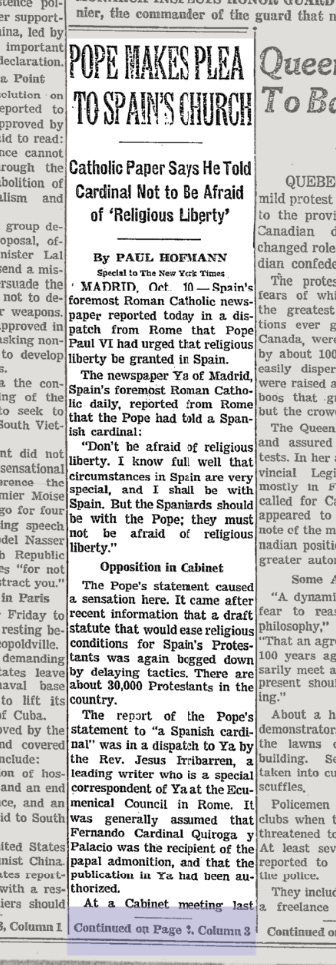
And what does this Church ask of you after close to 2,000 years of experiences of all kinds in her relations with you, the powers of the earth? What does the Church ask of you today? She tells you in one of the major documents of this council. She asks of you only liberty, the liberty to believe and to preach her faith, the freedom to love her God and serve Him, the freedom to live and to bring to men her message of life. Do not fear her. She is made after the image of her Master, whose mysterious action does not interfere with your prerogatives but heals everything human of its fatal weakness, transfigures it and fills it with hope, truth and beauty (emphasis added).
Compare the exhortation of Pope Leo XIII in his 1895 encyclical on America, Longinqua, where he is not content with a mere, superficial liberty of the Church:
The fact that Catholicity with you is in good condition, nay, is even enjoying a prosperous growth, is by all means to be attributed to the fecundity with which God has endowed His Church, in virtue of which unless men or circumstances interfere, she spontaneously expands and propagates herself; but she would bring forth more abundant fruits if, in addition to liberty, she enjoyed the favor of the laws and the patronage of the public authority (emphasis added).
Cf. John Paul II, Redemptor Hominis, (1979), no. 17; John Paul II, Message on the Value and Content of Freedom of Conscience and of Religion, (1980), no. 4; Benedict XVI, Ecclesia in Medio Oriente, (2012), nos. 26-7; Francis I, Evangelii Gaudium, (2013), nos. 255-6; Leo XIV, Audience to Members of the Diplomatic Corps, (2026), paras. 8-9.
See e.g. how T. Mariani, Teorica della relazione e dello Stato, Florence 1868, p. 445: “But just as families are everywhere and the entire citizenship results from them, and yet remain in their private being, so worship and faith, although they express a great social function, nevertheless retain before the law and the State the essential character of their origin: voluntary, private, and individual. Therefore, no formal and intrinsic act of public jurisprudence or international jurisprudence can originate from them, which forever separates every body of codes from the decree of Gratian, cancels the title of Catholic legally assumed by several nations, and puts an end to the compilations and the dominion of concordats.”
A tolerant state accepts only one religion, but tolerates others due to political needs; an indifferent state treats all religions equally. An example of a tolerant state is Italy; an indifferent state is Germany. In this Republic, by virtue of the constitution of 11 Aug. 1919, no “Church of State” is determined, but various religions are recognized as having the right to associate, to possess, and to acquire the character of a corporation under public law, albeit under certain conditions.
Such is the case, for example, in North America. The State is not atheistic, but rather in some way publicly devoted to Christianity, for it benefits from Christian rites every year. The State takes care to celebrate the day on which it thanks God: prayers are offered in the legislative assemblies, Protestant and Catholic chaplains are recruited, Sunday is publicly sanctified, the gospel is read in schools, etc. Cf. BADII, Ius canonicum comparatum, Rome, 1925, p. 577, where he quotes from BRYCE, République américaine: “Christianity is, in fact, considered to be, if not the legally established religion, at least the national religion. Far from regarding their Republic as impious, Americans think that the general acceptance of Christianity is one of the principal sources of their national prosperity, and that their nation is the very special object of divine favor.” The State is therefore not atheist, as AICHNER undeservedly asserts, Compendium iuris ecclesiasticalis, Brixinae, 1915, § 40, p. 120, but is indifferent as to the various Christian cults, and separate from the churches: hence by virtue of Constitut. art. VI, § 3, no one is bound in public office to profess a special religion, nor is any official church elected (Amendment I of the Constitution), nor can Congress pass a law in favor or to the detriment of any cult; but full freedom is left in the exercise of religion; BADII, 1. C.; FRIEDBERG-RUFFINI, Diritto ecclesiasticalo, Torino, 1893, § 29, p. 153 ff., with notes 26 and 27. Nor is the assumption of a single religion prohibited to individual Confederate States, as was the case in Utah. Cf. also GALANTE, Manuale di diritto ecclesiastico, Milan, 1914, p. 666 ff.
Encyclical Letter Libertas (see below p. 459); cf. above, n. 260 ff. — Pure liberalism has its fundamental principles in naturalism, from which the false dogmas of statolatry necessarily follow (the State is the source and origin of all rights, every other society is from the State, in the State and under the State). LIBERATORE, Chiesa e Stato, Naples, 1872, p. 7 sqq. Hence, as if one were some voluntary association of citizens, they place the Church of God under the empire and control of the republic: for it is not its aim to make laws, to judge, to take revenge, but only to encourage and advise; cf. v. g. C. CADORNA, Del primo ed unico principio del diritto pubblico clericale, Roma, 1888, p. 28 sqq. where he dares to argue from the Holy Scriptures and from the genuine Catholic doctrine: “It is not true that the Catholic religion establishes that the men and the religious authority who profess the same religion in common are anything other than a perfect Association in its kind... it is not true that according to the revealed Catholic institutions or dogmatically defined religious association and its internal authority have been placed in civil society not only with the natural right to freedom of conscience, and all its consequences; but also with the right to gradually withdraw from the natural, legal and sovereign power of the State.” Therefore, if the followers of any religion gather in a moral body, their society is considered to be like other colleges, to which those public rights are subject which are established according to the norms of civil law: the Church therefore applies the common law as to any moral body within the scope of the State. MAMIANI, Teorica della religione e dello Stato, Florence, 1868, c. XI, p. 209 ff.; BONGHI, Le associazioni religiose e lo Stato in Nuova Antologia, 1872, p. 48 ff.; MINGHETTI, Chiesa e Stato. Milan, 1878.
Encyclical Libertas (see infra p. 492). Cf. quoad ideas Cavour, ARTOM, Œuvres parlementaires du comte de Cavour, Paris, 1862; eiusdem comitis Lettere, ed. Chiaia, Turin, 1883, p. 121 ff. Of the formula “Free Church in free State”, cf. PADELLETTI, Libera Chiesa in libero Stato, Genesis of the Cavourian Formula, Nuova Antologia, June 1875.
LIBERATORE, 1. c.; DE LUCA, Institutiones iuris ecclesiasticali pubblici, Rome, 1901, vol. I, p. 236 ff.
Here these liberals are more properly called naturalists or rationalists (Enc. Libertas, see below p. 479). Their system is not far from the absurd principles of state atheism described above (cfr. above, n. 266). See, for example, SALVIATI, Chiesa e Stato (see above, n. 266, note 17); BAKOUNINE, Dio e lo Stato, Florence, 1908.
In Italy it was solemnly proclaimed by Count Cavour, in the subalpine assembly on March 27, 1861; but in the United States of America it has been in force since September 17, 1787; in Belgium since February 7, 1871; cf. FRIEDBERG-RUFFINI, Trattato di diritto ecclesiastico, Turin, 1893, § 29, n. 18, p. 159 ff.
Hence religious things, committed to the Church, are not fit to produce any juridical relationship in the external and civil order: “According to this system the Church is not known as a power; and this is unlike other systems, which, if they vary in the measure of this power, always recognize it as such.” ST. CASTAGNOLA, Delle relazioni giuridiche tra Chiesa e Stato, Turin, 1882. The formula “of the parallels” to Giolitti in Italian elections is also known.
“When we speak of separation, it is necessary to take this word in its true sense, that is, the State should not interfere in religious matters, nor the Church in civil matters: the State should grant full freedom for the Church to carry out its function within the sphere of common law. Therefore, let the Royal Placet and Ezequatur be abolished, and many other impediments be removed: let true separation be implemented, and the conditions of the State and the Church will be improved.” Full freedom for the Church to carry out its function within the sphere of common law. VECCHINI, La libertà della Chiesa secondo il diritto comune, in Nuova Antologia, 1883, ser. III, vol. 39.
Such is the system which prevails in the Federal States of America; see RUTTIMAN, Kirche u. Staat in N. Amerika, Zürich, 1871; THOMPSON, Church and State in the U. S., Boston (Berlin, German copy) 1873. — When such a system is truly applied, in which the Church’s common law right is applied to other private societies, the following main effects follow: a) “the Church in general or in its individual parts will acquire legal personality and the rights inherent in it, including full freedom to acquire, possess and to administer, in the same way as other private associations... hence all laws of suppression and amortization will have to fall; b) the Church will regulate its internal affairs completely independently of any interference or supervision by the State, which will not be able to interfere in matters concerning the education and instruction of priests, or nominations to ecclesiastical offices, or the distribution and destination of goods; hence the exequatur and the placet in the first two of the three senses indicated, all rights of presentation or nomination, royal bursars, etc. will fall; c) the Church, being nothing more than an association of individuals bound by a conventional bond for the purpose of worship, will be governed in all matters concerning the relationships between superiors and subjects and between the various members on the basis of its law, which will have the same value as the statute of any private association, and as such must serve as a norm in judging conflicts that may arise between the members of the association as a result of that conventional bond; judgment for which only the ordinary courts will be competent and therefore the exequatur and the placet in the third of the three senses mentioned above will lapse, as well as any appeal for abuse or recourse to the prince; d) the Church and its ministers, being as such ignored by the State which recognizes only freedom of conscience and of citizens, can no longer be the object on the one hand of any privilege and on the other of any measure of severity; therefore all prerogatives of honor must lapse, as well as the special penalties, exclusions from offices and electoral disqualifications specific to ministers of worship. FRIEDBERG-RUFFINI, op. cit., § 29, n. 7, p. 170, note 25; cf. VECCHINI, 1. C.; BORGATTI, Della libertà della Chiesa nel Regno, Florence, 1870.
Thus MINGHETTI, Chiesa e Stato, Milan, 1878, p. 199; in other words they do not want to give the Church full freedom, to enjoy the common law itself, for the constitution of legal persons, lest religious families and orders be formed or publicly organized (BONGHI, Le associazioni religiose e lo Stato, Nuova Antologia, XIX, 1872, p. 48 ff.) lest the so-called manusmortua increase (RUFFINI, in the note cit.); likewise they do not want the Church to proceed freely to govern itself by virtue of its norms, which common law should recognize for the internal social relations of the Church (SCADUTO, Le Guarentie pontificie, Torino, 1889, p. 552). Therefore they rather consider the Church as hostile to the State, to be under special surveillance and to be suppressed by special norms and sanctions (HINSCHIUS, Kirchenrecht, Berlin, 1857, § 40; PIOLA, La libertà della Chiesa, Milano, 1874, p. 31).
Cfr. De Rinaldis, Libera Chiesa in libero Stato, Torino, 1865, p. 165 ff. — More properly the formula of these would be A free Church in a sovereign State, indeed some wished to introduce the formula A free Religion in a sovereign State. On these see Filomusi-Guelfi, Enciclopedia giuridica, Napoli, 1917, p. 573. — A practical example of partial separation, with application of special restrictive law, mixed with jurisdictionalist principles, was in the Italian ecclesiastical legislation under the concordats. In fact, by the principle of separation, provision had been made for granting religious freedom, for abolishing certain forms of lay intervention in ecclesiastical matters (e.g. appeals from abuse, Sicilian legateship, royal nominations); but at the same time there were preserved in many places regalistic principles: Regium placet and Exequatur, iura regaliae, intervention in the administration of ecclesiastical patrimony as such, etc. Cfr. Friedberg-Ruffini, Trattato di diritto ecclesiastico, Torino, 1893, p. 124 ff.; Badii, Ius canonicum comparatum, Romae, 1925, p. 214 ff.; Galante, Manuale di diritto ecclesiastico, Milano, 1914, p. 426; Miceli, Diritto costituzionale, Milano, 1913, § 331, p. 984 ff. To these conditions an end was put by the Lateran Pacts of 1929.
The State, they argue, constituted in the civil order, represents its own essential nature as it is, namely together with its intellectual and moral contentions. They hold fast in this material and mechanical idea of the State, without considering that its vital function is to promote morality, truth, order, by means of true religion, at the same time.
These we have gathered from the authors cited thus far; very many others were ably collected and reduced to brief formulas by Cappello, Chiesa e Stato, Roma, 1910, p. 605-614.
“… The separation of Church and State sounds nowadays like an axiom in books, in parliaments, in newspapers. But this we affirm with certainty to be only the negative part of the modern system. That the Church, and more broadly worship, and the State ought to remain most separate according to law, not according to morality, and where the contrary occurs, substantial disorder intervenes and unhappily brings grave and lasting harm.” Mamiani, Teorica della religione e dello Stato, Firenze, 1868, p. 445; Minghetti, op. cit., p. 165.
“It is moreover an ordinary fact that in the system of alliance between the Church and the State, each of these two powers, jealously watching over itself, has consumed the vital forces which each could deploy, in secretly opposing and encroaching upon each other at every turn, straying with vain preoccupations from the primary purpose of each. Beneath the appearances of a sincere union there has in fact occurred only a sordid aggravating and tightening of insidious bonds, and it is the Church which can certainly dispose of far more efficacious means, and which escape any control of civil power, that has ended up dominating the field and many times perverting public opinion itself in its favor.” De Rinaldis, Libera Chiesa in libero Stato, Torino, 1865, p. 131.
Litt. Enc. Libertas (v. infra p. 493); Bargilliat, Praelectiones iuris canonici, Parisiis, 1913, p. 21; Moulart, L’Eglise et l’Etat, Paris, 1887, II, c. 4, a. 3.
In this question, we have not deemed it possible to set forth the truth of Catholic doctrine better than by following most closely the documents of the Roman Pontiffs, documents which treat of the same matter: they are especially the Encyclical Letters of Leo XIII, Libertas, Immortale Dei (cited at the end of this volume), and of Pius X, Vehementer Nos, 11 Feb. 1906 (Acta Pii X, vol. III). Their very words, carefully collected for this purpose, will be found cited frequently in this article.
Leo XIII, Enc. Humanum genus, 20 Apr. 1884 (Acta Leonis XIII, vol. IV, p. 60); cfr. Enc. Immortale Dei, §§ 12, Spernere, et 13, Hac ratione.
Vehementer Nos, § 12, Itaque (Acta Pii X, vol. III, p. 35); Enc. Dilectissima Nobis, De iniusta rei catholicae condicione in Hispania, 3 Jun. 1933 (A. A. S., 1933, vol. XXV, n. 10).
Rom., XIII, 1. — This wondrous ordering of all things and binding together of laws shines forth clearly, as befits the wisdom of God, in the physical, physiological, and moral order; indeed the teleological argument is one of the most obvious by which the existence and providence of God is proved.
Vehementer Nos, § 3 (Acta Pii X, p. 27); cfr. Libertas (v. infra p. 482-483).
Litt. Enc. Libertas (v. infra loc. cit.). — The irrationality of this system, with attention also to the principles of mere natural law, is excellently demonstrated by Solieri, Elementa iuris ecclesiastici, Romae, 1921, n. 289, p. 215.
Leo XIII, Enc. Annum ingressi, 19 March 1902 (v. Acta Leonis XIII, vol. XXII, p. 59 ff.). Cfr. what we cited above (n. 265) regarding the influence of the Catholic Church on the good of the State. Hence Benedict XV, Alloc. Cons. In hac quidem, 21 Nov. 1921: “For no one can deny that the agreement of civil religious consensus toward public tranquility contributes not a little, since the good is the foundation of all others” (A. A. S., vol. XXIII, p. 522).
For wherever the State has brought this about, it has given occasion to the most bitter conflicts between the priesthood and the imperial power; history uniformly attests that nothing more contentious arose than the determination of the competence of each society, as often as civil rulers departed from the wise dictates of Christian teaching which, in a state of harmony between the two powers, had augmented the prosperity and progress of civil society. Cfr. Enc. Immortale Dei, § 31, Fuit aliquando tempus.
Rightly therefore Filomusi-Guelfi, Enciclopedia giuridica, Napoli, 1917, § 124, p. 565, excludes the possibility of concretely applying the well-worn formula of the freedom of the Church, with this observation: “If civil law determines in its positive form (legislation) up to where the freedom of the Church does not invade its sphere, it is evident that in this determination the necessary point of encounter is found.”
“Since between the religious purpose and any particular human purpose (e.g. industry and commerce) there is no perfect analogy and similarity, the guarantee of the common law must prove incomplete and insufficient, both for the guarantee of the individual right of religion, and for the guarantee of the social expression of it in the Church, and for the guarantee of the rights of the State.” Filomusi-Guelfi, l. c., p. 566, where he rightly concludes: “There is no ideal of harmony and accord that can even in contingency trace the positive determinations so that the action of the Church and the action of the State may concur toward the ethical completion of man as an individual (individual) and of man as a universal (humanity).” Cfr. also Friedberg-Ruffini, op. cit., § 29, not. 25, p. 170, where also the reasons are given why the interest of the State excludes the Church from being treated according to the norms of common law. See also Zeller, Staat und Kirche, Leipzig, 1873; Audisio, Della società politica e religiosa, Firenze, 1876 (on this work however cfr. what we noted in vol. I, p. 26).
This is especially so if the primary duty of Catholic rulers providing the secular arm is taken into consideration, as will be demonstrated below.
Cfr. French law of separation 9 Dec. 1905; Portuguese decree of separation, 20 Apr. 1911; Const. Hisp. 9 Dec. 1931; vid. Badii, Ius canonicum comparatum, Romae, 1925, p. 284 ff.; p. 471 sq.
Alloc. Cons., 9 Jun. 1862.
To those who adduce the example of the condition of the Church in the United States of North America, these things must be said in reply, which Leo XIII wrote in the letter Longinqua Oceani, 6 June 1895 to the American bishops: “It has been granted to the Church among you, the temperament of civil life not being adverse, that, hindered by no chains of law, she may hold, against the force of common law, the full faculty of living and acting without offense; but although these things are true, nevertheless the error must be removed, lest anyone from this conclude that it is to be sought from America as the best example of the Church’s condition: or that it is universally permitted or expedient that civil and sacred affairs should be separated and dissociated after the American manner. That the Catholic cause is safe and sound among you, and even grows with prosperous increase, is to be attributed entirely to the fruitfulness with which the Church, divinely endowed, spontaneously pours itself forth and overflows, if no adversary opposes, if nothing stands in the way; yet she would produce far more abundant fruits, if, in addition to freedom, she were to enjoy the favor of the laws and the patronage of public authority” (Acta Leonis XIII, vol. XVI, p. 7).
Litt. Enc. Immortale Dei, § 25, Sed quia; cfr. supra, not. 24.
“For when the civil State enacts its laws abstracting from the Church, it comes about that in many matters it contradicts her, first from a deficiency of men who err in enacting laws concerning matters which do not pertain to the State, or in enacting them in an improper manner; 2° from the very nature of the matter, when the extent of mixed matters exists, or at least by reason of the subject who is drawn to diverse obligations; e.g. the Church commands the observance of feast days, the State requires schools, tribunals etc. to fulfill their duty. Hence it comes about that the same person can be compelled to sustain penalties or at least temporal losses in order to satisfy the precept of the Church, or to contradict his conscience in order to avoid penalties or losses… But who does not see that this redounds to the positive persecution of the Church? For positive persecution is held to occur whenever anyone is compelled to satisfy his conscience by sustaining some temporal harm, for what he is not otherwise bound to sustain.” Cavagnis, Institutiones iuris publici ecclesiastici, Romae, 1906, vol. I, p. 344, n. 534.
Enc. Mirari, 15 Aug. 1832. Denz., Enchiridion, n. 1615.
Syll., prop. 55. Denz., n. 1755. Cfr. the same Pontiff’s Alloc. Acerbissimum, 27 Sept. 1852.
Litt. Enc. Libertas (v. infra, p. 482).
Litt. Enc. Vehementer Nos, 11 Feb. 1906 (Acta Pii X, vol. III, p. 26); apud Denz., sub n. 1995 the concluding part of the epistle is cited, in which the reprobation and condemnation of the French law of separation are pronounced. — To this also pertain all the documents of the Fathers and of the Roman Pontiffs by which it is demonstrated that the Church is to be protected by the State (v. infra, n. 306).
For the most part those who speak thus are the very ones who oppress the Church, in accordance with what is noted under n. 283, 4°; whence rightly Audisio, Iuris naturae et gentium fundamenta, Romae, 1852, lib. III, tit. X, n. 11, p. 348: “Our critics praise the freedom of the Church: so let her gladly accept the bill of divorce and give thanks. But, good sirs, do you not also restore to her those juridical goods with which she was divinely endowed? Ungrateful sons, you drive forth your mother naked; and when she ought to remain where she has other children, you coerce her and lead her into captivity.”
On these matters see sect. II of this volume, where the errors and abuses of lay powers against the rights of the Church are treated.
Leo XIII, Enc. Libertas (v. infra, p. 482).
De Luca, Institutiones iuris ecclesiastici publici, Romae, 1901, vol. I, p. 243 ff. — To this pertains the following proposition condemned by Pius IX: “The Roman Pontiff can and ought to reconcile and accommodate himself to progress, liberalism, and modern civilization.” Syll., prop. 80. Denz., n. 1780.
Provided nevertheless, as we shall see below (n. seq.), that separation be so established that from common law the Church truly enjoys freedom. “This situation arises in certain countries. It is a state of affairs which, if it has its numerous and grave inconveniences, also offers some advantages, especially when the legislator, by a fortunate inconsistency, does not fail to draw inspiration from Christian principles; and these advantages, although they cannot justify the false principle of separation, nor authorize one to defend it, nevertheless render worthy of toleration a state of affairs which, practically speaking, is not the worst of all.” Leo XIII, Litt. Enc. Au milieu, 16 Feb. 1892 (Acta Leonis XIII, vol. XII, p. 39). Cfr. Badii, op. cit., p. 29, n. 2; those things also should be kept in mind which we cited above (p. 95, nota 35) from Enc. Longinqua.
Besides the documents cited above (n. 284), see also Pius X, Litt. ad Card. Ferrari archbp. of Milan, Le siamo grati, 27 Feb. 1906 (Acta Pii X, vol. III, p. 48); and already Pius IX: “But there are still practical liberal Catholics who, since they pursue this sinful and injurious practice contrary to all religion, we argue in response that they must be held, in the same condemned principles or in their consequences, to relapse.” Enc. Quanta cura, 8 Dec. 1864; alloc. Acerbissimum, 27 Sept. 1852.
These have recently been collected into a volume by Perugini, Concordata vigentia, Romae, 1934, where besides the Concordats entered into after the war, also the Conventions stipulated before the war and still in force are cited.
Cfr. Aichner, Compendium iuris ecclesiastici, Brixinae, 1915, § 40, p. 122 sq.
Solieri, Elementa iuris ecclesiastici, Romae, 1921, n. 296, p. 218; Bachofen, Summa iuris ecclesiastici publici, Romae, 1910, n. 131; De Angelis, Praelectiones iuris canonici, Romae, 1877, vol. I, p. 117 ff., where the rights to be vindicated for the Church in an indifferent State, by force of natural social law, are set forth in detail. It is therefore clear why the Church, while condemning the French and Spanish separations (v. infra, p. 380 and p. 390), tolerated the Belgian and American ones (v. infra, p. 369 and p. 429).
Comments
Nothing yet. Say the first thing.
Sign in to join the conversation.