
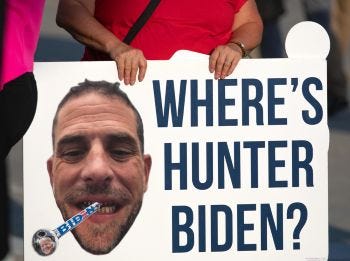
Here’s a sentence the Department of Justice never wanted to read out loud: the federal gun charge they once used to convict Hunter Biden was just dismantled by all nine Justices of the Supreme Court — Gorsuch, Thomas, the three liberals, every last one — without a single dissent.
Nine to nothing. In a building this divided, they can’t agree on lunch, but they agreed on this.
The case had nothing to do with Hunter, technically. On June 18, the Court ruled for a Texas man named Ali Hemani, who told federal agents he smoked marijuana every other day and happened to own a handgun. No other crime. He wasn’t accused of using the gun, waving the gun, or being high while holding the gun. He just owned one — the way roughly a hundred million other Americans do — and the feds decided that made him a criminal under a 1968 statute called the Gun Control Act, which bans firearm possession by any “unlawful user of or addicted to any controlled substance.”

See What This Actor is Finally Saying in Public
That’s the same statute — 18 U.S.C. 922(g)(3), for the lawyers in the room — that the Biden Justice Department deployed against the president’s own son back in 2024, when Hunter was convicted of buying a gun while addicted to crack. You remember how that ended. Joe Biden spent months swearing on every available microphone that he would never, ever pardon his boy, and then pardoned his boy. The verdict went up in a puff of fatherly smoke.
But here’s the thing about a pardon: it springs your kid. It doesn’t fix the law. Hunter walked. The statute stayed on the books to be aimed at everybody who isn’t named Biden. Until Wednesday.
Justice Gorsuch wrote the opinion, and he did not mince it. The government’s case, he wrote, “fails under every measure it asks us to consider,” because the historical gun laws the feds leaned on “targeted different kinds of people, did so for different reasons, and operated in different ways.” Translated out of robe-speak: you cannot strip an American of a constitutional right by pointing to dusty old statutes that have nothing to do with the guy standing in front of you. The Second Amendment is not a coupon the government honors only when it’s convenient.
Now, let’s be honest about what the Court did and didn’t do, because the other side is already spinning it. This was an “as-applied” ruling, not a wrecking ball through the whole statute. Gorsuch was careful to say the Court does “not address efforts to ban addicts, or those presently intoxicated, from possessing a firearm.” So no, the feds can’t be told they’ve lost every future case. What they lost is the right to treat “this guy admits he smokes weed sometimes” as automatic grounds to make him a felon. The blanket assumption is dead. The case-by-case headache is just beginning — for them, not us.
And every headline calling this a “loophole” or a “setback for gun safety” should be required to answer one question first: a setback for whom? Not for the hundred million Americans who own a firearm and also enjoy a perfectly legal beer or a perfectly legal joint in the eleven states where the voters legalized it. The only people who lost on Wednesday are the prosecutors who got used to disarming citizens on a technicality. When the New York Times calls your win a “loophole,” congratulations — you’ve won.
You — yes, you, the law-abiding American who owns a deer rifle and once filled a legal marijuana prescription for your back — you were a federal felon waiting to be discovered until nine Justices said otherwise. Sit with that for a second. The most divided Court in living memory had to unanimously remind your own government that the Bill of Rights still applies to you.
This didn’t come out of nowhere. Three years ago, in Bruen, the same Court told the government that if it wants to restrict the Second Amendment, it has to find a real historical twin for the restriction — not vibes, not “trust us,” an actual law from the founding era that did the same thing. The feds couldn’t find one for disarming pot smokers, because the Founders, whatever their flaws, did not run around confiscating muskets from guys who’d had a few. Bruen loaded the round. Hemani fired it. And there are at least a dozen more 922(g) cases stacked up in the lower courts right now, every one of them now reading Gorsuch’s opinion like a treasure map.
Watch what happens next. The Justice Department has two choices, and both of them are funny. It can keep charging marijuana users under a statute the Supreme Court just told them is constitutionally radioactive — and lose, publicly, one courtroom at a time. Or it can quietly stop, which means quietly admitting that thousands of these prosecutions over the years were the government flexing a power it never had. There is no version of the next twelve months where the people who built careers on 922(g)(3) come out looking good.
And somewhere, a lawyer is going to file the motion nobody at DOJ wants to think about — arguing that if the statute can’t constitutionally touch Ali Hemani of Texas, it never should have touched a guy in Delaware named Hunter, either. Pardon or no pardon. The conviction’s already wiped, sure. But the principle? The principle just flipped on its creators.
Joe Biden saved his son with a signature. He couldn’t save the law. Nine Justices made sure of that.
The next time someone tells you the Constitution is a “living document” that bends whichever way the government needs it to — remind them that on June 18, 2026, it stood up straight, all nine votes of it, and bent the government instead.
No posts
Comments
Nothing yet. Say the first thing.
Sign in to join the conversation.