
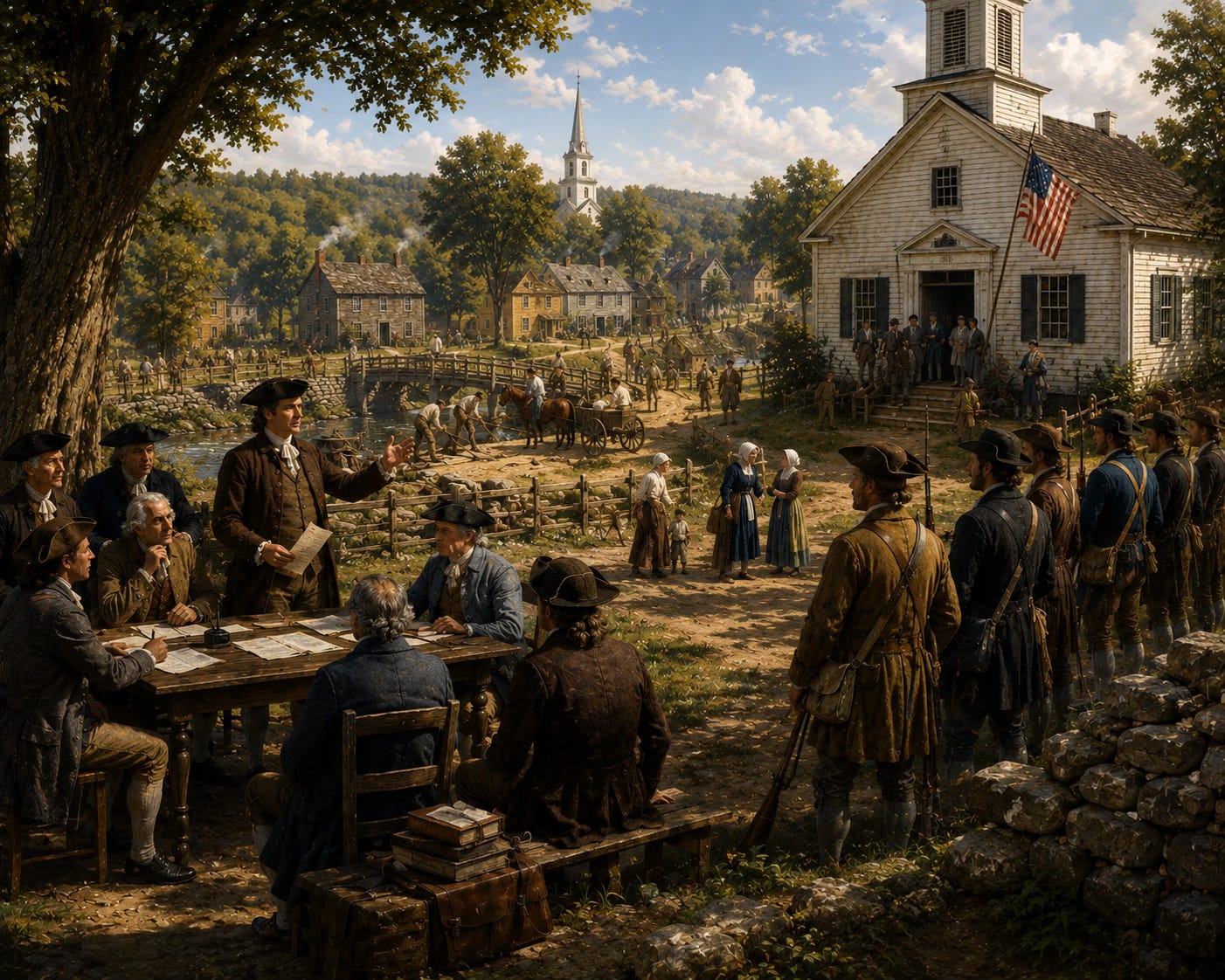
Ask most Americans where representative democracy began. They’ll probably answer: Washington and Congress, the White House.
The Founders would have course answered differently. They would have said the township, the county, the church, the jury, the schoolhouse.
That’s where republics are actually built.
Long before independence, Americans governed themselves locally. They repaired roads and built bridges, raised militias, resolved disputes, collected taxes and established schools.
Nobody waited for London and nobody asked permission.
Self-government became habit long before it became ideology.
This astonished Tocqueville when he visited the young American Republic in the 1830s.
Europeans looked upward whenever problems appeared. Americans looked sideways to neighbors first and government later.
The order mattered.
Because citizens who solve small problems eventually become capable of solving larger ones. Local government wasn’t simply administrative convenience. It was civic education.
The township taught compromise and responsibility, participation and accountability.
The Constitution assumed citizens already possessed those habits. It could not create them.
Which raises an uncomfortable question for modern America: if citizens no longer practice governing themselves locally ... can they continue governing themselves nationally?
The Founders believed the answer depended upon those smaller institutions and the daily practice of republican citizenship. They were right.
For this American experiment in self-government to continue long-term, we need to relearn local civic engagement. The future of the Republic depends on it.
If you enjoyed this article, you’ll love the documentary.
Thread of Liberty follows the entire thread of the American experiment—from ancient Rome and the Puritans, through the Revolution and the Constitution, to Tocqueville, Lincoln, Calvin Coolidge, and the modern Administrative State.
Thanks for reading American Leviathan! Subscribe for free to receive new posts and support my work.
Comments
Nothing yet. Say the first thing.
Sign in to join the conversation.